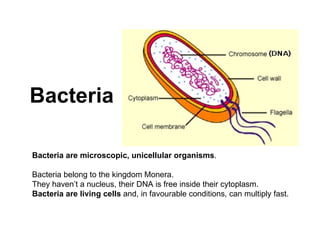
Bacteria are microscopic, unicellular organisms .  Bacteria belong to the kingdom  Monera . They haven’t a nucleus, their DNA is free inside their cytoplasm.   Bacteria are living cells  and, in favourable conditions, can multiply fast. Bacteria
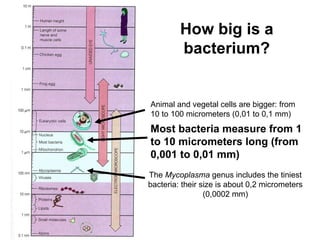
The  Mycoplasma  genus includes the tiniest bacteria: their size is about 0,2 micrometers (0,0002 mm) How big is a bacterium? Most bacteria measure from 1 to 10 micrometers long (from 0,001 to 0,01 mm) Animal and vegetal cells are bigger: from 10 to 100 micrometers (0,01 to 0,1 mm)
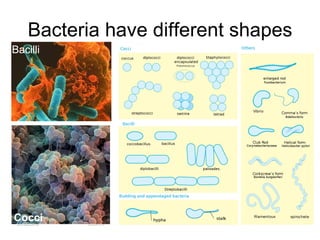
Bacteria have different shapes Bacilli Cocci
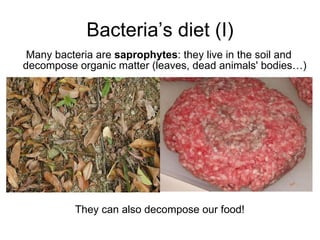
Bacteria’s diet (I) Many bacteria are  saprophytes : they live in the soil and decompose organic matter (leaves, dead animals' bodies…) They can also decompose our food!
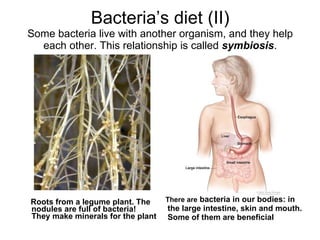
Bacteria’s diet (II) Some bacteria live with another organism, and they help each other. This relationship is called  symbiosis . There are  bacteria in our bodies: in the large intestine, skin and mouth. Some of them are beneficial Roots from a legume plant. The nodules are full of bacteria! They make minerals for the plant
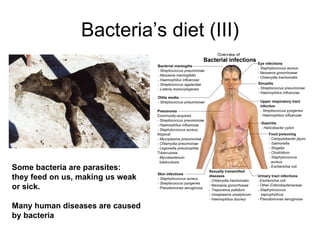
Bacteria’s diet (III) Some bacteria are parasites: they feed on us, making us weak or sick. Many human diseases are caused by bacteria
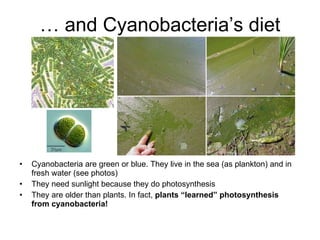
…  and Cyanobacteria’s diet Cyanobacteria are green or blue. They live in the sea (as plankton) and in fresh water (see photos) They need sunlight because they do photosynthesis They are older than plants. In fact,  plants “learned” photosynthesis from cyanobacteria!

Bacteria

  • 1.
    Bacteria are microscopic,unicellular organisms . Bacteria belong to the kingdom Monera . They haven’t a nucleus, their DNA is free inside their cytoplasm.  Bacteria are living cells and, in favourable conditions, can multiply fast. Bacteria
  • 2.
    The Mycoplasma genus includes the tiniest bacteria: their size is about 0,2 micrometers (0,0002 mm) How big is a bacterium? Most bacteria measure from 1 to 10 micrometers long (from 0,001 to 0,01 mm) Animal and vegetal cells are bigger: from 10 to 100 micrometers (0,01 to 0,1 mm)
  • 3.
    Bacteria have differentshapes Bacilli Cocci
  • 4.
    Bacteria’s diet (I)Many bacteria are saprophytes : they live in the soil and decompose organic matter (leaves, dead animals' bodies…) They can also decompose our food!
  • 5.
    Bacteria’s diet (II)Some bacteria live with another organism, and they help each other. This relationship is called symbiosis . There are bacteria in our bodies: in the large intestine, skin and mouth. Some of them are beneficial Roots from a legume plant. The nodules are full of bacteria! They make minerals for the plant
  • 6.
    Bacteria’s diet (III)Some bacteria are parasites: they feed on us, making us weak or sick. Many human diseases are caused by bacteria
  • 7.
    … andCyanobacteria’s diet Cyanobacteria are green or blue. They live in the sea (as plankton) and in fresh water (see photos) They need sunlight because they do photosynthesis They are older than plants. In fact, plants “learned” photosynthesis from cyanobacteria!