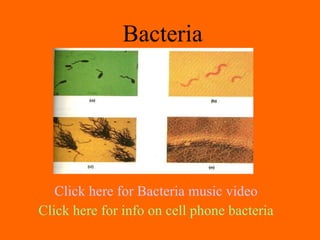

Bacteria Click here for Bacteria music video Click here for info on cell phone bacteria
Size of Bacteria Average bacteria 0.5 - 2.0 um in diam. RBC is 7.5 um in diam. Surface Area to Volume is 3:1 Typical Eukaryote Cell SA/Vol is 0.3:1 Food enters through SA, quickly reaches all parts of bacteria Eukaroytes need structures & organelles Chapter 5 - The Microbial World
Shapes of Bacteria Coccus Chain = Streptoccus Cluster = Staphylococcus Bacillus Chain = Streptobacillus Coccobacillus Vibrio = curved Spirillum Spirochete Chapter 5 - The Microbial World
Chapter 5 - The Microbial World
Bacterial Structures Flagella  Pili Capsule Plasma Membrane Cytoplasm Cell Wall Spores Chapter 5 - The Microbial World
Chapter 5 - The Microbial World Eukaryote Cell Structure
Flagella Motility - movement Swarming occurs with some bacteria Chapter 5 - The Microbial World
Chapter 5 - The Microbial World
Bacteria Their cytoplasm is 80% Water  DNA is circular, Haploid (1N) Advantages of 1N DNA over 2N DNA More efficient; grows quicker Mutations allow adaptation to environment quicker Plasmids; extra circular DNA Antibiotic Resistance No organelles (Mitochondria, Golgi, etc.) Chapter 5 - The Microbial World
Endospores Resistant structure Heat, irradiation, cold Boiling >1 hr still viable Takes time and energy to make spores Bacillus anthracis - spores  Used in biological warfare Chapter 5 - The Microbial World
Chapter 5 - The Microbial World
Bacteria “ Extreme” Bacteria – Domain of Archae Live near hydrothermal vents 250F, sulfur springs, saline lakes, acid locations.  Extremophiles = “lover of extremes” Chemosynthesis not photosynthesis Use Sulfate or Methane as energy source to make “food” for themselves since they are autotrophs (self feeders) Chapter 5 - The Microbial World
Chapter 5 - The Microbial World
Binomial nomenclature: Genus & Species

Bacteria

  • 1.
    Bacteria Click herefor Bacteria music video Click here for info on cell phone bacteria
  • 2.
    Size of BacteriaAverage bacteria 0.5 - 2.0 um in diam. RBC is 7.5 um in diam. Surface Area to Volume is 3:1 Typical Eukaryote Cell SA/Vol is 0.3:1 Food enters through SA, quickly reaches all parts of bacteria Eukaroytes need structures & organelles Chapter 5 - The Microbial World
  • 3.
    Shapes of BacteriaCoccus Chain = Streptoccus Cluster = Staphylococcus Bacillus Chain = Streptobacillus Coccobacillus Vibrio = curved Spirillum Spirochete Chapter 5 - The Microbial World
  • 4.
    Chapter 5 -The Microbial World
  • 5.
    Chapter 5 -The Microbial World
  • 6.
    Chapter 5 -The Microbial World
  • 7.
    Bacterial Structures Flagella Pili Capsule Plasma Membrane Cytoplasm Cell Wall Spores Chapter 5 - The Microbial World
  • 8.
    Chapter 5 -The Microbial World Eukaryote Cell Structure
  • 9.
    Flagella Motility -movement Swarming occurs with some bacteria Chapter 5 - The Microbial World
  • 10.
    Chapter 5 -The Microbial World
  • 11.
    Bacteria Their cytoplasmis 80% Water DNA is circular, Haploid (1N) Advantages of 1N DNA over 2N DNA More efficient; grows quicker Mutations allow adaptation to environment quicker Plasmids; extra circular DNA Antibiotic Resistance No organelles (Mitochondria, Golgi, etc.) Chapter 5 - The Microbial World
  • 12.
    Endospores Resistant structureHeat, irradiation, cold Boiling >1 hr still viable Takes time and energy to make spores Bacillus anthracis - spores Used in biological warfare Chapter 5 - The Microbial World
  • 13.
    Chapter 5 -The Microbial World
  • 14.
    Bacteria “ Extreme”Bacteria – Domain of Archae Live near hydrothermal vents 250F, sulfur springs, saline lakes, acid locations. Extremophiles = “lover of extremes” Chemosynthesis not photosynthesis Use Sulfate or Methane as energy source to make “food” for themselves since they are autotrophs (self feeders) Chapter 5 - The Microbial World
  • 15.
    Chapter 5 -The Microbial World
  • 16.
    Chapter 5 -The Microbial World
  • 17.
    Chapter 5 -The Microbial World
  • 18.
    Chapter 5 -The Microbial World
  • 19.