My name is inam-ur-
rehman
I am from class 7th
emerald
Definition
A microorganism is a microscopic
organism, which may be a single cell or
multicellular organism. The study of
microorganisms is called microbiology
Types
Bacteria
Fungi
Protista
Archaea
Viruses
Microbial mergers
Fungi
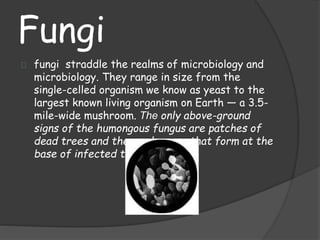
fungi straddle the realms of microbiology and
microbiology. They range in size from the
single-celled organism we know as yeast to the
largest known living organism on Earth — a 3.5-
mile-wide mushroom. The only above-ground
signs of the humongous fungus are patches of
dead trees and the mushrooms that form at the
base of infected trees.
bacteria
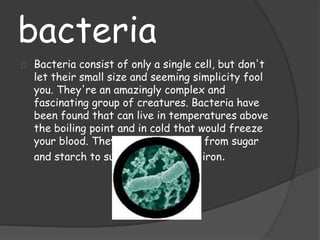
Bacteria consist of only a single cell, but don't
let their small size and seeming simplicity fool
you. They're an amazingly complex and
fascinating group of creatures. Bacteria have
been found that can live in temperatures above
the boiling point and in cold that would freeze
your blood. They "eat" everything from sugar
and starch to sunlight, sulfur and iron.
ProtistaProtists are eukaryotic creatures <you-carry-ah-tick>,
meaning their DNA is enclosed in a nucleus inside the
cell (unlike bacteria, which are prokaryotic <pro-carry-
ah-tick> and have no nucleus to enclose their DNA.
They’re not plants, animals or fungi, but they act
enough like them that scientists believe protists paved
the way for the evolution of early plants, animals, and
fungi. Protists fall into four general subgroups:
unicellular algae, protozoa, slime molds, and water
molds.
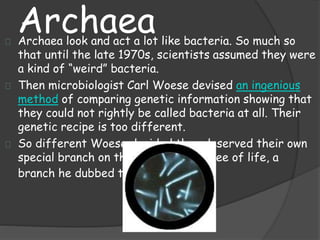
ArchaeaArchaea look and act a lot like bacteria. So much so
that until the late 1970s, scientists assumed they were
a kind of ā€œweirdā€ bacteria.
Then microbiologist Carl Woese devised an ingenious
method of comparing genetic information showing that
they could not rightly be called bacteria at all. Their
genetic recipe is too different.
So different Woese decided they deserved their own
special branch on the great family tree of life, a
branch he dubbed the Archaea.
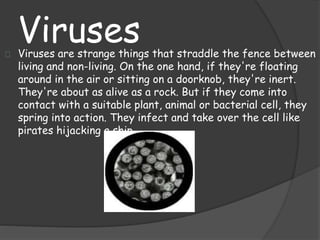
VirusesViruses are strange things that straddle the fence between
living and non-living. On the one hand, if they're floating
around in the air or sitting on a doorknob, they're inert.
They're about as alive as a rock. But if they come into
contact with a suitable plant, animal or bacterial cell, they
spring into action. They infect and take over the cell like
pirates hijacking a ship.
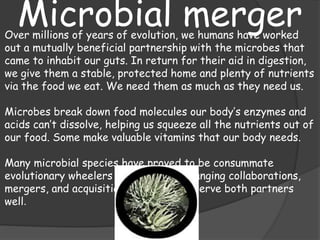
Microbial mergerOver millions of years of evolution, we humans have worked
out a mutually beneficial partnership with the microbes that
came to inhabit our guts. In return for their aid in digestion,
we give them a stable, protected home and plenty of nutrients
via the food we eat. We need them as much as they need us.
Microbes break down food molecules our body’s enzymes and
acids can’t dissolve, helping us squeeze all the nutrients out of
our food. Some make valuable vitamins that our body needs.
Many microbial species have proved to be consummate
evolutionary wheelers and dealers, arranging collaborations,
mergers, and acquisitions that usually serve both partners
well.
Thank you

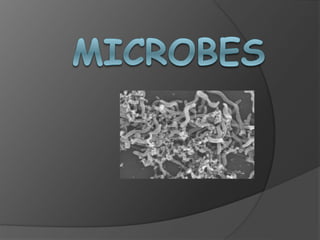
microbes

  • 2.
    My name isinam-ur- rehman I am from class 7th emerald
  • 4.
    Definition A microorganism isa microscopic organism, which may be a single cell or multicellular organism. The study of microorganisms is called microbiology
  • 5.
  • 6.
    Fungi fungi straddle therealms of microbiology and microbiology. They range in size from the single-celled organism we know as yeast to the largest known living organism on Earth — a 3.5- mile-wide mushroom. The only above-ground signs of the humongous fungus are patches of dead trees and the mushrooms that form at the base of infected trees.
  • 7.
    bacteria Bacteria consist ofonly a single cell, but don't let their small size and seeming simplicity fool you. They're an amazingly complex and fascinating group of creatures. Bacteria have been found that can live in temperatures above the boiling point and in cold that would freeze your blood. They "eat" everything from sugar and starch to sunlight, sulfur and iron.
  • 8.
    ProtistaProtists are eukaryoticcreatures <you-carry-ah-tick>, meaning their DNA is enclosed in a nucleus inside the cell (unlike bacteria, which are prokaryotic <pro-carry- ah-tick> and have no nucleus to enclose their DNA. They’re not plants, animals or fungi, but they act enough like them that scientists believe protists paved the way for the evolution of early plants, animals, and fungi. Protists fall into four general subgroups: unicellular algae, protozoa, slime molds, and water molds.
  • 9.
    ArchaeaArchaea look andact a lot like bacteria. So much so that until the late 1970s, scientists assumed they were a kind of ā€œweirdā€ bacteria. Then microbiologist Carl Woese devised an ingenious method of comparing genetic information showing that they could not rightly be called bacteria at all. Their genetic recipe is too different. So different Woese decided they deserved their own special branch on the great family tree of life, a branch he dubbed the Archaea.
  • 10.
    VirusesViruses are strangethings that straddle the fence between living and non-living. On the one hand, if they're floating around in the air or sitting on a doorknob, they're inert. They're about as alive as a rock. But if they come into contact with a suitable plant, animal or bacterial cell, they spring into action. They infect and take over the cell like pirates hijacking a ship.
  • 11.
    Microbial mergerOver millionsof years of evolution, we humans have worked out a mutually beneficial partnership with the microbes that came to inhabit our guts. In return for their aid in digestion, we give them a stable, protected home and plenty of nutrients via the food we eat. We need them as much as they need us. Microbes break down food molecules our body’s enzymes and acids can’t dissolve, helping us squeeze all the nutrients out of our food. Some make valuable vitamins that our body needs. Many microbial species have proved to be consummate evolutionary wheelers and dealers, arranging collaborations, mergers, and acquisitions that usually serve both partners well.
  • 12.