Backing Storage
Objectives
 To understand what a backup storage device is
 To understand and identify different types of backup
storage devices, including magnetic & optical
 To understand the difference between the devices e.g.
 Capacity
 Transfer rates
 Cost
 Security
What is a backup
 A backup refers to the copying and archiving of computer
data so it may be used to restore the original after a data loss
event.
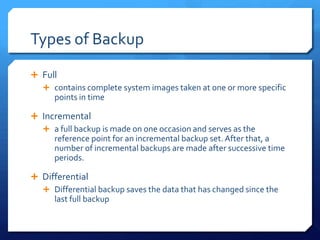
Types of Backup
 Full
 contains complete system images taken at one or more specific
points in time
 Incremental
 a full backup is made on one occasion and serves as the
reference point for an incremental backup set. After that, a
number of incremental backups are made after successive time
periods.
 Differential
 Differential backup saves the data that has changed since the
last full backup
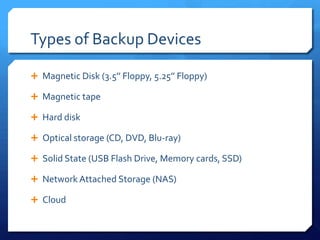
Types of Backup Devices
 Magnetic Disk (3.5’’ Floppy, 5.25’’ Floppy)
 Magnetic tape
 Hard disk
 Optical storage (CD, DVD, Blu-ray)
 Solid State (USB Flash Drive, Memory cards, SSD)
 Network Attached Storage (NAS)
 Cloud
Differences
 All back up mediums have their differences, these are usually
relating to:
 Capacity
 Cost
 Transfer speeds
 Security
 Portability
Assessment (Part of P1 & M1)
 P1 Describe the different types of backup devices, identifying
their individual specifications in terms of:
 Capacity
 Cost
 Transfer speeds
 Security
 Portability
 M1 Compare the features and functions of each backup
devices, giving strengths and weaknesses. Give examples of
which might be relevant for home use / small business / large
businesses etc.

Backing storage

  • 1.
  • 2.
    Objectives  To understandwhat a backup storage device is  To understand and identify different types of backup  To understand and identify different types of backup storage devices, including magnetic & optical  To understand the difference between the devices e.g.  Capacity  Transfer rates  Cost  Security
  • 3.
    What is abackup  A backup refers to the copying and archiving of computer data so it may be used to restore the original after a data loss event.
  • 4.
    Types of Backup Full  contains complete system images taken at one or more specific points in time  Incremental  a full backup is made on one occasion and serves as the reference point for an incremental backup set. After that, a number of incremental backups are made after successive time periods.  Differential  Differential backup saves the data that has changed since the last full backup
  • 5.
    Types of BackupDevices  Magnetic Disk (3.5’’ Floppy, 5.25’’ Floppy)  Magnetic tape  Hard disk  Optical storage (CD, DVD, Blu-ray)  Solid State (USB Flash Drive, Memory cards, SSD)  Network Attached Storage (NAS)  Cloud
  • 6.
    Differences  All backup mediums have their differences, these are usually relating to:  Capacity  Cost  Transfer speeds  Security  Portability
  • 7.
    Assessment (Part ofP1 & M1)  P1 Describe the different types of backup devices, identifying their individual specifications in terms of:  Capacity  Cost  Transfer speeds  Security  Portability  M1 Compare the features and functions of each backup devices, giving strengths and weaknesses. Give examples of which might be relevant for home use / small business / large businesses etc.