www.ijmer.com

International Journal of Modern Engineering Research (IJMER)
Vol. 3, Issue. 5, Sep - Oct. 2013 pp-2792-2796
ISSN: 2249-6645

Experimental Investigation of Performance & Emission
Characteristics of Diesel Engine Working On Diesel and
NOME with Ethanol and Triacetin Blends
Vivek pathak1, Prof. Amitesh Paul2
1

2

Department of Mechanical Engineering Sri Satya Sai Institute of Technology Sehore,Madhya Pradesh, India,
Head of Department Department of Mechanical Engineering,Sri Satya Sai Institute of Technology Sehore,Madhya
Pradesh,

ABSTRACT: This research presents effect of triacetin and ethanol as additive to biodiesel (Neem oil methyl ester) on the
performance and emission characteristics of a diesel engine at different loads and constant engine speed. Compared with
biodiesel, slightly lower brake specific energy consumption for triacetin and ethanol bended fuels was observed. At higher
engine loads CO,HC and smoke emission were found significantly lower with all blends[BD-1(5% triacetin,95% biodiesel),
BD-2(10% triacetin,90% biodiesel) , BE-1(5% ethanol, 95% biodiesels) and BE-2 (10% ethanol ,90% biodiesel)] compared
to Biodiesel , but NOx emission were found higher. The triacetin is also antiknock agent and has maximum oxygen content
about 53.3%. by this reason combustion of fuel can be improve.

Keywords: Biodiesel, Triacetin , Emission , Ethanol , Neem oil Methyl ester.
I.

INTRODUCTION

Conventional energy sources such as oil, coal and natural gas have limited reserves that are expected not to lost for
an extended period. World primary demand is projected to increase by 1.5% per year between 2007 to 2030, from just over
12,000 million tons of oil equivalent to 6800 million tones-as overall increase of 40%. As world reserves of fossil fuels and
raw material are limited, it has stimulated active research interest in non petroleum and non polluting fuels.[1-8]. Diesel
engines are the major source of power generation and transportation hence diesel is being used extensively, but due to the
gradual impact of environmental pollution there is an urgent need for suitable alternate fuels for use in diesel engine without
any modification.[5-9]There are different kinds of vegetable oils and biodiesel have been tested in diesel engines its reducing
characteristic for green house gas emissions. Its help on reducing a country’s reliance on crude oil imports its supportive
characteristic on agriculture by providing a new market for domestic crops, its effective lubricating property that eliminates
the need of any lubricate additive and its wide acceptance by vehicle manufacturers can be listed as the most important
advantages of biodiesel fuel[2-12]. There are more than 350 oil bearing crops identified, among which only Jatropha,
pongamia, sunflower, Soyabean, cottonseed, rapeseed, palm oil and peanut oil are considered as potential alternative fuels
for diesel engines [3,4,5,7,9]. vegetable oil and their derivates as fuels are non-toxic biodegradable environment friendly and
can be made from renewable resources[4,7,9,10,11,18,20,24] Transesterification can lower high viscosity of vegetable
oils[4,5]. Biodiesel in diesel engine can reduce HC CO and smoke emission but NOx emission may increase [9,10,11]. Some
studies have shown that biodiesel can decrease NOx emission but CO HC and smoke emission may increase. Poor flow of
biodiesel is a barrier in using of neat biodiesel in cold weather. The present study aims to investigate the use of neem oil
blend with diesel as an alternate fuel for compression ignition engine Triacetin and Ethanol (T&E) might improve cold flows
and viscosity properties. This research presents effect of Triacetin and Ethanol as additive to biodiesel [neem oil methyl ester
(NOME)] on the performance and emission characteristics of a diesel engine at different loads and constant engine speed
[14,15,21].

II.

MATERIALS AND METHODS

Biodiesel is the ester of vegetable oils produced through a process called Transesterification. Transesterification is a
chemical reaction which occurs between triglyceride and methyl alcohol in the presence of potassium hydroxide (KOH). It
consists of a sequence of three consecutive reactions where triglycerides are converted to diglycerides. diglycerides are
converted to monoglycerides followed by the conversion of monoglycerides to glycerol. In each step an ester is produced
and thus three ester molecules are produced from one molecule of triglyceride. Neem oil used in the present investigation
was taken from JNKV Jabalpur, Madhya Pradesh, India and filtered by cheesecloth to remove solid particles. The moisture
content was removed by heating the oil in an oven up to 110°C for one hour now the oil is taken in a round bottom flask and
heated around 50-60°C on a hot plate having magnetic stirrer arrangement, then methanol and potassium hydroxide are
added to the oil. The mixture was stirred continuously. Alcohol to vegetable oil molar ratio is one of the important factors
that affect the conversion efficiency of the process for the transesterification process 3 mol of alcohol are required for each
mole of the oil. However, in practice the molar ratio should be higher than this theoretical ratio in order to drive the reaction
towards early completion. After the completion of reaction, the products are allowed to separate into two layers, the lower
layer contains glycerol and the top layer contains ester which is separated and purified using water. Water is sprayed over the
ester and stirred gently and allowed to settle in the separating funnel, the lower layer is discarded and upper layer (purified
biodiesel) is separated.

www.ijmer.com

2792 | Page
www.ijmer.com

International Journal of Modern Engineering Research (IJMER)
Vol. 3, Issue. 5, Sep - Oct. 2013 pp-2792-2796
ISSN: 2249-6645

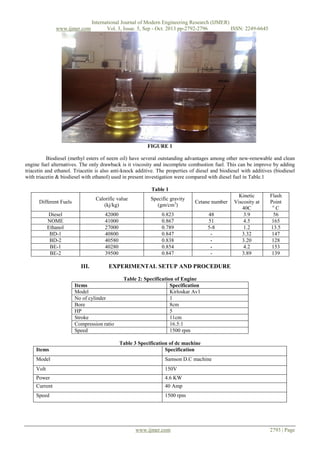
FIGURE 1
Biodiesel (methyl esters of neem oil) have several outstanding advantages among other new-renewable and clean
engine fuel alternatives. The only drawback is it viscosity and incomplete combustion fuel. This can be improve by adding
triacetin and ethanol. Triacetin is also anti-knock additive. The properties of diesel and biodiesel with additives (biodiesel
with triacetin & biodiesel with ethanol) used in present investigation were compared with diesel fuel in Table.1
Table 1
Different Fuels

Calorific value
(kj/kg)

Specific gravity
(gm/cm3)

Cetane number

Diesel
NOME
Ethanol
BD-1
BD-2
BE-1
BE-2

42000
41000
27000
40800
40580
40280
39500

0.823
0.867
0.789
0.847
0.838
0.854
0.847

48
51
5-8
-

III.

Flash
Point
o
C
56
165
13.5
147
128
153
139

EXPERIMENTAL SETUP AND PROCEDURE

Items
Model
No of cylinder
Bore
HP
Stroke
Compression ratio
Speed

Items

Kinetic
Viscosity at
40C
3.9
4.5
1.2
3.32
3.20
4.2
3.89

Table 2: Specification of Engine
Specification
Kirloskar Av1
1
8cm
5
11cm
16.5:1
1500 rpm
Table 3 Specification of dc machine
Specification

Model

Samson D.C machine

Volt

150V

Power

4.6 KW

Current

40 Amp

Speed

1500 rpm

www.ijmer.com

2793 | Page
www.ijmer.com

International Journal of Modern Engineering Research (IJMER)
Vol. 3, Issue. 5, Sep - Oct. 2013 pp-2792-2796
ISSN: 2249-6645
Table 4 Specification of exhaust gas analyzer
Measuring Quality
Measuring Range
CO
HC

IV.

0-10%vol
0-20000ppm

EXPERIMENTAL SET-UP LINE DIAGRAM

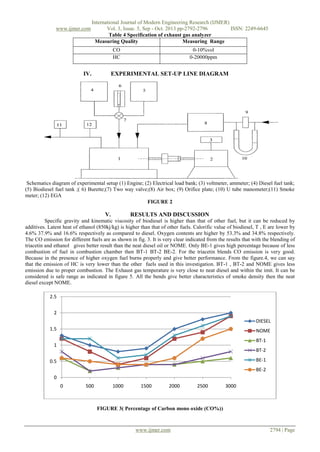
Schematics diagram of experimental setup (1) Engine; (2) Electrical load bank; (3) voltmeter, ammeter; (4) Diesel fuel tank;
(5) Biodiesel fuel tank ;( 6) Burette;(7) Two way valve;(8) Air box; (9) Orifice plate; (10) U tube manometer;(11) Smoke
meter; (12) EGA
FIGURE 2

V.

RESULTS AND DISCUSSION

Specific gravity and kinematic viscosity of biodiesel is higher than that of other fuel, but it can be reduced by
additives. Latent heat of ethanol (850kj/kg) is higher than that of other fuels. Calorific value of biodiesel, T , E are lower by
4.6% 37.9% and 16.6% respectively as compared to diesel. Oxygen contents are higher by 53.3% and 34.8% respectively.
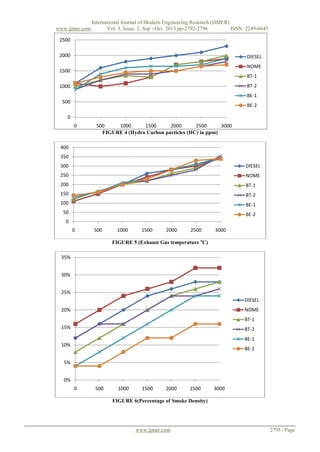
The CO emission for different fuels are as shown in fig. 3. It is very clear indicated from the results that with the blending of
triacetin and ethanol gives better result than the neat diesel oil or NOME. Only BE-1 gives high percentage because of less
combustion of fuel in combustion chamber then BT-1 BT-2 BE-2. For the triacetin blends CO emission is very good.
Because in the presence of higher oxygen fuel burns properly and give better performance. From the figure.4, we can say
that the emission of HC is very lower than the other fuels used in this investigation. BT-1 , BT-2 and NOME gives less
emission due to proper combustion. The Exhaust gas temperature is very close to neat diesel and within the imit. It can be
considered is safe range as indicated in figure 5. All the bends give better characteristics of smoke density then the neat
diesel except NOME.
2.5
2
DIESEL
1.5

NOME
BT-1

1

BT-2
BE-1

0.5

BE-2
0
0

500

1000

1500

2000

2500

3000

FIGURE 3( Percentage of Carbon mono oxide (CO%))

www.ijmer.com

2794 | Page
www.ijmer.com

International Journal of Modern Engineering Research (IJMER)
Vol. 3, Issue. 5, Sep - Oct. 2013 pp-2792-2796
ISSN: 2249-6645

2500
2000

DIESEL
NOME

1500

BT-1
BT-2

1000

BE-1
500

BE-2

0
0

500
1000
1500
2000
2500
3000
FIGURE 4 (Hydro Carbon particles (HC) in ppm)

400
350
300

DIESEL

250

NOME

200

BT-1

150

BT-2

100

BE-1

50

BE-2

0
0

500

1000

1500

2000

2500

3000

FIGURE 5 (Exhaust Gas temperature oC)
35%
30%
25%
DIESEL
NOME

20%

BT-1
15%

BT-2
BE-1

10%

BE-2

5%
0%
0

500

1000

1500

2000

2500

3000

FIGURE 6(Percentage of Smoke Density)

www.ijmer.com

2795 | Page
www.ijmer.com

International Journal of Modern Engineering Research (IJMER)
Vol. 3, Issue. 5, Sep - Oct. 2013 pp-2792-2796
ISSN: 2249-6645

VI.

CONCLUSION

Biodiesel NOME and its blends can be better option for any diesel engine for better performance without any
modification in engine and also environmental friendly. The emission of CO and HC can be decrease to a large extent, as
output come from this investigation. Because of the higher percentage of oxygen, combustion can be improved and also
reduce the knocking problem. The major output from this investigation is increase the NOME and its blends characteristics
by adding additives. The major problem like knocking viscosity and lower performance characteristics can be improved and
with less emission. From the above results we can say that , NOME and its bends will be better alternatives for diesel
engines because of mass production of neem in india , production cost of biodiesel is cheap and give better characteristic of
emission

REFERENCES
[1]
[2]
[3]
[4]
[5]
[6]
[7]
[8]
[9]
[10]
[11]
[12]
[13]
[14]
[15]
[16]
[17]
[18]
[19]
[20]
[21]
[22]
[23]
[24]

C D Rakopoulos D C Rakopoulos D T Hountalas. Performance and emission of bus engine using blends of diesel fuel with bio
diesel of sunflower and cotton seed oil derived from feedstock.
C D Rakopoulos D T Hountalas ] Comparative performance and emission study of direct injection diesel engine using blends o
diesel fuel with vegetable oils or biodiesel of various orgin.
Deepak Agarwal et.al. Performance and emissions characteristics of Jatropha oil (preheated and blend) in a direct injection
compression ignition engine (2007).
Deepak Agarwal et.al. Experimental investigation of control of NOx Emissions in biodiesel-fueled compression ignition engine
(2006).
Devendra Vashist et.al. A comparative study of castor and jatropha oil source and its methyl ester test on the diesel engine (2011).
Dinesh Dabhi K., 2 Khiraiya Krunal B.*, 3Nityam P. OzaA Review of Neem Biodiesel As Fuel for CI Engine..
Huseyin Aydin et.al. Effect of ethanol blending with biodiesel on engine performance and exhaust emissions in a CI engine.
(2010).
Joseph B. Gonsalves An Assessment of the Bio fuels Industry in India United Nations Conference on Trade and
Development.(2006).
Joshua Garba Abduljalal. Comparative study of biodiesel from kernel oil of jatropha curses and Azadirachta india in zaria nageria
K.Dilip Kumar1 P.Ravindra Kumar2 Experimental Investigation of Cotton Seed Oil and Neem Methyl Esters as Biodiesel On Ci
Engine.
K. Suresh Kumar et.al. Performance and exhaust emission characteristics of a CI engine fueled with Pongamia pinnata methyl ester
(PPME) and its blends with diesel (2008).
K.V.Radha, G.ManikandanNovel Production Of Biofuels From Neem Oil.
Lovekush Prasad1, Dr. Alka Agrawal2 Experimental Investigation of Performance of Diesel Engine Working On Diesel and Neem
Oil Blends.
M Pugazhvadvu S. Rajagopan. Investigation on a diesel engine fuelled with biodiesel blends and diethyl ether as an additive.
Nandkishore D Rao B.Sudheer premkumar M. Yohan. Performance and emission characterstics of straight vegetable oil ethanol
emission in a compression ignition engine.
Nishant Tyagi1, Ambuj Sharma2Experimental Investigation Of Neem Methyl Esters As Biodiesel on C.I Engine.
N.Janardan Rao M R Shasrty Dr P N Reddy.] Comparetive analysis of performance and emission of an engine with palm oil
biodiesel blends with diesel.
N.R. Banapurmath et.al. A comparative study of castor and jatropha oil source and its methyl ester test on the diesel engine. (2008).
Nithyananda B. S, Anand A, Dr. G. V. Naveen Prakash Performance Study on Diesel Engine Using Different Blends of Neem
Biodiesel.
P.K Deven N.V. Mahalaxmi. Performance emission and combustion charcterstic of poon oil and its diesel blends in a D I Diesek
Engine
P. Venkateshwer Rao B.V. Appa Rao and D. Radhakrishna.] Experimental analysis of DI engine performance with blends fuels of
Oxygenated additives and COME biodiesel.
Ramning Amol M., Dhote Priya S. and Ganvir V.NProduction of Neem Oil Methyl Ester (NOME) from Oscillatory Baffled
Reactor
Revansiddappa Byakod1, Prasanna Phatate1, Vinodkumar Kamble1, Sharath Babu1, M. C Navindgi2 Comparative Analysis of
Performance and Emission Charactristics of Neem Oil Using 3 And 4 Holes Injection Nozzle on DI Diesel Engine.
Y. Azoumah et.al. Exergy efficiency applied for the performance optimization of a direct injection compression ignition (CI)
engine using biofuels (2009).

www.ijmer.com

2796 | Page

Experimental Investigation of Performance & Emission Characteristics of Diesel Engine Working On Diesel and NOME with Ethanol and Triacetin Blends

  • 1.
    www.ijmer.com International Journal ofModern Engineering Research (IJMER) Vol. 3, Issue. 5, Sep - Oct. 2013 pp-2792-2796 ISSN: 2249-6645 Experimental Investigation of Performance & Emission Characteristics of Diesel Engine Working On Diesel and NOME with Ethanol and Triacetin Blends Vivek pathak1, Prof. Amitesh Paul2 1 2 Department of Mechanical Engineering Sri Satya Sai Institute of Technology Sehore,Madhya Pradesh, India, Head of Department Department of Mechanical Engineering,Sri Satya Sai Institute of Technology Sehore,Madhya Pradesh, ABSTRACT: This research presents effect of triacetin and ethanol as additive to biodiesel (Neem oil methyl ester) on the performance and emission characteristics of a diesel engine at different loads and constant engine speed. Compared with biodiesel, slightly lower brake specific energy consumption for triacetin and ethanol bended fuels was observed. At higher engine loads CO,HC and smoke emission were found significantly lower with all blends[BD-1(5% triacetin,95% biodiesel), BD-2(10% triacetin,90% biodiesel) , BE-1(5% ethanol, 95% biodiesels) and BE-2 (10% ethanol ,90% biodiesel)] compared to Biodiesel , but NOx emission were found higher. The triacetin is also antiknock agent and has maximum oxygen content about 53.3%. by this reason combustion of fuel can be improve. Keywords: Biodiesel, Triacetin , Emission , Ethanol , Neem oil Methyl ester. I. INTRODUCTION Conventional energy sources such as oil, coal and natural gas have limited reserves that are expected not to lost for an extended period. World primary demand is projected to increase by 1.5% per year between 2007 to 2030, from just over 12,000 million tons of oil equivalent to 6800 million tones-as overall increase of 40%. As world reserves of fossil fuels and raw material are limited, it has stimulated active research interest in non petroleum and non polluting fuels.[1-8]. Diesel engines are the major source of power generation and transportation hence diesel is being used extensively, but due to the gradual impact of environmental pollution there is an urgent need for suitable alternate fuels for use in diesel engine without any modification.[5-9]There are different kinds of vegetable oils and biodiesel have been tested in diesel engines its reducing characteristic for green house gas emissions. Its help on reducing a country’s reliance on crude oil imports its supportive characteristic on agriculture by providing a new market for domestic crops, its effective lubricating property that eliminates the need of any lubricate additive and its wide acceptance by vehicle manufacturers can be listed as the most important advantages of biodiesel fuel[2-12]. There are more than 350 oil bearing crops identified, among which only Jatropha, pongamia, sunflower, Soyabean, cottonseed, rapeseed, palm oil and peanut oil are considered as potential alternative fuels for diesel engines [3,4,5,7,9]. vegetable oil and their derivates as fuels are non-toxic biodegradable environment friendly and can be made from renewable resources[4,7,9,10,11,18,20,24] Transesterification can lower high viscosity of vegetable oils[4,5]. Biodiesel in diesel engine can reduce HC CO and smoke emission but NOx emission may increase [9,10,11]. Some studies have shown that biodiesel can decrease NOx emission but CO HC and smoke emission may increase. Poor flow of biodiesel is a barrier in using of neat biodiesel in cold weather. The present study aims to investigate the use of neem oil blend with diesel as an alternate fuel for compression ignition engine Triacetin and Ethanol (T&E) might improve cold flows and viscosity properties. This research presents effect of Triacetin and Ethanol as additive to biodiesel [neem oil methyl ester (NOME)] on the performance and emission characteristics of a diesel engine at different loads and constant engine speed [14,15,21]. II. MATERIALS AND METHODS Biodiesel is the ester of vegetable oils produced through a process called Transesterification. Transesterification is a chemical reaction which occurs between triglyceride and methyl alcohol in the presence of potassium hydroxide (KOH). It consists of a sequence of three consecutive reactions where triglycerides are converted to diglycerides. diglycerides are converted to monoglycerides followed by the conversion of monoglycerides to glycerol. In each step an ester is produced and thus three ester molecules are produced from one molecule of triglyceride. Neem oil used in the present investigation was taken from JNKV Jabalpur, Madhya Pradesh, India and filtered by cheesecloth to remove solid particles. The moisture content was removed by heating the oil in an oven up to 110°C for one hour now the oil is taken in a round bottom flask and heated around 50-60°C on a hot plate having magnetic stirrer arrangement, then methanol and potassium hydroxide are added to the oil. The mixture was stirred continuously. Alcohol to vegetable oil molar ratio is one of the important factors that affect the conversion efficiency of the process for the transesterification process 3 mol of alcohol are required for each mole of the oil. However, in practice the molar ratio should be higher than this theoretical ratio in order to drive the reaction towards early completion. After the completion of reaction, the products are allowed to separate into two layers, the lower layer contains glycerol and the top layer contains ester which is separated and purified using water. Water is sprayed over the ester and stirred gently and allowed to settle in the separating funnel, the lower layer is discarded and upper layer (purified biodiesel) is separated. www.ijmer.com 2792 | Page
  • 2.
    www.ijmer.com International Journal ofModern Engineering Research (IJMER) Vol. 3, Issue. 5, Sep - Oct. 2013 pp-2792-2796 ISSN: 2249-6645 FIGURE 1 Biodiesel (methyl esters of neem oil) have several outstanding advantages among other new-renewable and clean engine fuel alternatives. The only drawback is it viscosity and incomplete combustion fuel. This can be improve by adding triacetin and ethanol. Triacetin is also anti-knock additive. The properties of diesel and biodiesel with additives (biodiesel with triacetin & biodiesel with ethanol) used in present investigation were compared with diesel fuel in Table.1 Table 1 Different Fuels Calorific value (kj/kg) Specific gravity (gm/cm3) Cetane number Diesel NOME Ethanol BD-1 BD-2 BE-1 BE-2 42000 41000 27000 40800 40580 40280 39500 0.823 0.867 0.789 0.847 0.838 0.854 0.847 48 51 5-8 - III. Flash Point o C 56 165 13.5 147 128 153 139 EXPERIMENTAL SETUP AND PROCEDURE Items Model No of cylinder Bore HP Stroke Compression ratio Speed Items Kinetic Viscosity at 40C 3.9 4.5 1.2 3.32 3.20 4.2 3.89 Table 2: Specification of Engine Specification Kirloskar Av1 1 8cm 5 11cm 16.5:1 1500 rpm Table 3 Specification of dc machine Specification Model Samson D.C machine Volt 150V Power 4.6 KW Current 40 Amp Speed 1500 rpm www.ijmer.com 2793 | Page
  • 3.
    www.ijmer.com International Journal ofModern Engineering Research (IJMER) Vol. 3, Issue. 5, Sep - Oct. 2013 pp-2792-2796 ISSN: 2249-6645 Table 4 Specification of exhaust gas analyzer Measuring Quality Measuring Range CO HC IV. 0-10%vol 0-20000ppm EXPERIMENTAL SET-UP LINE DIAGRAM Schematics diagram of experimental setup (1) Engine; (2) Electrical load bank; (3) voltmeter, ammeter; (4) Diesel fuel tank; (5) Biodiesel fuel tank ;( 6) Burette;(7) Two way valve;(8) Air box; (9) Orifice plate; (10) U tube manometer;(11) Smoke meter; (12) EGA FIGURE 2 V. RESULTS AND DISCUSSION Specific gravity and kinematic viscosity of biodiesel is higher than that of other fuel, but it can be reduced by additives. Latent heat of ethanol (850kj/kg) is higher than that of other fuels. Calorific value of biodiesel, T , E are lower by 4.6% 37.9% and 16.6% respectively as compared to diesel. Oxygen contents are higher by 53.3% and 34.8% respectively. The CO emission for different fuels are as shown in fig. 3. It is very clear indicated from the results that with the blending of triacetin and ethanol gives better result than the neat diesel oil or NOME. Only BE-1 gives high percentage because of less combustion of fuel in combustion chamber then BT-1 BT-2 BE-2. For the triacetin blends CO emission is very good. Because in the presence of higher oxygen fuel burns properly and give better performance. From the figure.4, we can say that the emission of HC is very lower than the other fuels used in this investigation. BT-1 , BT-2 and NOME gives less emission due to proper combustion. The Exhaust gas temperature is very close to neat diesel and within the imit. It can be considered is safe range as indicated in figure 5. All the bends give better characteristics of smoke density then the neat diesel except NOME. 2.5 2 DIESEL 1.5 NOME BT-1 1 BT-2 BE-1 0.5 BE-2 0 0 500 1000 1500 2000 2500 3000 FIGURE 3( Percentage of Carbon mono oxide (CO%)) www.ijmer.com 2794 | Page
  • 4.
    www.ijmer.com International Journal ofModern Engineering Research (IJMER) Vol. 3, Issue. 5, Sep - Oct. 2013 pp-2792-2796 ISSN: 2249-6645 2500 2000 DIESEL NOME 1500 BT-1 BT-2 1000 BE-1 500 BE-2 0 0 500 1000 1500 2000 2500 3000 FIGURE 4 (Hydro Carbon particles (HC) in ppm) 400 350 300 DIESEL 250 NOME 200 BT-1 150 BT-2 100 BE-1 50 BE-2 0 0 500 1000 1500 2000 2500 3000 FIGURE 5 (Exhaust Gas temperature oC) 35% 30% 25% DIESEL NOME 20% BT-1 15% BT-2 BE-1 10% BE-2 5% 0% 0 500 1000 1500 2000 2500 3000 FIGURE 6(Percentage of Smoke Density) www.ijmer.com 2795 | Page
  • 5.
    www.ijmer.com International Journal ofModern Engineering Research (IJMER) Vol. 3, Issue. 5, Sep - Oct. 2013 pp-2792-2796 ISSN: 2249-6645 VI. CONCLUSION Biodiesel NOME and its blends can be better option for any diesel engine for better performance without any modification in engine and also environmental friendly. The emission of CO and HC can be decrease to a large extent, as output come from this investigation. Because of the higher percentage of oxygen, combustion can be improved and also reduce the knocking problem. The major output from this investigation is increase the NOME and its blends characteristics by adding additives. The major problem like knocking viscosity and lower performance characteristics can be improved and with less emission. From the above results we can say that , NOME and its bends will be better alternatives for diesel engines because of mass production of neem in india , production cost of biodiesel is cheap and give better characteristic of emission REFERENCES [1] [2] [3] [4] [5] [6] [7] [8] [9] [10] [11] [12] [13] [14] [15] [16] [17] [18] [19] [20] [21] [22] [23] [24] C D Rakopoulos D C Rakopoulos D T Hountalas. Performance and emission of bus engine using blends of diesel fuel with bio diesel of sunflower and cotton seed oil derived from feedstock. C D Rakopoulos D T Hountalas ] Comparative performance and emission study of direct injection diesel engine using blends o diesel fuel with vegetable oils or biodiesel of various orgin. Deepak Agarwal et.al. Performance and emissions characteristics of Jatropha oil (preheated and blend) in a direct injection compression ignition engine (2007). Deepak Agarwal et.al. Experimental investigation of control of NOx Emissions in biodiesel-fueled compression ignition engine (2006). Devendra Vashist et.al. A comparative study of castor and jatropha oil source and its methyl ester test on the diesel engine (2011). Dinesh Dabhi K., 2 Khiraiya Krunal B.*, 3Nityam P. OzaA Review of Neem Biodiesel As Fuel for CI Engine.. Huseyin Aydin et.al. Effect of ethanol blending with biodiesel on engine performance and exhaust emissions in a CI engine. (2010). Joseph B. Gonsalves An Assessment of the Bio fuels Industry in India United Nations Conference on Trade and Development.(2006). Joshua Garba Abduljalal. Comparative study of biodiesel from kernel oil of jatropha curses and Azadirachta india in zaria nageria K.Dilip Kumar1 P.Ravindra Kumar2 Experimental Investigation of Cotton Seed Oil and Neem Methyl Esters as Biodiesel On Ci Engine. K. Suresh Kumar et.al. Performance and exhaust emission characteristics of a CI engine fueled with Pongamia pinnata methyl ester (PPME) and its blends with diesel (2008). K.V.Radha, G.ManikandanNovel Production Of Biofuels From Neem Oil. Lovekush Prasad1, Dr. Alka Agrawal2 Experimental Investigation of Performance of Diesel Engine Working On Diesel and Neem Oil Blends. M Pugazhvadvu S. Rajagopan. Investigation on a diesel engine fuelled with biodiesel blends and diethyl ether as an additive. Nandkishore D Rao B.Sudheer premkumar M. Yohan. Performance and emission characterstics of straight vegetable oil ethanol emission in a compression ignition engine. Nishant Tyagi1, Ambuj Sharma2Experimental Investigation Of Neem Methyl Esters As Biodiesel on C.I Engine. N.Janardan Rao M R Shasrty Dr P N Reddy.] Comparetive analysis of performance and emission of an engine with palm oil biodiesel blends with diesel. N.R. Banapurmath et.al. A comparative study of castor and jatropha oil source and its methyl ester test on the diesel engine. (2008). Nithyananda B. S, Anand A, Dr. G. V. Naveen Prakash Performance Study on Diesel Engine Using Different Blends of Neem Biodiesel. P.K Deven N.V. Mahalaxmi. Performance emission and combustion charcterstic of poon oil and its diesel blends in a D I Diesek Engine P. Venkateshwer Rao B.V. Appa Rao and D. Radhakrishna.] Experimental analysis of DI engine performance with blends fuels of Oxygenated additives and COME biodiesel. Ramning Amol M., Dhote Priya S. and Ganvir V.NProduction of Neem Oil Methyl Ester (NOME) from Oscillatory Baffled Reactor Revansiddappa Byakod1, Prasanna Phatate1, Vinodkumar Kamble1, Sharath Babu1, M. C Navindgi2 Comparative Analysis of Performance and Emission Charactristics of Neem Oil Using 3 And 4 Holes Injection Nozzle on DI Diesel Engine. Y. Azoumah et.al. Exergy efficiency applied for the performance optimization of a direct injection compression ignition (CI) engine using biofuels (2009). www.ijmer.com 2796 | Page