By
Mr. Riyaz Ahmed
AssistantProfessor
Department of Pharmacology
Yenepoya Pharmacy College & Research Centre
HISTAMINE & ANTIHISTAMINES
2.
Contents
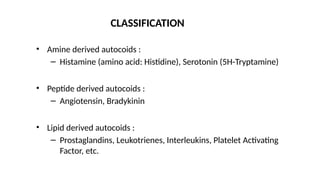
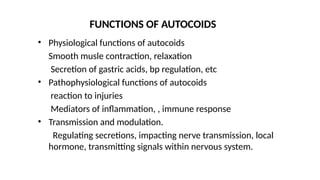
•Autocoids
•Histamine
•Sites, synthesis andstorage
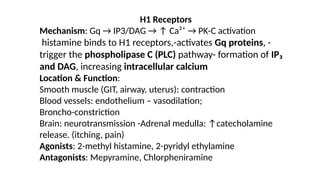
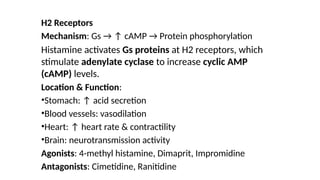
•Types of receptors
•Pathophysiological roles
•Histamine analogues
•Pharmacological action of histamine
•Antihistamines
•M.O.A. and Pharmacological actions of antihistamines
•Classification
•Therapeutic uses.
3.
• Define autocoidsand types
• Explain Histamine
• Explain types of receptors
• Explain antihistamines and classifications.
• Pharmacological actions of Antihistamines
• Therapeutic uses of Antihistamines.
Specific Learning Objectives
4.
• AUTACOIDS :-auto=self akos=healing/remedy
• These are diverse substances produced by a wide
variety of cells in the body, having intense biological
activity, but generally act locally (e.g. within
inflammatory pockets) at the site of synthesis and
release.
• They have also been called ‘local hormones’
AUTACOIDS
• Imidazole ethylamine
•Formed from the amino acid Histidine
• Important inflammatory mediator
• Potent biogenic amine and plays an important role in
inflammation, anaphylaxis, allergies, gastric acid secretion
and drug reaction.
INTRODUCTION
10.
As part ofan immune response to foreign
pathogens, histamine is produced by
basophils and mast cells found in nearby
connective tissues.
11.
1) Mast cellsite:
– Pulmonary tissue (mucosa of bronchial tree)
– Skin
– GIT(intestinal mucosa)
– Conc. Of histamine is particularly high in these tissues
2) Non-mast cell sites:
– CNS (neurons)
– Epidermis of skin.
– GIT(gastric cells)
– Cells in regenerating or rapidly growing tissues
– Basophils (in the blood)
SITES OF HISTAMINE RELEASE
12.
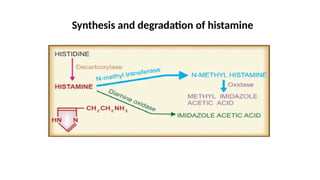
• Synthesis:- fromdecarboxylation of amino acid histidine
• Storage:- In mast cells, histamine (positively charged) is
held by an acidic protein and heparin (negatively charged)
within intracellular granules.
• Degradation:- oxidation and methylation.
SYNTHESIS, STORAGE AND DESTRUCTION
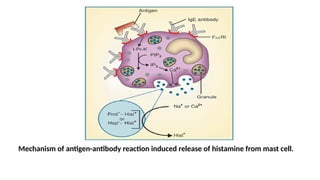
• Histamine heldby an acidic protein and heparin within
intracellular granules → Granules extrude by exocytosis
→ Na+
gets exchanged for histamine
MECHANISM OF RELEASE
15.
IgE-Mediated (Antigen-Induced) Release
Uponfirst exposure, IgE antibodies bind to mast cells and
"sensitize" them.
On re-exposure to the allergen, the allergen binds to IgE on the
mast cell surface, triggering degranulation and releasing
histamine along with other mediators (e.g., prostaglandins,
leukotrienes).
Non–Antigen-Mediated Release
Some drugs (e.g., morphine, codeine), venoms, or physical
factors (e.g., heat, trauma) can cause non-exocytotic release
by disrupting mast cell membranes or displacing histamine
from storage.
16.
Chemical & mechanicalmast cell injury cause
degranulation of cytoplasmic granules &
histamine is released
Certain amines accumulate in mast cells due
to affinity for heparin, displace histamine →
form heparin liberator complex → increases
permeability of mast cell membrane and
diffuse histamine.
H3 Receptors
Mechanism: Gi→ ↓ Ca²⁺ influx, ↓ cAMP
H3 receptors are mainly found on nerve endings. When
activated, they couple with Gi proteins to inhibit adenylate
cyclase, thereby decreasing cAMP. This reduces the release of
neurotransmitters like histamine, acetylcholine, and
norepinephrine—acting as a feedback control in the CNS.
Location & Function:
Brain (presynaptic): ↓ neurotransmitter release → sedation
Ileum: ↓ ACh release
Blood vessels: ↓ NA release → vasodilation
Agonists: (R)-α-methyl histamine, Imetit
Antagonists: Thioperamide, Impromidine, Ciprofloxacin
22.
H4 Receptors
Mechanism: Gi→ ↓ cAMP
Similar to H3, H4 receptors also couple with Gi proteins and reduce
cAMP levels. help in chemotaxis (movement) of eosinophils and
mast cells, contributing to allergic and inflammatory responses.
Location-Bone marrow, eosinophils, mast cells, basophils
Function: Mast cell chemotaxis-Chemotaxis is how immune cells
"smell" chemical signals and move toward the site of infection,
injury, or inflammation where those signals are strongest.
Antagonist: Thioperamide
23.
• Ulcers:- excessivestimulation of H2 produces excess
acid secretion.
• Allergic phenomenon:- mediation of hypersensitivity
reactions has been the first role ascribed to histamine.
• Causes inflammation - chemotaxis, opsonisation
(Coating of microbes by immune cells to enhance
phagocytosis or recognize antigens)
PATHOPHYSIOLOGICAL ROLES
24.
• As transmitter:-initiates the sensation of itch and pain at sensory
nerve endings.
• Headache:– due to sudden vasodilatation produce headache.
25.
• No therapeuticvalue
• Occasionally used in some diagnostic tests:
– Testing gastric acid secretion.
– Diagnosis of phenchromocytoma.
– Pulmonary function: to test for bronchial
hyperreactivity.
USES
26.
• Betahistine
– H1agonist
• Used to control vertigo in patients of Meniere’s disease. Vertigo
is a type of dizziness characterized by the illusion of rotational
movement, caused by disturbances in the vestibular system
(inner ear or its connections in the brain).
– Acts by causing vasodilation in internal ear.
• Betazole
– H2 agonist.
– Used in gastric function tests
HISTAMINE ANALOGUES (SUBSTITUTES)
27.
Blood vessels
• Causesmarked dilation of smaller blood vessels
• Dilation of cranial vessels causes pulsatile headache.
• Causes increased Capillary permeability due to separation
of endothelial cells → exudation of plasma:- H1 response
Pharmacological Actions
28.
• Intradermal injection→elicitsthe ‘triple response’
– Red spot: due to intense capillary dilatation. Immediate
reddening at the injection site
– Wheal: due to exudation of fluid from capillaries and
venules.
Local swelling (edematous elevation)
– Flare: i.e. redness in the surrounding area due to
arteriolar dilatation mediated by axon reflex.
29.
Glands
• H2 receptors-(on parietal cells) causes marked
increase in gastric secretion—primarily of acid but
also of pepsin → increases cAMP generation, which
in turn activates the membrane proton pump (H+/K+
ATPase).
Sensory nerve endings
• Injection (i.v. or intracutaneous):- Itching
30.
CNS
• Does notpenetrate blood brain barrier
• Intracerebroventricular administration:- (H1 and H2
receptors) produces rise in BP, cardiac stimulation,
behavioural arousal, hypothermia, vomiting and
ADH release.
• Blocks actionof histamine at receptor
• Competes with histamine for binding
• Displaces histamine from receptor
General Mechanism of Action of Antihistamines
33.
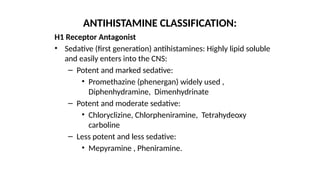
H1 Receptor Antagonist
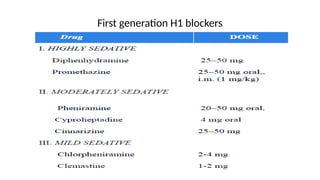
•Sedative (first generation) antihistamines: Highly lipid soluble
and easily enters into the CNS:
– Potent and marked sedative:
• Promethazine (phenergan) widely used ,
Diphenhydramine, Dimenhydrinate
– Potent and moderate sedative:
• Chloryclizine, Chlorpheniramine, Tetrahydeoxy
carboline
– Less potent and less sedative:
• Mepyramine , Pheniramine.
ANTIHISTAMINE CLASSIFICATION:
34.
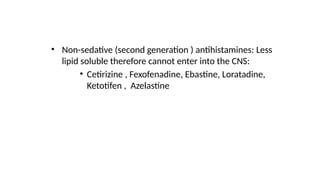
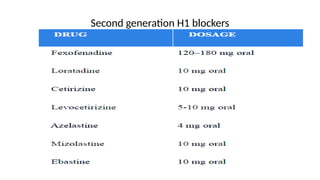
• Non-sedative (secondgeneration ) antihistamines: Less
lipid soluble therefore cannot enter into the CNS:
• Cetirizine , Fexofenadine, Ebastine, Loratadine,
Ketotifen , Azelastine
35.
• Mechanism ofaction:
– H1 antihistamines antagonize the effects of
histamine by competitively blocking the H1
receptors (competitive antagonism).
36.
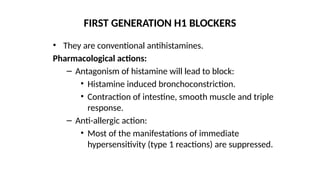
• They areconventional antihistamines.
Pharmacological actions:
– Antagonism of histamine will lead to block:
• Histamine induced bronchoconstriction.
• Contraction of intestine, smooth muscle and triple
response.
– Anti-allergic action:
• Most of the manifestations of immediate
hypersensitivity (type 1 reactions) are suppressed.
FIRST GENERATION H1 BLOCKERS
37.
– CNS:
• Producevariable degree of CNS
depression, sedation and drowsiness.
• At toxic doses, excitement and convulsions
are seen.
• As most of these drugs are lipophilic, easily
cross BBB and act on CNS .
38.
– Anticholinergic action:
•Dryness of mouth, blurring of vision,
constipation, urinary retention.
– At higher doses act as local anesthetics. They
block Na+
channels in excitable tissues
(Eg:- pheniramine, promethazine, diphenhydramine)
39.
Advantages over classicalantihistamines:
– Higher H1 selectivitiy: no anticholinergic side effects.
– Do not impair psychomotor performance.
– Absence of CNS depressant property. They poorly cross
BBB.
SECOND GENERATION H1 BLOCKERS
40.
– Additional antiallergicmechanisms apart from histamine blockade:
some also inhibit late phase allergic reaction by acting on
leukotrienes or by antiplatelet activating factor effect.
– Some of them are long acting.
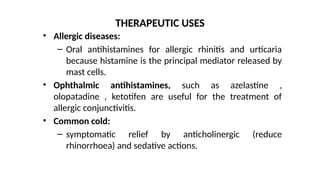
• Allergic diseases:
–Oral antihistamines for allergic rhinitis and urticaria
because histamine is the principal mediator released by
mast cells.
• Ophthalmic antihistamines, such as azelastine ,
olopatadine , ketotifen are useful for the treatment of
allergic conjunctivitis.
• Common cold:
– symptomatic relief by anticholinergic (reduce
rhinorrhoea) and sedative actions.
THERAPEUTIC USES
44.
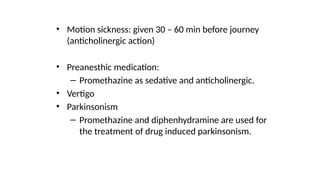
• Motion sickness:given 30 – 60 min before journey
(anticholinergic action)
• Preanesthic medication:
– Promethazine as sedative and anticholinergic.
• Vertigo
• Parkinsonism
– Promethazine and diphenhydramine are used for
the treatment of drug induced parkinsonism.
45.
• Cough
– Antihistaminicslike chlorpheniramine,
diphenhydramine and promethazine are used.
• As sedative, hypnotic, anxiolytic
– Induce sleep, especially in children.
46.
• Sedation, drowsiness,lack of concentration, headache,
fatigue, nausea, vomiting, loss of appetite and epigastric
discomfort, dry mouth, blurring of vision.
ADVERSE EFFECTS
47.
• They aregastroselective antihistamines.
• Eg:- cemetidine, ranitidine, nizatidine, famotidine
• Blocks H₂ receptors on parietal cells in the stomach lining.
H2 BLOCKERS
48.
Therapeutic Uses H2BLOCKERS
• Peptic Ulcer Disease (PUD)
– Duodenal & gastric ulcers
• Gastroesophageal Reflux Disease (GERD)
– Symptomatic relief of heartburn
• Prophylaxis of Stress Ulcers
– In ICU patients or those with severe stress
• Pre-anesthetic medication (famotidine)
– To reduce acid aspiration risk
49.
• They modulatethe histaminergic neurotransmission in
brain.
• They have application in obesity, sleep disorders,
neuropsychiatric disoders and cognitive functions.
• Eg:- Thioperamide and clobenpropit.
H3 BLOCKERS
50.
Summary
• Histamine isan important amine autacoid involved in
inflammation, allergy, and gastric acid secretion.
• Synthesized from histidine, stored in mast cells and
basophils, and released during allergic reactions.
• Acts through H1, H2, H3, and H4 receptors, each with
distinct locations and functions.
51.
• Histamine analogueslike betahistine and betazole have
diagnostic and therapeutic uses.
• Antihistamines are classified into:
– H1 blockers: First and second generation (sedative vs non-
sedative)
– H2 blockers: Reduce gastric acid (e.g., ranitidine)
• H1 antihistamines are useful in allergy, cold, motion sickness,
insomnia, and cough.
• Side effects include sedation, dry mouth, and GI discomfort.
52.
References
• Tripati KD.Essentials of medical pharmacology 6th. Edi
• Text book of principles of pharmacology by H.L.Sharma &
K.K.Sharma.
• Text book of pharmacology by Lippincott Williams & wilkins.