IOSR Journal of Mechanical and Civil Engineering (IOSR-JMCE)
e-ISSN: 2278-1684,p-ISSN: 2320-334X, Volume 12, Issue 2 Ver. VII (Mar - Apr. 2015), PP 05-09
www.iosrjournals.org
DOI: 10.9790/1684-12270509 www.iosrjournals.org 5 | Page
Groundwater Flow Analysis Using Visual Modflow
Lasya C.R, Dr. M. Inayathulla,
Department of civil engineering, Bangalore University, Bangalore-560001, India
Abstract: The sustainable use and management of groundwater resources is now a great challenge for many
countries of the world. Recently groundwater modelling has been an effective way to address this challenge.
There are a number of modelling software exist to simulate groundwater flow. Among them modelling software
MODFLOW is used to determine the interactions between the surface water and groundwater and to develop a
model for the study area.
Keywords: Conceptualization, Groundwater Modelling, ModFlow.
I. Introduction
Groundwater is a vital source of water throughout the world because of its availability and general
good quality. Few years ago ground water was taken as granted for safe use, but recent circumstances indicate
that ground water is seriously vulnerable to depletion in some countries. Because of this threat, it is important to
understand the processes that make ground water available for use. With the development of groundwater
investigations, it is important to understand the development of comprehensive conceptual models and to
analytical solutions or numerical methods of groundwater modelling.
II. Study Area
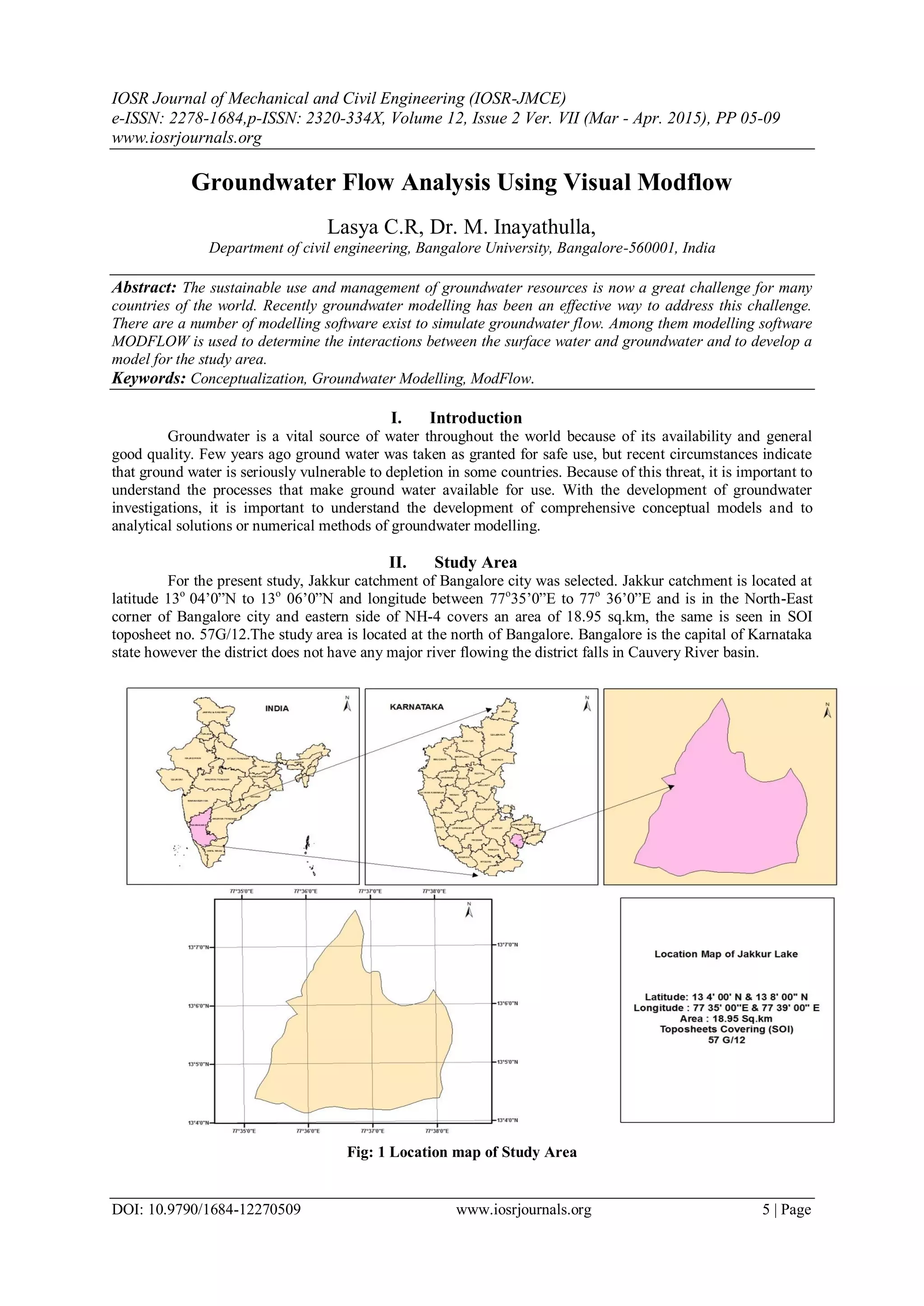
For the present study, Jakkur catchment of Bangalore city was selected. Jakkur catchment is located at
latitude 13o
04’0”N to 13o
06’0”N and longitude between 77o
35’0”E to 77o
36’0”E and is in the North-East
corner of Bangalore city and eastern side of NH-4 covers an area of 18.95 sq.km, the same is seen in SOI
toposheet no. 57G/12.The study area is located at the north of Bangalore. Bangalore is the capital of Karnataka
state however the district does not have any major river flowing the district falls in Cauvery River basin.
Fig: 1 Location map of Study Area
Groundwater Flow Analysis Using Visual Modflow
DOI: 10.9790/1684-12270509 www.iosrjournals.org 6 | Page
III. Methodology
Basically, a groundwater model is a simplified representation of the natural groundwater flow system.
Without them it would be impossible to evaluate all of the natural processes that impact a hydrogeologic design
because of complexities in
 The physical processes that occur in the hydrogeologic environment,
 The spatial distribution of properties and boundaries,
 The temporal nature of the flow system
A model can incorporate all of these complexities, and assess different options and future conditions. The better
we can represent these physical features, the better we can predict system response.
Types of Models
 Conceptual models:
1. A mental representation of site geology and hydrogeology
2. Contour plots of groundwater potential
 Physical models, electrical analogues
 Mathematical models
Conceptual Models: It is a hydrogeologist’s mental representation of the groundwater flow system.
 The Conceptual hydrogeologic model is the most important step in groundwater model process.
 It forms the basis for developing the numerical model.
 Provide a conceptual understanding of the physical setting related to groundwater flow.
 Integrate multiple data sources.
 Provide a basis for developing the numerical groundwater model.
Numerical Groundwater Models
A numerical model, like Visual MODFLOW, is a mathematical representation of the groundwater
environment. It is based on professional interpretation of the available data. It is built in a structured way to
provide some assurance that the site-specific model will provide meaningful results.
 The study area consists of six Open Wells (OW) and eleven Bore wells (BW). Latitude, Longitude,
Elevation, Fracture encountered, Depth
 of casing, total depth and in case of Open wells diameter is considered. Following table represents the
details of Open Wells and Bore wells.
Conceptualisation of Study Area:
To have better understanding on ground water regime of the study area a model is conceptualized,
designed and calibrated in Visual MODFLOW. It is a generic model with an objective to quantify the input and
output stresses on the aquifer system for a period of 720 days.
Conceptualisation of the study area.
Conceptualisation is used to determine number of layers in the study area as well as the nature of rock
and soil present in the study area. The purpose of preparing a conceptual model is to organize the field data and
simplify the flow problem with assumptions so that the system can be synthesized and analysed easily.
Conceptualisation is done by using MapInfo software which describes the weathered, fractured and massive
rocks as well as the casing depth of bore wells.
Conceptual Model and Grid Design
Conceptualing the model of the study area is the most important step in groundwater model process.
This is a process of visualisation of different hydrogeological and ground water flow conditions in the study
area. It forms the basis for developing the numerical model and provides a conceptual understanding of the
physical setting related to groundwater flow
The process of conceptualization helps in determining the number of visualized layers in the study area which
are having almost similar hydrogeological setup. The purpose of preparing a conceptual model is to organize the
field data and simplify the flow problem with assumptions so that the system can be synthesized and analyzed
easily.
Groundwater Flow Analysis Using Visual Modflow
DOI: 10.9790/1684-12270509 www.iosrjournals.org 7 | Page
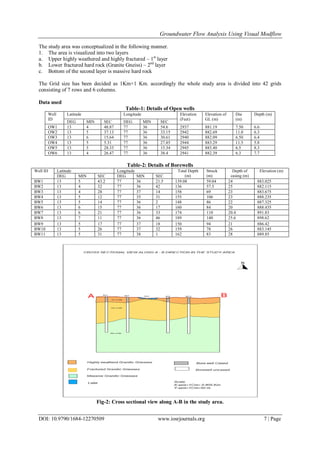
The study area was conceptualized in the following manner.
1. The area is visualized into two layers
a. Upper highly weathered and highly fractured – 1st
layer
b. Lower fractured hard rock (Granite Gneiss) – 2nd
layer
c. Bottom of the second layer is massive hard rock
The Grid size has been decided as 1Km×1 Km. accordingly the whole study area is divided into 42 grids
consisting of 7 rows and 6 columns.
Data used
Table-1: Details of Open wells
Well
ID
Latitude Longitude Elevation
(Feet)
Elevation of
GL (m)
Dia
(m)
Depth (m)
DEG MIN SEC DEG MIN SEC
OW1 13 4 48.87 77 36 54.6 2937 881.19 7.50 6.6
OW2 13 5 37.13 77 36 33.15 2942 882.69 11.0 6.3
OW3 13 6 15.64 77 36 30.61 2940 882.09 6.50 6.4
OW4 13 5 5.31 77 36 27.85 2944 883.29 11.5 5.8
OW5 13 5 28.33 77 36 15.34 2945 883.40 6.5 8.3
OW6 13 4 26.47 77 36 38.4 2941 882.39 6.3 7.7
Table-2: Details of Borewells
Well ID Latitude Longitude Total Depth
(m)
Struck
(m)
Depth of
casing (m)
Elevation (m)
DEG MIN SEC DEG MIN SEC
BW1 13 5 43.2 77 36 21.5 139.08 59.04 24 883.025
BW2 13 4 32 77 36 42 136 57.5 25 882.115
BW3 13 4 28 77 37 14 158 69 23 883.675
BW4 13 5 12 77 35 31 155 106 23 888.235
BW5 13 5 14 77 36 2 148 86 22 887.325
BW6 13 6 15 77 36 17 160 84 20 888.435
BW7 13 6 21 77 36 33 174 110 20.4 891.83
BW8 13 7 11 77 36 46 189 140 25.6 898.62
BW9 13 5 17 77 37 18 150 94 21 886.42
BW10 13 5 26 77 37 32 159 78 26 883.145
BW11 13 5 31 77 38 1 162 83 28 889.85
Fig-2: Cross sectional view along A-B in the study area.
Groundwater Flow Analysis Using Visual Modflow
DOI: 10.9790/1684-12270509 www.iosrjournals.org 8 | Page
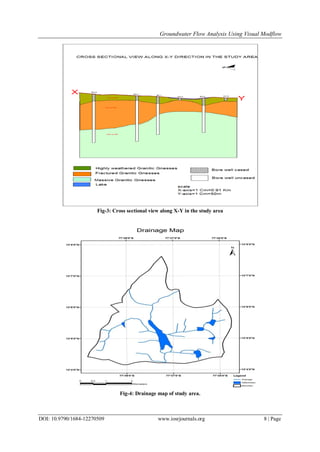
Fig-3: Cross sectional view along X-Y in the study area
Fig-4: Drainage map of study area.
Groundwater Flow Analysis Using Visual Modflow
DOI: 10.9790/1684-12270509 www.iosrjournals.org 9 | Page
IV. Conclusions
 The study area, a part of Jakkur River Basin, Karnataka State was chosen for ground water modeling in
Visual MODFLOW Pro with the objective to understand the ground water system and to quantify the input
and output stresses.
 The external and internal boundaries of the model domain were demarcated. No flow, constant head and
river boundary were demarcated. Input parameters like hydraulic conductivity, storage, recharge, draft,
evapotranspiration and initial heads were assigned to the model.
 The model was run both in steady state and transient flow conditions.
 The model was calibrated by changing the hydraulic conductivity values by using Trial and Error Method.
 The calculated vs. Observed head indicates the RMS error is 19%, 14 wells falling within the 95%
confidence interval.
 Sample Hydrographs of observation wells shows the calculated heads almost ( in 50-60% of the wells)
matching the observed heads
 The zone budget (recharge versus draft relationship) is obtained from the model shows at the end of stress
period 1 the ground water available is – 399 m3
/ day and at the end of stress period 12 (after 720 days) is –
49m3
/day.
Refrences
[1]. Anthony D (2002) “Preliminary surface water – groundwater interaction modelling: water balances” Technical Report No 22/02
CSIRO Land and Water Private Bag No 5 Western Australia 6913.
[2]. Bedekar. V (2011) “Abstracts of Papers & Presentations of Modflow-Surface and MODHMS” HGL Software Systems Hydro
GeoLogic, Inc.1107 Sunset Hills Road Ste. 400Reston VA 20190.
[3]. DevathaChella(2009) “Analysis of Flow Pattern between Hill and Lake” ARPN Journal of Engineering and Applied Sciences.
[4]. Elango .L (2001) “Modelling the effect of subsurface barrier on groundwater flow regime” Department of Geology,Anna
University, Chennai,Tamilnadu,India.
[5]. Fatema Akram (2012), “A Comparative View of Groundwater Flow Simulation Using Two Modelling Software - Modflow and
MIKE SHE” 18th Australasian Fluid Mechanics Conference Launceston, Australia.
[6]. Florian Werner “Groundwater Surface Water Interaction of a Post Lignite Mining Lake in Germany and its Relevance for the Local
Water Management”.
[7]. Henk M (2005) “Modeling Lake-Groundwater interactions in GFLOW”
[8]. Hoaglund(2012) “Surface-ground water interaction: From watershed process to hyporheicexchange” Kumamoto University.
[9]. Howard W (2010) “Linking MODFLOW with an Agent-Based Land-Use Model to Support Decision Making” Vol. 48, No. 5–
Ground Water (pages 649–660).
[10]. Jayaprakash. J.P (2011) “Impact Assessment and Ground Water Modelling Studies of Vented Dam at Tumbe, Dakshina Kannada
District, Karnataka” Central Ground Water Board, Bangalore.
[11]. Jay Thomas Aber (2007) “Modeling Groundwater Flow using PMWIN and ArcGIS” Water Resources Research Lab Kansas State
University.
[12]. Jairo E. Hernández1 (2012) “Modeling Groundwater Levels on the Calera Aquifer Region in Central Mexico Using ModFlow”
Journal of Agricultural Science and Technology B 2 (2012) 52-61.

B012270509

  • 1.
    IOSR Journal ofMechanical and Civil Engineering (IOSR-JMCE) e-ISSN: 2278-1684,p-ISSN: 2320-334X, Volume 12, Issue 2 Ver. VII (Mar - Apr. 2015), PP 05-09 www.iosrjournals.org DOI: 10.9790/1684-12270509 www.iosrjournals.org 5 | Page Groundwater Flow Analysis Using Visual Modflow Lasya C.R, Dr. M. Inayathulla, Department of civil engineering, Bangalore University, Bangalore-560001, India Abstract: The sustainable use and management of groundwater resources is now a great challenge for many countries of the world. Recently groundwater modelling has been an effective way to address this challenge. There are a number of modelling software exist to simulate groundwater flow. Among them modelling software MODFLOW is used to determine the interactions between the surface water and groundwater and to develop a model for the study area. Keywords: Conceptualization, Groundwater Modelling, ModFlow. I. Introduction Groundwater is a vital source of water throughout the world because of its availability and general good quality. Few years ago ground water was taken as granted for safe use, but recent circumstances indicate that ground water is seriously vulnerable to depletion in some countries. Because of this threat, it is important to understand the processes that make ground water available for use. With the development of groundwater investigations, it is important to understand the development of comprehensive conceptual models and to analytical solutions or numerical methods of groundwater modelling. II. Study Area For the present study, Jakkur catchment of Bangalore city was selected. Jakkur catchment is located at latitude 13o 04’0”N to 13o 06’0”N and longitude between 77o 35’0”E to 77o 36’0”E and is in the North-East corner of Bangalore city and eastern side of NH-4 covers an area of 18.95 sq.km, the same is seen in SOI toposheet no. 57G/12.The study area is located at the north of Bangalore. Bangalore is the capital of Karnataka state however the district does not have any major river flowing the district falls in Cauvery River basin. Fig: 1 Location map of Study Area
  • 2.
    Groundwater Flow AnalysisUsing Visual Modflow DOI: 10.9790/1684-12270509 www.iosrjournals.org 6 | Page III. Methodology Basically, a groundwater model is a simplified representation of the natural groundwater flow system. Without them it would be impossible to evaluate all of the natural processes that impact a hydrogeologic design because of complexities in  The physical processes that occur in the hydrogeologic environment,  The spatial distribution of properties and boundaries,  The temporal nature of the flow system A model can incorporate all of these complexities, and assess different options and future conditions. The better we can represent these physical features, the better we can predict system response. Types of Models  Conceptual models: 1. A mental representation of site geology and hydrogeology 2. Contour plots of groundwater potential  Physical models, electrical analogues  Mathematical models Conceptual Models: It is a hydrogeologist’s mental representation of the groundwater flow system.  The Conceptual hydrogeologic model is the most important step in groundwater model process.  It forms the basis for developing the numerical model.  Provide a conceptual understanding of the physical setting related to groundwater flow.  Integrate multiple data sources.  Provide a basis for developing the numerical groundwater model. Numerical Groundwater Models A numerical model, like Visual MODFLOW, is a mathematical representation of the groundwater environment. It is based on professional interpretation of the available data. It is built in a structured way to provide some assurance that the site-specific model will provide meaningful results.  The study area consists of six Open Wells (OW) and eleven Bore wells (BW). Latitude, Longitude, Elevation, Fracture encountered, Depth  of casing, total depth and in case of Open wells diameter is considered. Following table represents the details of Open Wells and Bore wells. Conceptualisation of Study Area: To have better understanding on ground water regime of the study area a model is conceptualized, designed and calibrated in Visual MODFLOW. It is a generic model with an objective to quantify the input and output stresses on the aquifer system for a period of 720 days. Conceptualisation of the study area. Conceptualisation is used to determine number of layers in the study area as well as the nature of rock and soil present in the study area. The purpose of preparing a conceptual model is to organize the field data and simplify the flow problem with assumptions so that the system can be synthesized and analysed easily. Conceptualisation is done by using MapInfo software which describes the weathered, fractured and massive rocks as well as the casing depth of bore wells. Conceptual Model and Grid Design Conceptualing the model of the study area is the most important step in groundwater model process. This is a process of visualisation of different hydrogeological and ground water flow conditions in the study area. It forms the basis for developing the numerical model and provides a conceptual understanding of the physical setting related to groundwater flow The process of conceptualization helps in determining the number of visualized layers in the study area which are having almost similar hydrogeological setup. The purpose of preparing a conceptual model is to organize the field data and simplify the flow problem with assumptions so that the system can be synthesized and analyzed easily.
  • 3.
    Groundwater Flow AnalysisUsing Visual Modflow DOI: 10.9790/1684-12270509 www.iosrjournals.org 7 | Page The study area was conceptualized in the following manner. 1. The area is visualized into two layers a. Upper highly weathered and highly fractured – 1st layer b. Lower fractured hard rock (Granite Gneiss) – 2nd layer c. Bottom of the second layer is massive hard rock The Grid size has been decided as 1Km×1 Km. accordingly the whole study area is divided into 42 grids consisting of 7 rows and 6 columns. Data used Table-1: Details of Open wells Well ID Latitude Longitude Elevation (Feet) Elevation of GL (m) Dia (m) Depth (m) DEG MIN SEC DEG MIN SEC OW1 13 4 48.87 77 36 54.6 2937 881.19 7.50 6.6 OW2 13 5 37.13 77 36 33.15 2942 882.69 11.0 6.3 OW3 13 6 15.64 77 36 30.61 2940 882.09 6.50 6.4 OW4 13 5 5.31 77 36 27.85 2944 883.29 11.5 5.8 OW5 13 5 28.33 77 36 15.34 2945 883.40 6.5 8.3 OW6 13 4 26.47 77 36 38.4 2941 882.39 6.3 7.7 Table-2: Details of Borewells Well ID Latitude Longitude Total Depth (m) Struck (m) Depth of casing (m) Elevation (m) DEG MIN SEC DEG MIN SEC BW1 13 5 43.2 77 36 21.5 139.08 59.04 24 883.025 BW2 13 4 32 77 36 42 136 57.5 25 882.115 BW3 13 4 28 77 37 14 158 69 23 883.675 BW4 13 5 12 77 35 31 155 106 23 888.235 BW5 13 5 14 77 36 2 148 86 22 887.325 BW6 13 6 15 77 36 17 160 84 20 888.435 BW7 13 6 21 77 36 33 174 110 20.4 891.83 BW8 13 7 11 77 36 46 189 140 25.6 898.62 BW9 13 5 17 77 37 18 150 94 21 886.42 BW10 13 5 26 77 37 32 159 78 26 883.145 BW11 13 5 31 77 38 1 162 83 28 889.85 Fig-2: Cross sectional view along A-B in the study area.
  • 4.
    Groundwater Flow AnalysisUsing Visual Modflow DOI: 10.9790/1684-12270509 www.iosrjournals.org 8 | Page Fig-3: Cross sectional view along X-Y in the study area Fig-4: Drainage map of study area.
  • 5.
    Groundwater Flow AnalysisUsing Visual Modflow DOI: 10.9790/1684-12270509 www.iosrjournals.org 9 | Page IV. Conclusions  The study area, a part of Jakkur River Basin, Karnataka State was chosen for ground water modeling in Visual MODFLOW Pro with the objective to understand the ground water system and to quantify the input and output stresses.  The external and internal boundaries of the model domain were demarcated. No flow, constant head and river boundary were demarcated. Input parameters like hydraulic conductivity, storage, recharge, draft, evapotranspiration and initial heads were assigned to the model.  The model was run both in steady state and transient flow conditions.  The model was calibrated by changing the hydraulic conductivity values by using Trial and Error Method.  The calculated vs. Observed head indicates the RMS error is 19%, 14 wells falling within the 95% confidence interval.  Sample Hydrographs of observation wells shows the calculated heads almost ( in 50-60% of the wells) matching the observed heads  The zone budget (recharge versus draft relationship) is obtained from the model shows at the end of stress period 1 the ground water available is – 399 m3 / day and at the end of stress period 12 (after 720 days) is – 49m3 /day. Refrences [1]. Anthony D (2002) “Preliminary surface water – groundwater interaction modelling: water balances” Technical Report No 22/02 CSIRO Land and Water Private Bag No 5 Western Australia 6913. [2]. Bedekar. V (2011) “Abstracts of Papers & Presentations of Modflow-Surface and MODHMS” HGL Software Systems Hydro GeoLogic, Inc.1107 Sunset Hills Road Ste. 400Reston VA 20190. [3]. DevathaChella(2009) “Analysis of Flow Pattern between Hill and Lake” ARPN Journal of Engineering and Applied Sciences. [4]. Elango .L (2001) “Modelling the effect of subsurface barrier on groundwater flow regime” Department of Geology,Anna University, Chennai,Tamilnadu,India. [5]. Fatema Akram (2012), “A Comparative View of Groundwater Flow Simulation Using Two Modelling Software - Modflow and MIKE SHE” 18th Australasian Fluid Mechanics Conference Launceston, Australia. [6]. Florian Werner “Groundwater Surface Water Interaction of a Post Lignite Mining Lake in Germany and its Relevance for the Local Water Management”. [7]. Henk M (2005) “Modeling Lake-Groundwater interactions in GFLOW” [8]. Hoaglund(2012) “Surface-ground water interaction: From watershed process to hyporheicexchange” Kumamoto University. [9]. Howard W (2010) “Linking MODFLOW with an Agent-Based Land-Use Model to Support Decision Making” Vol. 48, No. 5– Ground Water (pages 649–660). [10]. Jayaprakash. J.P (2011) “Impact Assessment and Ground Water Modelling Studies of Vented Dam at Tumbe, Dakshina Kannada District, Karnataka” Central Ground Water Board, Bangalore. [11]. Jay Thomas Aber (2007) “Modeling Groundwater Flow using PMWIN and ArcGIS” Water Resources Research Lab Kansas State University. [12]. Jairo E. Hernández1 (2012) “Modeling Groundwater Levels on the Calera Aquifer Region in Central Mexico Using ModFlow” Journal of Agricultural Science and Technology B 2 (2012) 52-61.