Indo – UKWater Centre
IITM, Pune
NERC – MoES
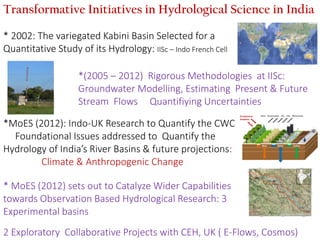
* 2002: The variegated Kabini Basin Selected for a
Quantitative Study of its Hydrology: IISc – Indo French Cell
Transformative Initiatives in Hydrological Science in India
*(2005 – 2012) Rigorous Methodologies at IISc:
Groundwater Modelling, Estimating Present & Future
Stream Flows Quantifiying Uncertainties
*MoES (2012): Indo-UK Research to Quantify the CWC
Foundational Issues addressed to Quantify the
Hydrology of India’s River Basins & future projections:
Climate & Anthropogenic Change
* MoES (2012) sets out to Catalyze Wider Capabilities
towards Observation Based Hydrological Research: 3
Experimental basins
2 Exploratory Collaborative Projects with CEH, UK ( E-Flows, Cosmos)
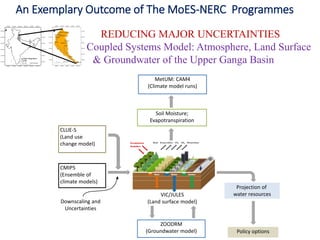
REDUCING MAJOR UNCERTAINTIES
A Coupled Systems Model: Atmosphere, Land Surface
& Groundwater of the Upper Ganga Basin
VIC/JULES
(Land surface model)
ZOODRM
(Groundwater model)
CMIP5
(Ensemble of
climate models)
MetUM: CAM4
(Climate model runs)
Projection of
water resources
Policy options
Downscaling and
Uncertainties
Soil Moisture;
Evapotranspiration
CLUE-S
(Land use
change model)
An Exemplary Outcome of The MoES-NERC Programmes
New Endeavours on the Anvil
standing on the shoulders of
Recent accomplishments: Two Examples
*A systems Dynamical Model of the Kaveri Basin by upscaling the
models constructed for the variegated Hydrological Response Units of
the Kabini Basin
* A systems Dynamical Model with coupled anthropogenic response, of
the Gandak sub-basin in the Ganga basin by incorporating the
knowledge gained during the conduct of the recently concluded CWC
project
Co-development of highly Complementary New Initiatives
that greatly Extend the Field of Direct Outcomes of the Officially
funded Programmes
Establishment in 2015, of an Interdisciplinary Centre of Water Research at IISc,
Bangalore
* Catalyze Articulation of Farsighted Research Problems
(Scientific Meetings/ Training Programmes)
* Produce Rigorously Researched Reports/Papers on Important Issues of Concern to Society (Ex: The
Chennai Flood)
* Identify, Design, and Conduct Scholarly Discussion Meetings on New Emerging Issues in Hydrological
Science and Practice
* Special emphasis on Production & Dissemination of Socially significant Knowledge and Real time
Information Products
* Attract International Attention to address cutting Edge Research Issues through
high Impact Intellectual Collaboration
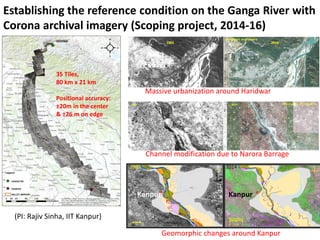
35 Tiles,
80 km x 21 km
Positional accuracy:
±20m in the center
& ±26 m on edge
Establishing the reference condition on the Ganga River with
Corona archival imagery (Scoping project, 2014-16)
Massive urbanization around Haridwar
Channel modification due to Narora Barrage
Kanpur Kanpur
Geomorphic changes around Kanpur
(PI: Rajiv Sinha, IIT Kanpur)
1965 2014
An International Discussion Meeting February 26-28, 2015
Quantification and Reduction of Uncertainties in Hydrological
Inferences
sponsored by the Indian Academy of Sciences
Highlights of the Meeting
The Discussion meeting ( over 5 sessions) attended by 20 scientists including 6 scholars
from Europe, USA and Australia who had financed their own travel.
Important research issues identified for addressal.
i) Development of potentially quantifiable measures to represent uncertainty in
Hydrological Inferences aimed at approaching Potential Predictability
ii) Methodologies for isolating Uncertainties in Predictions according to Influencing
Factors to obviate options in prioritization of research targets
iii) Development of a Systems approach to uncertainty reduction.
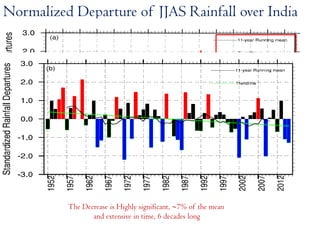
Normalized Departure of JJAS Rainfall over India
The Decreasing Trend of the multi-Decadal Variability since 1955
The Decrease is Highly significant, 7% of the mean
and extensive in time, 6 decades long
CEH Initiatives
Quantifying Ecological Flows
Upper Ganga Catchment CEH - NIH
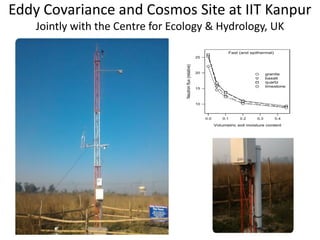
Eddy Covariance and Cosmos Site at IIT Kanpur
Jointly with the Centre for Ecology & Hydrology, UK
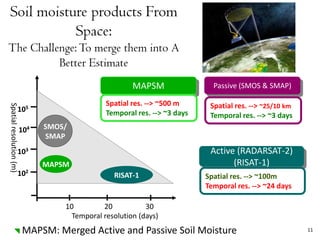
Soil moisture products From
Space:
The Challenge: To merge them into A
Better Estimate
Spatialresolution(m)
10 20 30
102
103
104
105
MAPSM
Temporal resolution (days)
RISAT-1
MAPSM
Passive (SMOS & SMAP)
Spatial res. --> ~25/10 km
Temporal res. --> ~3 days
Active (RADARSAT-2)
(RISAT-1)
Spatial res. --> ~100m
Temporal res. --> ~24 days
MAPSM: Merged Active and Passive Soil Moisture
SMOS/
SMAP
Spatial res. --> ~500 m
Temporal res. --> ~3 days
11
Evapotranspiration
Modeling
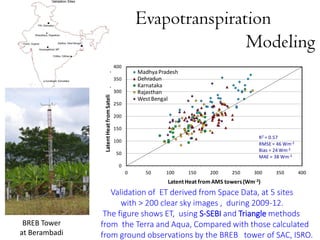
Validation of ET derived from Space Data, at 5 sites
with > 200 clear sky images , during 2009-12.
The figure shows ET, using S-SEBI and Triangle methods
from the Terra and Aqua, Compared with those calculated
from ground observations by the BREB tower of SAC, ISRO.
0
50
100
150
200
250
300
350
400
0 50 100 150 200 250 300 350 400
LatentHeatfromSatelite(Wm-2)
LatentHeat fromAMS towers (Wm-2)
Madhya Pradesh
Dehradun
Karnataka
Rajasthan
WestBengal
R2 = 0.57
RMSE = 46 Wm-2
Bias = 24 Wm-2
MAE = 38 Wm-2
BREB Tower
at Berambadi 12
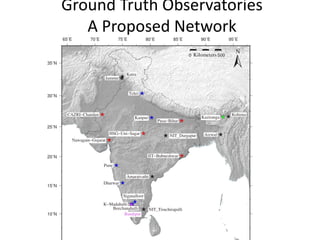
Ground Truth Observatories
A Proposed Network
Quantifying India’sWater Budget ?
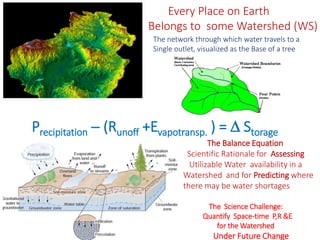
Precipitation  (Runoff +Evapotransp. ) =  Storage
The Balance Equation
Scientific Rationale for Assessing
Utilizable Water availability in a
Watershed and for Predicting where
there may be water shortages
The Science Challenge:
Quantify Space-time P,R &E
for the Watershed
Under Future Change
Every Place on Earth
Belongs to some Watershed (WS)
The network through which water travels to a
Single outlet, visualized as the Base of a tree
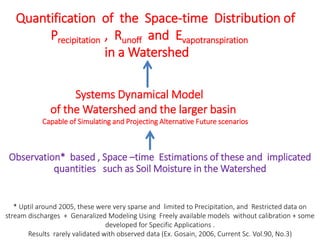
Observation* based , Space –time Estimations of these and implicated
quantities such as Soil Moisture in the Watershed
Quantification of the Space-time Distribution of
Precipitation , Runoff and Evapotranspiration
in a Watershed
Systems Dynamical Model
of the Watershed and the larger basin
Capable of Simulating and Projecting Alternative Future scenarios
* Uptil around 2005, these were very sparse and limited to Precipitation, and Restricted data on
stream discharges + Genaralized Modeling Using Freely available models without calibration + some
developed for Specific Applications .
Results rarely validated with observed data (Ex. Gosain, 2006, Current Sc. Vol.90, No.3)
Joint Centre Opportunities
1. A Modern Data Centre
2. Assimilation Algorithms
3.Training Courses/Programmes
4. Priming Initiatives to Address Significant Outstanding
Research/Analysis Issues
5. Outreach to the DevelopingWorld
The Next Stage Research Challenges
A continuing endeavour to improve our understanding of the Hydrology-Climate –Human System
and Decision support
1.Scale Issues in Hydrology
Process understanding at smaller watershed scales for upscaling to river basin scales; Downscaling of global datasets (including Projections) to watershed
scales; Nested scale modeling (interactive models at various spatial and time scales).
2. Quantification and reduction of uncertainties (Aleatory & Epistemic)
Relating to: model (process understanding), parameter, data, lack of knowledge, subjectivity, imprecision, spatial and time scales etc.
3. Refinement and Fusion of Retreival Algorithms of hydrologic variables
e.g., Soil Moisture and Evapo-transpiration from Satellite Products.
4. Applications of microvave and hypersepctral Remote Sensing in hydrology
5. Modeling non-stationarity in hydrologic processes, particularly of Extremes under climate change
6. Contaminant transport in surface and groundwater systems.
7. Hydrologic regionalisation of the country with climatic inputs
And, Test of the Hypothesis that the Hydrologic Regionalisation may be Affected by Climate Change
8.Two way feedbacks from land surface processes to climate and back
Providing an understanding of the Hydrometeorology of Floods and Droughts at different Space – Time Scales
9. Application areas, for Informed Decisions Making on water management
Systems models at river basin/watershed/aquifer scales; Conjucntive use (of surface and groundwater); Simulation at Management Scales; Converting flood
waters into a resource, by innovative groundwater recharge/ surface storage methods (d) Use of advanced technologies (e.g., sensor, communication, satellite -
) for monitoring ‘Hydrologic Fluxes (e) Intergated water resource management (including estimation of Environmental flows, Use for irrigation, Hydropower,
flood control etc) at riverbasin/watershed scales

IUKWC Workshop Nov16: Developing Hydro-climatic Services for Water Security - Welcome 2 - A_Gaur

  • 1.
    Indo – UKWaterCentre IITM, Pune NERC – MoES
  • 2.
    * 2002: Thevariegated Kabini Basin Selected for a Quantitative Study of its Hydrology: IISc – Indo French Cell Transformative Initiatives in Hydrological Science in India *(2005 – 2012) Rigorous Methodologies at IISc: Groundwater Modelling, Estimating Present & Future Stream Flows Quantifiying Uncertainties *MoES (2012): Indo-UK Research to Quantify the CWC Foundational Issues addressed to Quantify the Hydrology of India’s River Basins & future projections: Climate & Anthropogenic Change * MoES (2012) sets out to Catalyze Wider Capabilities towards Observation Based Hydrological Research: 3 Experimental basins 2 Exploratory Collaborative Projects with CEH, UK ( E-Flows, Cosmos)
  • 3.
    REDUCING MAJOR UNCERTAINTIES ACoupled Systems Model: Atmosphere, Land Surface & Groundwater of the Upper Ganga Basin VIC/JULES (Land surface model) ZOODRM (Groundwater model) CMIP5 (Ensemble of climate models) MetUM: CAM4 (Climate model runs) Projection of water resources Policy options Downscaling and Uncertainties Soil Moisture; Evapotranspiration CLUE-S (Land use change model) An Exemplary Outcome of The MoES-NERC Programmes
  • 4.
    New Endeavours onthe Anvil standing on the shoulders of Recent accomplishments: Two Examples *A systems Dynamical Model of the Kaveri Basin by upscaling the models constructed for the variegated Hydrological Response Units of the Kabini Basin * A systems Dynamical Model with coupled anthropogenic response, of the Gandak sub-basin in the Ganga basin by incorporating the knowledge gained during the conduct of the recently concluded CWC project
  • 5.
    Co-development of highlyComplementary New Initiatives that greatly Extend the Field of Direct Outcomes of the Officially funded Programmes Establishment in 2015, of an Interdisciplinary Centre of Water Research at IISc, Bangalore * Catalyze Articulation of Farsighted Research Problems (Scientific Meetings/ Training Programmes) * Produce Rigorously Researched Reports/Papers on Important Issues of Concern to Society (Ex: The Chennai Flood) * Identify, Design, and Conduct Scholarly Discussion Meetings on New Emerging Issues in Hydrological Science and Practice * Special emphasis on Production & Dissemination of Socially significant Knowledge and Real time Information Products * Attract International Attention to address cutting Edge Research Issues through high Impact Intellectual Collaboration
  • 6.
    35 Tiles, 80 kmx 21 km Positional accuracy: ±20m in the center & ±26 m on edge Establishing the reference condition on the Ganga River with Corona archival imagery (Scoping project, 2014-16) Massive urbanization around Haridwar Channel modification due to Narora Barrage Kanpur Kanpur Geomorphic changes around Kanpur (PI: Rajiv Sinha, IIT Kanpur) 1965 2014
  • 7.
    An International DiscussionMeeting February 26-28, 2015 Quantification and Reduction of Uncertainties in Hydrological Inferences sponsored by the Indian Academy of Sciences Highlights of the Meeting The Discussion meeting ( over 5 sessions) attended by 20 scientists including 6 scholars from Europe, USA and Australia who had financed their own travel. Important research issues identified for addressal. i) Development of potentially quantifiable measures to represent uncertainty in Hydrological Inferences aimed at approaching Potential Predictability ii) Methodologies for isolating Uncertainties in Predictions according to Influencing Factors to obviate options in prioritization of research targets iii) Development of a Systems approach to uncertainty reduction.
  • 8.
    Normalized Departure ofJJAS Rainfall over India The Decreasing Trend of the multi-Decadal Variability since 1955 The Decrease is Highly significant, 7% of the mean and extensive in time, 6 decades long
  • 9.
    CEH Initiatives Quantifying EcologicalFlows Upper Ganga Catchment CEH - NIH
  • 10.
    Eddy Covariance andCosmos Site at IIT Kanpur Jointly with the Centre for Ecology & Hydrology, UK
  • 11.
    Soil moisture productsFrom Space: The Challenge: To merge them into A Better Estimate Spatialresolution(m) 10 20 30 102 103 104 105 MAPSM Temporal resolution (days) RISAT-1 MAPSM Passive (SMOS & SMAP) Spatial res. --> ~25/10 km Temporal res. --> ~3 days Active (RADARSAT-2) (RISAT-1) Spatial res. --> ~100m Temporal res. --> ~24 days MAPSM: Merged Active and Passive Soil Moisture SMOS/ SMAP Spatial res. --> ~500 m Temporal res. --> ~3 days 11
  • 12.
    Evapotranspiration Modeling Validation of ETderived from Space Data, at 5 sites with > 200 clear sky images , during 2009-12. The figure shows ET, using S-SEBI and Triangle methods from the Terra and Aqua, Compared with those calculated from ground observations by the BREB tower of SAC, ISRO. 0 50 100 150 200 250 300 350 400 0 50 100 150 200 250 300 350 400 LatentHeatfromSatelite(Wm-2) LatentHeat fromAMS towers (Wm-2) Madhya Pradesh Dehradun Karnataka Rajasthan WestBengal R2 = 0.57 RMSE = 46 Wm-2 Bias = 24 Wm-2 MAE = 38 Wm-2 BREB Tower at Berambadi 12
  • 13.
  • 14.
  • 15.
    Precipitation  (Runoff+Evapotransp. ) =  Storage The Balance Equation Scientific Rationale for Assessing Utilizable Water availability in a Watershed and for Predicting where there may be water shortages The Science Challenge: Quantify Space-time P,R &E for the Watershed Under Future Change Every Place on Earth Belongs to some Watershed (WS) The network through which water travels to a Single outlet, visualized as the Base of a tree
  • 16.
    Observation* based ,Space –time Estimations of these and implicated quantities such as Soil Moisture in the Watershed Quantification of the Space-time Distribution of Precipitation , Runoff and Evapotranspiration in a Watershed Systems Dynamical Model of the Watershed and the larger basin Capable of Simulating and Projecting Alternative Future scenarios * Uptil around 2005, these were very sparse and limited to Precipitation, and Restricted data on stream discharges + Genaralized Modeling Using Freely available models without calibration + some developed for Specific Applications . Results rarely validated with observed data (Ex. Gosain, 2006, Current Sc. Vol.90, No.3)
  • 17.
    Joint Centre Opportunities 1.A Modern Data Centre 2. Assimilation Algorithms 3.Training Courses/Programmes 4. Priming Initiatives to Address Significant Outstanding Research/Analysis Issues 5. Outreach to the DevelopingWorld
  • 18.
    The Next StageResearch Challenges A continuing endeavour to improve our understanding of the Hydrology-Climate –Human System and Decision support 1.Scale Issues in Hydrology Process understanding at smaller watershed scales for upscaling to river basin scales; Downscaling of global datasets (including Projections) to watershed scales; Nested scale modeling (interactive models at various spatial and time scales). 2. Quantification and reduction of uncertainties (Aleatory & Epistemic) Relating to: model (process understanding), parameter, data, lack of knowledge, subjectivity, imprecision, spatial and time scales etc. 3. Refinement and Fusion of Retreival Algorithms of hydrologic variables e.g., Soil Moisture and Evapo-transpiration from Satellite Products. 4. Applications of microvave and hypersepctral Remote Sensing in hydrology 5. Modeling non-stationarity in hydrologic processes, particularly of Extremes under climate change 6. Contaminant transport in surface and groundwater systems. 7. Hydrologic regionalisation of the country with climatic inputs And, Test of the Hypothesis that the Hydrologic Regionalisation may be Affected by Climate Change 8.Two way feedbacks from land surface processes to climate and back Providing an understanding of the Hydrometeorology of Floods and Droughts at different Space – Time Scales 9. Application areas, for Informed Decisions Making on water management Systems models at river basin/watershed/aquifer scales; Conjucntive use (of surface and groundwater); Simulation at Management Scales; Converting flood waters into a resource, by innovative groundwater recharge/ surface storage methods (d) Use of advanced technologies (e.g., sensor, communication, satellite - ) for monitoring ‘Hydrologic Fluxes (e) Intergated water resource management (including estimation of Environmental flows, Use for irrigation, Hydropower, flood control etc) at riverbasin/watershed scales