Ayub Era(1958-1969)
Group members :
• Naufal Ali Shah
• Hafiz Hamza Ibsalim
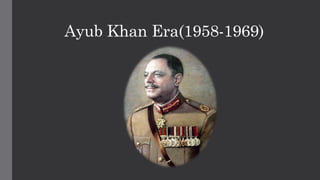
Ayub Khan Era(1958-1969)
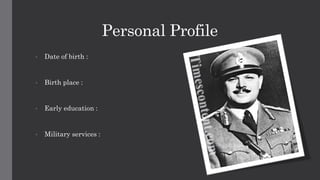
Personal Profile
• Date of birth :
• Birth place :
• Early education :
• Military services :
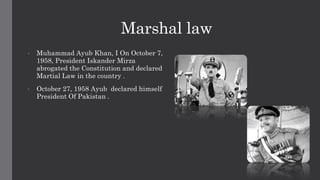
Marshal law
• Muhammad Ayub Khan, I On October 7,
1958, President Iskander Mirza
abrogated the Constitution and declared
Martial Law in the country .
• October 27, 1958 Ayub declared himself
President Of Pakistan .
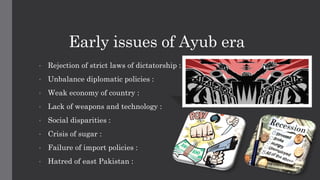
Early issues of Ayub era
• Rejection of strict laws of dictatorship :
• Unbalance diplomatic policies :
• Weak economy of country :
• Lack of weapons and technology :
• Social disparities :
• Crisis of sugar :
• Failure of import policies :
• Hatred of east Pakistan :
Policies adopted by Ayub Khan
• Introduction of monetary policy (1958-1959) :
• Introduction of Bonus voucher scheme :
• Liberal concessions from Government :
Policies adopted by Ayub Khan
Five year plan for the economy of
Pakistan(1960-1965) :
This plans gave highest priority to,
agriculture, heavy industrial development and
science . This Plane gave Pakistan an increase
income of 20% and the growth Rate of
agriculture increased from 1.43 to 5.1%.Other
Reasons for the Country economy increment
was Korean War proved to be a Highly factor .
Other Issues
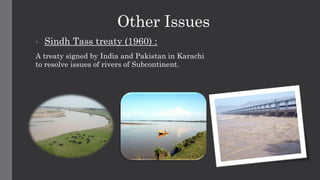
• Sindh Tass treaty (1960) :
A treaty signed by India and Pakistan in Karachi
to resolve issues of rivers of Subcontinent.
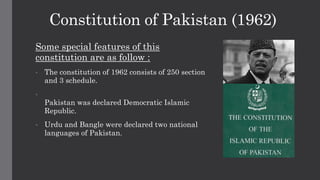
Constitution of Pakistan (1962)
Some special features of this
constitution are as follow :
• The constitution of 1962 consists of 250 section
and 3 schedule.
•
Pakistan was declared Democratic Islamic
Republic.
• Urdu and Bangle were declared two national
languages of Pakistan.
Achievements
• Green revolution :
A Green revolution was Set in force during
five year plan by increasing in irrigation
and introducing mechanized farming and
Fertilizers . As a result, between 1960-1965,
agriculture production grew by 3.8% per
annum. Between 1960 and 1964-65,
irrigation was the main cause of
development.
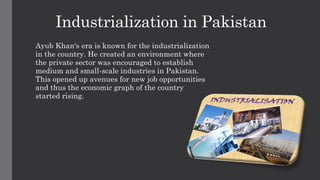
Industrialization in Pakistan
Ayub Khan's era is known for the industrialization
in the country. He created an environment where
the private sector was encouraged to establish
medium and small-scale industries in Pakistan.
This opened up avenues for new job opportunities
and thus the economic graph of the country
started rising.
Other achievements
• Administrative reforms were introduced
during his regime.
• He improved law and order in Pakistan.
• He made Islamabad a new Capital of
Pakistan .
• Making of price control list.
• He took steps to eradicate smuggling.
• He asked to return black money.
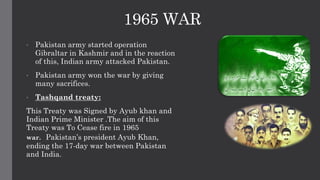
1965 WAR
• Pakistan army started operation
Gibraltar in Kashmir and in the reaction
of this, Indian army attacked Pakistan.
• Pakistan army won the war by giving
many sacrifices.
• Tashqand treaty:
This Treaty was Signed by Ayub khan and
Indian Prime Minister .The aim of this
Treaty was To Cease fire in 1965
war. Pakistan’s president Ayub Khan,
ending the 17-day war between Pakistan
and India.
Failures of Ayub
Mujeebs rebellious behavior :
General Ayub Khan was powerful military man but
he did many mistakes on this whole issue. During
the War of 1965 East Pakistanis raised the voice
that West Pakistan left them alone to kill from the
cruel Indian army. This destroyed their confidence
over our army and government. Then during that
period Sheikh Mujeeb met numerous times with
Indian high authority and Intelligence members of
India in London but in the result he took no any
action against him .
Other failures
• The Indian aggression in 1965 had implications for the economy,
including monetary policy Because of this 1966-67 the growth rate
of economy slowed down to 3.1% the lowest in ten-year period
ending 1969-70.
• Due to the increase in prices of fertilizers, edible oil, there was a
sharp increase in the import payments.
• By introducing the system of Basic Democracy (BD), the right of
adult franchise was curtailed.
• The whole of West Pakistan was made in one unit, with which the
small provinces were not happy
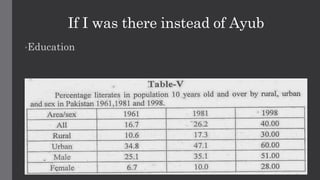
If I was there instead of Ayub
•Education
•
• Justice Between Two Wings Of Pakistan :
• Never sign the Tashkent treaty:
•Increase in Import
If I was there instead of Ayub
Conclusion
•He was the Man Of determination and have done Some successful
Decision as Well as Failure .
•. He always did what he thought better in the light of his own
experience.
•His regime can be characterized with some developments but he
couldn’t maintain the national harmony among the distant provinces
of Pakistan, i.e. East Pakistan and West Pakistan .
Ayub khan era  (1958 - 1969)

Ayub khan era (1958 - 1969)

  • 1.
    Ayub Era(1958-1969) Group members: • Naufal Ali Shah • Hafiz Hamza Ibsalim
  • 2.
  • 3.
    Personal Profile • Dateof birth : • Birth place : • Early education : • Military services :
  • 4.
    Marshal law • MuhammadAyub Khan, I On October 7, 1958, President Iskander Mirza abrogated the Constitution and declared Martial Law in the country . • October 27, 1958 Ayub declared himself President Of Pakistan .
  • 5.
    Early issues ofAyub era • Rejection of strict laws of dictatorship : • Unbalance diplomatic policies : • Weak economy of country : • Lack of weapons and technology : • Social disparities : • Crisis of sugar : • Failure of import policies : • Hatred of east Pakistan :
  • 6.
    Policies adopted byAyub Khan • Introduction of monetary policy (1958-1959) : • Introduction of Bonus voucher scheme : • Liberal concessions from Government :
  • 7.
    Policies adopted byAyub Khan Five year plan for the economy of Pakistan(1960-1965) : This plans gave highest priority to, agriculture, heavy industrial development and science . This Plane gave Pakistan an increase income of 20% and the growth Rate of agriculture increased from 1.43 to 5.1%.Other Reasons for the Country economy increment was Korean War proved to be a Highly factor .
  • 8.
    Other Issues • SindhTass treaty (1960) : A treaty signed by India and Pakistan in Karachi to resolve issues of rivers of Subcontinent.
  • 9.
    Constitution of Pakistan(1962) Some special features of this constitution are as follow : • The constitution of 1962 consists of 250 section and 3 schedule. • Pakistan was declared Democratic Islamic Republic. • Urdu and Bangle were declared two national languages of Pakistan.
  • 10.
    Achievements • Green revolution: A Green revolution was Set in force during five year plan by increasing in irrigation and introducing mechanized farming and Fertilizers . As a result, between 1960-1965, agriculture production grew by 3.8% per annum. Between 1960 and 1964-65, irrigation was the main cause of development.
  • 11.
    Industrialization in Pakistan AyubKhan's era is known for the industrialization in the country. He created an environment where the private sector was encouraged to establish medium and small-scale industries in Pakistan. This opened up avenues for new job opportunities and thus the economic graph of the country started rising.
  • 12.
    Other achievements • Administrativereforms were introduced during his regime. • He improved law and order in Pakistan. • He made Islamabad a new Capital of Pakistan . • Making of price control list. • He took steps to eradicate smuggling. • He asked to return black money.
  • 13.
    1965 WAR • Pakistanarmy started operation Gibraltar in Kashmir and in the reaction of this, Indian army attacked Pakistan. • Pakistan army won the war by giving many sacrifices. • Tashqand treaty: This Treaty was Signed by Ayub khan and Indian Prime Minister .The aim of this Treaty was To Cease fire in 1965 war. Pakistan’s president Ayub Khan, ending the 17-day war between Pakistan and India.
  • 14.
    Failures of Ayub Mujeebsrebellious behavior : General Ayub Khan was powerful military man but he did many mistakes on this whole issue. During the War of 1965 East Pakistanis raised the voice that West Pakistan left them alone to kill from the cruel Indian army. This destroyed their confidence over our army and government. Then during that period Sheikh Mujeeb met numerous times with Indian high authority and Intelligence members of India in London but in the result he took no any action against him .
  • 15.
    Other failures • TheIndian aggression in 1965 had implications for the economy, including monetary policy Because of this 1966-67 the growth rate of economy slowed down to 3.1% the lowest in ten-year period ending 1969-70. • Due to the increase in prices of fertilizers, edible oil, there was a sharp increase in the import payments. • By introducing the system of Basic Democracy (BD), the right of adult franchise was curtailed. • The whole of West Pakistan was made in one unit, with which the small provinces were not happy
  • 16.
    If I wasthere instead of Ayub •Education •
  • 17.
    • Justice BetweenTwo Wings Of Pakistan : • Never sign the Tashkent treaty: •Increase in Import If I was there instead of Ayub
  • 18.
    Conclusion •He was theMan Of determination and have done Some successful Decision as Well as Failure . •. He always did what he thought better in the light of his own experience. •His regime can be characterized with some developments but he couldn’t maintain the national harmony among the distant provinces of Pakistan, i.e. East Pakistan and West Pakistan .