First Military takeover: Era of
General Ayub Khan (27October
1958 to 25March 1969)
INSTRUCTER NAME: MARYAM ARIF
COURSE TITLE: PKAISTAN
STUDIES
Week
7th
UNIVERSITY OF GUJRAT
COURSE CODE: PKS-101
Personal Introduction: Ayub
khan
 Born on May 14, 1907 in ReHana village, near Haripur,
Hazara,
Pakistan.
 Studied at Aligarh Muslim University.
 Joined the army of the British Colonial powers in 1926.
 Fought in World War II as Commissioned Officer.
 Attained the rank of Brigadier General in 1947
 In 1950, became the first Pakistani to lead the army as its
Commander-In-Chief.
 Army took control of the country in 1958 & appointed
General Ayub Khan as Chief Martial Law Administrator.
 Soon after, Ayub Khan declared himself as President.
Ayub Khan’s Regime
Economic condition
Country was in total chaos
 Growth rate of 11 years (1959-70) was as high as
6.25%.
• Created an environment where the private sector was
encouraged to establish medium and small-scale
industries in Pakistan.
• Opened up avenues for new job opportunities, the
economic graph of the country started rising.
He was the first Pakistani ruler who attempted to bring
in land reforms but the idea was not implemented
properly.
 Labor, law and administrative reforms were also
introduced during his regime
 The commitment to rapid industrialization.
 The benefits of economic growth would drop
 Down to the poorer segments of the society.
Goals:
 Economic growth and price stability
 Develop industrial and agricultural capacity
Land Reforms
 First land reforms in Pakistan were introduced under the
Provincial Tenancy Act 1950 but faced resistance from the elite
landlords of Punjab and Sindh
 Second reforms
The second land reform in 1959 under the Marshal Law of
General Ayub Khan was implemented with relative success
because the dictatorship was not that dependent on local support
of the entrenched powers of the landlords.
 GREEN REVOLUTION
 LAND REFORMS
 Land Reform Commission: Appointed in October 1958
 A person could not own more than 500 acres of
 canal irrigated land or 1000 acres of unirrigated land.
 ABOLITION OF JAGIRS
 PROTECTION TO TENANTS
 RIGHTS FOR TENANTS
 THREE MAJOR DAMS WERE BUILT.
 AGRICULTURE DEVELOPMENT BANK WAS SETUP
 LOANS FOR FARMER
GREEN REVOLUTION:
 The phenomenal increase in growth took place in two
phases.
 1. 1960-1965
 Main cause of the growth was the increase in irrigation
facilities, mainly tube wells.
 Between 1960-65, about 25,000 tube wells were installed,
each costing R.s. 5000-
 12000 and the farm area serviced by tube wells doubled.
 2. 1966-1970
 ▶ Growth took place mainly because the expanded irrigation
facilities were
 supplemented by the technology package of
 ▶ High yielding varieties (HYV) seeds,
 ▶ Chemical fertilizers and
 ▶ Pesticides.
Industrial Reforms
 In February 1959, the Government announced a new industrial
policy of “Gradual liberalization of economy” to pave way for
smooth industrial growth.
 Main emphasis on the utilization of raw materials available in the
country .
 The extreme bureaucratic restraints were removed by a more
market-oriented approach
Educational Reforms
 According to the recommendations of the commission the whole
curriculum was revised from class 1 to 12
 .A number of educational experts and writers were entrusted
with to write new books for the national curriculum.
 The regime emphasised on the technical education.
 Engineering universities were established in Lahore and Dacca.
 Arrangements were also made alienate the higher education from
the secondary education.
 they were proved fruitful in the up gradation of education sector
after the independence.
Legal and constitutional reforms:
 A judicial commission under justice shabuddiin was created for
making a constitution.
 In June 1962 2nd constitution of Pakistan was promulgated which
lifted martial law
 Basic democratic system introduced
 Muslim family law (2nd march 1961) introduced
1) polygamy was abolished
2) consent of the current wife was made mandatory for a second
marriage
3) breaks were also placed on the practice of instant divorce
4) Registration of Nikah and Divorce
Constitution of 1962
i) Federal system (250 articles, 12 parts, and 3 schedules)
ii) Presidential form of Government
iii) Uni- cameral legislature
iv) Indirect elections
v) Fundamental Rights
vi) Islamic Provisions
o Objective Resolution made preamble of the constitution.
o Compulsory education of Quran & Islamic Studies.
o Promoting National Unity and acting upon Islam.
o The management of Zakat, Mosques & Auqaf .
o Cordial relations with Muslim Countries.
o No law conflicting with Islam.
o Establishment of the Islamic Advisory Council
Tashkent pact 4th june 1966
 The President of Pakistan and the Prime Minister of India agreed
to cultivate good friendly and neighborly relations according to
the Charter of the United Nation.
 Under the UN Charter, they will use their energies to resolve
their problems in a peaceful way.
 The President of Pakistan and the Prime Minister of India agreed
to withdraw from the war.
 They agreed not to interfere in each other’s internal affairs.
 Both leaders agreed to discourage all those actions which could
be harmful for the other country and encourage those which
could promote the friendly relationship between the two
countries.
 They agree that Higher Commissioners of Pakistan and India
should come back to their posts and make efforts for future
developments of both Countries
 They agree to make efforts for increasing bilateral trade and
 strengthening economic ties between the two countries. They
also agreed to enhance communication and cultural information
with each other.
 Both leaders agreed to make some law of repatriation for the
prisoners of war.
 They agreed that in future they will discuss the problems of
refugees also. They also agreed for an agreement to return the
property taken by the either side because of the conflict.
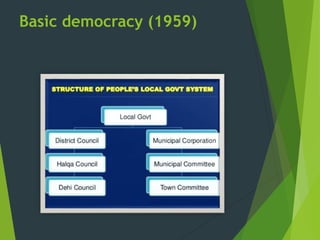
Basic democracy (1959)
Salient features
 Indirect democracy
 Broad mass of people would elect an electoral college
 80,000 Basic Democrats or Union Councillors
 Non-party basis elections
 These local leaders would elect the legislature and the President
 Constitution of 1962 linked the office of the President to the
local bodies.
 system of guided democracy comprised elected and non-elected
representatives with a local administration acting as the eyes, ear
and stick for the central government enabling it to maintain
sufficient authority over the politicians
 Under the system each province would have to elect 40,000 Basic
Democrats each representing at that time, about one thousand
populations, out the total of 80,000 was eventually raised to
120,000.
 These councils were to have developments responsibilities so
that the overall political plans would be built upon the views and
needs of the local areas . Law and order duties eventually
encompassed some powers under the Family Law Ordinance and
some ability to tax. Despite the splendid administration about
decentralization of power, the bureaucratic control over Basic
Democracies System remained firmly in place.
 Because the civil servants were responsible for selecting
candidates there by extending detailed administrative control
over political issues
 Initially Deputy Commissioners were appointed Chairman of
higher tier of local bodies. Their continued dominance of the
Tehsil/Thana; the District and the Division left their influence
unimpaired
Other important events
 Promulgation of EBDO (Elective bodies
disqualification order)and PODO(public office
disqualification order)
 War of 1965 between India and Pakistan
 Presidential Election 2nd June 1965 (Fatima
Jinnah contested)
 Indus water treaty signed between India and
Pakistan (19 September 1960) with the consent
of the World bank
Foreign policy
 lied to Pakistan with a global U.S. alliance against the
Soviet Union.
 Relation with U.S.A, Great Britain, China & Soviet
Union.
Impact of Ayub Khan’s Foreign
Policy
 He cultivated China and angered the U.S.A.
 The war increased the socio-economic problem.
Therefore, Ayub Khan was not very successful in his
foreign policy.
Final year:
 opened up negotiations
 increasing pressure from Bhutto and Bhashani
 handed over control of Pakistan by Yahya khan
Criticism
 Government corruption and nepotism
 Criticisms of his sons and family's personal wealth
 Presidential elections against Fatima Jinnah
 Gohar Ayub's corruption
 Increasing price of sugar
 Tashkent Pact
 Neglecting effective educational policy
Sources
 Friends not masters by Ayub khan
 Constitutional and political history of Pakistan by
Hamid Khan
 A short history of Pakistan by Ishtiaq Hussain

ppt for pakstudies

  • 1.
    First Military takeover:Era of General Ayub Khan (27October 1958 to 25March 1969) INSTRUCTER NAME: MARYAM ARIF COURSE TITLE: PKAISTAN STUDIES Week 7th UNIVERSITY OF GUJRAT COURSE CODE: PKS-101
  • 2.
    Personal Introduction: Ayub khan Born on May 14, 1907 in ReHana village, near Haripur, Hazara, Pakistan.  Studied at Aligarh Muslim University.  Joined the army of the British Colonial powers in 1926.  Fought in World War II as Commissioned Officer.  Attained the rank of Brigadier General in 1947  In 1950, became the first Pakistani to lead the army as its Commander-In-Chief.  Army took control of the country in 1958 & appointed General Ayub Khan as Chief Martial Law Administrator.  Soon after, Ayub Khan declared himself as President.
  • 3.
    Ayub Khan’s Regime Economiccondition Country was in total chaos  Growth rate of 11 years (1959-70) was as high as 6.25%. • Created an environment where the private sector was encouraged to establish medium and small-scale industries in Pakistan. • Opened up avenues for new job opportunities, the economic graph of the country started rising.
  • 4.
    He was thefirst Pakistani ruler who attempted to bring in land reforms but the idea was not implemented properly.  Labor, law and administrative reforms were also introduced during his regime  The commitment to rapid industrialization.  The benefits of economic growth would drop  Down to the poorer segments of the society. Goals:  Economic growth and price stability  Develop industrial and agricultural capacity
  • 5.
    Land Reforms  Firstland reforms in Pakistan were introduced under the Provincial Tenancy Act 1950 but faced resistance from the elite landlords of Punjab and Sindh  Second reforms The second land reform in 1959 under the Marshal Law of General Ayub Khan was implemented with relative success because the dictatorship was not that dependent on local support of the entrenched powers of the landlords.  GREEN REVOLUTION  LAND REFORMS  Land Reform Commission: Appointed in October 1958  A person could not own more than 500 acres of  canal irrigated land or 1000 acres of unirrigated land.
  • 6.
     ABOLITION OFJAGIRS  PROTECTION TO TENANTS  RIGHTS FOR TENANTS  THREE MAJOR DAMS WERE BUILT.  AGRICULTURE DEVELOPMENT BANK WAS SETUP  LOANS FOR FARMER GREEN REVOLUTION:  The phenomenal increase in growth took place in two phases.  1. 1960-1965  Main cause of the growth was the increase in irrigation facilities, mainly tube wells.  Between 1960-65, about 25,000 tube wells were installed, each costing R.s. 5000-  12000 and the farm area serviced by tube wells doubled.
  • 7.
     2. 1966-1970 ▶ Growth took place mainly because the expanded irrigation facilities were  supplemented by the technology package of  ▶ High yielding varieties (HYV) seeds,  ▶ Chemical fertilizers and  ▶ Pesticides.
  • 8.
    Industrial Reforms  InFebruary 1959, the Government announced a new industrial policy of “Gradual liberalization of economy” to pave way for smooth industrial growth.  Main emphasis on the utilization of raw materials available in the country .  The extreme bureaucratic restraints were removed by a more market-oriented approach
  • 9.
    Educational Reforms  Accordingto the recommendations of the commission the whole curriculum was revised from class 1 to 12  .A number of educational experts and writers were entrusted with to write new books for the national curriculum.  The regime emphasised on the technical education.  Engineering universities were established in Lahore and Dacca.  Arrangements were also made alienate the higher education from the secondary education.  they were proved fruitful in the up gradation of education sector after the independence.
  • 10.
    Legal and constitutionalreforms:  A judicial commission under justice shabuddiin was created for making a constitution.  In June 1962 2nd constitution of Pakistan was promulgated which lifted martial law  Basic democratic system introduced  Muslim family law (2nd march 1961) introduced 1) polygamy was abolished 2) consent of the current wife was made mandatory for a second marriage 3) breaks were also placed on the practice of instant divorce 4) Registration of Nikah and Divorce
  • 11.
    Constitution of 1962 i)Federal system (250 articles, 12 parts, and 3 schedules) ii) Presidential form of Government iii) Uni- cameral legislature iv) Indirect elections v) Fundamental Rights vi) Islamic Provisions o Objective Resolution made preamble of the constitution. o Compulsory education of Quran & Islamic Studies. o Promoting National Unity and acting upon Islam. o The management of Zakat, Mosques & Auqaf . o Cordial relations with Muslim Countries. o No law conflicting with Islam. o Establishment of the Islamic Advisory Council
  • 12.
    Tashkent pact 4thjune 1966  The President of Pakistan and the Prime Minister of India agreed to cultivate good friendly and neighborly relations according to the Charter of the United Nation.  Under the UN Charter, they will use their energies to resolve their problems in a peaceful way.  The President of Pakistan and the Prime Minister of India agreed to withdraw from the war.  They agreed not to interfere in each other’s internal affairs.  Both leaders agreed to discourage all those actions which could be harmful for the other country and encourage those which could promote the friendly relationship between the two countries.
  • 13.
     They agreethat Higher Commissioners of Pakistan and India should come back to their posts and make efforts for future developments of both Countries  They agree to make efforts for increasing bilateral trade and  strengthening economic ties between the two countries. They also agreed to enhance communication and cultural information with each other.  Both leaders agreed to make some law of repatriation for the prisoners of war.  They agreed that in future they will discuss the problems of refugees also. They also agreed for an agreement to return the property taken by the either side because of the conflict.
  • 14.
  • 15.
    Salient features  Indirectdemocracy  Broad mass of people would elect an electoral college  80,000 Basic Democrats or Union Councillors  Non-party basis elections  These local leaders would elect the legislature and the President
  • 16.
     Constitution of1962 linked the office of the President to the local bodies.  system of guided democracy comprised elected and non-elected representatives with a local administration acting as the eyes, ear and stick for the central government enabling it to maintain sufficient authority over the politicians  Under the system each province would have to elect 40,000 Basic Democrats each representing at that time, about one thousand populations, out the total of 80,000 was eventually raised to 120,000.  These councils were to have developments responsibilities so that the overall political plans would be built upon the views and needs of the local areas . Law and order duties eventually encompassed some powers under the Family Law Ordinance and some ability to tax. Despite the splendid administration about decentralization of power, the bureaucratic control over Basic Democracies System remained firmly in place.
  • 17.
     Because thecivil servants were responsible for selecting candidates there by extending detailed administrative control over political issues  Initially Deputy Commissioners were appointed Chairman of higher tier of local bodies. Their continued dominance of the Tehsil/Thana; the District and the Division left their influence unimpaired
  • 18.
    Other important events Promulgation of EBDO (Elective bodies disqualification order)and PODO(public office disqualification order)  War of 1965 between India and Pakistan  Presidential Election 2nd June 1965 (Fatima Jinnah contested)  Indus water treaty signed between India and Pakistan (19 September 1960) with the consent of the World bank
  • 19.
    Foreign policy  liedto Pakistan with a global U.S. alliance against the Soviet Union.  Relation with U.S.A, Great Britain, China & Soviet Union. Impact of Ayub Khan’s Foreign Policy  He cultivated China and angered the U.S.A.  The war increased the socio-economic problem. Therefore, Ayub Khan was not very successful in his foreign policy.
  • 20.
    Final year:  openedup negotiations  increasing pressure from Bhutto and Bhashani  handed over control of Pakistan by Yahya khan
  • 21.
    Criticism  Government corruptionand nepotism  Criticisms of his sons and family's personal wealth  Presidential elections against Fatima Jinnah  Gohar Ayub's corruption  Increasing price of sugar  Tashkent Pact  Neglecting effective educational policy
  • 22.
    Sources  Friends notmasters by Ayub khan  Constitutional and political history of Pakistan by Hamid Khan  A short history of Pakistan by Ishtiaq Hussain