Ayub Khan era
1958-1969
contents
• Important events of his era/decade of
devolpment
• Socio &Economic reforms
• 1965 war
• Tashkent declaration and fall of Ayub khan
• Conclusion
Important events
Controlled corruption period
• Ayub tried to wipeout corruption and get rid of
several social problems the country was facing
• Army cracked down on corrupt civil servants, black
marketers and smugglers. Traffic and civil rules were
strictly imposed and the common man was pleased.
Prsidential elections
Constitution
• in 1962 he lifted martial law and promulgated a
new constitution which was presidential;
• Presidential elections were held in 1965. The
Combined Opposition Party nominated Fatima
Jinnah as their candidate in the election but Ayub
Khan managed to sweep the polls. His critics
consider rigging as the chief cause of his victory
as they believe that Fatima Jinnah secured fewer
votes than her popularity, which was quite visible
during her public meetings before the election
Basic democracy
• Introduced the system of indirect elections
(basic democracy). The Electoral college would be
directly elected and the basic democrats would
than elected president, NA, PA.the BDs would
also run local govt and union councils. In theory
this was meant to provide services to the people
but actually there was coercion aand corruption
• Punishments under martial law were harsh
Reforms undertaken by ayub
Economic condition of pakistan
• Country was in total disarray
• Had no econmic weapon in their army to
fight the battle of its recovery
Industrial development
• created an environment where the private
sector was encouraged to establish medium
and small-scale industries in Pakistan
• opened up avenues for new job opportunities
and thus the economic graph of the country
started rising.
• Labour laws was introduced and labour law
was weighted heavily in favour of capitalism
• Wanted to spread wealth regionally rather
than socially. It eventually was unbalanced
regionally, espacially in east pakistan
• heavy industry did’t develop because capital
goods were being freely imported and the
customer goods industry was given incentives
• Bonus vouchers which could be purchsed on
the open market were meant to subsidize
imports
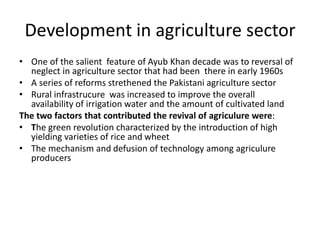
Development in agriculture sector
• One of the salient feature of Ayub Khan decade was to reversal of
neglect in agriculture sector that had been there in early 1960s
• A series of reforms strethened the Pakistani agriculture sector
• Rural infrastrucure was increased to improve the overall
availability of irrigation water and the amount of cultivated land
The two factors that contributed the revival of agriculure were:
• The green revolution characterized by the introduction of high
yielding varieties of rice and wheet
• The mechanism and defusion of technology among agriculure
producers
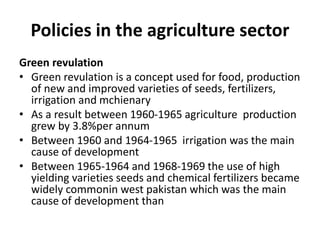
Policies in the agriculture sector
Green revulation
• Green revulation is a concept used for food, production
of new and improved varieties of seeds, fertilizers,
irrigation and mchienary
• As a result between 1960-1965 agriculture production
grew by 3.8%per annum
• Between 1960 and 1964-1965 irrigation was the main
cause of development
• Between 1965-1964 and 1968-1969 the use of high
yielding varieties seeds and chemical fertilizers became
widely commonin west pakistan which was the main
cause of development than
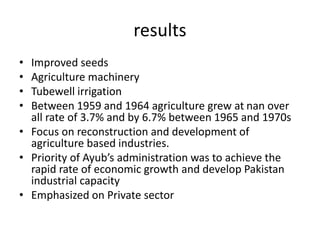
results
• Improved seeds
• Agriculture machinery
• Tubewell irrigation
• Between 1959 and 1964 agriculture grew at nan over
all rate of 3.7% and by 6.7% between 1965 and 1970s
• Focus on reconstruction and development of
agriculture based industries.
• Priority of Ayub’s administration was to achieve the
rapid rate of economic growth and develop Pakistan
industrial capacity
• Emphasized on Private sector
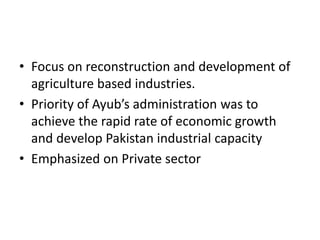
• Focus on reconstruction and development of
agriculture based industries.
• Priority of Ayub’s administration was to
achieve the rapid rate of economic growth
and develop Pakistan industrial capacity
• Emphasized on Private sector
1965 war
Background
India abrogated article 370 in his constitution
which had given kashmir an autonomous state
with a separate prime minister and In 1964
declare that kashmir was an integral part of
india
1965 war
Situation for pakistan
• situation was desperate for pakistan as it
might have had to surrender its claim to Azad
Kashmir and might be crushed by India in
conjunction with Afghanistan
• only choice was to prevent India from treating
Kashmir as a settled issue and to allow self-
determination to the kashmiris.
• Pakistan sent infiltrators to kashmir on assurance
given to Ayub Khanby Z.A. Bhutto thatindia would
not cross the international border.
• 6 sep 1965 india crossed the international border
and tried to capture lahore and Sialkot
• Lahore was saved due to BRB canal and pakistan
won at chawinda. Pakistan Navy took the Indian
port of dawarka.
• India captured kargill on 15 august 1965 and
returned after Tashkent declaration and remained
on Pakistan side till 1971.
results
• Both sides claimed victory but intially and
subsquently both admitted defeat
• India did’t capture on lahore and pakistan and
Pakistan was failed in Kashmir
• There was a ceasefire after 17 days of fighting
Third world relations
• All third world countries support pakistan except
malashiya
• China support pakistan
• During sino indian war USSR provide military and
weapon to India and Pakistan was surprized
• 1963 ayub khan signed sino boundary agreement
with China and develop their relations
• Chines wanted pakistan to remain steadfast and if
so , it would help pakistan and Ayub Khan threw
away this opportunity
USSR role and Tashkent declaration
• Tashkent is the capital of Uzbikstan and alexi N kosygin held this talk
• These talks lasted from 10 jan 1966 between Ayub Khan and Lal
Bhadur Shastri.
• India n wanted a no war Pact from Pakistan in order to put the
Kashmir dispute into permanat cold storage.
British stated thatproblem could be reached in four stages.
• Both sides stop fighting
• Both sides agree to return of status qua
• Meaures be taken to neutralize
• Future settlement of the whole problem of Kashmir
• The first two stages would be inacceptable to pakistan unless
followed by last two.
• This was the objective of Tashkent
provisions
• Tashkent declarnedation finally signed 10jan 1966
• Discontinuous of hostile propaganda
• Restoration of full diplomatic representation
• The reaffirmation by both sides of their obligation
under United Nations Charter
• The withdrawl all armed personnel
• Machinary to continue joint India/pakistan
discussions on their issues of direct concern
reaction
• Tashkent declaration was in favour of india
• Violent created due to Tashkent in Pakistan
because people of Pakistan want to solve the
Kahsmir Issue
• Due to this Pakistani masses was against ayub
Khan
• Another reason of his against is media highlight
the issue that Ayub Khan want to become
president of his son Gahar Ayyub
• Later movement resulted in Ayub resignation on
24 march 1969.

Ayub_era (1).ppt

  • 1.
  • 2.
    contents • Important eventsof his era/decade of devolpment • Socio &Economic reforms • 1965 war • Tashkent declaration and fall of Ayub khan • Conclusion
  • 3.
    Important events Controlled corruptionperiod • Ayub tried to wipeout corruption and get rid of several social problems the country was facing • Army cracked down on corrupt civil servants, black marketers and smugglers. Traffic and civil rules were strictly imposed and the common man was pleased.
  • 4.
    Prsidential elections Constitution • in1962 he lifted martial law and promulgated a new constitution which was presidential; • Presidential elections were held in 1965. The Combined Opposition Party nominated Fatima Jinnah as their candidate in the election but Ayub Khan managed to sweep the polls. His critics consider rigging as the chief cause of his victory as they believe that Fatima Jinnah secured fewer votes than her popularity, which was quite visible during her public meetings before the election
  • 5.
    Basic democracy • Introducedthe system of indirect elections (basic democracy). The Electoral college would be directly elected and the basic democrats would than elected president, NA, PA.the BDs would also run local govt and union councils. In theory this was meant to provide services to the people but actually there was coercion aand corruption • Punishments under martial law were harsh
  • 6.
    Reforms undertaken byayub Economic condition of pakistan • Country was in total disarray • Had no econmic weapon in their army to fight the battle of its recovery
  • 7.
    Industrial development • createdan environment where the private sector was encouraged to establish medium and small-scale industries in Pakistan • opened up avenues for new job opportunities and thus the economic graph of the country started rising. • Labour laws was introduced and labour law was weighted heavily in favour of capitalism
  • 8.
    • Wanted tospread wealth regionally rather than socially. It eventually was unbalanced regionally, espacially in east pakistan • heavy industry did’t develop because capital goods were being freely imported and the customer goods industry was given incentives • Bonus vouchers which could be purchsed on the open market were meant to subsidize imports
  • 9.
    Development in agriculturesector • One of the salient feature of Ayub Khan decade was to reversal of neglect in agriculture sector that had been there in early 1960s • A series of reforms strethened the Pakistani agriculture sector • Rural infrastrucure was increased to improve the overall availability of irrigation water and the amount of cultivated land The two factors that contributed the revival of agriculure were: • The green revolution characterized by the introduction of high yielding varieties of rice and wheet • The mechanism and defusion of technology among agriculure producers
  • 10.
    Policies in theagriculture sector Green revulation • Green revulation is a concept used for food, production of new and improved varieties of seeds, fertilizers, irrigation and mchienary • As a result between 1960-1965 agriculture production grew by 3.8%per annum • Between 1960 and 1964-1965 irrigation was the main cause of development • Between 1965-1964 and 1968-1969 the use of high yielding varieties seeds and chemical fertilizers became widely commonin west pakistan which was the main cause of development than
  • 11.
    results • Improved seeds •Agriculture machinery • Tubewell irrigation • Between 1959 and 1964 agriculture grew at nan over all rate of 3.7% and by 6.7% between 1965 and 1970s • Focus on reconstruction and development of agriculture based industries. • Priority of Ayub’s administration was to achieve the rapid rate of economic growth and develop Pakistan industrial capacity • Emphasized on Private sector
  • 12.
    • Focus onreconstruction and development of agriculture based industries. • Priority of Ayub’s administration was to achieve the rapid rate of economic growth and develop Pakistan industrial capacity • Emphasized on Private sector
  • 13.
    1965 war Background India abrogatedarticle 370 in his constitution which had given kashmir an autonomous state with a separate prime minister and In 1964 declare that kashmir was an integral part of india
  • 14.
    1965 war Situation forpakistan • situation was desperate for pakistan as it might have had to surrender its claim to Azad Kashmir and might be crushed by India in conjunction with Afghanistan • only choice was to prevent India from treating Kashmir as a settled issue and to allow self- determination to the kashmiris.
  • 15.
    • Pakistan sentinfiltrators to kashmir on assurance given to Ayub Khanby Z.A. Bhutto thatindia would not cross the international border. • 6 sep 1965 india crossed the international border and tried to capture lahore and Sialkot • Lahore was saved due to BRB canal and pakistan won at chawinda. Pakistan Navy took the Indian port of dawarka. • India captured kargill on 15 august 1965 and returned after Tashkent declaration and remained on Pakistan side till 1971.
  • 16.
    results • Both sidesclaimed victory but intially and subsquently both admitted defeat • India did’t capture on lahore and pakistan and Pakistan was failed in Kashmir • There was a ceasefire after 17 days of fighting
  • 17.
    Third world relations •All third world countries support pakistan except malashiya • China support pakistan • During sino indian war USSR provide military and weapon to India and Pakistan was surprized • 1963 ayub khan signed sino boundary agreement with China and develop their relations • Chines wanted pakistan to remain steadfast and if so , it would help pakistan and Ayub Khan threw away this opportunity
  • 18.
    USSR role andTashkent declaration • Tashkent is the capital of Uzbikstan and alexi N kosygin held this talk • These talks lasted from 10 jan 1966 between Ayub Khan and Lal Bhadur Shastri. • India n wanted a no war Pact from Pakistan in order to put the Kashmir dispute into permanat cold storage. British stated thatproblem could be reached in four stages. • Both sides stop fighting • Both sides agree to return of status qua • Meaures be taken to neutralize • Future settlement of the whole problem of Kashmir • The first two stages would be inacceptable to pakistan unless followed by last two. • This was the objective of Tashkent
  • 19.
    provisions • Tashkent declarnedationfinally signed 10jan 1966 • Discontinuous of hostile propaganda • Restoration of full diplomatic representation • The reaffirmation by both sides of their obligation under United Nations Charter • The withdrawl all armed personnel • Machinary to continue joint India/pakistan discussions on their issues of direct concern
  • 20.
    reaction • Tashkent declarationwas in favour of india • Violent created due to Tashkent in Pakistan because people of Pakistan want to solve the Kahsmir Issue • Due to this Pakistani masses was against ayub Khan • Another reason of his against is media highlight the issue that Ayub Khan want to become president of his son Gahar Ayyub • Later movement resulted in Ayub resignation on 24 march 1969.