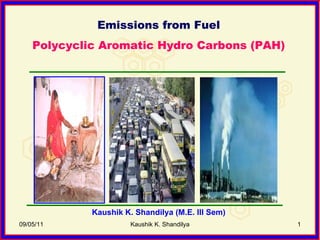
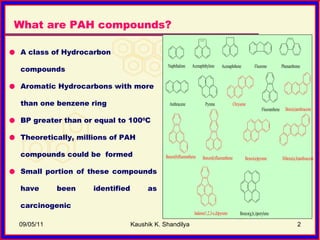
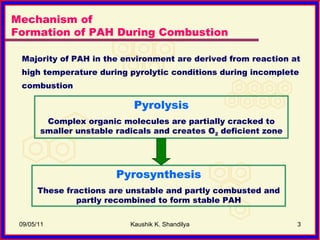
09/05/11 Kaushik K. Shandilya Emissions from Fuel Polycyclic Aromatic Hydro Carbons (PAH) Kaushik K. Shandilya (M.E. III Sem)
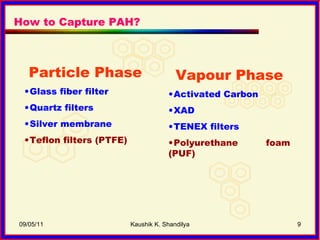
A class of Hydrocarbon compounds  Aromatic Hydrocarbons with more than one benzene ring BP greater than or equal to 100 0 C  Theoretically, millions of PAH compounds could be  formed Small portion of these compounds have been identified as carcinogenic 09/05/11 Kaushik K. Shandilya What are PAH compounds?
09/05/11 Kaushik K. Shandilya Mechanism of  Formation of PAH During Combustion  Majority of PAH in the environment are derived from reaction at high temperature during pyrolytic conditions during incomplete combustion  Pyrolysis Complex organic molecules are partially cracked to smaller unstable radicals and creates O 2  deficient zone Pyrosynthesis These fractions are unstable and partly combusted and partly recombined to form stable PAH
09/05/11 Kaushik K. Shandilya CO- 11.4 %  H2 – 8.2 %  CH4 - 2 %  ORC – 0.5 %  O 2   -  1.0 %  Coal firing System Pyrolysis During combustion, reduced environmental conditions are formed around the flame and unstable organic radicals are formed CO- 18.2 %  H2 – 1.1 %  CH4 – 0.3 %  ORC – 6.0 %  O 2   -  0 %  Automobiles Reduced Conditions Source: Diesel. Net
09/05/11 Kaushik K. Shandilya Pyrosynthesis Source: H. Richter, J.B. Howard, Progress in Energy Combustion Science, Feb 2000 These fractions are unstable and partly combusted and partly recombined to form stable PAH
09/05/11 Kaushik K. Shandilya Source-1: Emission Inventory Program USEPA Source-2: Bruce A. Benner, Environ. Sci. Technol. 1989, 23, 1269-1278 PAH Emissions by Category in USA Sources wise Emissions of PAH
09/05/11 Kaushik K. Shandilya Vapour Pressure of PAHs Volatile Semi - Volatile Source: US Department of Health and Human Services
09/05/11 Kaushik K. Shandilya % of Total PAH Associated with Particle Source: USPEA, Publications EPA-454/R-98-014
09/05/11 Kaushik K. Shandilya How to Capture PAH? Particle Phase Glass fiber filter Quartz filters Silver membrane Teflon filters (PTFE) Vapour Phase Activated Carbon XAD TENEX filters Polyurethane foam (PUF)
09/05/11 Kaushik K. Shandilya High Volume sampler for PAH Size selective inlet   (Separation of PM>10microns) WINS Impactor  (Separation of PM>2.5 and 10 microns) Teflon filter (PTFE) (Collection of PM<2.5 microns) PUF adsorbent (cartridge with ice jacket) (Collection of VOC) Dry gas meter Suction pump
09/05/11 Kaushik K. Shandilya PUF Holder PUF Adsorbent
09/05/11 Kaushik K. Shandilya PUF Holder Glass fiber filter “ PUF” holder
09/05/11 Kaushik K. Shandilya The PUF should be of the polyether type used for furniture upholstery, pillows, and mattresses. The PUF cylinders (plugs) should be slightly larger in  diameter than the internal diameter of the cartridge Polyurethane Foam PUF Adsorbent
09/05/11 Kaushik K. Shandilya “ PUF” vrs “XAD Resin” Technical Assistance Document for Sampling and Analysis of Toxic Organic Compounds in Ambient Air , U. S. Environmental Protection Agency, EPA-600/4-83-027, June 1983. PUF XAD Resin Collection efficiency of  NV-PAH >99 >99 Collection efficiency of  V-PAH 90-100 97-100 Loss of V-PAH at 25  O C in 30 days 10-15 <5 Flow characteristics in HVS Unchanged -ve impact Recovery  More solvent Less solvent Species collected other than PAH Pesticides, PCB, Dioxins Poor collection  PUF is widely used for PAH sampling
09/05/11 Kaushik K. Shandilya Naphthalene, acenaphthylene, and acenaphthene possess relatively high vapor pressures Collection efficiency less than 35% Avoid PUF if… PUF Adsorbent XAD Resin is a suitable option
Type of equipment WINS, DICHT, Cascade Flow rate  0.5- 1 m 3 /min Minimum air collection 300 m 3   Suction pump type Constant vol. Pore size for filter 0.25   m (min) Recommended particle range 0.45 - 10   m Filter type PTFE or GFA  09/05/11 Kaushik K. Shandilya Sampling Requirements for PAH analysis–  (USEPA Recommendation)
PM (Size Selective Inlets) Inlet particle cut point 10  ± 0.5   m During wind tunnel tests  Collection of PM25 shall be less than 5% at 8 and 24KMPH wind speeds variation in sampling flow rate shall be less than 5% Filter media should collect more than 99% of 0.3   m size 09/05/11 Kaushik K. Shandilya Certification of PM samplers–  (USEPA Recommendation)
Selection of filters depends on   Application (only PM, Ions, PAH, VOC, C) Chemical stability Storage and hygroscopic nature  Mechanical stability for the recommended flow rate Blank concentrations Cost and availability  09/05/11 Kaushik K. Shandilya Selection of Filters for PM sampling
09/05/11 Kaushik K. Shandilya Types of Filters for “PM” sampling Cellulose fiber Cellulose fiber (often called – Paper filters) Cellulose Acetate Cellulose nitrate and mixer of esters (cellulose acetate)  Pure Quartz fiber Mat of Quartz fiber Mixed Quartz Quartz + Borosilicate Glass fiber Borosilicate glass fiber Teflon coated glass fiber Borosilicate glass fiber with a mat of Teflon Teflon Carbon based material stretched between methyl pentane/propylene  Nylon Pure nylon
Baseline values of PAH in the filter Baseline values of PAH in the silicon oil used in WINS Impactor Loss of Filter weight during handling Uniformity in weighing conditions (pre-post sampling) Volatility of PAH during sampling, transportation and sample storage (Effect of ambient temperature) Photolysis due to exposure to UV and incandescent light during sampling and analysis  09/05/11 Kaushik K. Shandilya Sampling Errors and Uncertainties
09/05/11 Kaushik K. Shandilya Loss of PAH during measurement Baseline values in the filter and oil Establishing blank tests and extraction with methanol before sampling  Sampling Cold bath for PUF filter, minimum exposure to sunlight, add surrogate standards  Storage of samples  and analysis  Storage in ice bath and  incandescent lighting in the lab
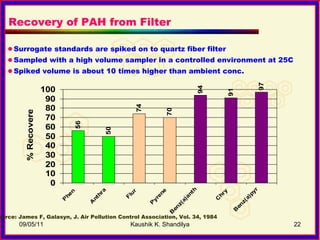
09/05/11 Kaushik K. Shandilya Recovery of PAH from Filter Surrogate standards are spiked on to quartz fiber filter Sampled with a high volume sampler in a controlled environment at 25C Spiked volume is about 10 times higher than ambient conc.  Source: James F, Galasyn, J. Air Pollution Control Association, Vol. 34, 1984
PAH compounds are susceptible to photodecomposition during sampling at site and also at analytical table Major sources are sunlight and fluorescent bulbs 09/05/11 Kaushik K. Shandilya Photodecomposition of PAH
09/05/11 Kaushik K. Shandilya Favourable region of light for decomposition of PAH is UV light ranging from 290 – 400nm Favorable wavelengths for Photodecomposition of PAH Rate and extent widely varied in PAH degradation Not easily correlated with molecular weight of PAH
09/05/11 Kaushik K. Shandilya Higher degradation in case of 6 to 8 ring compounds More degradation with less ‘EC’ is present Function of particle surface area Photodecomposition of PAH Source:  Ingwen Chinm J. Environmental Pollution, 114, 2001
09/05/11 Kaushik K. Shandilya Reaction of PAH with Atmospheric pollutants General ambient concentrations of these pollutants are far less Pollutant Study Findings Ref SO 2   (Exposed to 10000 ug/m3 for 10 days) No change in the concentration for 16 PAH Butler, J.D, Atmos. Env. 15, 1981 Ozone (Exposed to 2 PPM for 10 days) Considerable degradation with half life ranging 0.1-0.6 h -1 Kataz, Envi. Sci. Technol. 9, 1977 NO 2 Exposed to 3000 ug/m3 for 24 hours) About 1% reduction and no change in lower ring compounds Pitts et. al.  Science, 202, 1978
09/05/11 Kaushik K. Shandilya Storage of samples and preservation Filter cassettes  Filter holder and ice box
09/05/11 Kaushik K. Shandilya Analysis of samples by  High Performance Liquid Chromatography
09/05/11 Kaushik K. Shandilya Environment… -Not our bequeathal property -But borrowed from children
09/05/11 Kaushik K. Shandilya Thanks

Pah

  • 1.
    09/05/11 Kaushik K.Shandilya Emissions from Fuel Polycyclic Aromatic Hydro Carbons (PAH) Kaushik K. Shandilya (M.E. III Sem)
  • 2.
    A class ofHydrocarbon compounds Aromatic Hydrocarbons with more than one benzene ring BP greater than or equal to 100 0 C Theoretically, millions of PAH compounds could be formed Small portion of these compounds have been identified as carcinogenic 09/05/11 Kaushik K. Shandilya What are PAH compounds?
  • 3.
    09/05/11 Kaushik K.Shandilya Mechanism of Formation of PAH During Combustion Majority of PAH in the environment are derived from reaction at high temperature during pyrolytic conditions during incomplete combustion Pyrolysis Complex organic molecules are partially cracked to smaller unstable radicals and creates O 2 deficient zone Pyrosynthesis These fractions are unstable and partly combusted and partly recombined to form stable PAH
  • 4.
    09/05/11 Kaushik K.Shandilya CO- 11.4 % H2 – 8.2 % CH4 - 2 % ORC – 0.5 % O 2 - 1.0 % Coal firing System Pyrolysis During combustion, reduced environmental conditions are formed around the flame and unstable organic radicals are formed CO- 18.2 % H2 – 1.1 % CH4 – 0.3 % ORC – 6.0 % O 2 - 0 % Automobiles Reduced Conditions Source: Diesel. Net
  • 5.
    09/05/11 Kaushik K.Shandilya Pyrosynthesis Source: H. Richter, J.B. Howard, Progress in Energy Combustion Science, Feb 2000 These fractions are unstable and partly combusted and partly recombined to form stable PAH
  • 6.
    09/05/11 Kaushik K.Shandilya Source-1: Emission Inventory Program USEPA Source-2: Bruce A. Benner, Environ. Sci. Technol. 1989, 23, 1269-1278 PAH Emissions by Category in USA Sources wise Emissions of PAH
  • 7.
    09/05/11 Kaushik K.Shandilya Vapour Pressure of PAHs Volatile Semi - Volatile Source: US Department of Health and Human Services
  • 8.
    09/05/11 Kaushik K.Shandilya % of Total PAH Associated with Particle Source: USPEA, Publications EPA-454/R-98-014
  • 9.
    09/05/11 Kaushik K.Shandilya How to Capture PAH? Particle Phase Glass fiber filter Quartz filters Silver membrane Teflon filters (PTFE) Vapour Phase Activated Carbon XAD TENEX filters Polyurethane foam (PUF)
  • 10.
    09/05/11 Kaushik K.Shandilya High Volume sampler for PAH Size selective inlet (Separation of PM>10microns) WINS Impactor (Separation of PM>2.5 and 10 microns) Teflon filter (PTFE) (Collection of PM<2.5 microns) PUF adsorbent (cartridge with ice jacket) (Collection of VOC) Dry gas meter Suction pump
  • 11.
    09/05/11 Kaushik K.Shandilya PUF Holder PUF Adsorbent
  • 12.
    09/05/11 Kaushik K.Shandilya PUF Holder Glass fiber filter “ PUF” holder
  • 13.
    09/05/11 Kaushik K.Shandilya The PUF should be of the polyether type used for furniture upholstery, pillows, and mattresses. The PUF cylinders (plugs) should be slightly larger in diameter than the internal diameter of the cartridge Polyurethane Foam PUF Adsorbent
  • 14.
    09/05/11 Kaushik K.Shandilya “ PUF” vrs “XAD Resin” Technical Assistance Document for Sampling and Analysis of Toxic Organic Compounds in Ambient Air , U. S. Environmental Protection Agency, EPA-600/4-83-027, June 1983. PUF XAD Resin Collection efficiency of NV-PAH >99 >99 Collection efficiency of V-PAH 90-100 97-100 Loss of V-PAH at 25 O C in 30 days 10-15 <5 Flow characteristics in HVS Unchanged -ve impact Recovery More solvent Less solvent Species collected other than PAH Pesticides, PCB, Dioxins Poor collection PUF is widely used for PAH sampling
  • 15.
    09/05/11 Kaushik K.Shandilya Naphthalene, acenaphthylene, and acenaphthene possess relatively high vapor pressures Collection efficiency less than 35% Avoid PUF if… PUF Adsorbent XAD Resin is a suitable option
  • 16.
    Type of equipmentWINS, DICHT, Cascade Flow rate 0.5- 1 m 3 /min Minimum air collection 300 m 3 Suction pump type Constant vol. Pore size for filter 0.25  m (min) Recommended particle range 0.45 - 10  m Filter type PTFE or GFA 09/05/11 Kaushik K. Shandilya Sampling Requirements for PAH analysis– (USEPA Recommendation)
  • 17.
    PM (Size SelectiveInlets) Inlet particle cut point 10 ± 0.5  m During wind tunnel tests Collection of PM25 shall be less than 5% at 8 and 24KMPH wind speeds variation in sampling flow rate shall be less than 5% Filter media should collect more than 99% of 0.3  m size 09/05/11 Kaushik K. Shandilya Certification of PM samplers– (USEPA Recommendation)
  • 18.
    Selection of filtersdepends on Application (only PM, Ions, PAH, VOC, C) Chemical stability Storage and hygroscopic nature Mechanical stability for the recommended flow rate Blank concentrations Cost and availability 09/05/11 Kaushik K. Shandilya Selection of Filters for PM sampling
  • 19.
    09/05/11 Kaushik K.Shandilya Types of Filters for “PM” sampling Cellulose fiber Cellulose fiber (often called – Paper filters) Cellulose Acetate Cellulose nitrate and mixer of esters (cellulose acetate) Pure Quartz fiber Mat of Quartz fiber Mixed Quartz Quartz + Borosilicate Glass fiber Borosilicate glass fiber Teflon coated glass fiber Borosilicate glass fiber with a mat of Teflon Teflon Carbon based material stretched between methyl pentane/propylene Nylon Pure nylon
  • 20.
    Baseline values ofPAH in the filter Baseline values of PAH in the silicon oil used in WINS Impactor Loss of Filter weight during handling Uniformity in weighing conditions (pre-post sampling) Volatility of PAH during sampling, transportation and sample storage (Effect of ambient temperature) Photolysis due to exposure to UV and incandescent light during sampling and analysis 09/05/11 Kaushik K. Shandilya Sampling Errors and Uncertainties
  • 21.
    09/05/11 Kaushik K.Shandilya Loss of PAH during measurement Baseline values in the filter and oil Establishing blank tests and extraction with methanol before sampling Sampling Cold bath for PUF filter, minimum exposure to sunlight, add surrogate standards Storage of samples and analysis Storage in ice bath and incandescent lighting in the lab
  • 22.
    09/05/11 Kaushik K.Shandilya Recovery of PAH from Filter Surrogate standards are spiked on to quartz fiber filter Sampled with a high volume sampler in a controlled environment at 25C Spiked volume is about 10 times higher than ambient conc. Source: James F, Galasyn, J. Air Pollution Control Association, Vol. 34, 1984
  • 23.
    PAH compounds aresusceptible to photodecomposition during sampling at site and also at analytical table Major sources are sunlight and fluorescent bulbs 09/05/11 Kaushik K. Shandilya Photodecomposition of PAH
  • 24.
    09/05/11 Kaushik K.Shandilya Favourable region of light for decomposition of PAH is UV light ranging from 290 – 400nm Favorable wavelengths for Photodecomposition of PAH Rate and extent widely varied in PAH degradation Not easily correlated with molecular weight of PAH
  • 25.
    09/05/11 Kaushik K.Shandilya Higher degradation in case of 6 to 8 ring compounds More degradation with less ‘EC’ is present Function of particle surface area Photodecomposition of PAH Source: Ingwen Chinm J. Environmental Pollution, 114, 2001
  • 26.
    09/05/11 Kaushik K.Shandilya Reaction of PAH with Atmospheric pollutants General ambient concentrations of these pollutants are far less Pollutant Study Findings Ref SO 2 (Exposed to 10000 ug/m3 for 10 days) No change in the concentration for 16 PAH Butler, J.D, Atmos. Env. 15, 1981 Ozone (Exposed to 2 PPM for 10 days) Considerable degradation with half life ranging 0.1-0.6 h -1 Kataz, Envi. Sci. Technol. 9, 1977 NO 2 Exposed to 3000 ug/m3 for 24 hours) About 1% reduction and no change in lower ring compounds Pitts et. al. Science, 202, 1978
  • 27.
    09/05/11 Kaushik K.Shandilya Storage of samples and preservation Filter cassettes Filter holder and ice box
  • 28.
    09/05/11 Kaushik K.Shandilya Analysis of samples by High Performance Liquid Chromatography
  • 29.
    09/05/11 Kaushik K.Shandilya Environment… -Not our bequeathal property -But borrowed from children
  • 30.
    09/05/11 Kaushik K.Shandilya Thanks