Avoiding Run-on Sentences,
Comma Splices, and
Fragments
    ;
,             Getting Your
            Punctuation Right!
What Does a Comma Signal?
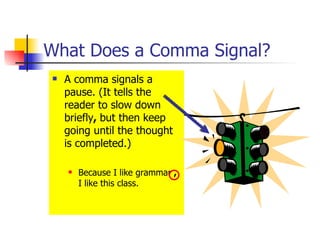
   A comma signals a
    pause. (It tells the
    reader to slow down
    briefly, but then keep
    going until the thought
    is completed.)

       Because I like grammar ,
        I like this class.
What Do Periods & Semicolons
Signal?
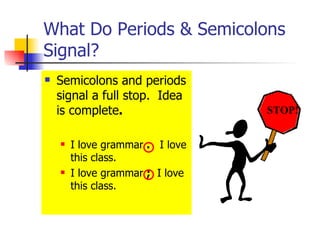
   Semicolons and periods
    signal a full stop. Idea
    is complete.                  STOP!


       I love grammar . I love
        this class.
       I love grammar ; I love
        this class.
What Is a Run-on Sentence?
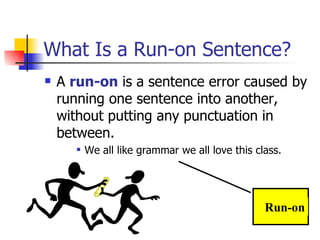
   A run-on is a sentence error caused by
    running one sentence into another,
    without putting any punctuation in
    between.
          We all like grammar we all love this class.


                                                  Run-on
What Is a Comma Splice?

                                            ,

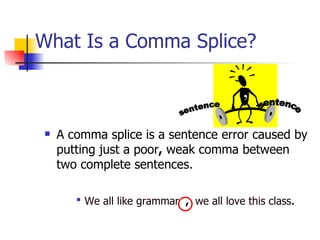
   A comma splice is a sentence error caused by
    putting just a poor, weak comma between
    two complete sentences.

       
           We all like grammar , we all love this class.
How Can I Correct Comma Splices and
      Run-ons? The 1st way is to…
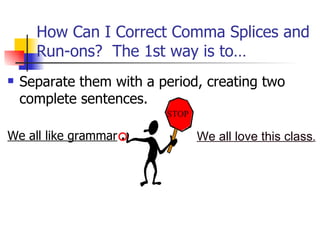
   Separate them with a period, creating two
    complete sentences.
                          STOP

We all like grammar .            We all love this class.
Now you try! Use a period to correct
these run-ons and comma splices.
   These punctuation rules aren’t hard I know
    how to avoid run-ons.
   These punctuation rules aren’t hard. I know
    how to avoid run-ons. Correct!
   My new supervisor has been making all sorts
    of changes, she is really causing problems.
   My new supervisor has been making all sorts
    of changes. She is really causing problems.
Correct!
How Can I Correct Comma Splices
    and Run-ons? The 2nd way is to…
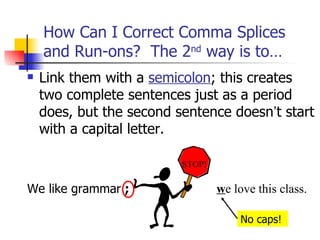
   Link them with a semicolon; this creates
    two complete sentences just as a period
    does, but the second sentence doesn’t start
    with a capital letter.

                          STOP!

We like grammar ;                 we love this class.

                                       No caps!
How Can I Correct Comma Splices and
    Run-ons? The 3rd way is to…
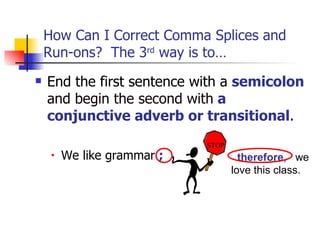
   End the first sentence with a semicolon
    and begin the second with a
    conjunctive adverb or transitional.
                             STOP
     •   We like grammar ;            therefore, we
                                    love this class.
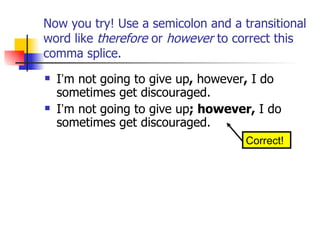
Now you try! Use a semicolon and a transitional
word like therefore or however to correct this
comma splice.
   I’m not going to give up, however, I do
    sometimes get discouraged.
   I’m not going to give up; however, I do
    sometimes get discouraged.
                                    Correct!
How Can I Correct Comma Splices and
Run-ons? The 4th way is to…
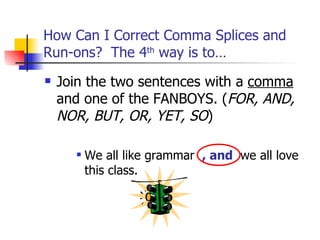
   Join the two sentences with a comma
    and one of the FANBOYS. (FOR, AND,
    NOR, BUT, OR, YET, SO)

         We all like grammar , and we all love
          this class.
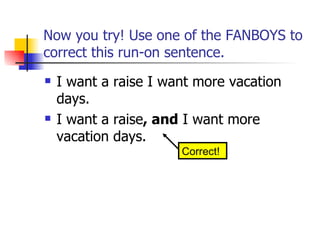
Now you try! Use one of the FANBOYS to
correct this run-on sentence.
   I want a raise I want more vacation
    days.
   I want a raise, and I want more
    vacation days.
                       Correct!
How Can I Correct Comma Splices and
         Run-ons? The last way is to…

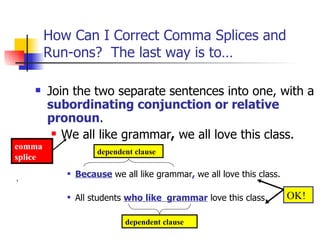
        Join the two separate sentences into one, with a
         subordinating conjunction or relative
         pronoun.
           We all like grammar, we all love this class.
comma
                     dependent clause
splice
               Because we all like grammar, we all love this class.

               All students who like grammar love this class.         OK!

                            dependent clause
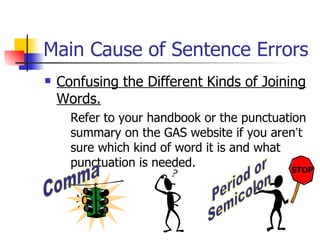
Main Cause of Sentence Errors
   Confusing the Different Kinds of Joining
    Words.
      Refer to your handbook or the punctuation
      summary on the GAS website if you aren’t
      sure which kind of word it is and what
      punctuation is needed.                 STOP
                                             STOP
Let’s try a few, just to make sure you
can catch any punctuation errors!
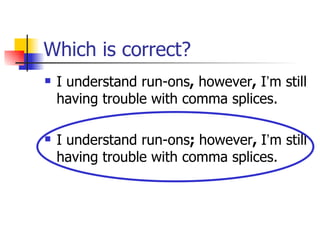
Which is correct?
   I understand run-ons, however, I’m still
    having trouble with comma splices.

   I understand run-ons; however, I’m still
    having trouble with comma splices.
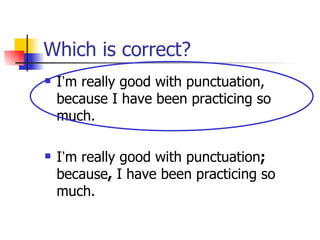
Which is correct?
   I’m really good with punctuation,
    because I have been practicing so
    much.

   I’m really good with punctuation;
    because, I have been practicing so
    much.
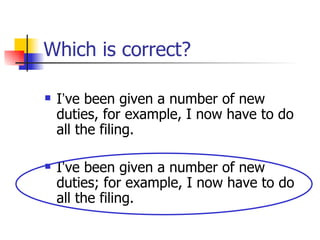
Which is correct?

   I’ve been given a number of new
    duties, for example, I now have to do
    all the filing.

   I’ve been given a number of new
    duties; for example, I now have to do
    all the filing.
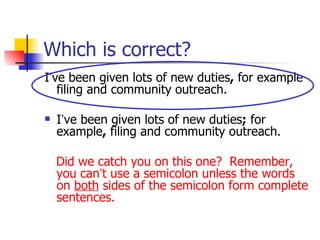
Which is correct?
I’ve been given lots of new duties, for example
   filing and community outreach.

   I’ve been given lots of new duties; for
    example, filing and community outreach.

    Did we catch you on this one? Remember,
    you can’t use a semicolon unless the words
    on both sides of the semicolon form complete
    sentences.
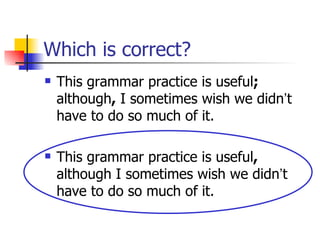
Which is correct?
   This grammar practice is useful;
    although, I sometimes wish we didn’t
    have to do so much of it.

   This grammar practice is useful,
    although I sometimes wish we didn’t
    have to do so much of it.
You’ve got it!


   No more
                      The
  fragments,
                      END!
comma splices,
   or run-on
sentences ever
    again!
Break Time!
In – Class Activity
   Magazine advertisements are filled with sentence
    fragments. There are several reasons for this–fragments
    can be emphatic, they stand out from sentences because
    they are unusual or even irritating, and they can create a
    conversational tone.
       Using the assortment of ads that contain fragments groups are to
        identify all of the fragments in the ads.
       Students are then to change each fragment into a complete
        sentence.
           analyze the difference that complete sentences make on the

            overall tone of the ad.
       present their findings on one or two of the ads to the
        rest of the class.
Responding to Readings
   Complete the Daily Sparks

Avoiding runons

  • 1.
    Avoiding Run-on Sentences, CommaSplices, and Fragments ; , Getting Your Punctuation Right!
  • 2.
    What Does aComma Signal?  A comma signals a pause. (It tells the reader to slow down briefly, but then keep going until the thought is completed.)  Because I like grammar , I like this class.
  • 3.
    What Do Periods& Semicolons Signal?  Semicolons and periods signal a full stop. Idea is complete. STOP!  I love grammar . I love this class.  I love grammar ; I love this class.
  • 4.
    What Is aRun-on Sentence?  A run-on is a sentence error caused by running one sentence into another, without putting any punctuation in between.  We all like grammar we all love this class. Run-on
  • 5.
    What Is aComma Splice? ,  A comma splice is a sentence error caused by putting just a poor, weak comma between two complete sentences.  We all like grammar , we all love this class.
  • 6.
    How Can ICorrect Comma Splices and Run-ons? The 1st way is to…  Separate them with a period, creating two complete sentences. STOP We all like grammar . We all love this class.
  • 7.
    Now you try!Use a period to correct these run-ons and comma splices.  These punctuation rules aren’t hard I know how to avoid run-ons.  These punctuation rules aren’t hard. I know how to avoid run-ons. Correct!  My new supervisor has been making all sorts of changes, she is really causing problems.  My new supervisor has been making all sorts of changes. She is really causing problems. Correct!
  • 8.
    How Can ICorrect Comma Splices and Run-ons? The 2nd way is to…  Link them with a semicolon; this creates two complete sentences just as a period does, but the second sentence doesn’t start with a capital letter. STOP! We like grammar ; we love this class. No caps!
  • 9.
    How Can ICorrect Comma Splices and Run-ons? The 3rd way is to…  End the first sentence with a semicolon and begin the second with a conjunctive adverb or transitional. STOP • We like grammar ; therefore, we love this class.
  • 10.
    Now you try!Use a semicolon and a transitional word like therefore or however to correct this comma splice.  I’m not going to give up, however, I do sometimes get discouraged.  I’m not going to give up; however, I do sometimes get discouraged. Correct!
  • 11.
    How Can ICorrect Comma Splices and Run-ons? The 4th way is to…  Join the two sentences with a comma and one of the FANBOYS. (FOR, AND, NOR, BUT, OR, YET, SO)  We all like grammar , and we all love this class.
  • 12.
    Now you try!Use one of the FANBOYS to correct this run-on sentence.  I want a raise I want more vacation days.  I want a raise, and I want more vacation days. Correct!
  • 13.
    How Can ICorrect Comma Splices and Run-ons? The last way is to…  Join the two separate sentences into one, with a subordinating conjunction or relative pronoun.  We all like grammar, we all love this class. comma dependent clause splice  Because we all like grammar, we all love this class.  All students who like grammar love this class. OK! dependent clause
  • 14.
    Main Cause ofSentence Errors  Confusing the Different Kinds of Joining Words. Refer to your handbook or the punctuation summary on the GAS website if you aren’t sure which kind of word it is and what punctuation is needed. STOP STOP
  • 15.
    Let’s try afew, just to make sure you can catch any punctuation errors!
  • 16.
    Which is correct?  I understand run-ons, however, I’m still having trouble with comma splices.  I understand run-ons; however, I’m still having trouble with comma splices.
  • 17.
    Which is correct?  I’m really good with punctuation, because I have been practicing so much.  I’m really good with punctuation; because, I have been practicing so much.
  • 18.
    Which is correct?  I’ve been given a number of new duties, for example, I now have to do all the filing.  I’ve been given a number of new duties; for example, I now have to do all the filing.
  • 19.
    Which is correct? I’vebeen given lots of new duties, for example filing and community outreach.  I’ve been given lots of new duties; for example, filing and community outreach. Did we catch you on this one? Remember, you can’t use a semicolon unless the words on both sides of the semicolon form complete sentences.
  • 20.
    Which is correct?  This grammar practice is useful; although, I sometimes wish we didn’t have to do so much of it.  This grammar practice is useful, although I sometimes wish we didn’t have to do so much of it.
  • 21.
    You’ve got it! No more The fragments, END! comma splices, or run-on sentences ever again!
  • 22.
  • 23.
    In – ClassActivity  Magazine advertisements are filled with sentence fragments. There are several reasons for this–fragments can be emphatic, they stand out from sentences because they are unusual or even irritating, and they can create a conversational tone.  Using the assortment of ads that contain fragments groups are to identify all of the fragments in the ads.  Students are then to change each fragment into a complete sentence.  analyze the difference that complete sentences make on the overall tone of the ad.  present their findings on one or two of the ads to the rest of the class.
  • 24.
    Responding to Readings  Complete the Daily Sparks