Parts of Speech:
What is an ADVERB?
English 7
Mr. Holes
So, what is an
ADVERB ?
An ADVERB is a word that describes or modifies
anything other than a Noun or Pronoun.
ADVERBS have many functions in sentences and
they account for many of the words in our language.
An ADVERB is one of the 8 parts of speech.
Parts of Speech: What is an ADVERB?
So, what does an
ADVERB do?
Remember, an ADVERB describes anything other than a Noun or Pronoun
ADVERBS often describe Verbs.
They indicate Time, Place, Manner, Amount,
Cause, or Degree.
Many times they answer: ‘How’, ‘When’, ‘Where’
Parts of Speech: What is an ADVERB?
So, what does an
ADVERB do?
Remember, an ADVERB describes anything other than a Noun or Pronoun
Many Adverbs end with –ly:
usually, finally, skillfully, quickly, slowly, carefully
Some Adverbs don’t end that way: well, more, still,
then, today, tomorrow, yesterday, sideways
Parts of Speech: What is an ADVERB?
So, what does an
ADVERB do?
Remember, an ADVERB describes anything other than a Noun or Pronoun
Examples of ADVERBS that describe Verbs (actions):
The man worked here.
The man worked carefully.
The man worked efficiently.
The man worked today.
Parts of Speech: What is an ADVERB?
So, what does an
ADVERB do?
Remember, an ADVERB describes anything other than a Noun or Pronoun
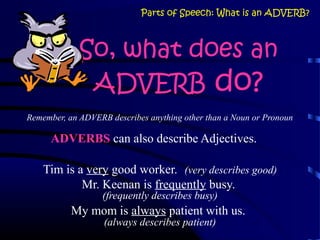
ADVERBS can also describe Adjectives.
Tim is a very good worker. (very describes good)
Mr. Keenan is frequently busy.
(frequently describes busy)
My mom is always patient with us.
(always describes patient)
Parts of Speech: What is an ADVERB?
So, what does an
ADVERB do?
Remember, an ADVERB describes anything other than a Noun or Pronoun
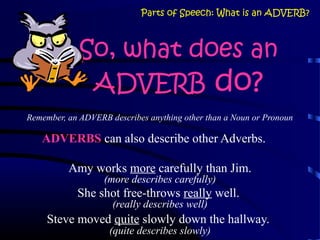
ADVERBS can also describe other Adverbs.
Amy works more carefully than Jim.
(more describes carefully)
She shot free-throws really well.
(really describes well)
Steve moved quite slowly down the hallway.
(quite describes slowly)
Parts of Speech: What is an ADVERB?
So, what does an
ADVERB do?
Remember, an ADVERB describes anything other than a Noun or Pronoun
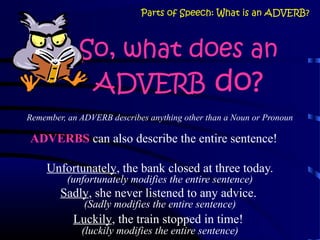
ADVERBS can also describe the entire sentence!
Unfortunately, the bank closed at three today.
(unfortunately modifies the entire sentence)
Sadly, she never listened to any advice.
(Sadly modifies the entire sentence)
Luckily, the train stopped in time!
(luckily modifies the entire sentence)
Parts of Speech: What is an ADVERB?
Can there be
problems with an
ADVERB?
Remember, an ADVERB describes anything other than a Noun or Pronoun
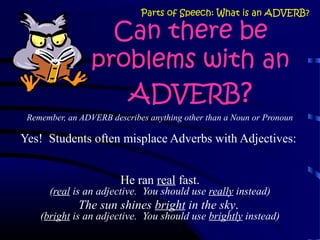
Yes! Students often misplace Adverbs with Adjectives:
He ran real fast.
(real is an adjective. You should use really instead)
The sun shines bright in the sky.
(bright is an adjective. You should use brightly instead)
Parts of Speech: What is an ADVERB?
Remember, an ADVERB describes anything other than a Noun or Pronoun
Yes! Students often overuse some Adverbs.
Avoid the following words: not, too, very, usually,
truly, really, totally, suddenly, hopefully
They can be replaced with other more descriptive
and specific adverbs.
Parts of Speech: What is an ADVERB?
Can there be
problems with an
ADVERB?
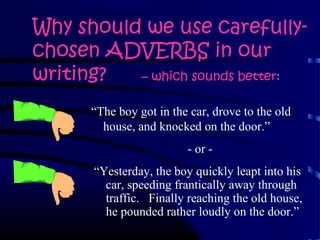
Why should we use carefully-
chosen ADVERBS in our
writing? – which sounds better:
“Yesterday, the boy quickly leapt into his
car, speeding frantically away through
traffic. Finally reaching the old house,
he pounded rather loudly on the door.”
“The boy got in the car, drove to the old
house, and knocked on the door.”
- or -
Why should we use carefully-
chosen ADVERBS in our
writing?
Customize this editing technique to your
writing. Use both adverbs and strong
action verbs to convey the exact meaning
of your sentence and provide the reader
with specific images.
The first example is rather dull, isn’t it?
There is no detail for the action verbs.
How can using ADVERBS
help you?
• Communicating your ideas clearly
• Demonstrating you have control
over your writing
• Making your writing
more exciting &
fun to read
What do we think of authors
or writers who don’t use
interesting ADVERBS?
• They do not proofread.
• They are lazy
(and probably boring).
• They do not take the time
to re-read their work.
• They don’t care if the
reader enjoys their writing
Knowing the Parts of
Speech IS Important!!!
• For knowledge
• For a job
• For education
• For clarity
• For communication

English Grammar - 11

  • 1.
    Parts of Speech: Whatis an ADVERB? English 7 Mr. Holes
  • 2.
    So, what isan ADVERB ? An ADVERB is a word that describes or modifies anything other than a Noun or Pronoun. ADVERBS have many functions in sentences and they account for many of the words in our language. An ADVERB is one of the 8 parts of speech. Parts of Speech: What is an ADVERB?
  • 3.
    So, what doesan ADVERB do? Remember, an ADVERB describes anything other than a Noun or Pronoun ADVERBS often describe Verbs. They indicate Time, Place, Manner, Amount, Cause, or Degree. Many times they answer: ‘How’, ‘When’, ‘Where’ Parts of Speech: What is an ADVERB?
  • 4.
    So, what doesan ADVERB do? Remember, an ADVERB describes anything other than a Noun or Pronoun Many Adverbs end with –ly: usually, finally, skillfully, quickly, slowly, carefully Some Adverbs don’t end that way: well, more, still, then, today, tomorrow, yesterday, sideways Parts of Speech: What is an ADVERB?
  • 5.
    So, what doesan ADVERB do? Remember, an ADVERB describes anything other than a Noun or Pronoun Examples of ADVERBS that describe Verbs (actions): The man worked here. The man worked carefully. The man worked efficiently. The man worked today. Parts of Speech: What is an ADVERB?
  • 6.
    So, what doesan ADVERB do? Remember, an ADVERB describes anything other than a Noun or Pronoun ADVERBS can also describe Adjectives. Tim is a very good worker. (very describes good) Mr. Keenan is frequently busy. (frequently describes busy) My mom is always patient with us. (always describes patient) Parts of Speech: What is an ADVERB?
  • 7.
    So, what doesan ADVERB do? Remember, an ADVERB describes anything other than a Noun or Pronoun ADVERBS can also describe other Adverbs. Amy works more carefully than Jim. (more describes carefully) She shot free-throws really well. (really describes well) Steve moved quite slowly down the hallway. (quite describes slowly) Parts of Speech: What is an ADVERB?
  • 8.
    So, what doesan ADVERB do? Remember, an ADVERB describes anything other than a Noun or Pronoun ADVERBS can also describe the entire sentence! Unfortunately, the bank closed at three today. (unfortunately modifies the entire sentence) Sadly, she never listened to any advice. (Sadly modifies the entire sentence) Luckily, the train stopped in time! (luckily modifies the entire sentence) Parts of Speech: What is an ADVERB?
  • 9.
    Can there be problemswith an ADVERB? Remember, an ADVERB describes anything other than a Noun or Pronoun Yes! Students often misplace Adverbs with Adjectives: He ran real fast. (real is an adjective. You should use really instead) The sun shines bright in the sky. (bright is an adjective. You should use brightly instead) Parts of Speech: What is an ADVERB?
  • 10.
    Remember, an ADVERBdescribes anything other than a Noun or Pronoun Yes! Students often overuse some Adverbs. Avoid the following words: not, too, very, usually, truly, really, totally, suddenly, hopefully They can be replaced with other more descriptive and specific adverbs. Parts of Speech: What is an ADVERB? Can there be problems with an ADVERB?
  • 11.
    Why should weuse carefully- chosen ADVERBS in our writing? – which sounds better: “Yesterday, the boy quickly leapt into his car, speeding frantically away through traffic. Finally reaching the old house, he pounded rather loudly on the door.” “The boy got in the car, drove to the old house, and knocked on the door.” - or -
  • 12.
    Why should weuse carefully- chosen ADVERBS in our writing? Customize this editing technique to your writing. Use both adverbs and strong action verbs to convey the exact meaning of your sentence and provide the reader with specific images. The first example is rather dull, isn’t it? There is no detail for the action verbs.
  • 13.
    How can usingADVERBS help you? • Communicating your ideas clearly • Demonstrating you have control over your writing • Making your writing more exciting & fun to read
  • 14.
    What do wethink of authors or writers who don’t use interesting ADVERBS? • They do not proofread. • They are lazy (and probably boring). • They do not take the time to re-read their work. • They don’t care if the reader enjoys their writing
  • 15.
    Knowing the Partsof Speech IS Important!!! • For knowledge • For a job • For education • For clarity • For communication