Avoiding Run-On
Sentences
FROM THE WRITING CENTER
@ THE A.R.C.
Learning Objectives
• Identify and correct run-on sentences.
• Identify and correct comma splices.
Run-On Sentences
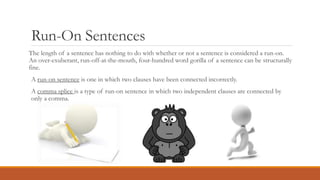
The length of a sentence has nothing to do with whether or not a sentence is considered a run-on.
An over-exuberant, run-off-at-the-mouth, four-hundred word gorilla of a sentence can be structurally
fine.
A run-on sentence is one in which two clauses have been connected incorrectly.
A comma splice is a type of run-on sentence in which two independent clauses are connected by
only a comma.
Traps of the Run-On Sentence
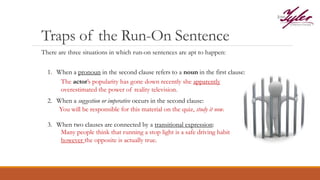
There are three situations in which run-on sentences are apt to happen:
1. When a pronoun in the second clause refers to a noun in the first clause:
The actor’s popularity has gone down recently she apparently
overestimated the power of reality television.
2. When a suggestion or imperative occurs in the second clause:
You will be responsible for this material on the quiz, study it now.
3. When two clauses are connected by a transitional expression:
Many people think that running a stop light is a safe driving habit
however the opposite is actually true.
Avoiding Run-On Sentences
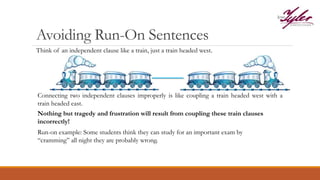
Think of an independent clause like a train, just a train headed west.
Connecting two independent clauses improperly is like coupling a train headed west with a
train headed east.
Nothing but tragedy and frustration will result from coupling these train clauses
incorrectly!
Run-on example: Some students think they can study for an important exam by
“cramming” all night they are probably wrong.
Comma Splices
Example: Some students think they can study for an important exam by “cramming” all
night, they are probably wrong.
This is an example of the dreaded Comma Splice!
How do you correct comma splices?
A comma splice connects two independent clauses with only a comma.
Correcting Run-ons and Comma Splices
There are several ways to fix a Comma Splice:
◦ 1. Insert a period and begin a new sentence.
Some students think they can study for an important exam by “cramming” all
night. They are probably wrong.
• 2. Insert a comma plus a coordinating conjunction (for/and/nor/but/or/yet/so.)
Some students think they can study for an important exam by “cramming” all
night, but they are probably wrong.
• 3. Use a semicolon.
Some students think they can study for an important exam by “cramming” all
night; they are probably wrong.
Escape the Run-on!
1. The actor’s popularity has gone has gone down recently, and she apparently
overestimated the power of reality television.
2. You will be responsible for this material on the quiz. Study it now.
3. Many people think that running a stop light is a safe driving habit; however,
the opposite is actually true.
In Conclusion…
 Run-ons happen when independent clauses are joined incorrectly.
 A comma splice is a type of run-on. It is when independent clauses are incorrectly fused together
with a comma.
 To avoid run-ons and comma splices, be sure that you have one of the following in between your
independent clauses:
• A semicolon
• A comma and a coordinating conjunction
• A period

Avoiding Run -Ons

  • 1.
    Avoiding Run-On Sentences FROM THEWRITING CENTER @ THE A.R.C.
  • 2.
    Learning Objectives • Identifyand correct run-on sentences. • Identify and correct comma splices.
  • 3.
    Run-On Sentences The lengthof a sentence has nothing to do with whether or not a sentence is considered a run-on. An over-exuberant, run-off-at-the-mouth, four-hundred word gorilla of a sentence can be structurally fine. A run-on sentence is one in which two clauses have been connected incorrectly. A comma splice is a type of run-on sentence in which two independent clauses are connected by only a comma.
  • 4.
    Traps of theRun-On Sentence There are three situations in which run-on sentences are apt to happen: 1. When a pronoun in the second clause refers to a noun in the first clause: The actor’s popularity has gone down recently she apparently overestimated the power of reality television. 2. When a suggestion or imperative occurs in the second clause: You will be responsible for this material on the quiz, study it now. 3. When two clauses are connected by a transitional expression: Many people think that running a stop light is a safe driving habit however the opposite is actually true.
  • 5.
    Avoiding Run-On Sentences Thinkof an independent clause like a train, just a train headed west. Connecting two independent clauses improperly is like coupling a train headed west with a train headed east. Nothing but tragedy and frustration will result from coupling these train clauses incorrectly! Run-on example: Some students think they can study for an important exam by “cramming” all night they are probably wrong.
  • 6.
    Comma Splices Example: Somestudents think they can study for an important exam by “cramming” all night, they are probably wrong. This is an example of the dreaded Comma Splice! How do you correct comma splices? A comma splice connects two independent clauses with only a comma.
  • 7.
    Correcting Run-ons andComma Splices There are several ways to fix a Comma Splice: ◦ 1. Insert a period and begin a new sentence. Some students think they can study for an important exam by “cramming” all night. They are probably wrong. • 2. Insert a comma plus a coordinating conjunction (for/and/nor/but/or/yet/so.) Some students think they can study for an important exam by “cramming” all night, but they are probably wrong. • 3. Use a semicolon. Some students think they can study for an important exam by “cramming” all night; they are probably wrong.
  • 8.
    Escape the Run-on! 1.The actor’s popularity has gone has gone down recently, and she apparently overestimated the power of reality television. 2. You will be responsible for this material on the quiz. Study it now. 3. Many people think that running a stop light is a safe driving habit; however, the opposite is actually true.
  • 9.
    In Conclusion…  Run-onshappen when independent clauses are joined incorrectly.  A comma splice is a type of run-on. It is when independent clauses are incorrectly fused together with a comma.  To avoid run-ons and comma splices, be sure that you have one of the following in between your independent clauses: • A semicolon • A comma and a coordinating conjunction • A period

Editor's Notes

  • #4 I added a definition of comma splices.
  • #5 Since many of the run-on examples were comma splices, I changed them into run-ons to avoid confusion.
  • #6 I removed the intergalactic spaceship example. I thought it would be good to make the example sentence a straight-up run-on sentence rather than a comma splice.