Norteas school of agricultura
Fourth Quarter
Practice English 5
Engineer: Oscar García
Group: 1
Name: Avalos Díaz Robin Neuin
a). Present simple whit future meaning
 a. A future tense is not used in a time clause or conditional clause. The
meaning of the clause is future, but the simple present tense is used, e.g.
Ejemplo, present simple whit future meaning
 Linda will leave soon. Before she leaves, she is going to finish her work.
 As soon as the taxi arrives, we will be able to leave for the airport.
 I will wait until she comes.
 I will go to bed after I finish my work.
 I will go to bed after I have finished my work.
b).Future “be about to” + infiniteve ¡,
verbos + infiniteve
b).Future “be about to” + infiniteve ¡, verbos
+ infiniteve
 Infinitive is a grammatical term used to refer to certain verb forms that exist
in many languages. As with many linguistic concepts, there is not a single
definition applicable to all languages. The word is derived from Late Latin
infinitivus, a derivative of infinitus meaning "infinite". Infinitives are used
mostly as non-finite verbs.
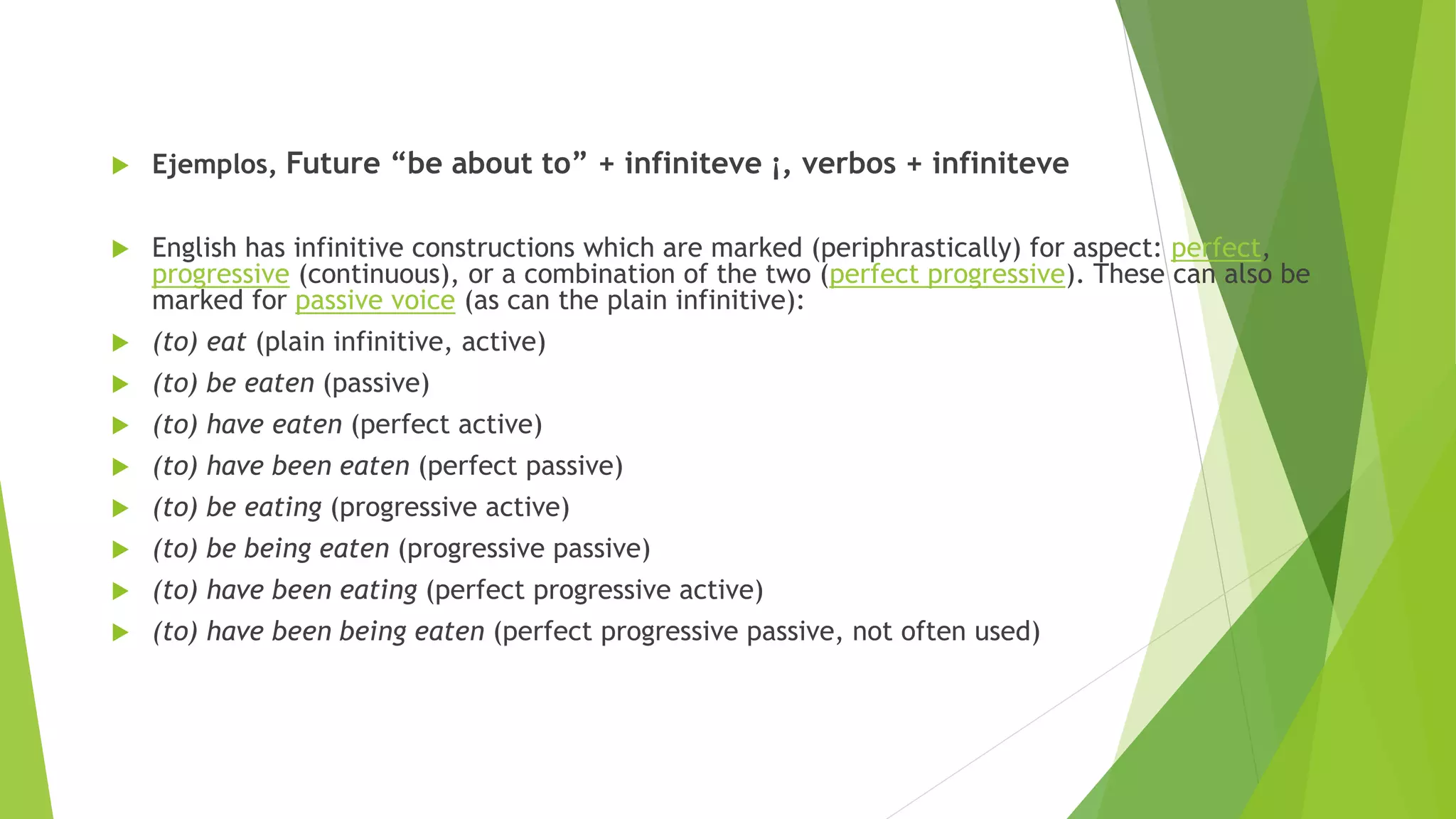
 Ejemplos, Future “be about to” + infiniteve ¡, verbos + infiniteve
 English has infinitive constructions which are marked (periphrastically) for aspect: perfect,
progressive (continuous), or a combination of the two (perfect progressive). These can also be
marked for passive voice (as can the plain infinitive):
 (to) eat (plain infinitive, active)
 (to) be eaten (passive)
 (to) have eaten (perfect active)
 (to) have been eaten (perfect passive)
 (to) be eating (progressive active)
 (to) be being eaten (progressive passive)
 (to) have been eating (perfect progressive active)
 (to) have been being eaten (perfect progressive passive, not often used)
c).Present perfec simple + “just/for/since”
c).Present perfec simple +
“just/for/since”
 Para que el verbo este en pasado a los regulares se les añade d,o ed
depende de la regla, y los irregulares tienes que estudiartelos el pasado de
do - es did,speak es spoken etc.Y es lo mismo para todas las personas.
Se usa el pasado simple para acciones finalizadas,verbos regulares lived,
acaba
en e añade d,worked,played etc
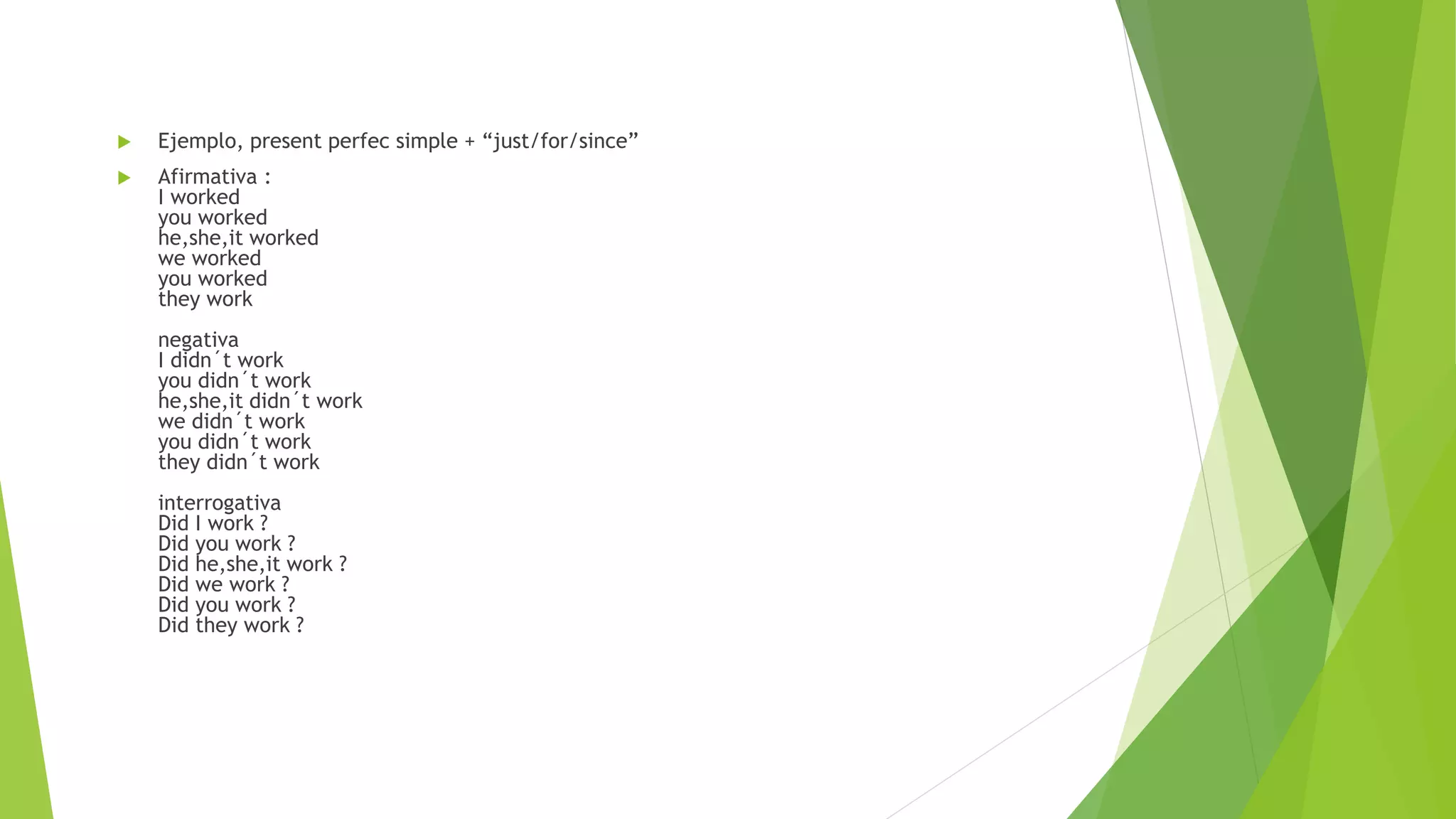
 Ejemplo, present perfec simple + “just/for/since”
 Afirmativa :
I worked
you worked
he,she,it worked
we worked
you worked
they work
negativa
I didn´t work
you didn´t work
he,she,it didn´t work
we didn´t work
you didn´t work
they didn´t work
interrogativa
Did I work ?
Did you work ?
Did he,she,it work ?
Did we work ?
Did you work ?
Did they work ?
d). Reported speech
d). Reported speech
 When do we use reported speech? Sometimes someone says a sentence, for example "I'm
going to the cinema tonight". Later, maybe we want to tell someone else what the first
person said.
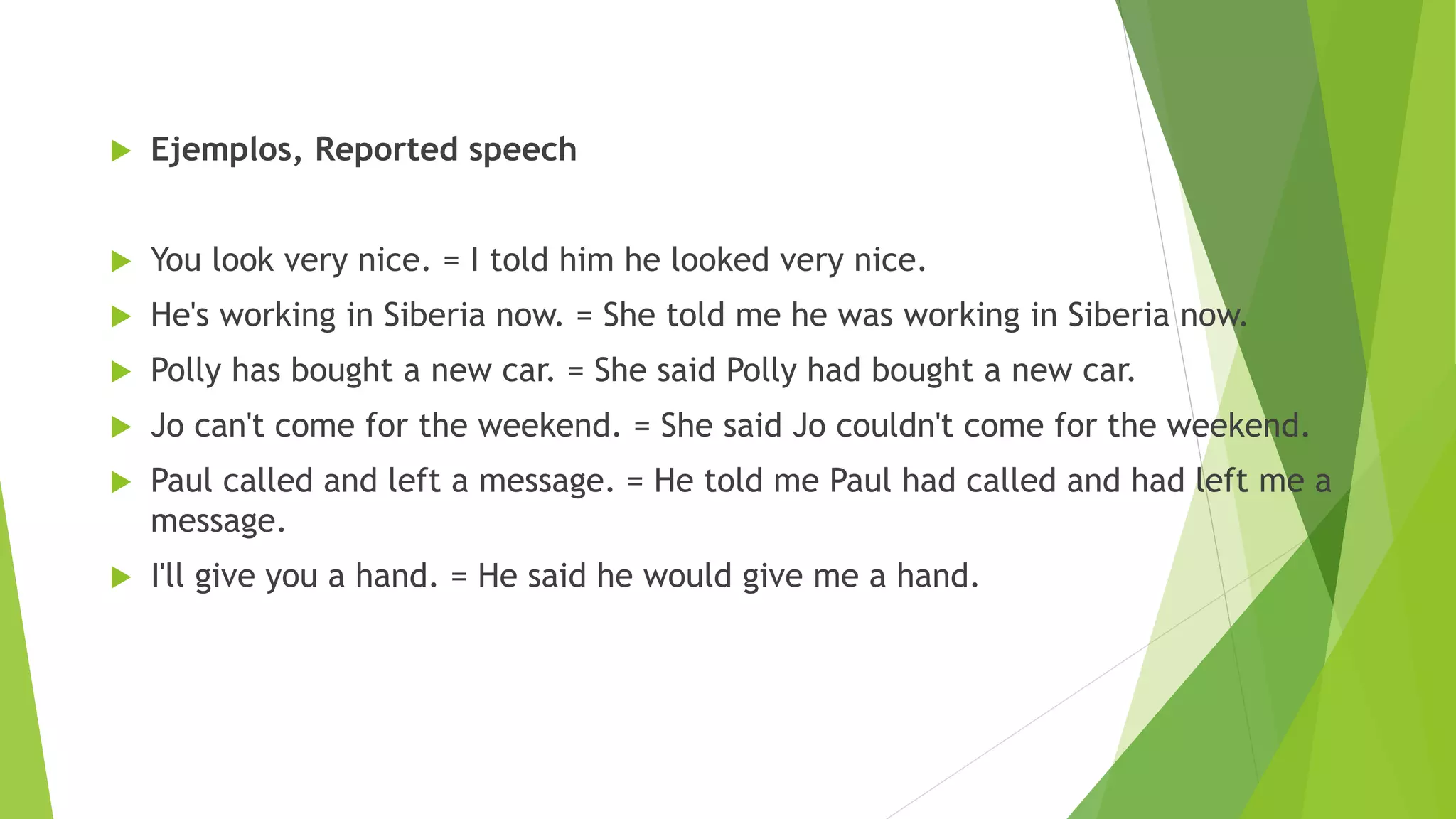
 Ejemplos, Reported speech
 You look very nice. = I told him he looked very nice.
 He's working in Siberia now. = She told me he was working in Siberia now.
 Polly has bought a new car. = She said Polly had bought a new car.
 Jo can't come for the weekend. = She said Jo couldn't come for the weekend.
 Paul called and left a message. = He told me Paul had called and had left me a
message.
 I'll give you a hand. = He said he would give me a hand.
e). Past tense of” there is there are
 If this is your first visit, be sure to check out the FAQ by clicking the link above. You may
have to register before you can post: click the register link above to proceed. To start
viewing messages, select the forum that you want to visit from the selection below.
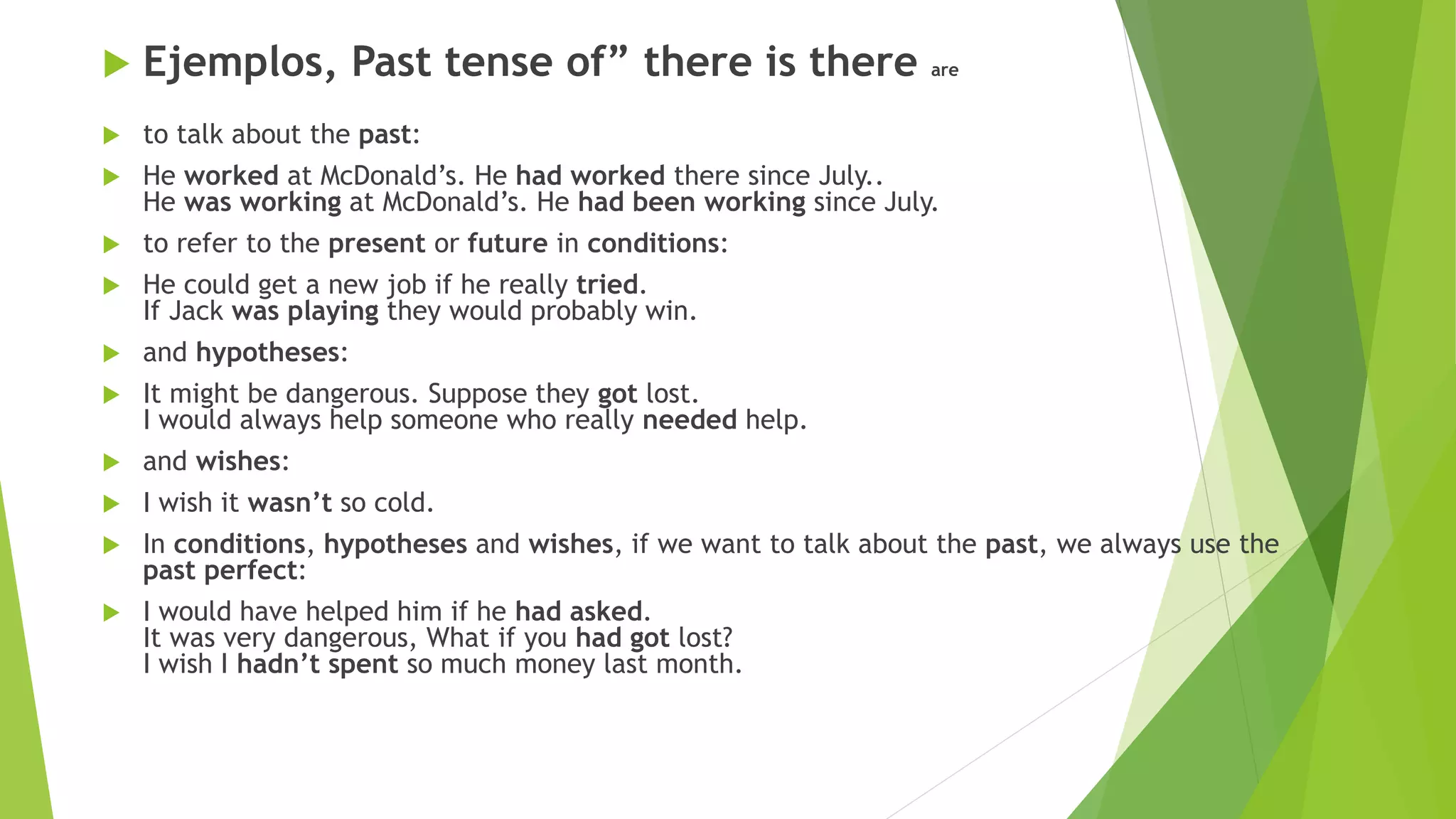
 Ejemplos, Past tense of” there is there are
 to talk about the past:
 He worked at McDonald’s. He had worked there since July..
He was working at McDonald’s. He had been working since July.
 to refer to the present or future in conditions:
 He could get a new job if he really tried.
If Jack was playing they would probably win.
 and hypotheses:
 It might be dangerous. Suppose they got lost.
I would always help someone who really needed help.
 and wishes:
 I wish it wasn’t so cold.
 In conditions, hypotheses and wishes, if we want to talk about the past, we always use the
past perfect:
 I would have helped him if he had asked.
It was very dangerous, What if you had got lost?
I wish I hadn’t spent so much money last month.
f). Past continuos
f). Past continuos
 The past continuous is used for actions that occurred at a specific time in the past. As the
present continuous, is formed with the verb "to be" and the gerund.
 Para formar el pasado continuo se utiliza el verbo auxiliar "to be" y el gerundio (infinitivo +
"-ing") del verbo. El verbo auxiliar "to be" está en el pasado simple, pero ten en cuenta que
"to be" es un verbo irregular.
 Ejemplo, Past continuos
I was talking. (Estaba hablando.)
He was eating. (Estaba comiendo.)
They were learning. (Estaban aprendiendo.)
•I was not [wasn't] talking. (No estaba hablando.)
•He was not [wasn't] eating. (No estaba comiendo.)
They were not [weren't] learning. (No estaban aprendiendo.)
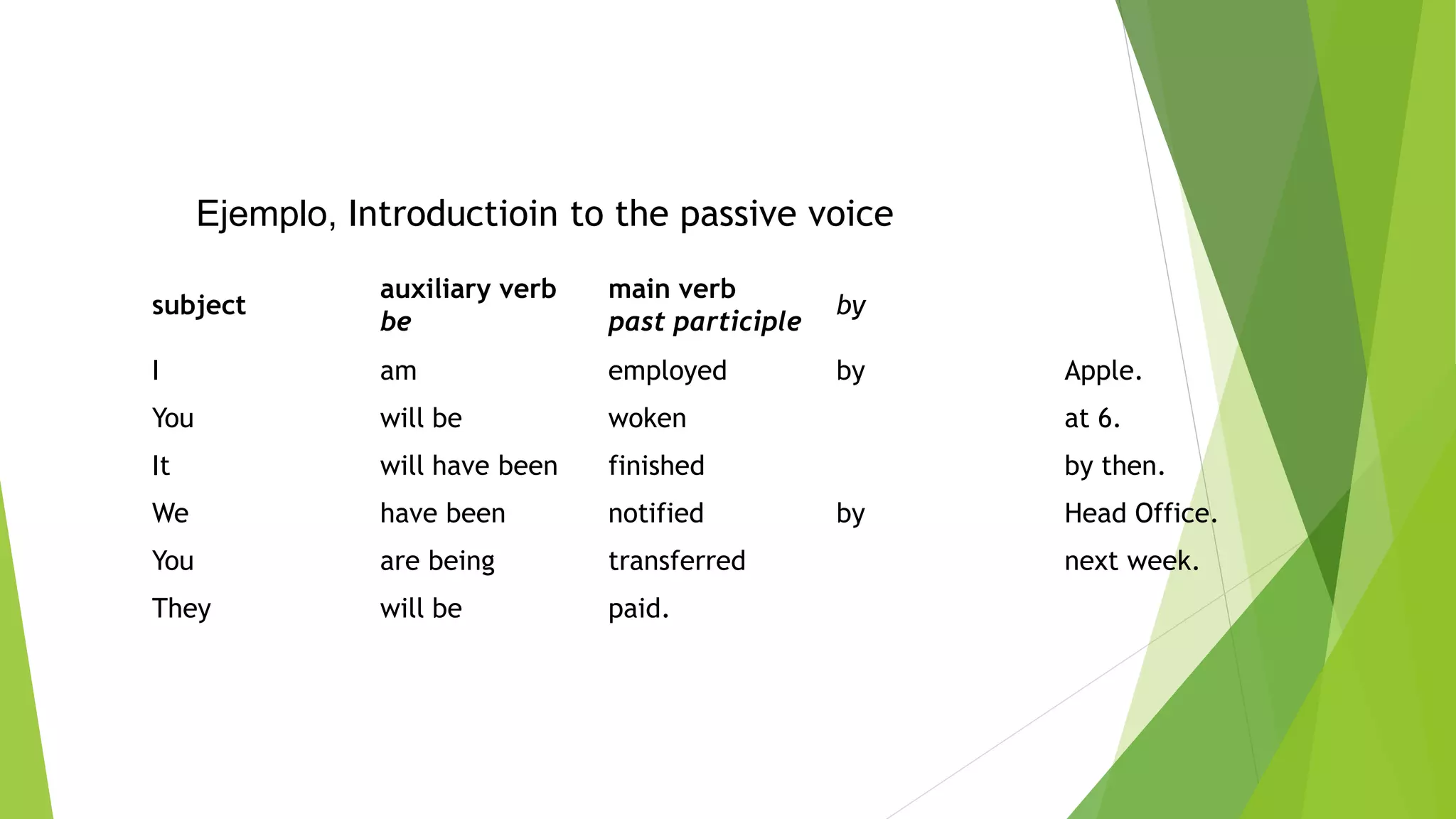
g). Introductioin to the passive voice
 Although the passive voice is less common than the active voice, there are several good
reasons to sometimes use the passive. On this page we look at how to construct the passive
voice and when and why to use it. (For a basic explanation of the difference between
active and passive, please see voice.)
subject
auxiliary verb
be
main verb
past participle
by
I am employed by Apple.
You will be woken at 6.
It will have been finished by then.
We have been notified by Head Office.
You are being transferred next week.
They will be paid.
Ejemplo, Introductioin to the passive voice
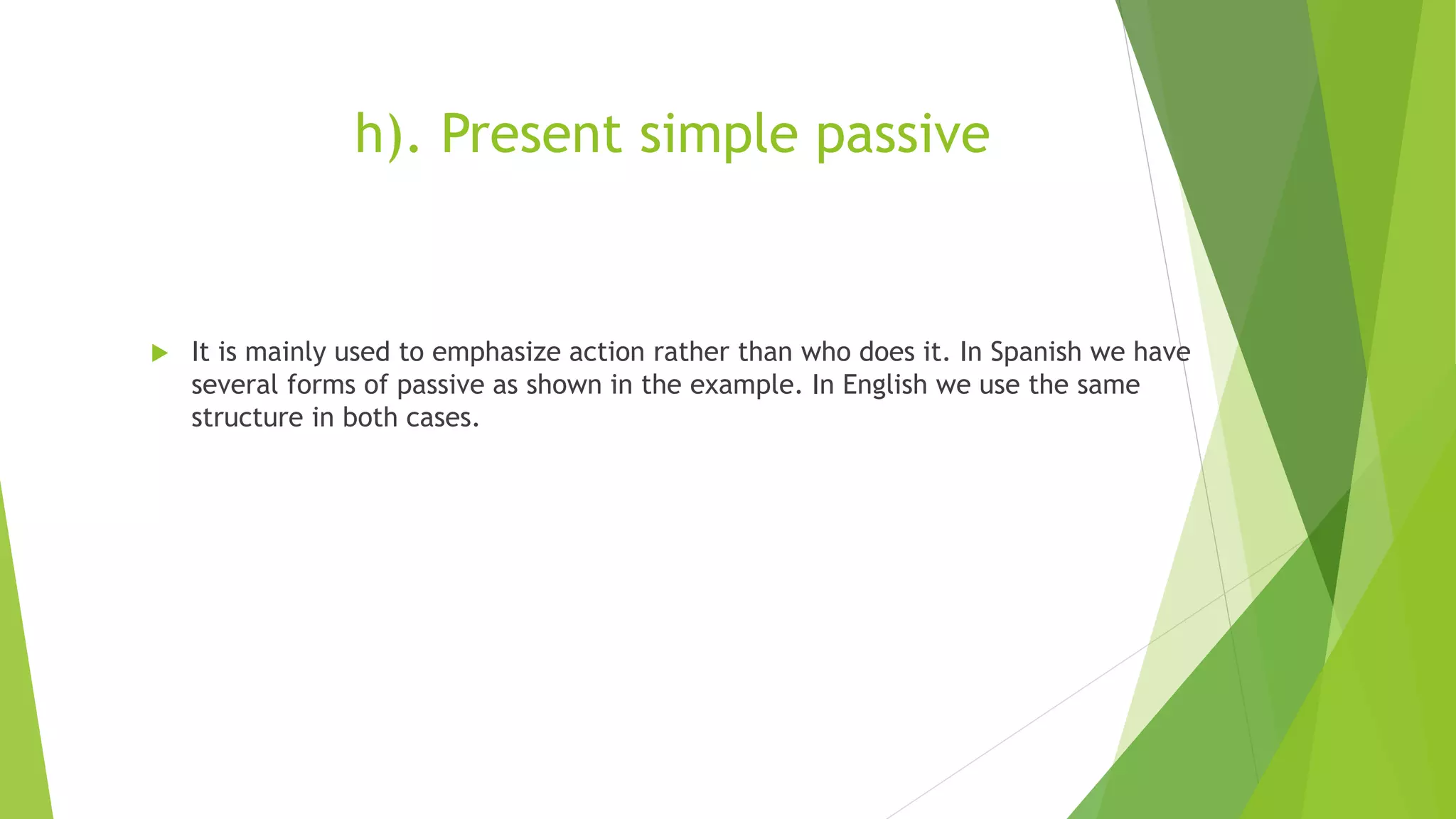
h). Present simple passive
 It is mainly used to emphasize action rather than who does it. In Spanish we have
several forms of passive as shown in the example. In English we use the same
structure in both cases.
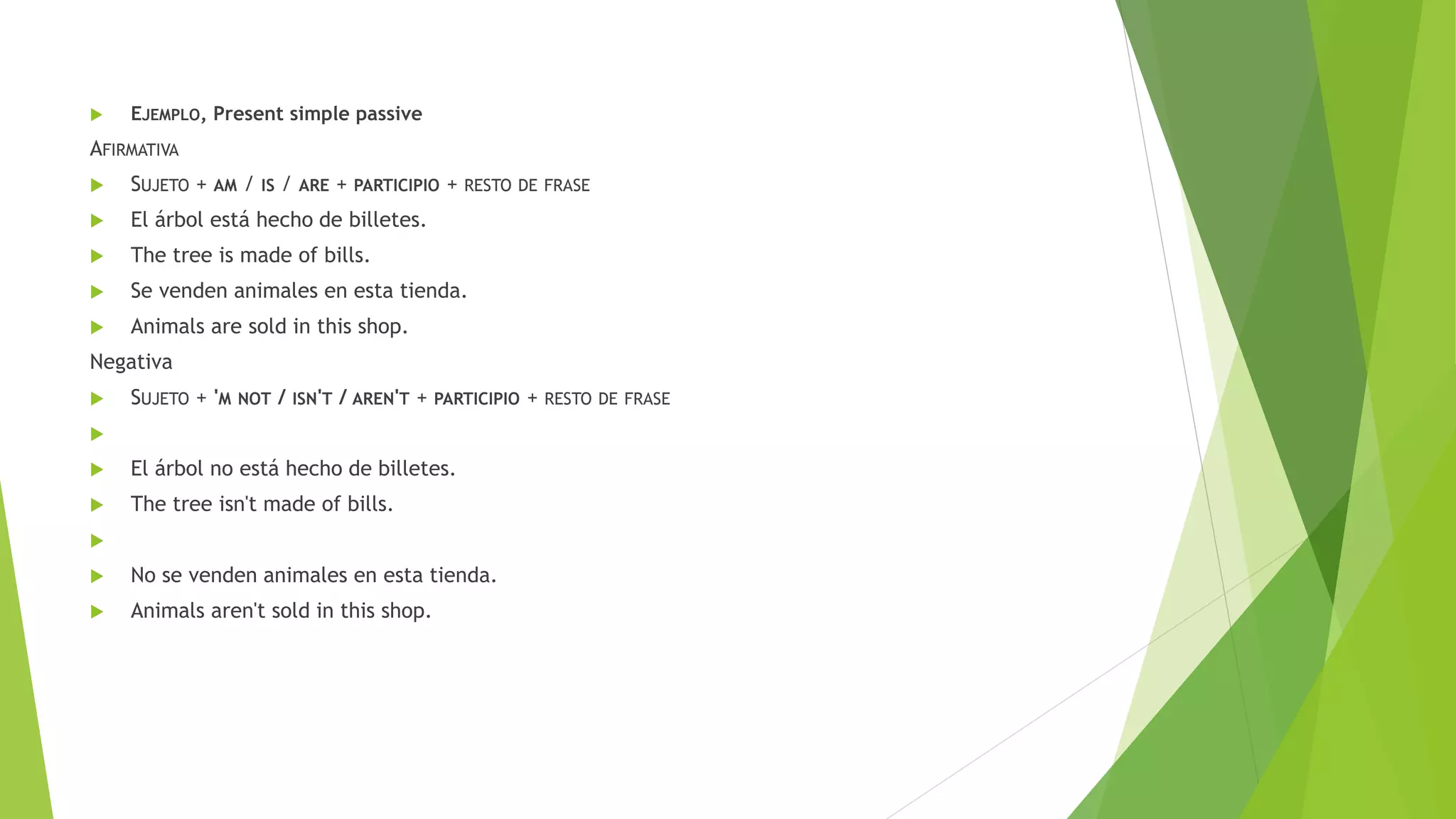
 EJEMPLO, Present simple passive
AFIRMATIVA
 SUJETO + AM / IS / ARE + PARTICIPIO + RESTO DE FRASE
 El árbol está hecho de billetes.
 The tree is made of bills.
 Se venden animales en esta tienda.
 Animals are sold in this shop.
Negativa
 SUJETO + 'M NOT / ISN'T / AREN'T + PARTICIPIO + RESTO DE FRASE

 El árbol no está hecho de billetes.
 The tree isn't made of bills.

 No se venden animales en esta tienda.
 Animals aren't sold in this shop.
EGRAFIA
 https://www.englishclub.com/grammar/verbs-voice-passive.htm
 http://www.blueblocnotes.com/grammar/passive-voice/present-simple

Avalos DÍaz Robin practica 5

  • 1.
    Norteas school ofagricultura Fourth Quarter Practice English 5 Engineer: Oscar García Group: 1 Name: Avalos Díaz Robin Neuin
  • 2.
    a). Present simplewhit future meaning
  • 3.
    a). Present simplewhit future meaning  a. A future tense is not used in a time clause or conditional clause. The meaning of the clause is future, but the simple present tense is used, e.g.
  • 4.
    Ejemplo, present simplewhit future meaning  Linda will leave soon. Before she leaves, she is going to finish her work.  As soon as the taxi arrives, we will be able to leave for the airport.  I will wait until she comes.  I will go to bed after I finish my work.  I will go to bed after I have finished my work.
  • 5.
    b).Future “be aboutto” + infiniteve ¡, verbos + infiniteve
  • 6.
    b).Future “be aboutto” + infiniteve ¡, verbos + infiniteve  Infinitive is a grammatical term used to refer to certain verb forms that exist in many languages. As with many linguistic concepts, there is not a single definition applicable to all languages. The word is derived from Late Latin infinitivus, a derivative of infinitus meaning "infinite". Infinitives are used mostly as non-finite verbs.
  • 7.
     Ejemplos, Future“be about to” + infiniteve ¡, verbos + infiniteve  English has infinitive constructions which are marked (periphrastically) for aspect: perfect, progressive (continuous), or a combination of the two (perfect progressive). These can also be marked for passive voice (as can the plain infinitive):  (to) eat (plain infinitive, active)  (to) be eaten (passive)  (to) have eaten (perfect active)  (to) have been eaten (perfect passive)  (to) be eating (progressive active)  (to) be being eaten (progressive passive)  (to) have been eating (perfect progressive active)  (to) have been being eaten (perfect progressive passive, not often used)
  • 8.
    c).Present perfec simple+ “just/for/since”
  • 9.
    c).Present perfec simple+ “just/for/since”  Para que el verbo este en pasado a los regulares se les añade d,o ed depende de la regla, y los irregulares tienes que estudiartelos el pasado de do - es did,speak es spoken etc.Y es lo mismo para todas las personas. Se usa el pasado simple para acciones finalizadas,verbos regulares lived, acaba en e añade d,worked,played etc
  • 10.
     Ejemplo, presentperfec simple + “just/for/since”  Afirmativa : I worked you worked he,she,it worked we worked you worked they work negativa I didn´t work you didn´t work he,she,it didn´t work we didn´t work you didn´t work they didn´t work interrogativa Did I work ? Did you work ? Did he,she,it work ? Did we work ? Did you work ? Did they work ?
  • 11.
  • 12.
    d). Reported speech When do we use reported speech? Sometimes someone says a sentence, for example "I'm going to the cinema tonight". Later, maybe we want to tell someone else what the first person said.
  • 13.
     Ejemplos, Reportedspeech  You look very nice. = I told him he looked very nice.  He's working in Siberia now. = She told me he was working in Siberia now.  Polly has bought a new car. = She said Polly had bought a new car.  Jo can't come for the weekend. = She said Jo couldn't come for the weekend.  Paul called and left a message. = He told me Paul had called and had left me a message.  I'll give you a hand. = He said he would give me a hand.
  • 14.
    e). Past tenseof” there is there are
  • 15.
    e). Past tenseof” there is there are  If this is your first visit, be sure to check out the FAQ by clicking the link above. You may have to register before you can post: click the register link above to proceed. To start viewing messages, select the forum that you want to visit from the selection below.
  • 16.
     Ejemplos, Pasttense of” there is there are  to talk about the past:  He worked at McDonald’s. He had worked there since July.. He was working at McDonald’s. He had been working since July.  to refer to the present or future in conditions:  He could get a new job if he really tried. If Jack was playing they would probably win.  and hypotheses:  It might be dangerous. Suppose they got lost. I would always help someone who really needed help.  and wishes:  I wish it wasn’t so cold.  In conditions, hypotheses and wishes, if we want to talk about the past, we always use the past perfect:  I would have helped him if he had asked. It was very dangerous, What if you had got lost? I wish I hadn’t spent so much money last month.
  • 17.
  • 18.
    f). Past continuos The past continuous is used for actions that occurred at a specific time in the past. As the present continuous, is formed with the verb "to be" and the gerund.  Para formar el pasado continuo se utiliza el verbo auxiliar "to be" y el gerundio (infinitivo + "-ing") del verbo. El verbo auxiliar "to be" está en el pasado simple, pero ten en cuenta que "to be" es un verbo irregular.
  • 19.
     Ejemplo, Pastcontinuos I was talking. (Estaba hablando.) He was eating. (Estaba comiendo.) They were learning. (Estaban aprendiendo.) •I was not [wasn't] talking. (No estaba hablando.) •He was not [wasn't] eating. (No estaba comiendo.) They were not [weren't] learning. (No estaban aprendiendo.)
  • 20.
    g). Introductioin tothe passive voice
  • 21.
    g). Introductioin tothe passive voice  Although the passive voice is less common than the active voice, there are several good reasons to sometimes use the passive. On this page we look at how to construct the passive voice and when and why to use it. (For a basic explanation of the difference between active and passive, please see voice.)
  • 22.
    subject auxiliary verb be main verb pastparticiple by I am employed by Apple. You will be woken at 6. It will have been finished by then. We have been notified by Head Office. You are being transferred next week. They will be paid. Ejemplo, Introductioin to the passive voice
  • 23.
  • 24.
    h). Present simplepassive  It is mainly used to emphasize action rather than who does it. In Spanish we have several forms of passive as shown in the example. In English we use the same structure in both cases.
  • 25.
     EJEMPLO, Presentsimple passive AFIRMATIVA  SUJETO + AM / IS / ARE + PARTICIPIO + RESTO DE FRASE  El árbol está hecho de billetes.  The tree is made of bills.  Se venden animales en esta tienda.  Animals are sold in this shop. Negativa  SUJETO + 'M NOT / ISN'T / AREN'T + PARTICIPIO + RESTO DE FRASE   El árbol no está hecho de billetes.  The tree isn't made of bills.   No se venden animales en esta tienda.  Animals aren't sold in this shop.
  • 26.