By ABDUL LATHIFF
Introduction
Introduction-Synapse
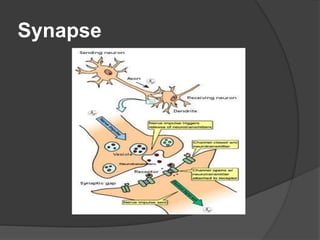
 In the nervous system, a synapse is a
structure that permits a neuron to pass
an electrical or chemical signal to
another cell (neural or otherwise).
 Synapses are essential to neuronal
function: neurons are cells that are
specialized to pass signals to individual
target cells.
Synapse
Introduction-Synapse
 There are two fundamentally different types of
synapses:
 In a chemical synapse, the presynaptic neuron
releases a chemical called a neurotransmitter
that binds to receptors located in the
postsynaptic cell.
 In an electrical synapse, the presynaptic and
postsynaptic cell membranes are connected
by channels that are capable of passing
electrical current, causing voltage changes in
the presynaptic cell to induce voltage changes
in the postsynaptic cell.
The Peripheral Nervous System
The peripheral nervous system consists of the
following principal elements:
 autonomic nervous system, which includes the
enteric nervous system
 somatic efferent nerves, innervating skeletal
muscle
 somatic and visceral afferent nerves.
Autonomic Nervous System
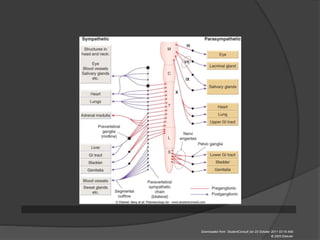
Autonomic pathways -consists of two neurons
arranged in series
somatic efferent pathways - a single motor neuron
connects the central nervous system to the skeletal
muscle fibre.
The two neurons in the autonomic pathway are
known, respectively, as preganglionic and
postganglionic.
Downloaded from: StudentConsult (on 23 October 2011 03:19 AM)
© 2005 Elsevier
Autonomic Nervous System
 The autonomic nervous system conveys
all the outputs from the central nervous
system to the rest of the body, except for
the motor innervations of skeletal
muscle.
Basic Anatomy and Physiology of the
Autonomic Nervous System
The autonomic nervous system consists of three
main anatomical divisions:
1. Sympathetic
2. Parasympathetic and
3. The Enteric Nervous System
(consisting of the intrinsic nerve plexuses of the
gastrointestinal tract, which are closely interconnected
with the sympathetic and parasympathetic systems)
Physiology of the Autonomic Nervous
System
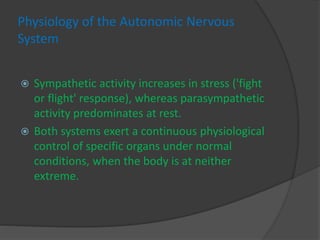
 Sympathetic activity increases in stress ('fight
or flight' response), whereas parasympathetic
activity predominates at rest.
 Both systems exert a continuous physiological
control of specific organs under normal
conditions, when the body is at neither
extreme.
Physiology of the Autonomic Nervous
System
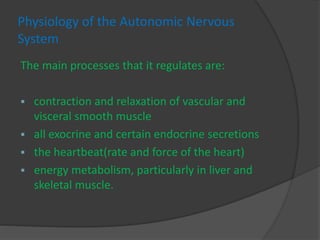
The main processes that it regulates are:
 contraction and relaxation of vascular and
visceral smooth muscle
 all exocrine and certain endocrine secretions
 the heartbeat(rate and force of the heart)
 energy metabolism, particularly in liver and
skeletal muscle.
The main effects of the Autonomic Nervous
System
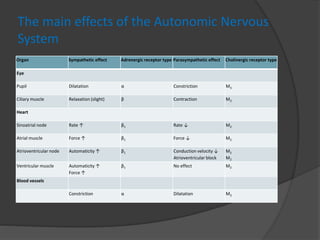
Organ Sympathetic effect Adrenergic receptor type Parasympathetic effect Cholinergic receptor type
Eye
Pupil Dilatation α Constriction M3
Ciliary muscle Relaxation (slight) β Contraction M3
Heart
Sinoatrial node Rate ↑ β1 Rate ↓ M2
Atrial muscle Force ↑ β1 Force ↓ M2
Atrioventricular node Automaticity ↑ β1 Conduction velocity ↓
Atrioventricular block
M2
M2
Ventricular muscle Automaticity ↑
Force ↑
β1 No effect M2
Blood vessels
Constriction α Dilatation M3
The main effects of the Autonomic Nervous
System
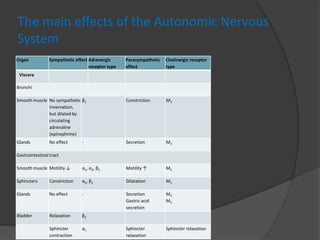
Organ Sympathetic effect Adrenergic
receptor type
Parasympathetic
effect
Cholinergic receptor
type
Viscera
Bronchi
Smooth muscle No sympathetic
innervation,
but dilated by
circulating
adrenaline
(epinephrine)
β2 Constriction M3
Glands No effect - Secretion M3
Gastrointestinal tract
Smooth muscle Motility ↓ α1, α2, β2 Motility ↑ M3
Sphincters Constriction α2, β2 Dilatation M3
Glands No effect - Secretion
Gastric acid
secretion
M3
M3
Bladder Relaxation β2
Sphincter
contraction
α1 Sphincter
relaxation
Sphincter relaxation
The main effects of the
Autonomic Nervous System
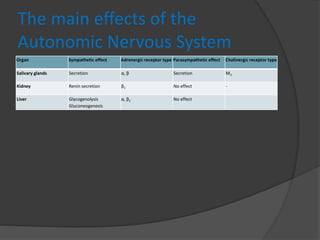
Organ Sympathetic effect Adrenergic receptor type Parasympathetic effect Cholinergic receptor type
Salivary glands Secretion α, β Secretion M3
Kidney Renin secretion β1 No effect -
Liver Glycogenolysis
Gluconeogenesis
α, β2 No effect
Neuro transmitters of the Autonomic
Nervous System
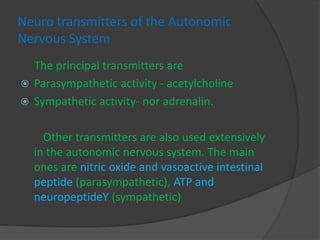
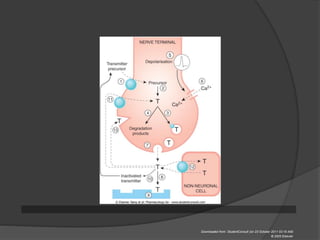
The principal transmitters are
 Parasympathetic activity - acetylcholine
 Sympathetic activity- nor adrenalin.
Other transmitters are also used extensively
in the autonomic nervous system. The main
ones are nitric oxide and vasoactive intestinal
peptide (parasympathetic), ATP and
neuropeptideY (sympathetic)
Downloaded from: StudentConsult (on 23 October 2011 03:19 AM)
© 2005 Elsevier
Parasympathetic/Cholinergic Receptors
 Main subdivision - muscarnic and nicotinic subtypes.
 Three main types of muscarnic receptors occur(mainly
heart, smooth muscle, glands)
 M1 receptors ('neural') producing slow excitation of
ganglia.
 M2 receptors ('cardiac') causing decrease in cardiac
rate and force of contraction (mainly of atria).
 M3 receptors ('glandular') causing secretion,
contraction of visceral smooth muscle, vascular
relaxation.
 Two further molecular muscarnic receptors subtypes,
M4 and M5, occur mainly in the CNS.
Parasympathetic/Cholinergic Receptors
 Nicotinic receptors fall into three main classes,
the muscle
 ganglionic and
 CNS types
Effects of Drugs on Cholinergic Transmission
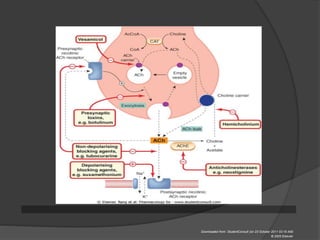
Drugs can influence cholinergic transmission either by acting
on postsynaptic ACh receptors as agonists or antagonists or by
affecting the release or destruction of endogenous ACh.
According to their physiological site of action:
1. muscarnic agonists
2. muscarnic antagonists
3. ganglion-stimulating drugs
4. ganglion-blocking drugs
5. neuromuscular-blocking drugs
6. Anticholinesterases and other drugs that enhance cholinergic
transmission.
Downloaded from: StudentConsult (on 23 October 2011 03:19 AM)
© 2005 Elsevier
Drugs Affecting Muscarnic Receptors
Muscarnic agonists
 Important compounds include acetylcholine, carbachol,
methacholine, muscarine and pilocarpine.
 Main effects are bradycardia and vasodilatation
(endothelium-dependent), leading to fall in blood pressure;
contraction of visceral smooth muscle (gut, bladder, bronchi,
etc.); exocrine secretions, pupillary constriction and ciliary
muscle contraction, leading to decrease of intraocular
pressure.
 Main use is in treatment of glaucoma (especially
pilocarpine).
Drugs Affecting Muscarnic Receptors
Muscarnic antagonists
 Most important compounds are atropine, scopolamine,
ipratropium and pirenzepine.
 Main effects are inhibition of secretions; tachycardia,
pupillary dilatation and paralysis of accommodation;
relaxation of smooth muscle (gut, bronchi, biliary tract,
bladder); inhibition of gastric acid secretion (especially
pirenzepine); central nervous system effects (mainly
excitatory with atropine; depressant, including
amnesia, with scopolamine), including antiemetic
effect and antiparkinsonian effect.
Clinical uses of Muscarnic Antagonists
 Cardiovascular
Treatment of sinus bradycardia (e.g. after myocardial infarction):
atropine.
 Ophthalmic
To dilate the pupil: for example tropicamide or cyclopentolate eye
drops.
 Neurological
Prevention of motion sickness: for example scopolamine (orally or
transdermally).
Parkinsonism especially to counteract movement disorders caused
by antipsychotic drugs : for example benzhexol, benztropine.
Clinical uses of Muscarnic Antagonists
 Respiratory
Asthma and chronic obstructive pulmonary disease -ipratropium or tiotropium by
inhalation.
 Anaesthetic premedication
To dry secretions: for example atropine, scopolamine. (Current anaesthetics are
relatively non-irritant,, so this use is now less important.)
 Gastrointestinal
 To facilitate endoscopy and gastrointestinal radiology by relaxing gastrointestinal
smooth muscle (antispasmodic action): for example scopolamine.
 As an antispasmodic in irritable bowel syndrome or colonic diverticular disease: for
example dicycloverine (dicyclomine).
 To treat peptic ulcer disease by suppressing gastric acid secretion for example
pirenzepine (M1-selective antagonist). This is used less since the introduction of
histamine H2 antagonists and proton pump inhibitors.
Nicotine receptor agonists and
antagonists/Drugs acting on autonomic
ganglia
Nicotine receptor agonists /Ganglion-stimulating drugs
 Compounds include nicotine, dimethylphenylpiperazinium
(DMPP).
 Both sympathetic and parasympathetic ganglia are stimulated,
so effects are complex, including tachycardia and increase of
blood pressure; variable effects on gastrointestinal motility and
secretions; increased bronchial, salivary and sweat secretions.
Additional effects result from stimulation of other neuronal
structures, including sensory and noradrenergic nerve
terminals.
 Nicotine also has important central nervous system effects.
 No therapeutic uses, except for nicotine to assist giving up
smoking.
Nicotine receptor agonists and
antagonists/Drugs acting on autonomic
ganglia
 Nicotine receptor antagonists/Ganglion-blocking drugs
 Compounds include hexamethonium, trimetaphan,
tubocurarine.
 Block all autonomic ganglia and enteric ganglia.
Main effects: hypotension and loss of cardiovascular
reflexes, inhibition of secretions, gastrointestinal
paralysis, impaired micturition.
 Clinically obsolete, except for occasional use of
trimetaphan to produce controlled hypotension in
anaesthesia
Noradrenergic transmission
 CATECHOLAMINES
Catecholamines are compounds containing a catechol moiety
(a benzene ring with two adjacent hydroxyl groups) and an amine
side-chain Pharmacologically, the most important ones are:
 Noradrenaline (norepinephrine), a transmitter released by
sympathetic nerve terminals
 Adrenaline (epinephrine), a hormone secreted by the adrenal
medulla
 Dopamine, the metabolic precursor of noradrenaline and
adrenaline, also a transmitter/neuromodulator in the central
nervous system
Classification of adrenoceptors
Main pharmacological classification into α and
β subtypes
 two main α-receptor subtypes, α1 and α2,
each divided into three further subtypes
 three β-adrenoceptor subtypes (β1, β2, β3)
 all belong to the super family of G-protein-
coupled receptors.
The Effects of adrenoceptors activation
 α1-receptors: vasoconstriction, relaxation of
gastrointestinal smooth muscle, salivary
secretion and hepatic glycogenolysis
 α2-receptors: inhibition of transmitter release
(including noradrenaline and acetylcholine
release from autonomic nerves), platelet
aggregation, contraction of vascular smooth
muscle, inhibition of insulin release
The Effects of adrenoceptors activation
 β1-receptors: increased cardiac rate and force
 β2-receptors: bronchodilatation,
vasodilatation, relaxation of visceral smooth
muscle, hepatic glycogenolysis and muscle
tremor
 β3-receptors: lipolysis.
DRUGS ACTING ON NORADRENERGIC
TRANSMISSION
 Many clinically important drugs, particularly
those used to treat cardiovascular, respiratory
and psychiatric disorders act by affecting
noradrenergic neuron function.
DRUGS ACTING ON NORADRENERGIC
TRANSMISSION
The main drug targets are:
 adrenoceptors
 monoamine transporters
 catecholamine-metabolising enzymes.
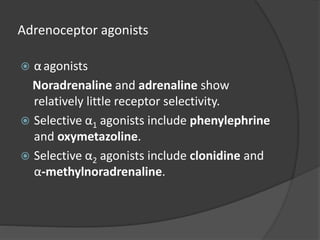
Adrenoceptor agonists
 αagonists
Noradrenaline and adrenaline show
relatively little receptor selectivity.
 Selective α1 agonists include phenylephrine
and oxymetazoline.
 Selective α2 agonists include clonidine and
α-methylnoradrenaline.
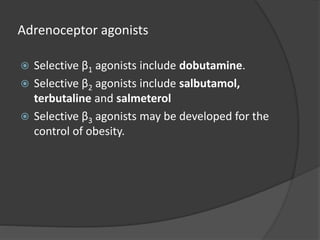
Adrenoceptor agonists
 Selective β1 agonists include dobutamine.
 Selective β2 agonists include salbutamol,
terbutaline and salmeterol
 Selective β3 agonists may be developed for the
control of obesity.
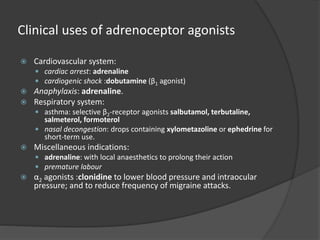
Clinical uses of adrenoceptor agonists
 Cardiovascular system:
 cardiac arrest: adrenaline
 cardiogenic shock :dobutamine (β1 agonist)
 Anaphylaxis: adrenaline.
 Respiratory system:
 asthma: selective β2-receptor agonists salbutamol, terbutaline,
salmeterol, formoterol
 nasal decongestion: drops containing xylometazoline or ephedrine for
short-term use.
 Miscellaneous indications:
 adrenaline: with local anaesthetics to prolong their action
 premature labour
 α2 agonists :clonidine to lower blood pressure and intraocular
pressure; and to reduce frequency of migraine attacks.
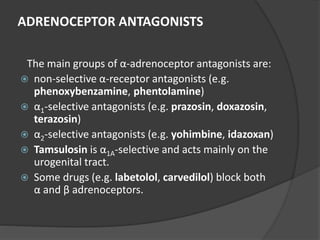
ADRENOCEPTOR ANTAGONISTS
The main groups of α-adrenoceptor antagonists are:
 non-selective α-receptor antagonists (e.g.
phenoxybenzamine, phentolamine)
 α1-selective antagonists (e.g. prazosin, doxazosin,
terazosin)
 α2-selective antagonists (e.g. yohimbine, idazoxan)
 Tamsulosin is α1A-selective and acts mainly on the
urogenital tract.
 Some drugs (e.g. labetolol, carvedilol) block both
α and β adrenoceptors.
Clinical uses of α-adrenoceptor antagonists
 Severe hypertension: α1-selective antagonists
(e.g. doxazosin) in combination with other
drugs.
 Benign prostatic hypertrophy (e.g. tamsulosin,
a selective α1A-receptor antagonist).
 Phaeochromocytoma: phenoxybenzamine
(irreversible antagonist) in preparation for
surgery.
β-Adrenoceptor antagonists
 Non-selective between β1 and β2
adrenoceptors: propranolol, alprenolol,
oxprenolol.
 β1-selective: atenolol, nebivolol.
 Alprenolol and oxprenolol have partial agonist
activity.
Clinical uses of β-adrenoceptor antagonists
 Cardiovascular:
 angina pectoris
 myocardial infarction
 dysrhythmias
 heart failure
 hypertension (no longer first choice)
 Other uses:
 glaucoma (e.g. timolol eye drops)
 Thyrotoxicosis as adjunct to definitive treatment
 Anxiety- to control somatic symptoms (e.g.
palpitations, tremor)
 migraine prophylaxis
 benign essential tremor (a familial disorder).

Autonomic Nervous system

  • 1.
  • 2.
  • 3.
    Introduction-Synapse  In thenervous system, a synapse is a structure that permits a neuron to pass an electrical or chemical signal to another cell (neural or otherwise).  Synapses are essential to neuronal function: neurons are cells that are specialized to pass signals to individual target cells.
  • 4.
  • 5.
    Introduction-Synapse  There aretwo fundamentally different types of synapses:  In a chemical synapse, the presynaptic neuron releases a chemical called a neurotransmitter that binds to receptors located in the postsynaptic cell.  In an electrical synapse, the presynaptic and postsynaptic cell membranes are connected by channels that are capable of passing electrical current, causing voltage changes in the presynaptic cell to induce voltage changes in the postsynaptic cell.
  • 6.
    The Peripheral NervousSystem The peripheral nervous system consists of the following principal elements:  autonomic nervous system, which includes the enteric nervous system  somatic efferent nerves, innervating skeletal muscle  somatic and visceral afferent nerves.
  • 7.
    Autonomic Nervous System Autonomicpathways -consists of two neurons arranged in series somatic efferent pathways - a single motor neuron connects the central nervous system to the skeletal muscle fibre. The two neurons in the autonomic pathway are known, respectively, as preganglionic and postganglionic.
  • 8.
    Downloaded from: StudentConsult(on 23 October 2011 03:19 AM) © 2005 Elsevier
  • 9.
    Autonomic Nervous System The autonomic nervous system conveys all the outputs from the central nervous system to the rest of the body, except for the motor innervations of skeletal muscle.
  • 10.
    Basic Anatomy andPhysiology of the Autonomic Nervous System The autonomic nervous system consists of three main anatomical divisions: 1. Sympathetic 2. Parasympathetic and 3. The Enteric Nervous System (consisting of the intrinsic nerve plexuses of the gastrointestinal tract, which are closely interconnected with the sympathetic and parasympathetic systems)
  • 11.
    Physiology of theAutonomic Nervous System  Sympathetic activity increases in stress ('fight or flight' response), whereas parasympathetic activity predominates at rest.  Both systems exert a continuous physiological control of specific organs under normal conditions, when the body is at neither extreme.
  • 12.
    Physiology of theAutonomic Nervous System The main processes that it regulates are:  contraction and relaxation of vascular and visceral smooth muscle  all exocrine and certain endocrine secretions  the heartbeat(rate and force of the heart)  energy metabolism, particularly in liver and skeletal muscle.
  • 13.
    The main effectsof the Autonomic Nervous System Organ Sympathetic effect Adrenergic receptor type Parasympathetic effect Cholinergic receptor type Eye Pupil Dilatation α Constriction M3 Ciliary muscle Relaxation (slight) β Contraction M3 Heart Sinoatrial node Rate ↑ β1 Rate ↓ M2 Atrial muscle Force ↑ β1 Force ↓ M2 Atrioventricular node Automaticity ↑ β1 Conduction velocity ↓ Atrioventricular block M2 M2 Ventricular muscle Automaticity ↑ Force ↑ β1 No effect M2 Blood vessels Constriction α Dilatation M3
  • 14.
    The main effectsof the Autonomic Nervous System Organ Sympathetic effect Adrenergic receptor type Parasympathetic effect Cholinergic receptor type Viscera Bronchi Smooth muscle No sympathetic innervation, but dilated by circulating adrenaline (epinephrine) β2 Constriction M3 Glands No effect - Secretion M3 Gastrointestinal tract Smooth muscle Motility ↓ α1, α2, β2 Motility ↑ M3 Sphincters Constriction α2, β2 Dilatation M3 Glands No effect - Secretion Gastric acid secretion M3 M3 Bladder Relaxation β2 Sphincter contraction α1 Sphincter relaxation Sphincter relaxation
  • 15.
    The main effectsof the Autonomic Nervous System Organ Sympathetic effect Adrenergic receptor type Parasympathetic effect Cholinergic receptor type Salivary glands Secretion α, β Secretion M3 Kidney Renin secretion β1 No effect - Liver Glycogenolysis Gluconeogenesis α, β2 No effect
  • 16.
    Neuro transmitters ofthe Autonomic Nervous System The principal transmitters are  Parasympathetic activity - acetylcholine  Sympathetic activity- nor adrenalin. Other transmitters are also used extensively in the autonomic nervous system. The main ones are nitric oxide and vasoactive intestinal peptide (parasympathetic), ATP and neuropeptideY (sympathetic)
  • 17.
    Downloaded from: StudentConsult(on 23 October 2011 03:19 AM) © 2005 Elsevier
  • 18.
    Parasympathetic/Cholinergic Receptors  Mainsubdivision - muscarnic and nicotinic subtypes.  Three main types of muscarnic receptors occur(mainly heart, smooth muscle, glands)  M1 receptors ('neural') producing slow excitation of ganglia.  M2 receptors ('cardiac') causing decrease in cardiac rate and force of contraction (mainly of atria).  M3 receptors ('glandular') causing secretion, contraction of visceral smooth muscle, vascular relaxation.  Two further molecular muscarnic receptors subtypes, M4 and M5, occur mainly in the CNS.
  • 19.
    Parasympathetic/Cholinergic Receptors  Nicotinicreceptors fall into three main classes, the muscle  ganglionic and  CNS types
  • 20.
    Effects of Drugson Cholinergic Transmission Drugs can influence cholinergic transmission either by acting on postsynaptic ACh receptors as agonists or antagonists or by affecting the release or destruction of endogenous ACh. According to their physiological site of action: 1. muscarnic agonists 2. muscarnic antagonists 3. ganglion-stimulating drugs 4. ganglion-blocking drugs 5. neuromuscular-blocking drugs 6. Anticholinesterases and other drugs that enhance cholinergic transmission.
  • 21.
    Downloaded from: StudentConsult(on 23 October 2011 03:19 AM) © 2005 Elsevier
  • 22.
    Drugs Affecting MuscarnicReceptors Muscarnic agonists  Important compounds include acetylcholine, carbachol, methacholine, muscarine and pilocarpine.  Main effects are bradycardia and vasodilatation (endothelium-dependent), leading to fall in blood pressure; contraction of visceral smooth muscle (gut, bladder, bronchi, etc.); exocrine secretions, pupillary constriction and ciliary muscle contraction, leading to decrease of intraocular pressure.  Main use is in treatment of glaucoma (especially pilocarpine).
  • 23.
    Drugs Affecting MuscarnicReceptors Muscarnic antagonists  Most important compounds are atropine, scopolamine, ipratropium and pirenzepine.  Main effects are inhibition of secretions; tachycardia, pupillary dilatation and paralysis of accommodation; relaxation of smooth muscle (gut, bronchi, biliary tract, bladder); inhibition of gastric acid secretion (especially pirenzepine); central nervous system effects (mainly excitatory with atropine; depressant, including amnesia, with scopolamine), including antiemetic effect and antiparkinsonian effect.
  • 24.
    Clinical uses ofMuscarnic Antagonists  Cardiovascular Treatment of sinus bradycardia (e.g. after myocardial infarction): atropine.  Ophthalmic To dilate the pupil: for example tropicamide or cyclopentolate eye drops.  Neurological Prevention of motion sickness: for example scopolamine (orally or transdermally). Parkinsonism especially to counteract movement disorders caused by antipsychotic drugs : for example benzhexol, benztropine.
  • 25.
    Clinical uses ofMuscarnic Antagonists  Respiratory Asthma and chronic obstructive pulmonary disease -ipratropium or tiotropium by inhalation.  Anaesthetic premedication To dry secretions: for example atropine, scopolamine. (Current anaesthetics are relatively non-irritant,, so this use is now less important.)  Gastrointestinal  To facilitate endoscopy and gastrointestinal radiology by relaxing gastrointestinal smooth muscle (antispasmodic action): for example scopolamine.  As an antispasmodic in irritable bowel syndrome or colonic diverticular disease: for example dicycloverine (dicyclomine).  To treat peptic ulcer disease by suppressing gastric acid secretion for example pirenzepine (M1-selective antagonist). This is used less since the introduction of histamine H2 antagonists and proton pump inhibitors.
  • 26.
    Nicotine receptor agonistsand antagonists/Drugs acting on autonomic ganglia Nicotine receptor agonists /Ganglion-stimulating drugs  Compounds include nicotine, dimethylphenylpiperazinium (DMPP).  Both sympathetic and parasympathetic ganglia are stimulated, so effects are complex, including tachycardia and increase of blood pressure; variable effects on gastrointestinal motility and secretions; increased bronchial, salivary and sweat secretions. Additional effects result from stimulation of other neuronal structures, including sensory and noradrenergic nerve terminals.  Nicotine also has important central nervous system effects.  No therapeutic uses, except for nicotine to assist giving up smoking.
  • 27.
    Nicotine receptor agonistsand antagonists/Drugs acting on autonomic ganglia  Nicotine receptor antagonists/Ganglion-blocking drugs  Compounds include hexamethonium, trimetaphan, tubocurarine.  Block all autonomic ganglia and enteric ganglia. Main effects: hypotension and loss of cardiovascular reflexes, inhibition of secretions, gastrointestinal paralysis, impaired micturition.  Clinically obsolete, except for occasional use of trimetaphan to produce controlled hypotension in anaesthesia
  • 28.
    Noradrenergic transmission  CATECHOLAMINES Catecholaminesare compounds containing a catechol moiety (a benzene ring with two adjacent hydroxyl groups) and an amine side-chain Pharmacologically, the most important ones are:  Noradrenaline (norepinephrine), a transmitter released by sympathetic nerve terminals  Adrenaline (epinephrine), a hormone secreted by the adrenal medulla  Dopamine, the metabolic precursor of noradrenaline and adrenaline, also a transmitter/neuromodulator in the central nervous system
  • 29.
    Classification of adrenoceptors Mainpharmacological classification into α and β subtypes  two main α-receptor subtypes, α1 and α2, each divided into three further subtypes  three β-adrenoceptor subtypes (β1, β2, β3)  all belong to the super family of G-protein- coupled receptors.
  • 30.
    The Effects ofadrenoceptors activation  α1-receptors: vasoconstriction, relaxation of gastrointestinal smooth muscle, salivary secretion and hepatic glycogenolysis  α2-receptors: inhibition of transmitter release (including noradrenaline and acetylcholine release from autonomic nerves), platelet aggregation, contraction of vascular smooth muscle, inhibition of insulin release
  • 31.
    The Effects ofadrenoceptors activation  β1-receptors: increased cardiac rate and force  β2-receptors: bronchodilatation, vasodilatation, relaxation of visceral smooth muscle, hepatic glycogenolysis and muscle tremor  β3-receptors: lipolysis.
  • 32.
    DRUGS ACTING ONNORADRENERGIC TRANSMISSION  Many clinically important drugs, particularly those used to treat cardiovascular, respiratory and psychiatric disorders act by affecting noradrenergic neuron function.
  • 33.
    DRUGS ACTING ONNORADRENERGIC TRANSMISSION The main drug targets are:  adrenoceptors  monoamine transporters  catecholamine-metabolising enzymes.
  • 34.
    Adrenoceptor agonists  αagonists Noradrenalineand adrenaline show relatively little receptor selectivity.  Selective α1 agonists include phenylephrine and oxymetazoline.  Selective α2 agonists include clonidine and α-methylnoradrenaline.
  • 35.
    Adrenoceptor agonists  Selectiveβ1 agonists include dobutamine.  Selective β2 agonists include salbutamol, terbutaline and salmeterol  Selective β3 agonists may be developed for the control of obesity.
  • 36.
    Clinical uses ofadrenoceptor agonists  Cardiovascular system:  cardiac arrest: adrenaline  cardiogenic shock :dobutamine (β1 agonist)  Anaphylaxis: adrenaline.  Respiratory system:  asthma: selective β2-receptor agonists salbutamol, terbutaline, salmeterol, formoterol  nasal decongestion: drops containing xylometazoline or ephedrine for short-term use.  Miscellaneous indications:  adrenaline: with local anaesthetics to prolong their action  premature labour  α2 agonists :clonidine to lower blood pressure and intraocular pressure; and to reduce frequency of migraine attacks.
  • 37.
    ADRENOCEPTOR ANTAGONISTS The maingroups of α-adrenoceptor antagonists are:  non-selective α-receptor antagonists (e.g. phenoxybenzamine, phentolamine)  α1-selective antagonists (e.g. prazosin, doxazosin, terazosin)  α2-selective antagonists (e.g. yohimbine, idazoxan)  Tamsulosin is α1A-selective and acts mainly on the urogenital tract.  Some drugs (e.g. labetolol, carvedilol) block both α and β adrenoceptors.
  • 38.
    Clinical uses ofα-adrenoceptor antagonists  Severe hypertension: α1-selective antagonists (e.g. doxazosin) in combination with other drugs.  Benign prostatic hypertrophy (e.g. tamsulosin, a selective α1A-receptor antagonist).  Phaeochromocytoma: phenoxybenzamine (irreversible antagonist) in preparation for surgery.
  • 39.
    β-Adrenoceptor antagonists  Non-selectivebetween β1 and β2 adrenoceptors: propranolol, alprenolol, oxprenolol.  β1-selective: atenolol, nebivolol.  Alprenolol and oxprenolol have partial agonist activity.
  • 40.
    Clinical uses ofβ-adrenoceptor antagonists  Cardiovascular:  angina pectoris  myocardial infarction  dysrhythmias  heart failure  hypertension (no longer first choice)  Other uses:  glaucoma (e.g. timolol eye drops)  Thyrotoxicosis as adjunct to definitive treatment  Anxiety- to control somatic symptoms (e.g. palpitations, tremor)  migraine prophylaxis  benign essential tremor (a familial disorder).