1
Targeted Group: MSc in Automotive Engineering
26 August 2023
Advanced Vehicle Control System – AEng6111
Lectured By:- Solomon N (PhD)
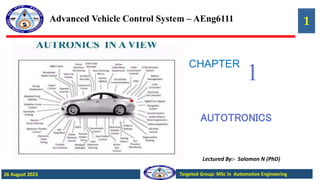
AUTOTRONICS
1
CHAPTER
2
Advanced Vehicle Control System
26 August 2023
Outlines
 Vehicle communication
 Network topology,
 Automotive network,
 Bus systems,
 Vehicle system architecture,
 Multiplexing,
 Mechatronics,
 Control unit,
 Modules,
 Energy management,
 Electromagnetic compatibility,
 The concept of an electronic engine control system, and
 Modern automotive instrumentation
3
Advanced Vehicle Control System
26 August 2023
What is Autotronics?
 The Autotronics is referred to as modern automotive technology and also
commonly known as Automotive Mechatronics.
 Autotronics is the automotive technology which combines AUTOMOBILE
and ELECTRONICS.
 Its objective is to develop and understand the principles of conversion in
design, construction and working of mechanical and electronic systems in
automobiles.
 while hybrid refers to technology that uses two or more distinct power
sources to move the vehicle.
4
Advanced Vehicle Control System
26 August 2023
Cont.
 Conventional automobiles depends on high power data processors to
operate, efficiently, the systems through electronic controls.
 Modern electric cars rely/depend on power electronics for the main
propulsion control as well as the energy management system.
 Future autonomous cars will rely on powerful computer systems, an
array of sensors, networking and satellite navigation. All these are not
possible without electronics.
5
Advanced Vehicle Control System
26 August 2023
Electronics in motor vehicle
6
Advanced Vehicle Control System
26 August 2023
Electronics in motor vehicle
CAN – Control Area Network
LIN – Local Interconnect
Network
Flexiray – FlexRay Gateway
Tool for Test Labs and
Vehicle Trials
VAN - Vehicle area network
MOST – Media Oriented
System Transport
D2B- Decimal to Binary
7
Advanced Vehicle Control System
26 August 2023
Vehicle communication
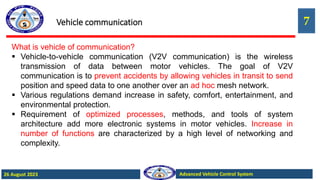
What is vehicle of communication?
 Vehicle-to-vehicle communication (V2V communication) is the wireless
transmission of data between motor vehicles. The goal of V2V
communication is to prevent accidents by allowing vehicles in transit to send
position and speed data to one another over an ad hoc mesh network.
 Various regulations demand increase in safety, comfort, entertainment, and
environmental protection.
 Requirement of optimized processes, methods, and tools of system
architecture add more electronic systems in motor vehicles. Increase in
number of functions are characterized by a high level of networking and
complexity.
8
Advanced Vehicle Control System
26 August 2023
Vehicle communication
ECU interconnection in a modern mid-size vehicle
9
Advanced Vehicle Control System
26 August 2023
Vehicle communication
 In today’s vehicles, virtually all the ECUs are networked directly or indirectly
(e.g. via gateways) with each other.
 Gateways facilitate the exchange of data between different communication
systems and beyond vehicle limits. Use of 360° camera for automatic park-
assist also enables the driver to have a bird’s-eye view of the vehicle in the
infotainment-system display. [Connection to radio systems and the Internet is
an example of communication beyond vehicle limits.]
 In the beginning of the development of communication systems, logic
functions were distributed to many individual ECUs [function-specific ECUs]
in the vehicle. This means that virtually every function had its own ECU.
10
Advanced Vehicle Control System
26 August 2023
Vehicle communication
 Later when the number of functions increased sharply, new functions
were frequently integrated in ECUs that already existed in the vehicle.
Integration of ‘parking-assist function’ in the “Body Control Module” is
an example. [BCM is responsible for controlling and monitoring the
functions and components of the body electronics like ‘light-actuator
technology’ ‘door-actuator technology.’]
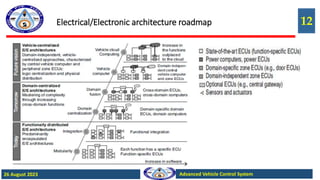
 The new development is called “Functionally distributed E/E
architectures”.
11
Advanced Vehicle Control System
26 August 2023
Vehicle communication
 Later, to manage dependencies of the functions within the individual domains
increased sharply, “domain-centralized” and “cross-domain-centralized” E/E
architectures. [Domain refers to the grouping of similar functions. Examples of
domain are body control, infotainment, driver assistance etc.] An example of
cross-domain function is “Vehicle Motion Control”. In this, sensors, actuators,
and functions from the “Powertrain” and “Chassis and Safety” domains interact
directly with each other.
 The next step would be Vehicle-centralized E/E architectures in which the
vehicle is in particular characterized by a high degree of automation, networked
systems [both vehicle-internal and vehicle-external] and by multimedia and
infotainment applications. In this architecture, all the logic are to be brought
together on a powerful central vehicle computer. All the functional interfaces
would then be located within this central vehicle computer.
12
Advanced Vehicle Control System
26 August 2023
Electrical/Electronic architecture roadmap
13
Advanced Vehicle Control System
26 August 2023
Network topology
 Network topology refers to the way different computers, devices or nodes
connect to each other in a communication network.
 It describes their physical arrangement and explains the logical flow of
information throughout the network.
 A computer network topology can consist of one physical topology and
several logical topologies.
 A physical topology explains how computers, devices or nodes connect
with each other in a network based on their location.
 It involves assessing the physical layout of network cables and
workstations. Conversely, a logical topology explains how data flows from
one device to another based on network protocols.
 Therefore, network topology defines the virtual shape, layout and
structure of a network from both a physical and logical viewpoint.
14
Advanced Vehicle Control System
26 August 2023
Network topology
 Network topology:- With the tremendous speed at which computing
technology is advancing, the complexity of automotive control system is
ever increasing.
 The individual components need to be networked so that the multitude of
information that is managed by the individual systems can also be used
elsewhere throughout the system.
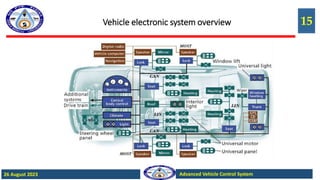
 A network is a system in which a group of elements can exchange
information via a transportation medium. [If the elements are visualized as
nodes and the communication relationships as lines, a picture is created
of a network where many nodes are related to several other nodes.]
 The nodes in a communication network are also often referred to as
network subscribers or stations.
15
Advanced Vehicle Control System
26 August 2023
Vehicle electronic system overview
16
Advanced Vehicle Control System
26 August 2023
Network topology
 Different requirements are made of the network topology for a variety of
communication network applications, while the topology determines some
of the characteristics of the overall network. All network topologies are
based on the following seven basic topologies
o Point-to-point network topology.
o Bus topology
o Star topology
o Ring topology
o Mesh topology
o Tree network topology and
o Hybrid topologies are created by combining these basic topologies.
17
Advanced Vehicle Control System
26 August 2023
Network topology
Nodes: In networking, nodes refer to
connection points, redistribution points and
communication endpoints.
Cables: The physical network topology
consists of several types of cables and
equipment, including coaxial cables,
twisted pair cables and optical fiber cables.
Hub and switch: The hub and switch
connect multiple devices in a network,
receive messages and transmit them to the
correct nodes or devices.
Router: A router analyzes, receives and
transmits information between different IP
networks by identifying the correct IP
addresses of source and destination hosts.
18
Advanced Vehicle Control System
26 August 2023
Network topology
1. Point-to-point network topology;- is the simplest method. This type of
network topology involves connecting two nodes or devices using a
common link. The two devices could be two computers, servers, routers
or switches connected to each other with a cable. Point-to-point network
topology is common in computer networking, computer architecture and
telecommunications systems.
Some of the advantages of using point-to-point network topology include:
o High bandwidth and speed
o Low latency/dormancy
o Easy maintenance
19
Advanced Vehicle Control System
26 August 2023
Network topology
2. Bus network topology:- is a foundational method that many network
administrators use to connect all of the devices or nodes to one primary cable
with various drop lines and taps.
o Drop lines are the cables that connect to the primary cable, also known as
the bus, while taps are the individual connectors. This creates one channel
for communication throughout the network. When someone uses their
computer to send a message through this type of network, all of the
connected computers are aware of this action. However, only the receiver of
the message can accept it by verifying its address, which is attached to the
data frame.
20
Advanced Vehicle Control System
26 August 2023
Network topology
Advantages of bus systems in comparison to conventional wiring:
o Reduced costs with less weight and installation space because of fewer
cables in the wiring harness
o Better reliability and functional reliability due to fewer plug-in connections
o Simplification of vehicle assembly during production
o Multiple use of sensor signals
o Simple connection of system components to a bus
o Easier handling of equipment and special equipment variants in a vehicle
21
Advanced Vehicle Control System
26 August 2023
Cont.
Automotive Networking and Bus system
 Electrical and electronic systems in motor vehicles
influence and complement each other. For example,
signal lines were used in previous injection and ignition
systems in order to simplify communication between
these two systems.
 Rapid increase in the number of electronic systems
increased the information that was being exchanged.
This increased the number of signal lines and plug
connections required. Transfer of large volumes of data,
from different sources, became easier when a serial
bus system was first used in a vehicle [Mercedes-Benz
500E] in 1991.
22
Advanced Vehicle Control System
26 August 2023
Requirements for bus systems
 Data transfer rate [Transfer rate, Data rate or Bit rate]
o This variable specifies the volume of data that is transmitted during a time unit
[bits/seconds]. The required data rate is dependent on the application. For
example, to switch on and off the air-conditioning compressor a slower transfer
rate is required where as to transfer audio signals a higher rate is required.
 Interference immunity
o Ideally, the data should be transferred without interference. However, this cannot
be guaranteed in a motor vehicle because of electromagnetic effects [EMI]. The
interference immunity requirements depend on the safety relevance of the
electronic systems concerned. Lesser requirements are made of comfort and
convenience systems than the ABS.
23
Advanced Vehicle Control System
26 August 2023
Requirements for bus systems
 Real-time capability
o This requirement guarantees that the system results are calculated within a
fixed time interval. The duration of the time interval depends on the application.
[Eg. The ABS must react to the incipient locking of a wheel within a few
milliseconds (wheel speed reduction), whereas response times of 100ms are
adequate for actuating the power-window motor.] Human beings cannot
perceive delay periods of less than 100ms. If signals from other control units
are needed for functions (e.g. a torque reduction request during a shift
operation), the bus system must transmit the data at a faster rate and with a
smaller time delay so that the overall system complies with the specified real-
time requirements.
24
Advanced Vehicle Control System
26 August 2023
Requirements for bus systems
 Number of network nodes
o The maximum number of nodes
to be integrated varies for
different areas of vehicle
operation. The number of nodes
for comfort and convenience
systems may be high due to
servomotor networking (e.g. seat
adjustment) and intelligent
sensors (e.g. rain sensors).
Several identical busses can be
used if necessary.
Classification of bus Systems
CLASS A
Transfer rate Low data rates [up to 10 kbit/s]
Applications Actuator and sensor networking
Representative LIN
CLASS B
Transfer rate Average data rates [up to 125 kbit/s]
Applications
Complex mechanisms for error handling, control unit networking in
the comfort functions
Representative Low speed CAN [CAN B]
CLASS C
Transfer rate High data rates [up to 1 Mbit/s]
Applications
Real-time requirements, control unit networking in the drive and
running gear functions
Representative High speed CAN
CLASS C+
Transfer rate Extremely high data rates [up to 10 Mbit/s]
Applications
Real-time requirements, control unit networking in the drive and
running gear functions
Representative FlexRay
CLASS D
Transfer rate Extremely high data rates [up to 10 Mbit/s]
Applications Control unit networking in the telematics and multi-media functions
Representative MOS
25
Advanced Vehicle Control System
26 August 2023
Requirements for bus systems
Do a comparative study of the following bus systems: CAN-A, CAN-B, LIN, & TP
 Network applications in a vehicle
The overall vehicle system can be divided into four domains or functional areas from
the point of view or electrics/electronics:
o Drivetrain
o Chassis
o Interior and
o Telematics
o In the drivetrain and chassis domains, the emphasis is primarily on real-time applications. A system is said to
be having real-time capability if its response times are adequate for the task in hand. [example scenario;
rapid ignition timing advance in the ‘Motronic’ after a request from the traction-control system for reducing
torque and therefore preventing the wheel from spinning.] In the interior domain, the main focus is on
multiplex aspects in networking. Mainly multimedia and infotainment applications are networked in the
telematics domain.
26
Advanced Vehicle Control System
26 August 2023
Requirements for bus systems
Do a comparative study of the following bus systems: CAN-A, CAN-B, LIN, & TP
 Real time applications
The drivetrain and chassis systems are assigned to class C network. [These require
fast transfer rates in order to ensure the real-time behavior that is required for these
applications.] These requirements are met by the CAN bus with a transfer rate of 500 kBaud (high-speed
CAN). [Baud is the rate at which information is transferred. 500kBaud means that the port is capable of
transferring a maximum of 500 kbits per second].Examples of systems that run on this network:
o Engine-management system [Motronic or electronic diesel control, EDC]
o Transmission control
o Antilock brake systems, ABS
o Vehicle dynamics control [e.g. electronic stability program, ESP]
o Chassis control systems [e.g. active body control, ABC]
o Support systems [e.g. adaptive cruise control, ACC]
27
Advanced Vehicle Control System
26 August 2023
Requirements for bus systems
Do a comparative study of the following bus systems: CAN-A, CAN-B, LIN, & TP
 Multiplex applications
The multiplex application is suitable for controlling and regulating components in the body and
comfort and convenience electronics area (class B), such as
o Displays
o Lighting
o Access authorization with anti-theft warning device
o Air-conditioning
o Seat and mirror adjustment
o Door module (power-window unit, door-mirror adjustment)
o Windshield wipers
o Headlamp adjustment
The transfer rate requirements are not as high for class B systems as they are for class C systems. For this
reason, low-speed CAN with a transfer rate of 125 kbit/s or single-wire CAN with 33 kbit/s. can be used. If the
transfer rate requirements drop to less than 20 kbit/s, the low-cost LIN is more frequently used. Applications are
mainly in the mechatronics area; examples being the transfer of switch information or the activation of actuators.
28
Advanced Vehicle Control System
26 August 2023
Requirements for bus systems
Do a comparative study of the following bus systems: CAN-A, CAN-B, LIN, &
TP
 Multimedia networking
Mobile communication applications combine components such as
o Car sound system
o CD changer
o Navigation system
o Driver-information systems
o Telephone
o Video system
o Voice input
o Internet, E-mail
o Back-up camera
29
Advanced Vehicle Control System
26 August 2023
Network topology
3. Ring network topology: consists of two primary point-to-point links that connect
one device to two more devices located on each side of it. This creates a ring of
devices that data can flow through until it reaches its target device. In this
configuration, the way messages pass from one device to another is circular and
unidirectional. Each device or computer in the ring has access to the message for a
fixed amount of time to assist with the transmission. When the message reaches its
destination, the receiver removes the data. Some of the advantages of using ring
network topology include:
o Easy installation
o Minimal cabling required
o Reduced data collision
30
Advanced Vehicle Control System
26 August 2023
Network topology
3. Ring network topology
Media Oriented System Transport [MOST] is a
software protocol and hardware architecture. MOST
is optimized for automotive infotainment [multimedia
networking] system. MOST buses uses ring
topology and synchronous data communication to
transport audio, video, voice and data signals via
plastic optical fiber (POF) (MOST25, MOST150) or
electrical conductor (MOST50, MOST150) physical
layers. It provides an optical solution for automotive
peripherals like car radios, CD and DVD players,
and GPS navigation systems.
31
Advanced Vehicle Control System
26 August 2023
Network topology
4. Star network topology:- is the most common configuration. In this layout, each
device or node connects to a central network hub. Devices use this central hub to
communicate with each other indirectly. If a device wants to send or receive a
message, it must first contact the hub to act as a middleware between devices.
Once the hub understands what type of message the device wants to send, it
transmits it via broadcast or unicast to the designated receivers. The main reason
star network topology is so popular is because it improves network security by
preventing data from passing through every device. Some of the other advantages
of using star network topology include:
o Centralized control
o Easy scalability and reconfiguration
o Cost-efficiency
32
Advanced Vehicle Control System
26 August 2023
Network topology
5. Mesh network topology:- involves creating a dedicated point-to-point link
between each device in a network. This allows data to transmit directly between
two devices without flowing through other devices in the same network. There are
two primary types of mesh network topologies.
 The first is a full mesh network topology. In this configuration, each node
connects to every other node within the network.
 The second is a partial mesh network topology. In this layout, some of the nodes
may not be connected to every single node within the network. Some of the
advantages of using mesh network topology include:
o Fast communication
o More privacy and better security
o Decreased congestion on channels
33
Advanced Vehicle Control System
26 August 2023
Network topology
6. Tree network topology:- connects star networks by integrating bus networks to
create a parent-child hierarchy. In this configuration, each node is either directly
or indirectly connected to the primary bus cable. In order to accomplish this,
network administrators divide the network into segments, which makes them
easier to maintain. Each segment consists of a primary hub that connects all of
the sub-hubs. Some of the advantages of using tree network topology include:
o Extended distance network coverage
o Limited data loss
o Increased number of direct and indirect nodes
34
Advanced Vehicle Control System
26 August 2023
Network topology
7. Hybrid network topology:- topology combines at least two other network
topologies. This type of configuration is popular because it allows network
administrators to create network topologies that are practical and meet the
unique needs of each organization. For example, a network administrator might
use a bus network topology to house both a star network topology and a ring
network topology by using drop lines and taps to connect with them. This makes
it easy for network administrators to select the best features of each type of
network topology. Some of the advantages of using hybrid network topology
include:
o Increased volume of nodes
o Improved flexibility
o Increased reliability
35
Advanced Vehicle Control System
26 August 2023
Vehicle System Architecture
• A 1950’s car electrical network had approx. 40 lines. Only electric cables
required for the battery, starter, ignition and the lighting and signaling
systems.
• In the 1990s the cabling work in a luxury class vehicle amounted to
around 3 km.
• 5 years after the millennium, depending on the class, a typical vehicle had
20 to 80 electronic control units. Up to around 90 % of innovations in
modern motor vehicle can only be realized by electronics and
microprocessor-controlled systems.
36
Advanced Vehicle Control System
26 August 2023
Vehicle System Architecture
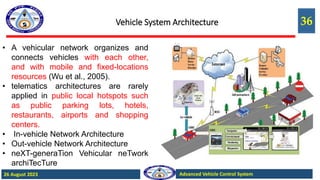
• A vehicular network organizes and
connects vehicles with each other,
and with mobile and fixed-locations
resources (Wu et al., 2005).
• telematics architectures are rarely
applied in public local hotspots such
as public parking lots, hotels,
restaurants, airports and shopping
centers.
• In-vehicle Network Architecture
• Out-vehicle Network Architecture
• neXT-generaTion Vehicular neTwork
archiTecTure
37
Advanced Vehicle Control System
26 August 2023
Vehicle System Architecture
 IN-VEHICLE NETWORK
ARCHITECTURE
Disaster communication network that
combine different automotive bus
protocols
o CAN (Controled Area Network)
o LIN (Local Interconect Network)
o Flex-Ray
o vasos and osek/VdX in-Vehicle
management system
 CAN (Controled Area Network)
 German automotive system supplier Robert Bosch
created CAN in the mid-1980s for automotive
applications as an effective means of allowing
robust serial communication (Pazul et al., 1999)
 The goal: establish a standard for more reliable and
efficient communication by integrating devices,
sensors and actuators in a system for real-time
control applications
38
Advanced Vehicle Control System
26 August 2023
Vehicle System Architecture
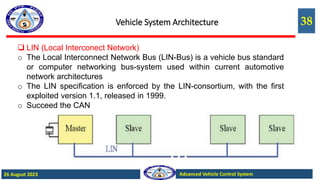
 LIN (Local Interconect Network)
o The Local Interconnect Network Bus (LIN-Bus) is a vehicle bus standard
or computer networking bus-system used within current automotive
network architectures
o The LIN specification is enforced by the LIN-consortium, with the first
exploited version 1.1, released in 1999.
o Succeed the CAN
39
Advanced Vehicle Control System
26 August 2023
Vehicle System Architecture
 Flex-Ray
provides a high-speed serial communication, time
triggered bus and fault-tolerant communication
between electronic devices for future automotive
applications (FlexRay, 2005; Xu et al., 2008)
o FlexRay (2005) was developed for the next
generation of automobiles and future
applications, including x-by-wire, by a
consortium founded by BMW, Bosch,
DaimlerChrysler and Philips in 2000 (FlexRay
Consortium, 2009).
o FlexRay serving as the backbone provides
determinism for engine control and fault
tolerance for steer-by-wire, brake-bywire and
other advanced safety applications
40
Advanced Vehicle Control System
26 August 2023
Vehicle System Architecture
 vasos and osek/VdX in-Vehicle management system
o vASOS (Sun et al., 2006) (Vehicular Application Specific Embedded
Operating Systems) is designed specifically for vehicle use, and is
designed to run on a high-performance user interface computer.
o It fulfills and provides specific device drivers, such as CAN/LIN buses,
which are used to communicate with other ECU nodes for diagnostic
purposes, and other fundamental network functions for the vehicle
domain
41
Advanced Vehicle Control System
26 August 2023
Vehicle System Architecture
The properties of vASOS are as follows:
o Focusing on system real-time
performance, scalability and
robustness
o Small kernel size, small memory
footprint, low-cost and high efficiency.
o Plug and play device driver interfaces
for expansibility
o Emphasis on network control
methods, especially wireless
networks
o Fast boot-up and good power
management
Architecture
42
Advanced Vehicle Control System
26 August 2023
Vehicle System Architecture
OUT-VEHICLE NETWORK
ARCHITECTUR (ieee 802.11p
and Wimax)
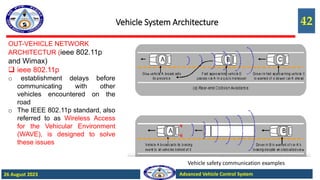
 ieee 802.11p
o establishment delays before
communicating with other
vehicles encountered on the
road
o The IEEE 802.11p standard, also
referred to as Wireless Access
for the Vehicular Environment
(WAVE), is designed to solve
these issues
Vehicle safety communication examples
43
Advanced Vehicle Control System
26 August 2023
Vehicle System Architecture
OUT-VEHICLE NETWORK ARCHITECTUR
 Wimax (Worldwide Interoperability of Microwave Access)
o The Mobile WiMAX network consists of the access services network (ASN) and connectivity
services network (CSN)
44
Advanced Vehicle Control System
26 August 2023
Vehicle System Architecture
 NEXT-GENERATION VEHICULAR NETWORK ARCHITECTURE
Under development at the University of Detroit Mercy by several researchers in
collaboration (Mahfoud et al., 2008)
o in-Vehicle personal computer
o system architecture
 IN-VEHICLE PERSONAL COMPUTER
o Automotive manufacturers are planning to provide new Internet and
entertainment services inside vehicles.
o Intel Corporation has announced plans to bring PCs to cars in a project called
Connected Car PC Technology
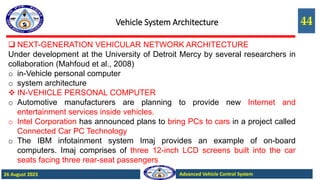
o The IBM infotainment system Imaj provides an example of on-board
computers. Imaj comprises of three 12-inch LCD screens built into the car
seats facing three rear-seat passengers
45
Advanced Vehicle Control System
26 August 2023
Vehicle System Architecture
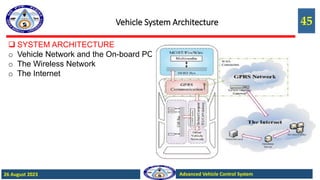
 SYSTEM ARCHITECTURE
o Vehicle Network and the On-board PC
o The Wireless Network
o The Internet
46
Advanced Vehicle Control System
26 August 2023
Vehicle System Architecture
A typical scenario is as given below;
• The radar sensor of the Adaptive Cruise Control system (ACC) measures the
distance to the vehicle traveling in front. If this distance is shorter than a
specified minimum distance, the ACC electronic control unit sends this
information to the engine management, the ESP electronic control unit and the
airbag electronic control unit. The engine management reduces torque and
thus driving speed. If this is not sufficient, the Electronic Stability Program
(ESP) must also generate brake pressure to decelerate the vehicle. If the
distance continues to shorten, the airbag and seat-belt pre-tensioners are set
to emergency standby. The communication between the electronic control
units cannot take more than fractions of a second. The more electronic control
units interact in the one complete system, the more difficult it becomes for
them to communicate undisturbed.
47
Advanced Vehicle Control System
26 August 2023
Vehicle System Architecture
A typical scenario is as given below;
• The networking of these electronics creates the prerequisite for having this wide
variety of electronic systems integrated within the complete vehicle system to form a
whole. The proportion of electrics and electronics in the motor vehicle will continue to
increase. Advancements in engine technologies, safety, comfort and convenience,
and infotainment etc. continuously increases electronics in modern vehicles.
However, this results in a complexity that can only be overcome at considerable
expense.
• The architecture of a system represents its “construction plan”. It describes the
structural and dynamic system characteristics as a whole. In a modern vehicle, for
different realization technologies, different views of system architecture are required.
These include hardware architecture, software architecture, network architecture, etc.
The problems that arise in the integration of differently structured subsystems can be
reduced by means of an architecture.
48
Advanced Vehicle Control System
26 August 2023
Multiplexing
• Multiplexing is a technology that allows a
substantial amount of information to flow
between electronic control units and
accessories via reduced electrical wiring.
• Multiplexing is a technique through which
one or many signals are transmitted
concurrently over a single data link.
• A multiplexed system consists of n
number devices that share the
capacitance of a link, so a link means
multiple paths can have multiple
channels.
49
Advanced Vehicle Control System
26 August 2023
Multiplexing
Conventional system
Multiplexing system
50
Advanced Vehicle Control System
26 August 2023
Multiplexing
Illustration of switching scheme
As shown in the illustration of switching
scheme, whenever the input switch
connects the computer to an
appropriate input, the output switch
connects the computer to the
corresponding display or actuator. IN a
real time control system, the actual
switching is done by means of a solid-
state electronic switching device. The
one at the input side is called a
multiplexer [MUX] that selects one of
several inputs for each output. The
device at the output side is called a
demultiplexer [DMUX].
51
Advanced Vehicle Control System
26 August 2023
Mechatronics
 The term “mechatronics” is derived from the words ‘mechanisms’ and
‘electronics’, where electronics means “hardware” and “software”, and
mechanisms is the generic term for the disciplines of “mechanical engineering”
and “hydraulics”.
 Mechatronics aim to achieve a synergistic optimization of mechanical
engineering, electronic hardware and software in order to project more
functions at low cost, less weight and installation space, and better quality.
 A modern automobile use mechatronics in wide areas of application. Engine
management and fuel injection for gasoline and diesel engines, transmission-
shift control, electrical and thermal energy management and a wide variety of
braking and vehicle-dynamic systems are some of them.
52
Advanced Vehicle Control System
26 August 2023
Mechatronics
 Besides systems and components, mechatronics are also playing an
increasingly vital role in the field of automotive micromechanics.
 Hot-film air-mass meters and yaw-rate sensors are two examples.
 CRDI system may be considered for an example of application of
mechatronics at system level. In the common-rail system, pressure
generation and fuel injection are separated from each other.
 A high-pressure accumulator [the common rail] stores constantly the fuel
pressure required for each of the engine’s operating states.
53
Advanced Vehicle Control System
26 August 2023
Mechatronics
 A solenoid-valve-controlled injector with integrated nozzle assumes
the function of injecting the fuel directly into the combustion chamber
of each cylinder. The engine electronics constantly request data on
accelerator-pedal position, rotational speed, operating temperature,
fresh-air intake flow, and rail pressure in order to optimize the control
of fuel metering as a function of the operating conditions.
54
Advanced Vehicle Control System
26 August 2023
Control Units and Data Processing Architecture
The electronic components of a vehicle control system are accommodated
in an electronic control unit [ECU]. The number of ECUs in a vehicle has
increased sharply in the recent years, as more and more systems are being
electronically controlled. The following are some of the systems which use
ECUs, on a typical automobile.
• Engine management
• Transmission control,
• Driving-dynamics control (electronic stability program with antilock
braking system and traction control system),
• Vehicle power supply control unit,
• A/C control unit,
• Door control unit
55
Advanced Vehicle Control System
26 August 2023
Control Units and Data Processing Architecture
For example, without precise control of
various parameters, it would not be
possible to adhere to current emission
limits and low consumption figures
under high engine-performance
conditions. An Engine Control Unit
performs the entire open and closed-
loop control of the engine (e.g., ignition
in a gasoline engine and fuel injection)
and of many of the peripheral units
(e.g., turbocharger and EGR).
56
Advanced Vehicle Control System
26 August 2023
Control Units and Data Processing Architecture
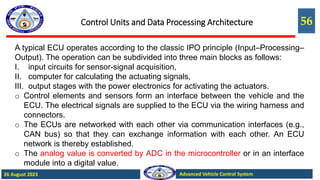
A typical ECU operates according to the classic IPO principle (Input–Processing–
Output). The operation can be subdivided into three main blocks as follows:
I. input circuits for sensor-signal acquisition,
II. computer for calculating the actuating signals,
III. output stages with the power electronics for activating the actuators.
o Control elements and sensors form an interface between the vehicle and the
ECU. The electrical signals are supplied to the ECU via the wiring harness and
connectors.
o The ECUs are networked with each other via communication interfaces (e.g.,
CAN bus) so that they can exchange information with each other. An ECU
network is thereby established.
o The analog value is converted by ADC in the microcontroller or in an interface
module into a digital value.
57
Advanced Vehicle Control System
26 August 2023
Automotive Instrumentation
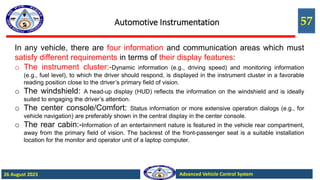
In any vehicle, there are four information and communication areas which must
satisfy different requirements in terms of their display features:
o The instrument cluster:-Dynamic information (e.g., driving speed) and monitoring information
(e.g., fuel level), to which the driver should respond, is displayed in the instrument cluster in a favorable
reading position close to the driver’s primary field of vision.
o The windshield: A head-up display (HUD) reflects the information on the windshield and is ideally
suited to engaging the driver’s attention.
o The center console/Comfort: Status information or more extensive operation dialogs (e.g., for
vehicle navigation) are preferably shown in the central display in the center console.
o The rear cabin:-Information of an entertainment nature is featured in the vehicle rear compartment,
away from the primary field of vision. The backrest of the front-passenger seat is a suitable installation
location for the monitor and operator unit of a laptop computer.
58
Advanced Vehicle Control System
26 August 2023
Automotive Instrumentation
Earlier instrument cluster First gen instrument cluster Modern instrument cluster with LCDs
The graphics module in the instrument cluster enables an indication of driver-related functions [for example,
service intervals, check functions covering the vehicle’s operating state and vehicle diagnostics etc.] They
can also show route-direction information from the navigation system. In modules in which surface area is
small, instead of digitized map excerpts, only route-direction symbols [for example turn instructions or
intersection symbols] appear in the display
59
Advanced Vehicle Control System
26 August 2023
Automotive Instrumentation
Modern high-end and premium vehicles often use full-
color thin-film transistor (TFT) liquid crystal displays
(LCD) in digital clusters to provide a signature user
experience. The cluster electronic control unit have
mechanisms to correctly display safety relevant content
(tell-tales), and more safety information is shown to the
driver through advanced driver-assistance system
(ADAS) features. In-Vehicle Infotainment (IVI) system
features, such as navigation, audio, and telephony data,
are often integrated into the digital cluster. Here,
dynamically reconfigurable clusters let the driver
personalize the user interface (UI).
Premium car instrument cluster in Infotainment mode
A futuristic concept
Some vehicle manufacturers integrate the instrument cluster
application into a digital cockpit domain controller alongside other
workloads on a mixed-criticality platform. An application processor
with an integrated 3D-graphics engine supports a rich 3D user
experience.
60
Advanced Vehicle Control System
26 August 2023
Automotive Instrumentation
Head-up Display
Conventional instrument clusters are situated at
a viewing distance of 0.8 to 1.2 m. In order to
read information in the area of the instrument
cluster, the driver must adjust his or her eyes
from long distance (observing the road scene) to
the short viewing distance for the instrument.
This a customization process usually requires,
depending on the driver’s age, 0.3 to 0.5 s. A
head-up display, or heads-up display [HUD]
presents data without requiring users to look
away from their usual viewpoints. This is made
possible by using a transparent display onto
which information are projected. HUD mounted on to the dashboard
61
Advanced Vehicle Control System
26 August 2023
Automotive Instrumentation
Head-up Display
The HUD may be mounted on the
windshield or on to the dashboard, just
beneath the driver’s line of sight. This
enables the driver to view information with
the head positioned "up" and looking
forward, instead of looking down or
sideways by moving his or her head. The
optical system generates a virtual image at
such a viewing distance that the human
eye can remain adjusted to long distance.
HUD projection onto the windscreen
62
Advanced Vehicle Control System
26 August 2023
Automotive Instrumentation
Head-up Display
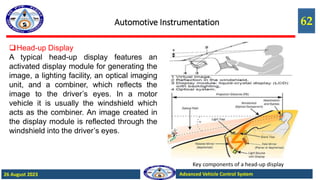
A typical head-up display features an
activated display module for generating the
image, a lighting facility, an optical imaging
unit, and a combiner, which reflects the
image to the driver’s eyes. In a motor
vehicle it is usually the windshield which
acts as the combiner. An image created in
the display module is reflected through the
windshield into the driver’s eyes.
Key components of a head-up display
63
Advanced Vehicle Control System
26 August 2023
Automotive Instrumentation
Head-up Display
“Augmented-reality” head-up displays are more
sophisticated. They use laser or a “Digital Light
Projection” [DLP] module to generate the image.
[In DLP, images are generated by micromechanical
elements.] Augmented-reality head-up displays are
characterized by a larger projection field. This enables the
system to display the warning of an obstacle in the driver’s field
of vision and at the virtual distance in which it is located in
nature. [With this system, for example, route-direction information
can be displayed at an intersection precisely where the junction
suggested by the navigation system is situated; at an
expressway/highway exit the arrow for recommending the exit
can be positioned on the deceleration lane.]
Augmented-reality head-up display
64
Advanced Vehicle Control System
26 August 2023
Electronic engine control system,
 COMPUTER CONTROLLED FUEL SUPPLY: Electronic fuel control overview, drive cycle,
advantages, basic system operation, controller inputs and outputs, engine control sequence,
case studies of advanced fuel supply systems
 COMMON TECHNOLOGY: Engine management system, ABS, traction control, wheel
spin regulation, stability control, OBD, diagnostic tools and equipment, head-on
displays, SRS.
 SENSORS AND ACTUATORS: Types of sensors: a sensor for speed, throttle position,
exhaust oxygen level, manifold pressure, crankshaft position, coolant temperature, exhaust
temperature, air mass flow, knock sensor, flex-fuel sensor, and other sensors for engine
application. Sensors are used for vehicle motion control, LIDAR, digital vision camera, and other
instruments used for vehicle environmental information. Actuators used in fuel injection, EGR
control, VVT, instrument cluster, ignition coil operator. Relays.
 INTELLIGENT SYSTEMS: Intelligent Transportation Systems [ITSs], ITS architecture,
Control by wire, Autonomous vehicles, connected vehicles.
65
Advanced Vehicle Control System
26 August 2023
Advanced Vehicle Control System – AEng6111
The end!

Autotronics.pptx

  • 1.
    1 Targeted Group: MScin Automotive Engineering 26 August 2023 Advanced Vehicle Control System – AEng6111 Lectured By:- Solomon N (PhD) AUTOTRONICS 1 CHAPTER
  • 2.
    2 Advanced Vehicle ControlSystem 26 August 2023 Outlines  Vehicle communication  Network topology,  Automotive network,  Bus systems,  Vehicle system architecture,  Multiplexing,  Mechatronics,  Control unit,  Modules,  Energy management,  Electromagnetic compatibility,  The concept of an electronic engine control system, and  Modern automotive instrumentation
  • 3.
    3 Advanced Vehicle ControlSystem 26 August 2023 What is Autotronics?  The Autotronics is referred to as modern automotive technology and also commonly known as Automotive Mechatronics.  Autotronics is the automotive technology which combines AUTOMOBILE and ELECTRONICS.  Its objective is to develop and understand the principles of conversion in design, construction and working of mechanical and electronic systems in automobiles.  while hybrid refers to technology that uses two or more distinct power sources to move the vehicle.
  • 4.
    4 Advanced Vehicle ControlSystem 26 August 2023 Cont.  Conventional automobiles depends on high power data processors to operate, efficiently, the systems through electronic controls.  Modern electric cars rely/depend on power electronics for the main propulsion control as well as the energy management system.  Future autonomous cars will rely on powerful computer systems, an array of sensors, networking and satellite navigation. All these are not possible without electronics.
  • 5.
    5 Advanced Vehicle ControlSystem 26 August 2023 Electronics in motor vehicle
  • 6.
    6 Advanced Vehicle ControlSystem 26 August 2023 Electronics in motor vehicle CAN – Control Area Network LIN – Local Interconnect Network Flexiray – FlexRay Gateway Tool for Test Labs and Vehicle Trials VAN - Vehicle area network MOST – Media Oriented System Transport D2B- Decimal to Binary
  • 7.
    7 Advanced Vehicle ControlSystem 26 August 2023 Vehicle communication What is vehicle of communication?  Vehicle-to-vehicle communication (V2V communication) is the wireless transmission of data between motor vehicles. The goal of V2V communication is to prevent accidents by allowing vehicles in transit to send position and speed data to one another over an ad hoc mesh network.  Various regulations demand increase in safety, comfort, entertainment, and environmental protection.  Requirement of optimized processes, methods, and tools of system architecture add more electronic systems in motor vehicles. Increase in number of functions are characterized by a high level of networking and complexity.
  • 8.
    8 Advanced Vehicle ControlSystem 26 August 2023 Vehicle communication ECU interconnection in a modern mid-size vehicle
  • 9.
    9 Advanced Vehicle ControlSystem 26 August 2023 Vehicle communication  In today’s vehicles, virtually all the ECUs are networked directly or indirectly (e.g. via gateways) with each other.  Gateways facilitate the exchange of data between different communication systems and beyond vehicle limits. Use of 360° camera for automatic park- assist also enables the driver to have a bird’s-eye view of the vehicle in the infotainment-system display. [Connection to radio systems and the Internet is an example of communication beyond vehicle limits.]  In the beginning of the development of communication systems, logic functions were distributed to many individual ECUs [function-specific ECUs] in the vehicle. This means that virtually every function had its own ECU.
  • 10.
    10 Advanced Vehicle ControlSystem 26 August 2023 Vehicle communication  Later when the number of functions increased sharply, new functions were frequently integrated in ECUs that already existed in the vehicle. Integration of ‘parking-assist function’ in the “Body Control Module” is an example. [BCM is responsible for controlling and monitoring the functions and components of the body electronics like ‘light-actuator technology’ ‘door-actuator technology.’]  The new development is called “Functionally distributed E/E architectures”.
  • 11.
    11 Advanced Vehicle ControlSystem 26 August 2023 Vehicle communication  Later, to manage dependencies of the functions within the individual domains increased sharply, “domain-centralized” and “cross-domain-centralized” E/E architectures. [Domain refers to the grouping of similar functions. Examples of domain are body control, infotainment, driver assistance etc.] An example of cross-domain function is “Vehicle Motion Control”. In this, sensors, actuators, and functions from the “Powertrain” and “Chassis and Safety” domains interact directly with each other.  The next step would be Vehicle-centralized E/E architectures in which the vehicle is in particular characterized by a high degree of automation, networked systems [both vehicle-internal and vehicle-external] and by multimedia and infotainment applications. In this architecture, all the logic are to be brought together on a powerful central vehicle computer. All the functional interfaces would then be located within this central vehicle computer.
  • 12.
    12 Advanced Vehicle ControlSystem 26 August 2023 Electrical/Electronic architecture roadmap
  • 13.
    13 Advanced Vehicle ControlSystem 26 August 2023 Network topology  Network topology refers to the way different computers, devices or nodes connect to each other in a communication network.  It describes their physical arrangement and explains the logical flow of information throughout the network.  A computer network topology can consist of one physical topology and several logical topologies.  A physical topology explains how computers, devices or nodes connect with each other in a network based on their location.  It involves assessing the physical layout of network cables and workstations. Conversely, a logical topology explains how data flows from one device to another based on network protocols.  Therefore, network topology defines the virtual shape, layout and structure of a network from both a physical and logical viewpoint.
  • 14.
    14 Advanced Vehicle ControlSystem 26 August 2023 Network topology  Network topology:- With the tremendous speed at which computing technology is advancing, the complexity of automotive control system is ever increasing.  The individual components need to be networked so that the multitude of information that is managed by the individual systems can also be used elsewhere throughout the system.  A network is a system in which a group of elements can exchange information via a transportation medium. [If the elements are visualized as nodes and the communication relationships as lines, a picture is created of a network where many nodes are related to several other nodes.]  The nodes in a communication network are also often referred to as network subscribers or stations.
  • 15.
    15 Advanced Vehicle ControlSystem 26 August 2023 Vehicle electronic system overview
  • 16.
    16 Advanced Vehicle ControlSystem 26 August 2023 Network topology  Different requirements are made of the network topology for a variety of communication network applications, while the topology determines some of the characteristics of the overall network. All network topologies are based on the following seven basic topologies o Point-to-point network topology. o Bus topology o Star topology o Ring topology o Mesh topology o Tree network topology and o Hybrid topologies are created by combining these basic topologies.
  • 17.
    17 Advanced Vehicle ControlSystem 26 August 2023 Network topology Nodes: In networking, nodes refer to connection points, redistribution points and communication endpoints. Cables: The physical network topology consists of several types of cables and equipment, including coaxial cables, twisted pair cables and optical fiber cables. Hub and switch: The hub and switch connect multiple devices in a network, receive messages and transmit them to the correct nodes or devices. Router: A router analyzes, receives and transmits information between different IP networks by identifying the correct IP addresses of source and destination hosts.
  • 18.
    18 Advanced Vehicle ControlSystem 26 August 2023 Network topology 1. Point-to-point network topology;- is the simplest method. This type of network topology involves connecting two nodes or devices using a common link. The two devices could be two computers, servers, routers or switches connected to each other with a cable. Point-to-point network topology is common in computer networking, computer architecture and telecommunications systems. Some of the advantages of using point-to-point network topology include: o High bandwidth and speed o Low latency/dormancy o Easy maintenance
  • 19.
    19 Advanced Vehicle ControlSystem 26 August 2023 Network topology 2. Bus network topology:- is a foundational method that many network administrators use to connect all of the devices or nodes to one primary cable with various drop lines and taps. o Drop lines are the cables that connect to the primary cable, also known as the bus, while taps are the individual connectors. This creates one channel for communication throughout the network. When someone uses their computer to send a message through this type of network, all of the connected computers are aware of this action. However, only the receiver of the message can accept it by verifying its address, which is attached to the data frame.
  • 20.
    20 Advanced Vehicle ControlSystem 26 August 2023 Network topology Advantages of bus systems in comparison to conventional wiring: o Reduced costs with less weight and installation space because of fewer cables in the wiring harness o Better reliability and functional reliability due to fewer plug-in connections o Simplification of vehicle assembly during production o Multiple use of sensor signals o Simple connection of system components to a bus o Easier handling of equipment and special equipment variants in a vehicle
  • 21.
    21 Advanced Vehicle ControlSystem 26 August 2023 Cont. Automotive Networking and Bus system  Electrical and electronic systems in motor vehicles influence and complement each other. For example, signal lines were used in previous injection and ignition systems in order to simplify communication between these two systems.  Rapid increase in the number of electronic systems increased the information that was being exchanged. This increased the number of signal lines and plug connections required. Transfer of large volumes of data, from different sources, became easier when a serial bus system was first used in a vehicle [Mercedes-Benz 500E] in 1991.
  • 22.
    22 Advanced Vehicle ControlSystem 26 August 2023 Requirements for bus systems  Data transfer rate [Transfer rate, Data rate or Bit rate] o This variable specifies the volume of data that is transmitted during a time unit [bits/seconds]. The required data rate is dependent on the application. For example, to switch on and off the air-conditioning compressor a slower transfer rate is required where as to transfer audio signals a higher rate is required.  Interference immunity o Ideally, the data should be transferred without interference. However, this cannot be guaranteed in a motor vehicle because of electromagnetic effects [EMI]. The interference immunity requirements depend on the safety relevance of the electronic systems concerned. Lesser requirements are made of comfort and convenience systems than the ABS.
  • 23.
    23 Advanced Vehicle ControlSystem 26 August 2023 Requirements for bus systems  Real-time capability o This requirement guarantees that the system results are calculated within a fixed time interval. The duration of the time interval depends on the application. [Eg. The ABS must react to the incipient locking of a wheel within a few milliseconds (wheel speed reduction), whereas response times of 100ms are adequate for actuating the power-window motor.] Human beings cannot perceive delay periods of less than 100ms. If signals from other control units are needed for functions (e.g. a torque reduction request during a shift operation), the bus system must transmit the data at a faster rate and with a smaller time delay so that the overall system complies with the specified real- time requirements.
  • 24.
    24 Advanced Vehicle ControlSystem 26 August 2023 Requirements for bus systems  Number of network nodes o The maximum number of nodes to be integrated varies for different areas of vehicle operation. The number of nodes for comfort and convenience systems may be high due to servomotor networking (e.g. seat adjustment) and intelligent sensors (e.g. rain sensors). Several identical busses can be used if necessary. Classification of bus Systems CLASS A Transfer rate Low data rates [up to 10 kbit/s] Applications Actuator and sensor networking Representative LIN CLASS B Transfer rate Average data rates [up to 125 kbit/s] Applications Complex mechanisms for error handling, control unit networking in the comfort functions Representative Low speed CAN [CAN B] CLASS C Transfer rate High data rates [up to 1 Mbit/s] Applications Real-time requirements, control unit networking in the drive and running gear functions Representative High speed CAN CLASS C+ Transfer rate Extremely high data rates [up to 10 Mbit/s] Applications Real-time requirements, control unit networking in the drive and running gear functions Representative FlexRay CLASS D Transfer rate Extremely high data rates [up to 10 Mbit/s] Applications Control unit networking in the telematics and multi-media functions Representative MOS
  • 25.
    25 Advanced Vehicle ControlSystem 26 August 2023 Requirements for bus systems Do a comparative study of the following bus systems: CAN-A, CAN-B, LIN, & TP  Network applications in a vehicle The overall vehicle system can be divided into four domains or functional areas from the point of view or electrics/electronics: o Drivetrain o Chassis o Interior and o Telematics o In the drivetrain and chassis domains, the emphasis is primarily on real-time applications. A system is said to be having real-time capability if its response times are adequate for the task in hand. [example scenario; rapid ignition timing advance in the ‘Motronic’ after a request from the traction-control system for reducing torque and therefore preventing the wheel from spinning.] In the interior domain, the main focus is on multiplex aspects in networking. Mainly multimedia and infotainment applications are networked in the telematics domain.
  • 26.
    26 Advanced Vehicle ControlSystem 26 August 2023 Requirements for bus systems Do a comparative study of the following bus systems: CAN-A, CAN-B, LIN, & TP  Real time applications The drivetrain and chassis systems are assigned to class C network. [These require fast transfer rates in order to ensure the real-time behavior that is required for these applications.] These requirements are met by the CAN bus with a transfer rate of 500 kBaud (high-speed CAN). [Baud is the rate at which information is transferred. 500kBaud means that the port is capable of transferring a maximum of 500 kbits per second].Examples of systems that run on this network: o Engine-management system [Motronic or electronic diesel control, EDC] o Transmission control o Antilock brake systems, ABS o Vehicle dynamics control [e.g. electronic stability program, ESP] o Chassis control systems [e.g. active body control, ABC] o Support systems [e.g. adaptive cruise control, ACC]
  • 27.
    27 Advanced Vehicle ControlSystem 26 August 2023 Requirements for bus systems Do a comparative study of the following bus systems: CAN-A, CAN-B, LIN, & TP  Multiplex applications The multiplex application is suitable for controlling and regulating components in the body and comfort and convenience electronics area (class B), such as o Displays o Lighting o Access authorization with anti-theft warning device o Air-conditioning o Seat and mirror adjustment o Door module (power-window unit, door-mirror adjustment) o Windshield wipers o Headlamp adjustment The transfer rate requirements are not as high for class B systems as they are for class C systems. For this reason, low-speed CAN with a transfer rate of 125 kbit/s or single-wire CAN with 33 kbit/s. can be used. If the transfer rate requirements drop to less than 20 kbit/s, the low-cost LIN is more frequently used. Applications are mainly in the mechatronics area; examples being the transfer of switch information or the activation of actuators.
  • 28.
    28 Advanced Vehicle ControlSystem 26 August 2023 Requirements for bus systems Do a comparative study of the following bus systems: CAN-A, CAN-B, LIN, & TP  Multimedia networking Mobile communication applications combine components such as o Car sound system o CD changer o Navigation system o Driver-information systems o Telephone o Video system o Voice input o Internet, E-mail o Back-up camera
  • 29.
    29 Advanced Vehicle ControlSystem 26 August 2023 Network topology 3. Ring network topology: consists of two primary point-to-point links that connect one device to two more devices located on each side of it. This creates a ring of devices that data can flow through until it reaches its target device. In this configuration, the way messages pass from one device to another is circular and unidirectional. Each device or computer in the ring has access to the message for a fixed amount of time to assist with the transmission. When the message reaches its destination, the receiver removes the data. Some of the advantages of using ring network topology include: o Easy installation o Minimal cabling required o Reduced data collision
  • 30.
    30 Advanced Vehicle ControlSystem 26 August 2023 Network topology 3. Ring network topology Media Oriented System Transport [MOST] is a software protocol and hardware architecture. MOST is optimized for automotive infotainment [multimedia networking] system. MOST buses uses ring topology and synchronous data communication to transport audio, video, voice and data signals via plastic optical fiber (POF) (MOST25, MOST150) or electrical conductor (MOST50, MOST150) physical layers. It provides an optical solution for automotive peripherals like car radios, CD and DVD players, and GPS navigation systems.
  • 31.
    31 Advanced Vehicle ControlSystem 26 August 2023 Network topology 4. Star network topology:- is the most common configuration. In this layout, each device or node connects to a central network hub. Devices use this central hub to communicate with each other indirectly. If a device wants to send or receive a message, it must first contact the hub to act as a middleware between devices. Once the hub understands what type of message the device wants to send, it transmits it via broadcast or unicast to the designated receivers. The main reason star network topology is so popular is because it improves network security by preventing data from passing through every device. Some of the other advantages of using star network topology include: o Centralized control o Easy scalability and reconfiguration o Cost-efficiency
  • 32.
    32 Advanced Vehicle ControlSystem 26 August 2023 Network topology 5. Mesh network topology:- involves creating a dedicated point-to-point link between each device in a network. This allows data to transmit directly between two devices without flowing through other devices in the same network. There are two primary types of mesh network topologies.  The first is a full mesh network topology. In this configuration, each node connects to every other node within the network.  The second is a partial mesh network topology. In this layout, some of the nodes may not be connected to every single node within the network. Some of the advantages of using mesh network topology include: o Fast communication o More privacy and better security o Decreased congestion on channels
  • 33.
    33 Advanced Vehicle ControlSystem 26 August 2023 Network topology 6. Tree network topology:- connects star networks by integrating bus networks to create a parent-child hierarchy. In this configuration, each node is either directly or indirectly connected to the primary bus cable. In order to accomplish this, network administrators divide the network into segments, which makes them easier to maintain. Each segment consists of a primary hub that connects all of the sub-hubs. Some of the advantages of using tree network topology include: o Extended distance network coverage o Limited data loss o Increased number of direct and indirect nodes
  • 34.
    34 Advanced Vehicle ControlSystem 26 August 2023 Network topology 7. Hybrid network topology:- topology combines at least two other network topologies. This type of configuration is popular because it allows network administrators to create network topologies that are practical and meet the unique needs of each organization. For example, a network administrator might use a bus network topology to house both a star network topology and a ring network topology by using drop lines and taps to connect with them. This makes it easy for network administrators to select the best features of each type of network topology. Some of the advantages of using hybrid network topology include: o Increased volume of nodes o Improved flexibility o Increased reliability
  • 35.
    35 Advanced Vehicle ControlSystem 26 August 2023 Vehicle System Architecture • A 1950’s car electrical network had approx. 40 lines. Only electric cables required for the battery, starter, ignition and the lighting and signaling systems. • In the 1990s the cabling work in a luxury class vehicle amounted to around 3 km. • 5 years after the millennium, depending on the class, a typical vehicle had 20 to 80 electronic control units. Up to around 90 % of innovations in modern motor vehicle can only be realized by electronics and microprocessor-controlled systems.
  • 36.
    36 Advanced Vehicle ControlSystem 26 August 2023 Vehicle System Architecture • A vehicular network organizes and connects vehicles with each other, and with mobile and fixed-locations resources (Wu et al., 2005). • telematics architectures are rarely applied in public local hotspots such as public parking lots, hotels, restaurants, airports and shopping centers. • In-vehicle Network Architecture • Out-vehicle Network Architecture • neXT-generaTion Vehicular neTwork archiTecTure
  • 37.
    37 Advanced Vehicle ControlSystem 26 August 2023 Vehicle System Architecture  IN-VEHICLE NETWORK ARCHITECTURE Disaster communication network that combine different automotive bus protocols o CAN (Controled Area Network) o LIN (Local Interconect Network) o Flex-Ray o vasos and osek/VdX in-Vehicle management system  CAN (Controled Area Network)  German automotive system supplier Robert Bosch created CAN in the mid-1980s for automotive applications as an effective means of allowing robust serial communication (Pazul et al., 1999)  The goal: establish a standard for more reliable and efficient communication by integrating devices, sensors and actuators in a system for real-time control applications
  • 38.
    38 Advanced Vehicle ControlSystem 26 August 2023 Vehicle System Architecture  LIN (Local Interconect Network) o The Local Interconnect Network Bus (LIN-Bus) is a vehicle bus standard or computer networking bus-system used within current automotive network architectures o The LIN specification is enforced by the LIN-consortium, with the first exploited version 1.1, released in 1999. o Succeed the CAN
  • 39.
    39 Advanced Vehicle ControlSystem 26 August 2023 Vehicle System Architecture  Flex-Ray provides a high-speed serial communication, time triggered bus and fault-tolerant communication between electronic devices for future automotive applications (FlexRay, 2005; Xu et al., 2008) o FlexRay (2005) was developed for the next generation of automobiles and future applications, including x-by-wire, by a consortium founded by BMW, Bosch, DaimlerChrysler and Philips in 2000 (FlexRay Consortium, 2009). o FlexRay serving as the backbone provides determinism for engine control and fault tolerance for steer-by-wire, brake-bywire and other advanced safety applications
  • 40.
    40 Advanced Vehicle ControlSystem 26 August 2023 Vehicle System Architecture  vasos and osek/VdX in-Vehicle management system o vASOS (Sun et al., 2006) (Vehicular Application Specific Embedded Operating Systems) is designed specifically for vehicle use, and is designed to run on a high-performance user interface computer. o It fulfills and provides specific device drivers, such as CAN/LIN buses, which are used to communicate with other ECU nodes for diagnostic purposes, and other fundamental network functions for the vehicle domain
  • 41.
    41 Advanced Vehicle ControlSystem 26 August 2023 Vehicle System Architecture The properties of vASOS are as follows: o Focusing on system real-time performance, scalability and robustness o Small kernel size, small memory footprint, low-cost and high efficiency. o Plug and play device driver interfaces for expansibility o Emphasis on network control methods, especially wireless networks o Fast boot-up and good power management Architecture
  • 42.
    42 Advanced Vehicle ControlSystem 26 August 2023 Vehicle System Architecture OUT-VEHICLE NETWORK ARCHITECTUR (ieee 802.11p and Wimax)  ieee 802.11p o establishment delays before communicating with other vehicles encountered on the road o The IEEE 802.11p standard, also referred to as Wireless Access for the Vehicular Environment (WAVE), is designed to solve these issues Vehicle safety communication examples
  • 43.
    43 Advanced Vehicle ControlSystem 26 August 2023 Vehicle System Architecture OUT-VEHICLE NETWORK ARCHITECTUR  Wimax (Worldwide Interoperability of Microwave Access) o The Mobile WiMAX network consists of the access services network (ASN) and connectivity services network (CSN)
  • 44.
    44 Advanced Vehicle ControlSystem 26 August 2023 Vehicle System Architecture  NEXT-GENERATION VEHICULAR NETWORK ARCHITECTURE Under development at the University of Detroit Mercy by several researchers in collaboration (Mahfoud et al., 2008) o in-Vehicle personal computer o system architecture  IN-VEHICLE PERSONAL COMPUTER o Automotive manufacturers are planning to provide new Internet and entertainment services inside vehicles. o Intel Corporation has announced plans to bring PCs to cars in a project called Connected Car PC Technology o The IBM infotainment system Imaj provides an example of on-board computers. Imaj comprises of three 12-inch LCD screens built into the car seats facing three rear-seat passengers
  • 45.
    45 Advanced Vehicle ControlSystem 26 August 2023 Vehicle System Architecture  SYSTEM ARCHITECTURE o Vehicle Network and the On-board PC o The Wireless Network o The Internet
  • 46.
    46 Advanced Vehicle ControlSystem 26 August 2023 Vehicle System Architecture A typical scenario is as given below; • The radar sensor of the Adaptive Cruise Control system (ACC) measures the distance to the vehicle traveling in front. If this distance is shorter than a specified minimum distance, the ACC electronic control unit sends this information to the engine management, the ESP electronic control unit and the airbag electronic control unit. The engine management reduces torque and thus driving speed. If this is not sufficient, the Electronic Stability Program (ESP) must also generate brake pressure to decelerate the vehicle. If the distance continues to shorten, the airbag and seat-belt pre-tensioners are set to emergency standby. The communication between the electronic control units cannot take more than fractions of a second. The more electronic control units interact in the one complete system, the more difficult it becomes for them to communicate undisturbed.
  • 47.
    47 Advanced Vehicle ControlSystem 26 August 2023 Vehicle System Architecture A typical scenario is as given below; • The networking of these electronics creates the prerequisite for having this wide variety of electronic systems integrated within the complete vehicle system to form a whole. The proportion of electrics and electronics in the motor vehicle will continue to increase. Advancements in engine technologies, safety, comfort and convenience, and infotainment etc. continuously increases electronics in modern vehicles. However, this results in a complexity that can only be overcome at considerable expense. • The architecture of a system represents its “construction plan”. It describes the structural and dynamic system characteristics as a whole. In a modern vehicle, for different realization technologies, different views of system architecture are required. These include hardware architecture, software architecture, network architecture, etc. The problems that arise in the integration of differently structured subsystems can be reduced by means of an architecture.
  • 48.
    48 Advanced Vehicle ControlSystem 26 August 2023 Multiplexing • Multiplexing is a technology that allows a substantial amount of information to flow between electronic control units and accessories via reduced electrical wiring. • Multiplexing is a technique through which one or many signals are transmitted concurrently over a single data link. • A multiplexed system consists of n number devices that share the capacitance of a link, so a link means multiple paths can have multiple channels.
  • 49.
    49 Advanced Vehicle ControlSystem 26 August 2023 Multiplexing Conventional system Multiplexing system
  • 50.
    50 Advanced Vehicle ControlSystem 26 August 2023 Multiplexing Illustration of switching scheme As shown in the illustration of switching scheme, whenever the input switch connects the computer to an appropriate input, the output switch connects the computer to the corresponding display or actuator. IN a real time control system, the actual switching is done by means of a solid- state electronic switching device. The one at the input side is called a multiplexer [MUX] that selects one of several inputs for each output. The device at the output side is called a demultiplexer [DMUX].
  • 51.
    51 Advanced Vehicle ControlSystem 26 August 2023 Mechatronics  The term “mechatronics” is derived from the words ‘mechanisms’ and ‘electronics’, where electronics means “hardware” and “software”, and mechanisms is the generic term for the disciplines of “mechanical engineering” and “hydraulics”.  Mechatronics aim to achieve a synergistic optimization of mechanical engineering, electronic hardware and software in order to project more functions at low cost, less weight and installation space, and better quality.  A modern automobile use mechatronics in wide areas of application. Engine management and fuel injection for gasoline and diesel engines, transmission- shift control, electrical and thermal energy management and a wide variety of braking and vehicle-dynamic systems are some of them.
  • 52.
    52 Advanced Vehicle ControlSystem 26 August 2023 Mechatronics  Besides systems and components, mechatronics are also playing an increasingly vital role in the field of automotive micromechanics.  Hot-film air-mass meters and yaw-rate sensors are two examples.  CRDI system may be considered for an example of application of mechatronics at system level. In the common-rail system, pressure generation and fuel injection are separated from each other.  A high-pressure accumulator [the common rail] stores constantly the fuel pressure required for each of the engine’s operating states.
  • 53.
    53 Advanced Vehicle ControlSystem 26 August 2023 Mechatronics  A solenoid-valve-controlled injector with integrated nozzle assumes the function of injecting the fuel directly into the combustion chamber of each cylinder. The engine electronics constantly request data on accelerator-pedal position, rotational speed, operating temperature, fresh-air intake flow, and rail pressure in order to optimize the control of fuel metering as a function of the operating conditions.
  • 54.
    54 Advanced Vehicle ControlSystem 26 August 2023 Control Units and Data Processing Architecture The electronic components of a vehicle control system are accommodated in an electronic control unit [ECU]. The number of ECUs in a vehicle has increased sharply in the recent years, as more and more systems are being electronically controlled. The following are some of the systems which use ECUs, on a typical automobile. • Engine management • Transmission control, • Driving-dynamics control (electronic stability program with antilock braking system and traction control system), • Vehicle power supply control unit, • A/C control unit, • Door control unit
  • 55.
    55 Advanced Vehicle ControlSystem 26 August 2023 Control Units and Data Processing Architecture For example, without precise control of various parameters, it would not be possible to adhere to current emission limits and low consumption figures under high engine-performance conditions. An Engine Control Unit performs the entire open and closed- loop control of the engine (e.g., ignition in a gasoline engine and fuel injection) and of many of the peripheral units (e.g., turbocharger and EGR).
  • 56.
    56 Advanced Vehicle ControlSystem 26 August 2023 Control Units and Data Processing Architecture A typical ECU operates according to the classic IPO principle (Input–Processing– Output). The operation can be subdivided into three main blocks as follows: I. input circuits for sensor-signal acquisition, II. computer for calculating the actuating signals, III. output stages with the power electronics for activating the actuators. o Control elements and sensors form an interface between the vehicle and the ECU. The electrical signals are supplied to the ECU via the wiring harness and connectors. o The ECUs are networked with each other via communication interfaces (e.g., CAN bus) so that they can exchange information with each other. An ECU network is thereby established. o The analog value is converted by ADC in the microcontroller or in an interface module into a digital value.
  • 57.
    57 Advanced Vehicle ControlSystem 26 August 2023 Automotive Instrumentation In any vehicle, there are four information and communication areas which must satisfy different requirements in terms of their display features: o The instrument cluster:-Dynamic information (e.g., driving speed) and monitoring information (e.g., fuel level), to which the driver should respond, is displayed in the instrument cluster in a favorable reading position close to the driver’s primary field of vision. o The windshield: A head-up display (HUD) reflects the information on the windshield and is ideally suited to engaging the driver’s attention. o The center console/Comfort: Status information or more extensive operation dialogs (e.g., for vehicle navigation) are preferably shown in the central display in the center console. o The rear cabin:-Information of an entertainment nature is featured in the vehicle rear compartment, away from the primary field of vision. The backrest of the front-passenger seat is a suitable installation location for the monitor and operator unit of a laptop computer.
  • 58.
    58 Advanced Vehicle ControlSystem 26 August 2023 Automotive Instrumentation Earlier instrument cluster First gen instrument cluster Modern instrument cluster with LCDs The graphics module in the instrument cluster enables an indication of driver-related functions [for example, service intervals, check functions covering the vehicle’s operating state and vehicle diagnostics etc.] They can also show route-direction information from the navigation system. In modules in which surface area is small, instead of digitized map excerpts, only route-direction symbols [for example turn instructions or intersection symbols] appear in the display
  • 59.
    59 Advanced Vehicle ControlSystem 26 August 2023 Automotive Instrumentation Modern high-end and premium vehicles often use full- color thin-film transistor (TFT) liquid crystal displays (LCD) in digital clusters to provide a signature user experience. The cluster electronic control unit have mechanisms to correctly display safety relevant content (tell-tales), and more safety information is shown to the driver through advanced driver-assistance system (ADAS) features. In-Vehicle Infotainment (IVI) system features, such as navigation, audio, and telephony data, are often integrated into the digital cluster. Here, dynamically reconfigurable clusters let the driver personalize the user interface (UI). Premium car instrument cluster in Infotainment mode A futuristic concept Some vehicle manufacturers integrate the instrument cluster application into a digital cockpit domain controller alongside other workloads on a mixed-criticality platform. An application processor with an integrated 3D-graphics engine supports a rich 3D user experience.
  • 60.
    60 Advanced Vehicle ControlSystem 26 August 2023 Automotive Instrumentation Head-up Display Conventional instrument clusters are situated at a viewing distance of 0.8 to 1.2 m. In order to read information in the area of the instrument cluster, the driver must adjust his or her eyes from long distance (observing the road scene) to the short viewing distance for the instrument. This a customization process usually requires, depending on the driver’s age, 0.3 to 0.5 s. A head-up display, or heads-up display [HUD] presents data without requiring users to look away from their usual viewpoints. This is made possible by using a transparent display onto which information are projected. HUD mounted on to the dashboard
  • 61.
    61 Advanced Vehicle ControlSystem 26 August 2023 Automotive Instrumentation Head-up Display The HUD may be mounted on the windshield or on to the dashboard, just beneath the driver’s line of sight. This enables the driver to view information with the head positioned "up" and looking forward, instead of looking down or sideways by moving his or her head. The optical system generates a virtual image at such a viewing distance that the human eye can remain adjusted to long distance. HUD projection onto the windscreen
  • 62.
    62 Advanced Vehicle ControlSystem 26 August 2023 Automotive Instrumentation Head-up Display A typical head-up display features an activated display module for generating the image, a lighting facility, an optical imaging unit, and a combiner, which reflects the image to the driver’s eyes. In a motor vehicle it is usually the windshield which acts as the combiner. An image created in the display module is reflected through the windshield into the driver’s eyes. Key components of a head-up display
  • 63.
    63 Advanced Vehicle ControlSystem 26 August 2023 Automotive Instrumentation Head-up Display “Augmented-reality” head-up displays are more sophisticated. They use laser or a “Digital Light Projection” [DLP] module to generate the image. [In DLP, images are generated by micromechanical elements.] Augmented-reality head-up displays are characterized by a larger projection field. This enables the system to display the warning of an obstacle in the driver’s field of vision and at the virtual distance in which it is located in nature. [With this system, for example, route-direction information can be displayed at an intersection precisely where the junction suggested by the navigation system is situated; at an expressway/highway exit the arrow for recommending the exit can be positioned on the deceleration lane.] Augmented-reality head-up display
  • 64.
    64 Advanced Vehicle ControlSystem 26 August 2023 Electronic engine control system,  COMPUTER CONTROLLED FUEL SUPPLY: Electronic fuel control overview, drive cycle, advantages, basic system operation, controller inputs and outputs, engine control sequence, case studies of advanced fuel supply systems  COMMON TECHNOLOGY: Engine management system, ABS, traction control, wheel spin regulation, stability control, OBD, diagnostic tools and equipment, head-on displays, SRS.  SENSORS AND ACTUATORS: Types of sensors: a sensor for speed, throttle position, exhaust oxygen level, manifold pressure, crankshaft position, coolant temperature, exhaust temperature, air mass flow, knock sensor, flex-fuel sensor, and other sensors for engine application. Sensors are used for vehicle motion control, LIDAR, digital vision camera, and other instruments used for vehicle environmental information. Actuators used in fuel injection, EGR control, VVT, instrument cluster, ignition coil operator. Relays.  INTELLIGENT SYSTEMS: Intelligent Transportation Systems [ITSs], ITS architecture, Control by wire, Autonomous vehicles, connected vehicles.
  • 65.
    65 Advanced Vehicle ControlSystem 26 August 2023 Advanced Vehicle Control System – AEng6111 The end!