International Research Journal of Engineering and Technology (IRJET) e-ISSN: 2395-0056
Volume: 05 Issue: 03 | Mar-2018 www.irjet.net p-ISSN: 2395-0072
© 2017, IRJET | Impact Factor value: 6.171 | ISO 9001:2008 Certified Journal | Page 54
AUTOMATIC REVERSE WHEEL LOCKING MECHANISM
Yashwant Bhesota1, Sumit Paroliya2, Kumar Rajul Patel3, Madhvi Sharma4
1,2,3 Final Year student, Department of Automobile Engineering
4 Assistant Professor, Department of Automobile Engineering
Oriental Institute of Science & Technology, Bhopal(M.P.)
---------------------------------------------------------------------***---------------------------------------------------------------------
Abstract: Road transport safety is an importantissueinthe
land transport sector all over the world due to the increment
in the usage of automobiles in few decades. Thepaperpresents
“AUTOMATIC REVERSE WHEEL LOCKING MECHANISM” for
both light and heavy vehicles. This paper outlines system
requirements to successfully develop and deploy a less
complicated, safe and secure mechanism for the uncontrolled
reverse motion of the vehicle on hilly terrains. The mechanism
consists of a vehicle and ratchet & pawl connected to the rear
drive shaft of the vehicle and an actuator along with the help
of an inclination sensor which will control the movement of
the pawl while engaging or disengaging the mechanism. The
engaging mechanism will represent the reverse motion is
undesirable or to be restricted and disengaging mechanism
when the reverse motion is desirable.
Key Words: Ratchet, Pawl, Actuators, Inclinometer.
1. INTRODUCTION
Ratchets and pawls are mechanical gearing assemblies that
are used to transmit intermittent rotary motion,ortopermit
a shaft to rotate in one direction but not the other. They are
used in many applications effectively which includesa Gaint
Wheel in the amusement parks, Clocks, Shaping machines
etc.
The current invention relates to the automatic locking of a
vehicle against the rearward motion exceptwhenthevehicle
is in the reverse gear. In general, automatically locking rear
or drive wheels of a vehicle against reverse rotation so asto
prevent accidents. In a recent analysis of fatal accident
statistics showed that reversing activities were involved in
12% of all the fatal transport accidents. Accidents during
reverse movement results lessin injury but, moredamageto
vehicles and other human properties.
1.1 Objective
 The main objective of our project is to preventthese
types of accidents and unexpected reverse
movement with some simple and economical
means.
 To prevent the uncontrolled reverse motion of an
automobile under slopes and hilly roads.
 To protect drivers and pedestrians from disastrous
accidents occurring due to Loss of control and
improper handling of equipment.
 To ensure safety of the driver and vehicle on
inclined terrains.
 To increase the life of brakes and to reduce the fuel
consumption.
 The most common problem in the hilly terrainsisto
park the vehicles in the slope and to start up.
 While waiting in traffic on mountain roads the
vehicles had to move very slowly step by step, this
situation is difficult for drivers to make the car not
move back and may lead to accidents.
 This problem may occur due to driver’s
carelessness or improper handling of the vehicle
equipments.
 The problem associated with the brakes is that it
locks all the four wheels of the vehicle so that itwill
not be able to move in forward as well as in the
reverse direction.
 So as to avoid such cases we designed a simple and
economical equipment which will givea solutionto
the above mentioned problems.
There are basically four components which are used
for the designing of the equipment, and they are:
a) Ratchet
b) Pawl
c) Actuator
d) Inclinometer(Inclination Sensor)
a) Ratchet
A ratchet is a mechanical component having circular profile
with teeth on the circumference spirally arranged such that
it allows motion in only one direction. Each tooth has slight
slope that is broader at root and sharper at top.
1.2 Problem Definition
2. COMPONENTS
International Research Journal of Engineering and Technology (IRJET) e-ISSN: 2395-0056
Volume: 05 Issue: 03 | Mar-2018 www.irjet.net p-ISSN: 2395-0072
© 2017, IRJET | Impact Factor value: 6.171 | ISO 9001:2008 Certified Journal | Page 55
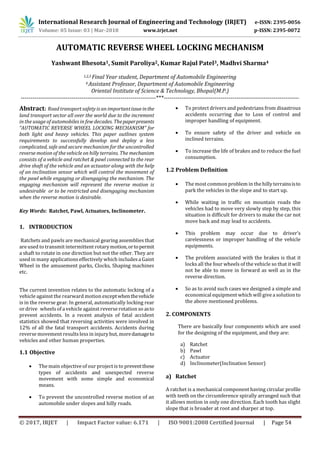
Fig -1: Ratchet
When the teeth are moving in the constraint (i.e., forward)
direction, the pawl easily slides up and over the gently
sloped edges of the teeth when the teeth move in the
opposite (backward) direction, however the pawl will catch
against the steeply sloped edge of the first tooth it
encounters, thereby locking it against the tooth and
preventing any further motion in that direction.
Fig -2: Locking of Ratchet and Pawl
Because the ratchet can only stop backward motion at tooth
boundaries, thus does allow a limited amount of backward
motion. This backward motion which is limited to a
maximum distance equal to the spacing between the teeth is
called backlash.
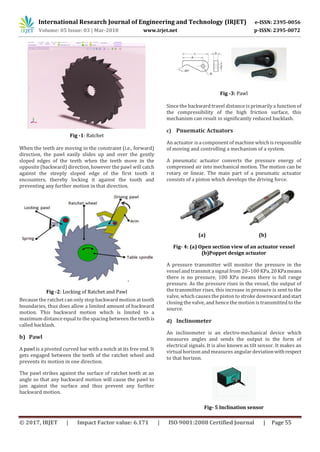
b) Pawl
A pawl is a pivoted curved bar with a notch at its free end. It
gets engaged between the teeth of the ratchet wheel and
prevents its motion in one direction.
The pawl strikes against the surface of ratchet teeth at an
angle so that any backward motion will cause the pawl to
jam against the surface and thus prevent any further
backward motion.
c) Pnuematic Actuators
An actuator is a component of machine which is responsible
of moving and controlling a mechanism of a system.
A pneumatic actuator converts the pressure energy of
compressed air into mechanical motion. The motion can be
rotary or linear. The main part of a pneumatic actuator
consists of a piston which develops the driving force.
(a) (b)
Fig- 4: (a) Open section view of an actuator vessel
(b)Poppet design actuator
A pressure transmitter will monitor the pressure in the
vessel and transmit a signal from 20–100 KPa.20KPameans
there is no pressure, 100 KPa means there is full range
pressure. As the pressure rises in the vessel, the output of
the transmitter rises, this increase in pressure is sent to the
valve, which causesthe piston to stroke downwardandstart
closing the valve, and hence the motion is transmitted to the
source.
d) Inclinometer
An inclinometer is an electro-mechanical device which
measures angles and sends the output in the form of
electrical signals. It is also known as tilt sensor. It makes an
virtual horizon and measures angular deviationwithrespect
to that horizon.
Fig- 5 Inclination sensor
Fig -3: Pawl
Since the backward travel distance isprimarily a function of
the compressibility of the high friction surface, this
mechanism can result in significantly reduced backlash.
International Research Journal of Engineering and Technology (IRJET) e-ISSN: 2395-0056
Volume: 05 Issue: 03 | Mar-2018 www.irjet.net p-ISSN: 2395-0072
© 2017, IRJET | Impact Factor value: 6.171 | ISO 9001:2008 Certified Journal | Page 56
They are used in cameras, aircraft flightcontrols,automobile
security systems and in other applications requiring
measurement of tilt.
Factors which influence the use of inclinometers
 Gravity
 Temperature (drift), zero offset, linearity,vibration,
shock, cross-axis sensitivity,
acceleration/deceleration.
 A clear line of sight between the user and the
measured point is needed.
 A well defined object is required to obtain the
maximum precision.
 The angle measurement precision and accuracy is
limited to slightly better than one arcsec.
3. SELECTION OF MATERIAL
Material to be considered for ratchet and pawl are Grey Cast
and C45. The reasons for selecting the material are as:
 Readily available
 Available in required standard sizes
 Economical to use
 High tensile strength
 Moderate factor of safety
The mechanism is designed for the loading conditions of an
All Terrain Vehicle(ATV) weighing 250 Kg and 2 ratchetsare
attached on the rear drive shaft along with 2 pawls so as to
make the unexpected reverse motion to be constraint. The
assembly is mounted such that both the rear wheels would
be equally balanced.
4. FABRICATION PROCESS
I. The ratchet wheels are been coupled with two of the
rear drive shafts near the center hub.
II. The wheels are attached to the both the ends of the
drive shaft form an axle like structure.
III. The steel bars are cut into equal lengths to design a
frame which supports the pawl and the lever
mechanism along with the rear wheels.
IV. The lever mechanism is to engage and disengage the
pawl from ratchet wheel.
V. Here we used a pneumatic actuator controlled by an
inclination sensor to actuate the lever.
5. WORKING
When the vehicle is stationary in an inclined surface, it is
impossible to operate 3 foot pedals by 2 foot to start the
vehicle from rest to forward motion with ease.
To solve this problem, we make use of a ratchet wheels
which are attached to the drive shafts. The ratchet wheel is
engaged with the help of pawl which is controlled by the
help lever, inclination sensor and actuator.
The inclination sensor is mounted on the front axle or drive
shaft which will be operated as there would be a deflection
of 15° or more. So, as the vehicle comes across through a
steeper road of gradient of more than 15° then the pawl will
come in engage position with the ratchet and will constraint
the reverse motion of the vehicle.
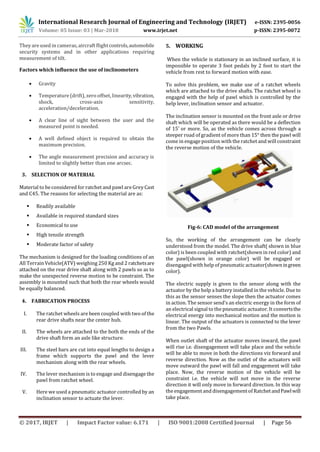
Fig-6: CAD model of the arrangement
So, the working of the arrangement can be clearly
understood from the model. The drive shaft( shown in blue
color) is been coupled with ratchet(shown in red color) and
the pawl(shown in orange color) will be engaged or
disengaged with help of pneumatic actuator(showningreen
color).
The electric supply is given to the sensor along with the
actuator by the help a battery installed in the vehicle. Due to
this as the sensor senses the slope then the actuator comes
in action. The sensor send’s an electric energy in the form of
an electrical signal to the pneumatic actuator. It convertsthe
electrical energy into mechanical motion and the motion is
linear. The output of the actuators is connected to the lever
from the two Pawls.
When outlet shaft of the actuator moves inward, the pawl
will rise i.e. disengagement will take place and the vehicle
will be able to move in both the directions viz forward and
reverse direction. Now as the outlet of the actuators will
move outward the pawl will fall and engagement will take
place. Now, the reverse motion of the vehicle will be
constraint i.e. the vehicle will not move in the reverse
direction it will only move in forward direction. In this way
the engagement and disengagement of RatchetandPawlwill
take place.
International Research Journal of Engineering and Technology (IRJET) e-ISSN: 2395-0056
Volume: 05 Issue: 03 | Mar-2018 www.irjet.net p-ISSN: 2395-0072
© 2017, IRJET | Impact Factor value: 6.171 | ISO 9001:2008 Certified Journal | Page 57
6. CONCLUSION
Our project “Automatic Reverse Wheel Locking Mechanism”
would help in avoiding the rearward motion of the vehicle
on the hilly terrains and Ghats. Since a less complex
structure is been used in our design, it can be easily used by
new drivers. Thus the mechanism can stop the vehicle from
rolling back in hill roads. This would be more helpful for the
drivers to drive their cars and park them comfortablyinhilly
roads.
7. FUTURE SCOPES
The modifications to be done in this project are material
strength and accuracy of working of the mechanism. And it
could be achieved by designing and analyzing the
mechanism according to the vehicle need and calculating
the forces for safety measures.
ACKNOWLEDGEMENT
It gives us immense pleasure to express our deepest sense
of gratitude and sincere thanks to our highly respected and
esteemed guide Ms. Madhvi Sharma, Automobile
Department, OIST Bhopal, for their valuable guidance,
encouragement and help for completing this work. Their
useful suggestions for this whole work and co-operative
behavior are sincerely acknowledged.
I also wish to express my gratitude to Prof. P. K. Prasad, HOD
(Automobile Department) for his kindheartedsupport.Ialso
wish to express my indebtness to my parents as well as my
family memberswhose blessings and supportalwayshelped
me to face the challenges ahead. At the end I would like to
express my sincere thanks to all my friends and others who
helped me directly or indirectly during this project work.
REFERENCES
[1] Health & safety Authority review on “Transport Safety
Reversing Vehicles”, 2009.
[2] Transport Research Wing article, “Road Accidents in
India”, Ministry of Road Transport and Highways, India,
2011.
[3] Criac Charles P, Thomas W. Cooper & W. MacDonald;
“Reverse Locking Mechanism” US patent 10106436A;
published on Sept 1936.
[4] Arunkumar, Prof. V. Balasubramani; “Anti Roll Back
System in vehicles using ratchet and pawl mechanism”;
published by- IJETCSE, Vol-12; Jan-2015.
[5] Chetan Gajmal, Prof. Harshal Ahire; “Automobile
Reverse Locking Differential Mechanism”;publishedby-
IRJET, Vol-3; Mar-2016.
[6] Tushar Thakre, Nikhil Kudale, Ankur Pangare & Prof.
D.U. Patil; “Reverse Wheel Locking Mechanism for
Automobiles”; published by-IJRRCME,Vol-2;April-2015.

Automatic Reverse Wheel Locking Mechanism

  • 1.
    International Research Journalof Engineering and Technology (IRJET) e-ISSN: 2395-0056 Volume: 05 Issue: 03 | Mar-2018 www.irjet.net p-ISSN: 2395-0072 © 2017, IRJET | Impact Factor value: 6.171 | ISO 9001:2008 Certified Journal | Page 54 AUTOMATIC REVERSE WHEEL LOCKING MECHANISM Yashwant Bhesota1, Sumit Paroliya2, Kumar Rajul Patel3, Madhvi Sharma4 1,2,3 Final Year student, Department of Automobile Engineering 4 Assistant Professor, Department of Automobile Engineering Oriental Institute of Science & Technology, Bhopal(M.P.) ---------------------------------------------------------------------***--------------------------------------------------------------------- Abstract: Road transport safety is an importantissueinthe land transport sector all over the world due to the increment in the usage of automobiles in few decades. Thepaperpresents “AUTOMATIC REVERSE WHEEL LOCKING MECHANISM” for both light and heavy vehicles. This paper outlines system requirements to successfully develop and deploy a less complicated, safe and secure mechanism for the uncontrolled reverse motion of the vehicle on hilly terrains. The mechanism consists of a vehicle and ratchet & pawl connected to the rear drive shaft of the vehicle and an actuator along with the help of an inclination sensor which will control the movement of the pawl while engaging or disengaging the mechanism. The engaging mechanism will represent the reverse motion is undesirable or to be restricted and disengaging mechanism when the reverse motion is desirable. Key Words: Ratchet, Pawl, Actuators, Inclinometer. 1. INTRODUCTION Ratchets and pawls are mechanical gearing assemblies that are used to transmit intermittent rotary motion,ortopermit a shaft to rotate in one direction but not the other. They are used in many applications effectively which includesa Gaint Wheel in the amusement parks, Clocks, Shaping machines etc. The current invention relates to the automatic locking of a vehicle against the rearward motion exceptwhenthevehicle is in the reverse gear. In general, automatically locking rear or drive wheels of a vehicle against reverse rotation so asto prevent accidents. In a recent analysis of fatal accident statistics showed that reversing activities were involved in 12% of all the fatal transport accidents. Accidents during reverse movement results lessin injury but, moredamageto vehicles and other human properties. 1.1 Objective  The main objective of our project is to preventthese types of accidents and unexpected reverse movement with some simple and economical means.  To prevent the uncontrolled reverse motion of an automobile under slopes and hilly roads.  To protect drivers and pedestrians from disastrous accidents occurring due to Loss of control and improper handling of equipment.  To ensure safety of the driver and vehicle on inclined terrains.  To increase the life of brakes and to reduce the fuel consumption.  The most common problem in the hilly terrainsisto park the vehicles in the slope and to start up.  While waiting in traffic on mountain roads the vehicles had to move very slowly step by step, this situation is difficult for drivers to make the car not move back and may lead to accidents.  This problem may occur due to driver’s carelessness or improper handling of the vehicle equipments.  The problem associated with the brakes is that it locks all the four wheels of the vehicle so that itwill not be able to move in forward as well as in the reverse direction.  So as to avoid such cases we designed a simple and economical equipment which will givea solutionto the above mentioned problems. There are basically four components which are used for the designing of the equipment, and they are: a) Ratchet b) Pawl c) Actuator d) Inclinometer(Inclination Sensor) a) Ratchet A ratchet is a mechanical component having circular profile with teeth on the circumference spirally arranged such that it allows motion in only one direction. Each tooth has slight slope that is broader at root and sharper at top. 1.2 Problem Definition 2. COMPONENTS
  • 2.
    International Research Journalof Engineering and Technology (IRJET) e-ISSN: 2395-0056 Volume: 05 Issue: 03 | Mar-2018 www.irjet.net p-ISSN: 2395-0072 © 2017, IRJET | Impact Factor value: 6.171 | ISO 9001:2008 Certified Journal | Page 55 Fig -1: Ratchet When the teeth are moving in the constraint (i.e., forward) direction, the pawl easily slides up and over the gently sloped edges of the teeth when the teeth move in the opposite (backward) direction, however the pawl will catch against the steeply sloped edge of the first tooth it encounters, thereby locking it against the tooth and preventing any further motion in that direction. Fig -2: Locking of Ratchet and Pawl Because the ratchet can only stop backward motion at tooth boundaries, thus does allow a limited amount of backward motion. This backward motion which is limited to a maximum distance equal to the spacing between the teeth is called backlash. b) Pawl A pawl is a pivoted curved bar with a notch at its free end. It gets engaged between the teeth of the ratchet wheel and prevents its motion in one direction. The pawl strikes against the surface of ratchet teeth at an angle so that any backward motion will cause the pawl to jam against the surface and thus prevent any further backward motion. c) Pnuematic Actuators An actuator is a component of machine which is responsible of moving and controlling a mechanism of a system. A pneumatic actuator converts the pressure energy of compressed air into mechanical motion. The motion can be rotary or linear. The main part of a pneumatic actuator consists of a piston which develops the driving force. (a) (b) Fig- 4: (a) Open section view of an actuator vessel (b)Poppet design actuator A pressure transmitter will monitor the pressure in the vessel and transmit a signal from 20–100 KPa.20KPameans there is no pressure, 100 KPa means there is full range pressure. As the pressure rises in the vessel, the output of the transmitter rises, this increase in pressure is sent to the valve, which causesthe piston to stroke downwardandstart closing the valve, and hence the motion is transmitted to the source. d) Inclinometer An inclinometer is an electro-mechanical device which measures angles and sends the output in the form of electrical signals. It is also known as tilt sensor. It makes an virtual horizon and measures angular deviationwithrespect to that horizon. Fig- 5 Inclination sensor Fig -3: Pawl Since the backward travel distance isprimarily a function of the compressibility of the high friction surface, this mechanism can result in significantly reduced backlash.
  • 3.
    International Research Journalof Engineering and Technology (IRJET) e-ISSN: 2395-0056 Volume: 05 Issue: 03 | Mar-2018 www.irjet.net p-ISSN: 2395-0072 © 2017, IRJET | Impact Factor value: 6.171 | ISO 9001:2008 Certified Journal | Page 56 They are used in cameras, aircraft flightcontrols,automobile security systems and in other applications requiring measurement of tilt. Factors which influence the use of inclinometers  Gravity  Temperature (drift), zero offset, linearity,vibration, shock, cross-axis sensitivity, acceleration/deceleration.  A clear line of sight between the user and the measured point is needed.  A well defined object is required to obtain the maximum precision.  The angle measurement precision and accuracy is limited to slightly better than one arcsec. 3. SELECTION OF MATERIAL Material to be considered for ratchet and pawl are Grey Cast and C45. The reasons for selecting the material are as:  Readily available  Available in required standard sizes  Economical to use  High tensile strength  Moderate factor of safety The mechanism is designed for the loading conditions of an All Terrain Vehicle(ATV) weighing 250 Kg and 2 ratchetsare attached on the rear drive shaft along with 2 pawls so as to make the unexpected reverse motion to be constraint. The assembly is mounted such that both the rear wheels would be equally balanced. 4. FABRICATION PROCESS I. The ratchet wheels are been coupled with two of the rear drive shafts near the center hub. II. The wheels are attached to the both the ends of the drive shaft form an axle like structure. III. The steel bars are cut into equal lengths to design a frame which supports the pawl and the lever mechanism along with the rear wheels. IV. The lever mechanism is to engage and disengage the pawl from ratchet wheel. V. Here we used a pneumatic actuator controlled by an inclination sensor to actuate the lever. 5. WORKING When the vehicle is stationary in an inclined surface, it is impossible to operate 3 foot pedals by 2 foot to start the vehicle from rest to forward motion with ease. To solve this problem, we make use of a ratchet wheels which are attached to the drive shafts. The ratchet wheel is engaged with the help of pawl which is controlled by the help lever, inclination sensor and actuator. The inclination sensor is mounted on the front axle or drive shaft which will be operated as there would be a deflection of 15° or more. So, as the vehicle comes across through a steeper road of gradient of more than 15° then the pawl will come in engage position with the ratchet and will constraint the reverse motion of the vehicle. Fig-6: CAD model of the arrangement So, the working of the arrangement can be clearly understood from the model. The drive shaft( shown in blue color) is been coupled with ratchet(shown in red color) and the pawl(shown in orange color) will be engaged or disengaged with help of pneumatic actuator(showningreen color). The electric supply is given to the sensor along with the actuator by the help a battery installed in the vehicle. Due to this as the sensor senses the slope then the actuator comes in action. The sensor send’s an electric energy in the form of an electrical signal to the pneumatic actuator. It convertsthe electrical energy into mechanical motion and the motion is linear. The output of the actuators is connected to the lever from the two Pawls. When outlet shaft of the actuator moves inward, the pawl will rise i.e. disengagement will take place and the vehicle will be able to move in both the directions viz forward and reverse direction. Now as the outlet of the actuators will move outward the pawl will fall and engagement will take place. Now, the reverse motion of the vehicle will be constraint i.e. the vehicle will not move in the reverse direction it will only move in forward direction. In this way the engagement and disengagement of RatchetandPawlwill take place.
  • 4.
    International Research Journalof Engineering and Technology (IRJET) e-ISSN: 2395-0056 Volume: 05 Issue: 03 | Mar-2018 www.irjet.net p-ISSN: 2395-0072 © 2017, IRJET | Impact Factor value: 6.171 | ISO 9001:2008 Certified Journal | Page 57 6. CONCLUSION Our project “Automatic Reverse Wheel Locking Mechanism” would help in avoiding the rearward motion of the vehicle on the hilly terrains and Ghats. Since a less complex structure is been used in our design, it can be easily used by new drivers. Thus the mechanism can stop the vehicle from rolling back in hill roads. This would be more helpful for the drivers to drive their cars and park them comfortablyinhilly roads. 7. FUTURE SCOPES The modifications to be done in this project are material strength and accuracy of working of the mechanism. And it could be achieved by designing and analyzing the mechanism according to the vehicle need and calculating the forces for safety measures. ACKNOWLEDGEMENT It gives us immense pleasure to express our deepest sense of gratitude and sincere thanks to our highly respected and esteemed guide Ms. Madhvi Sharma, Automobile Department, OIST Bhopal, for their valuable guidance, encouragement and help for completing this work. Their useful suggestions for this whole work and co-operative behavior are sincerely acknowledged. I also wish to express my gratitude to Prof. P. K. Prasad, HOD (Automobile Department) for his kindheartedsupport.Ialso wish to express my indebtness to my parents as well as my family memberswhose blessings and supportalwayshelped me to face the challenges ahead. At the end I would like to express my sincere thanks to all my friends and others who helped me directly or indirectly during this project work. REFERENCES [1] Health & safety Authority review on “Transport Safety Reversing Vehicles”, 2009. [2] Transport Research Wing article, “Road Accidents in India”, Ministry of Road Transport and Highways, India, 2011. [3] Criac Charles P, Thomas W. Cooper & W. MacDonald; “Reverse Locking Mechanism” US patent 10106436A; published on Sept 1936. [4] Arunkumar, Prof. V. Balasubramani; “Anti Roll Back System in vehicles using ratchet and pawl mechanism”; published by- IJETCSE, Vol-12; Jan-2015. [5] Chetan Gajmal, Prof. Harshal Ahire; “Automobile Reverse Locking Differential Mechanism”;publishedby- IRJET, Vol-3; Mar-2016. [6] Tushar Thakre, Nikhil Kudale, Ankur Pangare & Prof. D.U. Patil; “Reverse Wheel Locking Mechanism for Automobiles”; published by-IJRRCME,Vol-2;April-2015.