International Research Journal of Engineering and Technology (IRJET) e-ISSN: 2395-0056
Volume: 09 Issue: 05 | May 2022 www.irjet.net p-ISSN: 2395-0072
© 2022, IRJET | Impact Factor value: 7.529 | ISO 9001:2008 Certified Journal | Page 305
Automated Detection of Diabetic Retinopathy Using Deep Learning
Greeshma C Shekar1, Chaitanya J M Reddy2, HV Rakshitha3, Harshitha CS4, Keerthana R5
1,2,3,4,5Department of Computer Science and Engineering, Dayananda Sagar University, Bangalore, Karnataka,
India
---------------------------------------------------------------------***---------------------------------------------------------------------
Abstract - Diabetic retinopathyisoneoftheprevalent causes
of blindness among working-age adults. Diabetic retinopathy
or DR is an ailment because of diabetes mellitusthatcanharm
the patient image retina and also cause blood spills It is the
fastest growing cause of blindness. We have used Deep
learning classification techniques, Convolutional Neural
Network (CNN), pre-trained VGG-16, ResNet to detect the
severity level of Diabetic Retinopathy from the color fundus
image. Fundus photography technique is used to take these
photographs.
Key Words: Diabetic Retinopathy, Convolutional Neural
Network, VGG-16 and ResNet
1. INTRODUCTION
Diabetic retinopathy is a medical complicationthatiscaused
by the damage to the blood vessels of the light-sensitive
tissue which is present at the back of the eye, retina, which
can gradually lead to complete blindness and various other
eye problems depending on the severity of Diabetic
Retinopathy.
It is observed that 40% − 45% of diabetic patients are likely
to have DR in their life, but due to lack of knowledge and
delayed diagnosis, the condition escalates quickly.
Diabetes was once thought of as a disease of the affluent but
it's now reached epidemic proportion inbothdevelopedand
developing countries. Currently, a minimum of 366 million
people worldwide has diabetes, and this numberisprobably
going to extend as a results of an aging global population
Globally, the quantity of individuals with DR will grow from
126.6 million in 2010 to 191.0 million by 2030, and that we
estimate that the quantity with vision-threatening diabetic
retinopathy (VTDR) will increase from 37.3 million to 56.3
million, if prompt action isn't taken.
1.1 METHOD AND METHODOLOGY
1.2 DATA SET
We have used the data collected by the Asia-Pacific
TeleOphthalmology Society (APTOS) availableontheKaggle
platform.
The data set consists of 3,662 color fundus images. We have
used the dataset of such images for the training and testing
of our model. Each image in the dataset hasbeenassigned an
integral value on the scale of 0 to 4 according to the severity
of the disease by a professionally trained clinician as shown
in Table-1.
Table -1
International Research Journal of Engineering and Technology (IRJET) e-ISSN: 2395-0056
Volume: 09 Issue: 05 | May 2022 www.irjet.net p-ISSN: 2395-0072
© 2022, IRJET | Impact Factor value: 7.529 | ISO 9001:2008 Certified Journal | Page 306
In order to induce a more balanced date, we have split the
dataset into 80:20 for training and validation purpose.
Totally for training purpose we have considered 2,929 color
fundus images and 733 color fundus images for validation.
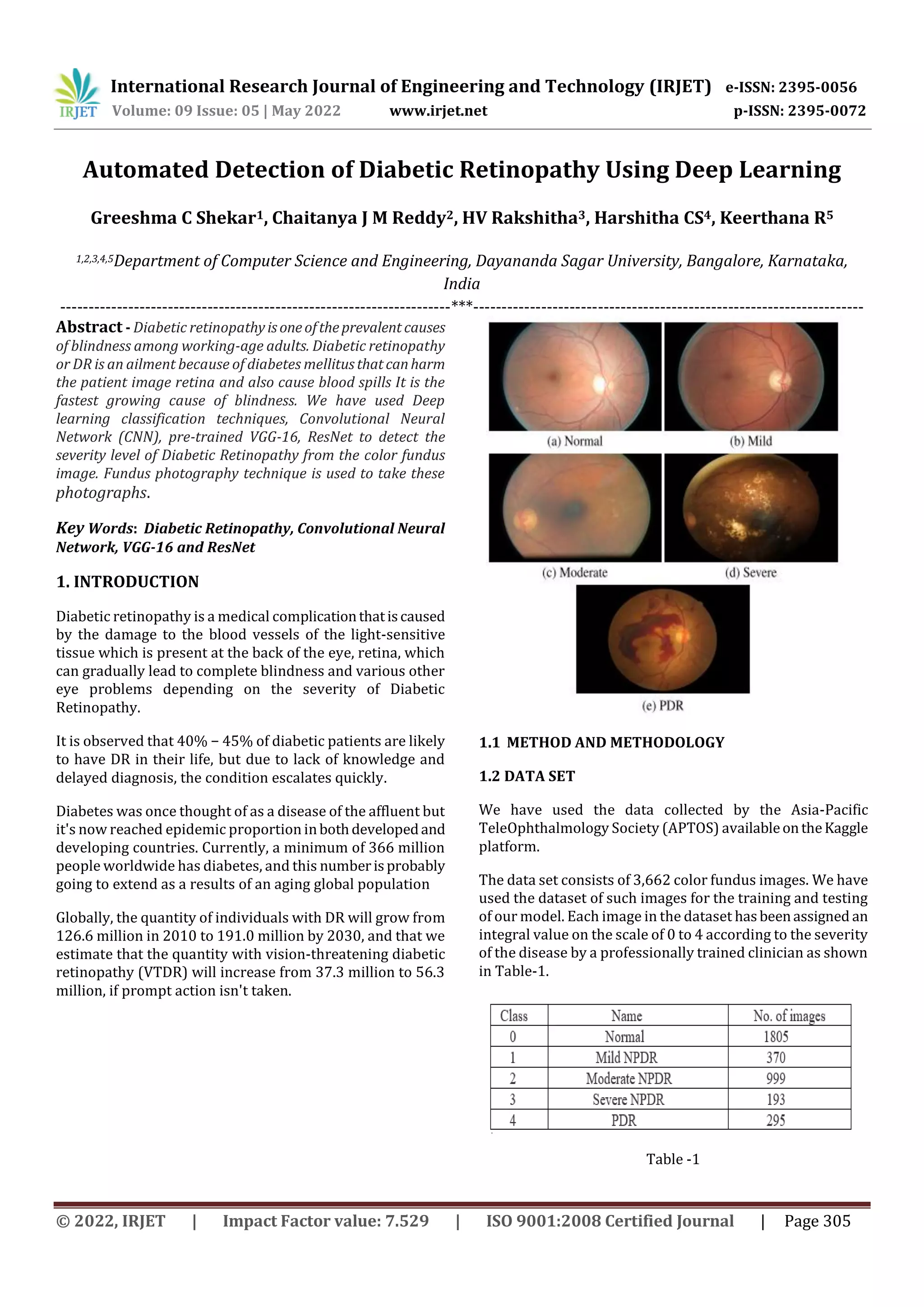
0 – Normal: The person is not suffering from Diabetic
Retinopathy.
1 – Mild Non-Proliferative DR (Mild_NPDR): Within the
Retina’s minute blood vessels, small areas of balloon like
inflammations.
2 – Moderate Non-Proliferative DR (Moderate_NPDR): The
blood vessels that sustain the retina areblockedatthisstage.
Within the retina, there might also be haemorrhages.
3 – Severe Non-Proliferative DR (Severe_NPDR): Moreblood
vessels are blocked in this particular stage, denying several
areas of retina of bloodsupply.Thenumberofhaemorrhages
in the retina also increases drastically.
4 – Proliferative DR (PDR): New and abnormal bloodvessels
developed on the surface of retina. These new blood vessels
are delicate and have the tendency to bleed, causing vision
threatening haemorrhages to fill the eye. They can also turn
into connective tissue which will contract over time,causing
the retina to detach and cause blindness.
2. PREPROCESSING
We are resizing the images forpre-processingthedatabefore
providing it to the model first, keeping in view the aspect
ratio to 256 × 256. It helps us to avoid features loss from
images. The dataset is distributed into training, validation
sets with a ratio of 80% and 20% respectively.
CNN ARCHITECTURE:
Convolutional Neural Network, is commonly used to
breaking down of visual imagery and thus used for retinal
images. A Convolutional Neural Network or CNN isa general
multilayered neural framework with an outstanding plan to
perceive complex features in the data. The pre-processing
required in a CNN is much lower as compared to other
classification algorithms. CNN architecture consists of these
main layers: convolutional layer, pooling layer, Dropout
layer and fully-connected layer.
We have built the sequential CNN model. Firstly, Conv2d
layer with parameters: 64 filters and kernel of size (3,3)
which is a 2-tuple specifying width and height of the 2D
convolution window.
The input shape parameter is passed with train’s shape and
with padding value to be the same to preserve the spatial
dimensions along with activation parameter to be Relu.
Max pooling is considered as the pooling layer, which down-
samples the resulting feature maps and increases the
receptive field on the filters [2,2].
These 2 layers are re-layered inthesamemanneroncemore.
Now a conv2d layer with parameters of 128 filters and (3,3)
kernel with padding and activation is to be the same and
Relu respectively.
Then a pooling layer is added wherein max pooling is done.
These 2 layers are re-layered in the same manner twice.
To maintain the effectivity of thedata andavoidoverfitting,a
Dropout Layer (DL) is added succeeding to the fully-
connected layer. Dropout usually randomly deactivates a
fraction of the units or connections for example 50%, in a
network on each training iteration.
International Research Journal of Engineering and Technology (IRJET) e-ISSN: 2395-0056
Volume: 09 Issue: 05 | May 2022 www.irjet.net p-ISSN: 2395-0072
© 2022, IRJET | Impact Factor value: 7.529 | ISO 9001:2008 Certified Journal | Page 307
After dropout and flattening the model, a dense layer is
added with 1024 units and activation to be Relu.
CNN
VGG-16 ARCHITECTURE:
VGG16 is one of the best vision model architectures present.
VGG16 is having a large number of hyper-parameters,
focused on having convolution layers of3x3filter withstride
1 and has same padding and max pool layer of 2x2 filter of
stride 2.
This arrangement of convolution and max pool layers is
consistently followed throughout the entire architecture.
At the end, it has 2 fully connected layers followed by a
SoftMax for output.
VGG16 has 16 layers that have weights.
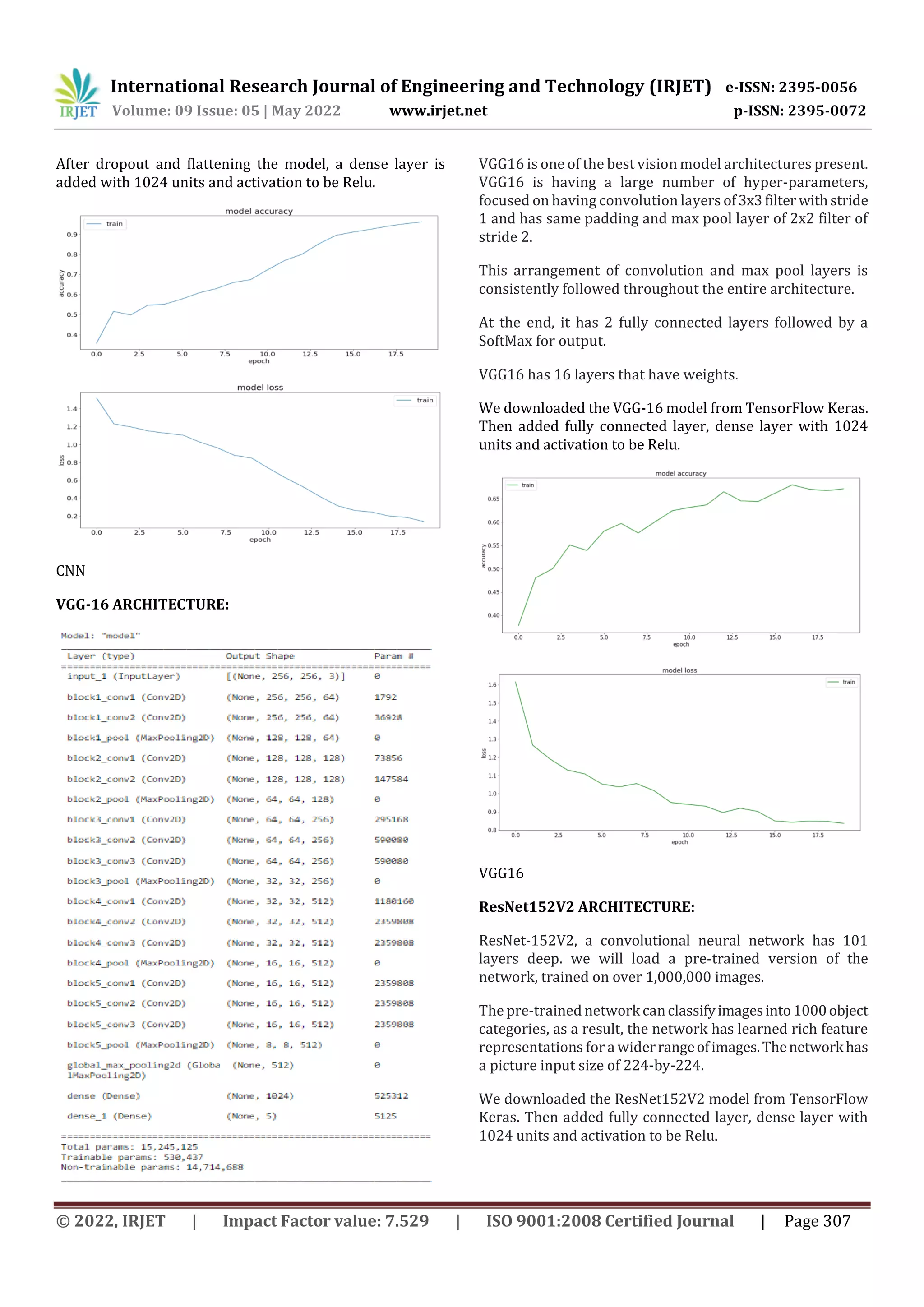
We downloaded the VGG-16 model from TensorFlow Keras.
Then added fully connected layer, dense layer with 1024
units and activation to be Relu.
VGG16
ResNet152V2 ARCHITECTURE:
ResNet-152V2, a convolutional neural network has 101
layers deep. we will load a pre-trained version of the
network, trained on over 1,000,000 images.
The pre-trained networkcanclassifyimagesinto1000object
categories, as a result, the network has learned rich feature
representations fora widerrangeofimages.Thenetworkhas
a picture input size of 224-by-224.
We downloaded the ResNet152V2 model from TensorFlow
Keras. Then added fully connected layer, dense layer with
1024 units and activation to be Relu.
International Research Journal of Engineering and Technology (IRJET) e-ISSN: 2395-0056
Volume: 09 Issue: 05 | May 2022 www.irjet.net p-ISSN: 2395-0072
© 2022, IRJET | Impact Factor value: 7.529 | ISO 9001:2008 Certified Journal | Page 308
ResNet152V2
For all the 3 models, epoch is defined to be once all images
are processed once individually of forward and backward to
the network. 1 epoch is counted to be:
(Number of iterations * batch size) / total number of images
present in training.
While training the models, we checked for 20 epochs, with
batch size 64. Each epoch as observed in the above graphs,
the loss decreased simultaneously the accuracy accuracy
increased.
GUI:
A web application has been developed, where the color
fundus image can be uploaded as the input to the models by
the user who can login with credentials.
The respective result according to the stage of Diabetic
Retinopathy will bedisplayedalongwithaccuracy.Theemail
of the result shall be sent to the patient.
The database consisting of the patient’s records are
maintained using MySQL
3. IMPLEMENTATION
The true positive rate also referred to as hit rateorrecall ofa
classifier is estimated by dividing the correctly classified
positives by the full positive count.
The false positive rate of the classifier is estimated by
dividing the incorrectly classified negatives by the overall
negatives.
The accuracy of a classifier is estimated by dividing the full
correctly classified positives and negatives by the overall
number of samples.
Precision is one indicator which tells the quality of positive
predictions made by the models.
Recall is the ratio of True Positive by the sum of True
Positive and False Negative.
CNN
International Research Journal of Engineering and Technology (IRJET) e-ISSN: 2395-0056
Volume: 09 Issue: 05 | May 2022 www.irjet.net p-ISSN: 2395-0072
© 2022, IRJET | Impact Factor value: 7.529 | ISO 9001:2008 Certified Journal | Page 309
VGG16
ResNet152V2
4. CONCLUSION
Out of 3,662 images, 733 images from the datasetarespitted
for validation purpose. Loading the validation images into
the models for predicting the label took 188 seconds.
We define accuracy as the number of patients with an
accurate classification rate.
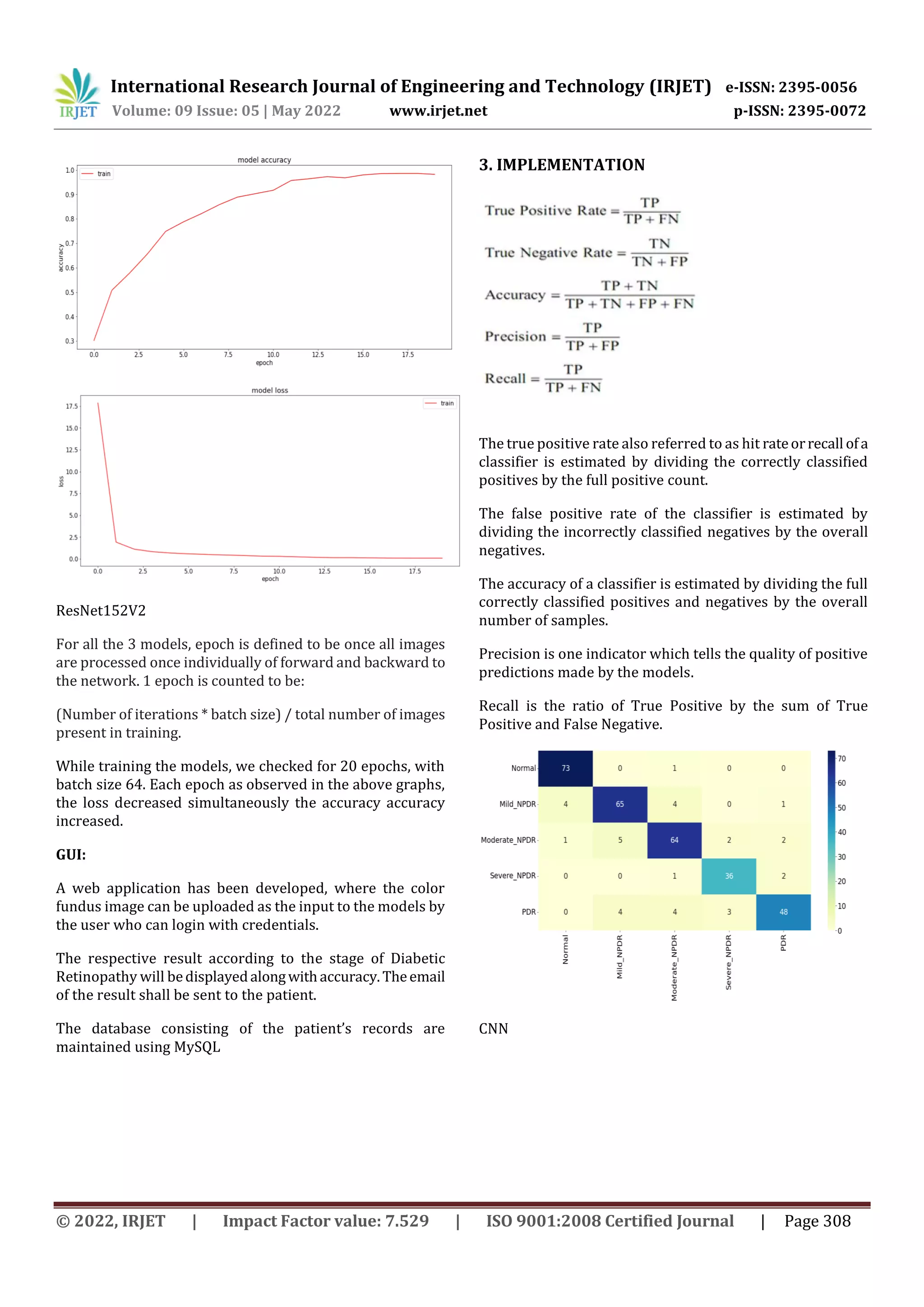
In this five-class problem, the accuracy of CNN model was
96%, ResNet152V2 was 98% and that of VGG-16 was 67%.
Thus, ResNet152V2 performs better than the other two
models.
CNN
VGG16
ResNet152V2
REFERENCES
[1] Yashal Shakti Kanungo, Bhargav Srinivasan, Dr. Savita
Choudhary, “Detecting Diabetic RetinopathyusingDeep
Learning”, 2017 2nd IEEE International Conference On
Recent Trends in Electronics Information &
CommunicationTechnology (RTEICT),May19-20,2017,
India
[2] Kavakiotis, I.; Tsave, O.; Salifoglou, A.; Maglaveras, N.;
Vlahavas, I.; Chouvarda, I. Machine learning and data
mining methods in diabetes research. Comput. Struct.
Biotechnol. J. 2017, 15, 104–116.
[3] Matias Iglicki, MD, PHD, Dinah Zur, MD, and Anat
Loewenstein, MD, MHA, “Detection of Diabetic
Retinopathy Using Deep LearningAnalysis”retina today
2021 feature.
[4] Shorav Suriyal, Christopher Druzgalski,KumarGautam,
“Mobile Assisted Diabetic Retinopathy Detection using
Deep Neural Network,” MARCH 19–24, 2018 ISBN:978-
1-5386-5475-0 IEEE CATALOG NUMBER:
CFP1818GART 978-1-5386-5475-0/18/$31.00 ©2018
IEEE
[5] Amol Prataprao Bhatkar, Dr. G.U. Kharat, “Detection of
Diabetic Retinopathy in Retinal Images using MLP
classifier” 978-1-4673-9692-9/15 $31.00 © 2015 IEEE
DOI 10.1109/iNIS.2015.30
[6] Mohamed Chetoui, Moulay A. Akhloufi, Mustapha
Kardouchi, “Diabetic Retinopathy Detection Using
Machine Learning and Texture Features,” 978-1-5386-
2410-4/18/$31.00 ©2018 IEEE
[7] XIANGLONG ZENG, HAIQUAN CHEN, YUAN LUO AND
WENBIN YE, “Automated Diabetic Retinopathy
Detection Based on Binocular Siamese-like
International Research Journal of Engineering and Technology (IRJET) e-ISSN: 2395-0056
Volume: 09 Issue: 05 | May 2022 www.irjet.net p-ISSN: 2395-0072
© 2022, IRJET | Impact Factor value: 7.529 | ISO 9001:2008 Certified Journal | Page 310
Convolutional Neural Network” 2169-3536 (c) 2018
IEEE
[8] Z. A. Omar, M. Hanafi, S. Mashohor, N. F. M. Mahfudz, M.
Muna’im, “Automatic diabeticretinopathy”978-1-5386-
0383-3/17/$31.00 ©2017 IEEE
[9] Yashal Shakti Kanungo, Bhargav Srinivasan, Dr. Savita
Choudhary, “Detecting Diabetic RetinopathyusingDeep
Learning” 978-1-5090-3704-9/17/$31.00©2017IEEE
[10] Deepthi K Prasad, Vibha L, Venugopal K R, “Early
Detection of Diabetic Retinopathy from Digital Retinal
Fundus Images”978-1-4673-6670-0/15/$31.00©2015
IEEE
[11] Enrique V. Carrera, Andr´es Gonz´alez, Ricardo Carrera,
“Automated detection of diabetic retinopathy using
SVM” 978-1-5090-6363-5/17/$31.00 _c 2017 IEEE
[12] Ratul Ghosh, Kuntal Ghosh, Sanjit Maitra, “Automatic
Detection and Classification of Diabetic Retinopathy
stages using CNN” 978-1-5090-2797-2/17/$31.00
©2017 IEEE
BIOGRAPHIES
Miss. Greeshma C Shekar is
pursuing Bachelor of Technology
degree in department of Computer
Science and Engineering from
Dayananda Sagar University,
located in Bangalore, Karnataka,
India. She has published papers
entitled,” Birds Audio Detection
using Convolutional Neural
Network and TransferLearning”in
IRJET Volume-8 Issue-9,
September 2021 and “Blockchain
and Cryptocurrency: The world of
Blockchain and Cryptocurrency”in
IJCSE Volume-9 Issue-7, July 2021.
She is currently in her final year of
Engineering and will begraduating
from Dayananda Sagar University
in the year 2022.
Miss. Keerthana R is pursuing
Bachelor of Technology degree in
department of Computer Science
and Engineering from Dayananda
Sagar University, located in
Bangalore, Karnataka, India. She is
currently in her final year of
Engineering and will begraduating
from Dayananda Sagar University
in the year 2022.
Miss. HV Rakshitha is pursuing
Bachelor of Technology degree in
department of Computer Science
and Engineering from Dayananda
Sagar University, located in
Bangalore, Karnataka, India. She is
currently in her final year of
Engineering and will begraduating
from Dayananda Sagar University
in the year 2022.
Miss. Chaitanya J M Reddy is
pursuing Bachelor of Technology
degree in department of Computer
Science and Engineering from
Dayananda Sagar University,
located in Bangalore, Karnataka,
India. She is currently in her final
year of Engineering and will be
graduating from Dayananda Sagar
University in the year 2022.
Miss. Harshitha CS is pursuing
Bachelor of Technology degree in
department of Computer Science
and Engineering from Dayananda
Sagar University, located in
Bangalore, Karnataka, India. She is
currently in her final year of
Engineering and will begraduating
from Dayananda Sagar University
in the year 2022.

Automated Detection of Diabetic Retinopathy Using Deep Learning

  • 1.
    International Research Journalof Engineering and Technology (IRJET) e-ISSN: 2395-0056 Volume: 09 Issue: 05 | May 2022 www.irjet.net p-ISSN: 2395-0072 © 2022, IRJET | Impact Factor value: 7.529 | ISO 9001:2008 Certified Journal | Page 305 Automated Detection of Diabetic Retinopathy Using Deep Learning Greeshma C Shekar1, Chaitanya J M Reddy2, HV Rakshitha3, Harshitha CS4, Keerthana R5 1,2,3,4,5Department of Computer Science and Engineering, Dayananda Sagar University, Bangalore, Karnataka, India ---------------------------------------------------------------------***--------------------------------------------------------------------- Abstract - Diabetic retinopathyisoneoftheprevalent causes of blindness among working-age adults. Diabetic retinopathy or DR is an ailment because of diabetes mellitusthatcanharm the patient image retina and also cause blood spills It is the fastest growing cause of blindness. We have used Deep learning classification techniques, Convolutional Neural Network (CNN), pre-trained VGG-16, ResNet to detect the severity level of Diabetic Retinopathy from the color fundus image. Fundus photography technique is used to take these photographs. Key Words: Diabetic Retinopathy, Convolutional Neural Network, VGG-16 and ResNet 1. INTRODUCTION Diabetic retinopathy is a medical complicationthatiscaused by the damage to the blood vessels of the light-sensitive tissue which is present at the back of the eye, retina, which can gradually lead to complete blindness and various other eye problems depending on the severity of Diabetic Retinopathy. It is observed that 40% − 45% of diabetic patients are likely to have DR in their life, but due to lack of knowledge and delayed diagnosis, the condition escalates quickly. Diabetes was once thought of as a disease of the affluent but it's now reached epidemic proportion inbothdevelopedand developing countries. Currently, a minimum of 366 million people worldwide has diabetes, and this numberisprobably going to extend as a results of an aging global population Globally, the quantity of individuals with DR will grow from 126.6 million in 2010 to 191.0 million by 2030, and that we estimate that the quantity with vision-threatening diabetic retinopathy (VTDR) will increase from 37.3 million to 56.3 million, if prompt action isn't taken. 1.1 METHOD AND METHODOLOGY 1.2 DATA SET We have used the data collected by the Asia-Pacific TeleOphthalmology Society (APTOS) availableontheKaggle platform. The data set consists of 3,662 color fundus images. We have used the dataset of such images for the training and testing of our model. Each image in the dataset hasbeenassigned an integral value on the scale of 0 to 4 according to the severity of the disease by a professionally trained clinician as shown in Table-1. Table -1
  • 2.
    International Research Journalof Engineering and Technology (IRJET) e-ISSN: 2395-0056 Volume: 09 Issue: 05 | May 2022 www.irjet.net p-ISSN: 2395-0072 © 2022, IRJET | Impact Factor value: 7.529 | ISO 9001:2008 Certified Journal | Page 306 In order to induce a more balanced date, we have split the dataset into 80:20 for training and validation purpose. Totally for training purpose we have considered 2,929 color fundus images and 733 color fundus images for validation. 0 – Normal: The person is not suffering from Diabetic Retinopathy. 1 – Mild Non-Proliferative DR (Mild_NPDR): Within the Retina’s minute blood vessels, small areas of balloon like inflammations. 2 – Moderate Non-Proliferative DR (Moderate_NPDR): The blood vessels that sustain the retina areblockedatthisstage. Within the retina, there might also be haemorrhages. 3 – Severe Non-Proliferative DR (Severe_NPDR): Moreblood vessels are blocked in this particular stage, denying several areas of retina of bloodsupply.Thenumberofhaemorrhages in the retina also increases drastically. 4 – Proliferative DR (PDR): New and abnormal bloodvessels developed on the surface of retina. These new blood vessels are delicate and have the tendency to bleed, causing vision threatening haemorrhages to fill the eye. They can also turn into connective tissue which will contract over time,causing the retina to detach and cause blindness. 2. PREPROCESSING We are resizing the images forpre-processingthedatabefore providing it to the model first, keeping in view the aspect ratio to 256 × 256. It helps us to avoid features loss from images. The dataset is distributed into training, validation sets with a ratio of 80% and 20% respectively. CNN ARCHITECTURE: Convolutional Neural Network, is commonly used to breaking down of visual imagery and thus used for retinal images. A Convolutional Neural Network or CNN isa general multilayered neural framework with an outstanding plan to perceive complex features in the data. The pre-processing required in a CNN is much lower as compared to other classification algorithms. CNN architecture consists of these main layers: convolutional layer, pooling layer, Dropout layer and fully-connected layer. We have built the sequential CNN model. Firstly, Conv2d layer with parameters: 64 filters and kernel of size (3,3) which is a 2-tuple specifying width and height of the 2D convolution window. The input shape parameter is passed with train’s shape and with padding value to be the same to preserve the spatial dimensions along with activation parameter to be Relu. Max pooling is considered as the pooling layer, which down- samples the resulting feature maps and increases the receptive field on the filters [2,2]. These 2 layers are re-layered inthesamemanneroncemore. Now a conv2d layer with parameters of 128 filters and (3,3) kernel with padding and activation is to be the same and Relu respectively. Then a pooling layer is added wherein max pooling is done. These 2 layers are re-layered in the same manner twice. To maintain the effectivity of thedata andavoidoverfitting,a Dropout Layer (DL) is added succeeding to the fully- connected layer. Dropout usually randomly deactivates a fraction of the units or connections for example 50%, in a network on each training iteration.
  • 3.
    International Research Journalof Engineering and Technology (IRJET) e-ISSN: 2395-0056 Volume: 09 Issue: 05 | May 2022 www.irjet.net p-ISSN: 2395-0072 © 2022, IRJET | Impact Factor value: 7.529 | ISO 9001:2008 Certified Journal | Page 307 After dropout and flattening the model, a dense layer is added with 1024 units and activation to be Relu. CNN VGG-16 ARCHITECTURE: VGG16 is one of the best vision model architectures present. VGG16 is having a large number of hyper-parameters, focused on having convolution layers of3x3filter withstride 1 and has same padding and max pool layer of 2x2 filter of stride 2. This arrangement of convolution and max pool layers is consistently followed throughout the entire architecture. At the end, it has 2 fully connected layers followed by a SoftMax for output. VGG16 has 16 layers that have weights. We downloaded the VGG-16 model from TensorFlow Keras. Then added fully connected layer, dense layer with 1024 units and activation to be Relu. VGG16 ResNet152V2 ARCHITECTURE: ResNet-152V2, a convolutional neural network has 101 layers deep. we will load a pre-trained version of the network, trained on over 1,000,000 images. The pre-trained networkcanclassifyimagesinto1000object categories, as a result, the network has learned rich feature representations fora widerrangeofimages.Thenetworkhas a picture input size of 224-by-224. We downloaded the ResNet152V2 model from TensorFlow Keras. Then added fully connected layer, dense layer with 1024 units and activation to be Relu.
  • 4.
    International Research Journalof Engineering and Technology (IRJET) e-ISSN: 2395-0056 Volume: 09 Issue: 05 | May 2022 www.irjet.net p-ISSN: 2395-0072 © 2022, IRJET | Impact Factor value: 7.529 | ISO 9001:2008 Certified Journal | Page 308 ResNet152V2 For all the 3 models, epoch is defined to be once all images are processed once individually of forward and backward to the network. 1 epoch is counted to be: (Number of iterations * batch size) / total number of images present in training. While training the models, we checked for 20 epochs, with batch size 64. Each epoch as observed in the above graphs, the loss decreased simultaneously the accuracy accuracy increased. GUI: A web application has been developed, where the color fundus image can be uploaded as the input to the models by the user who can login with credentials. The respective result according to the stage of Diabetic Retinopathy will bedisplayedalongwithaccuracy.Theemail of the result shall be sent to the patient. The database consisting of the patient’s records are maintained using MySQL 3. IMPLEMENTATION The true positive rate also referred to as hit rateorrecall ofa classifier is estimated by dividing the correctly classified positives by the full positive count. The false positive rate of the classifier is estimated by dividing the incorrectly classified negatives by the overall negatives. The accuracy of a classifier is estimated by dividing the full correctly classified positives and negatives by the overall number of samples. Precision is one indicator which tells the quality of positive predictions made by the models. Recall is the ratio of True Positive by the sum of True Positive and False Negative. CNN
  • 5.
    International Research Journalof Engineering and Technology (IRJET) e-ISSN: 2395-0056 Volume: 09 Issue: 05 | May 2022 www.irjet.net p-ISSN: 2395-0072 © 2022, IRJET | Impact Factor value: 7.529 | ISO 9001:2008 Certified Journal | Page 309 VGG16 ResNet152V2 4. CONCLUSION Out of 3,662 images, 733 images from the datasetarespitted for validation purpose. Loading the validation images into the models for predicting the label took 188 seconds. We define accuracy as the number of patients with an accurate classification rate. In this five-class problem, the accuracy of CNN model was 96%, ResNet152V2 was 98% and that of VGG-16 was 67%. Thus, ResNet152V2 performs better than the other two models. CNN VGG16 ResNet152V2 REFERENCES [1] Yashal Shakti Kanungo, Bhargav Srinivasan, Dr. Savita Choudhary, “Detecting Diabetic RetinopathyusingDeep Learning”, 2017 2nd IEEE International Conference On Recent Trends in Electronics Information & CommunicationTechnology (RTEICT),May19-20,2017, India [2] Kavakiotis, I.; Tsave, O.; Salifoglou, A.; Maglaveras, N.; Vlahavas, I.; Chouvarda, I. Machine learning and data mining methods in diabetes research. Comput. Struct. Biotechnol. J. 2017, 15, 104–116. [3] Matias Iglicki, MD, PHD, Dinah Zur, MD, and Anat Loewenstein, MD, MHA, “Detection of Diabetic Retinopathy Using Deep LearningAnalysis”retina today 2021 feature. [4] Shorav Suriyal, Christopher Druzgalski,KumarGautam, “Mobile Assisted Diabetic Retinopathy Detection using Deep Neural Network,” MARCH 19–24, 2018 ISBN:978- 1-5386-5475-0 IEEE CATALOG NUMBER: CFP1818GART 978-1-5386-5475-0/18/$31.00 ©2018 IEEE [5] Amol Prataprao Bhatkar, Dr. G.U. Kharat, “Detection of Diabetic Retinopathy in Retinal Images using MLP classifier” 978-1-4673-9692-9/15 $31.00 © 2015 IEEE DOI 10.1109/iNIS.2015.30 [6] Mohamed Chetoui, Moulay A. Akhloufi, Mustapha Kardouchi, “Diabetic Retinopathy Detection Using Machine Learning and Texture Features,” 978-1-5386- 2410-4/18/$31.00 ©2018 IEEE [7] XIANGLONG ZENG, HAIQUAN CHEN, YUAN LUO AND WENBIN YE, “Automated Diabetic Retinopathy Detection Based on Binocular Siamese-like
  • 6.
    International Research Journalof Engineering and Technology (IRJET) e-ISSN: 2395-0056 Volume: 09 Issue: 05 | May 2022 www.irjet.net p-ISSN: 2395-0072 © 2022, IRJET | Impact Factor value: 7.529 | ISO 9001:2008 Certified Journal | Page 310 Convolutional Neural Network” 2169-3536 (c) 2018 IEEE [8] Z. A. Omar, M. Hanafi, S. Mashohor, N. F. M. Mahfudz, M. Muna’im, “Automatic diabeticretinopathy”978-1-5386- 0383-3/17/$31.00 ©2017 IEEE [9] Yashal Shakti Kanungo, Bhargav Srinivasan, Dr. Savita Choudhary, “Detecting Diabetic RetinopathyusingDeep Learning” 978-1-5090-3704-9/17/$31.00©2017IEEE [10] Deepthi K Prasad, Vibha L, Venugopal K R, “Early Detection of Diabetic Retinopathy from Digital Retinal Fundus Images”978-1-4673-6670-0/15/$31.00©2015 IEEE [11] Enrique V. Carrera, Andr´es Gonz´alez, Ricardo Carrera, “Automated detection of diabetic retinopathy using SVM” 978-1-5090-6363-5/17/$31.00 _c 2017 IEEE [12] Ratul Ghosh, Kuntal Ghosh, Sanjit Maitra, “Automatic Detection and Classification of Diabetic Retinopathy stages using CNN” 978-1-5090-2797-2/17/$31.00 ©2017 IEEE BIOGRAPHIES Miss. Greeshma C Shekar is pursuing Bachelor of Technology degree in department of Computer Science and Engineering from Dayananda Sagar University, located in Bangalore, Karnataka, India. She has published papers entitled,” Birds Audio Detection using Convolutional Neural Network and TransferLearning”in IRJET Volume-8 Issue-9, September 2021 and “Blockchain and Cryptocurrency: The world of Blockchain and Cryptocurrency”in IJCSE Volume-9 Issue-7, July 2021. She is currently in her final year of Engineering and will begraduating from Dayananda Sagar University in the year 2022. Miss. Keerthana R is pursuing Bachelor of Technology degree in department of Computer Science and Engineering from Dayananda Sagar University, located in Bangalore, Karnataka, India. She is currently in her final year of Engineering and will begraduating from Dayananda Sagar University in the year 2022. Miss. HV Rakshitha is pursuing Bachelor of Technology degree in department of Computer Science and Engineering from Dayananda Sagar University, located in Bangalore, Karnataka, India. She is currently in her final year of Engineering and will begraduating from Dayananda Sagar University in the year 2022. Miss. Chaitanya J M Reddy is pursuing Bachelor of Technology degree in department of Computer Science and Engineering from Dayananda Sagar University, located in Bangalore, Karnataka, India. She is currently in her final year of Engineering and will be graduating from Dayananda Sagar University in the year 2022. Miss. Harshitha CS is pursuing Bachelor of Technology degree in department of Computer Science and Engineering from Dayananda Sagar University, located in Bangalore, Karnataka, India. She is currently in her final year of Engineering and will begraduating from Dayananda Sagar University in the year 2022.