ON SITE TESTING  OF AUTO RECLOSER RELAYS Riam A. Wibowo
Introduction  Autorecloser relays are widely implemented in the electric utilities Over Head Lines networks to improve power availability and to maintain system stability.  Site testing need to be  performed before operation  to ensure proper function of Autoreclosers. There is  not much manufacturer guidance in  functional site testing of Autoreclosers. Therefore,  testing engineers have to carry out the functional site tests according to specific requirements  of the installations.  Application of multifunction and numerical relays has reduced the number of elements and wirings  to be tested on site, but it would not eliminate the requirement to perform site testing.
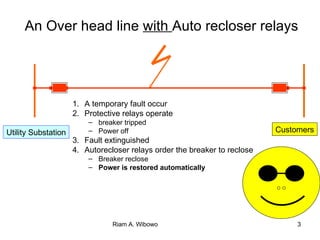
An Over head line  with  Auto recloser relays   A temporary fault occur Protective relays operate breaker tripped Power off Fault extinguished Autorecloser relays order the breaker to reclose Breaker reclose Power is restored automatically Utility Substation Customers
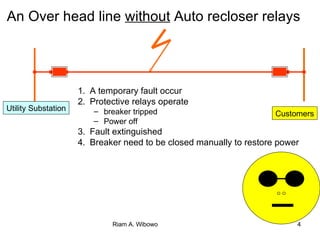
An Over head line  without  Auto recloser relays   A temporary fault occur Protective relays operate breaker tripped Power off Fault extinguished Breaker need to be closed manually to restore power Utility Substation Customers
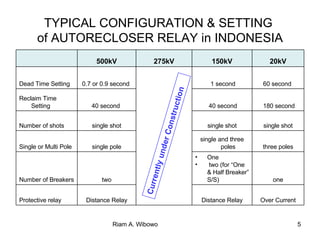
TYPICAL CONFIGURATION & SETTING  of AUTORECLOSER RELAY in INDONESIA Currently under Construction 275kV Over Current Distance Relay Distance Relay Protective relay  one One  two (for “One & Half Breaker” S/S) two Number of Breakers three poles single and three poles single pole Single or Multi Pole single shot single shot single shot Number of shots   180 second   40 second 40 second  Reclaim Time Setting 60 second    1 second 0.7 or 0.9 second  Dead Time Setting 20kV 150kV 500kV
Basic Requirement of Autorecloser Relay Performance The Autorecloser Relay should reclose the Breaker(s) whenever it is initiated by Protective Relay The Autorecloser Relay  should not  reclose the Breaker(s) if the initiation occurs during the Reclaim Time  For single pole mode, the Autorecloser Relay should only reclose the Breaker(s) for single phase to earth fault. The Autorecloser Relay should  never  reclose the Breaker(s)  if : no initiation from  Protective Relay (e.g. when the Breaker(s) are intentionally opened by people)  Any of the Breaker(s) is not ready  it is not switched to active
Basic Requirement of Autorecloser Relay Performance (2) For single and three poles mode : The Autorecloser Relay should reclose the Breaker(s) for line-line fault  under control  of synchrocheck relay The Autorecloser Relay should reclose the Breaker(s) for single phase to earth fault Three poles reclosing should be under Synchro Check control (except for 20kV radial networks) Failure of reclosing after single pole tripping should be followed by tripping of all poles
Specific  requirement  for 500 kV Autorecloser Relay The Autorecloser Relay should reclose the Breaker(s) when initiated by  any  Distance Relay (due to  duplex  configuration of 500 kV protection scheme) Since 500kV Substations are one & half breaker type, the Autorecloser Relay should be able to recognize and control each of the Breaker as “leader Breaker ” and “follower Breaker”
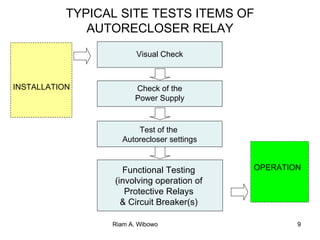
TYPICAL SITE TESTS ITEMS OF AUTORECLOSER RELAY INSTALLATION OPERATION Visual Check Check of the Power Supply Test of the  Autorecloser settings Functional Testing  (involving operation of  Protective Relays  & Circuit Breaker(s)
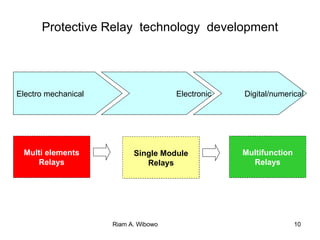
Protective Relay  technology  development Multi elements Relays Single Module  Relays Multifunction Relays Electro mechanical Electronic Digital/numerical
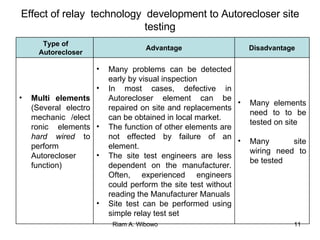
Effect of relay  technology  development to Autorecloser site testing Many elements need to to be tested on site Many site wiring need to be tested Many problems can be detected early by visual inspection In most cases, defective in Autorecloser element can be repaired on site and replacements can be obtained in local market.  The function of other elements are not effected by failure of an element.  The site test engineers are less dependent on the manufacturer. Often, experienced engineers could perform the site test without reading the Manufacturer Manuals Site test can be performed using simple relay test set Multi elements  (Several electro mechanic  /electronic  elements  hard wired  to perform Autorecloser function)   Disadvantage Advantage   Type of Autorecloser
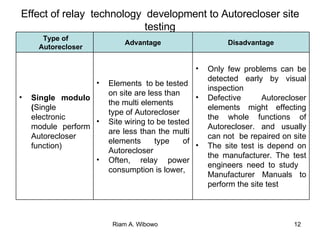
Effect of relay  technology  development to Autorecloser site testing Only few problems can be detected early by visual inspection Defective  Autorecloser elements might effecting the whole functions of Autorecloser. and usually can not  be repaired on site  The site test is depend on the manufacturer. The test engineers need to study  Manufacturer Manuals to perform the site test  Elements  to be tested on site are less than the multi elements type of Autorecloser Site wiring to be tested are less than  the multi elements type of Autorecloser Often, relay power consumption is lower,  Single modulo ( Single electronic module perform Autorecloser function)    Disadvantage Advantage   Type of Autorecloser
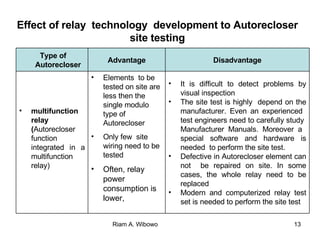
Effect of relay  technology  development to Autorecloser site testing It is difficult to detect problems by visual inspection The site test is highly  depend on the manufacturer. Even an experienced  test engineers need to carefully study  Manufacturer Manuals. Moreover a  special software and hardware is needed  to perform the site test.  Defective in Autorecloser element can not  be repaired on site. In some cases, the whole relay need to be replaced Modern and computerized relay test set is needed to perform the site test Elements  to be tested on site are less then the single modulo type of Autorecloser Only few  site wiring need to be tested Often, relay power consumption is lower, multifunction relay ( Autorecloser function integrated in a multifunction relay) Disadvantage Advantage   Type of Autorecloser
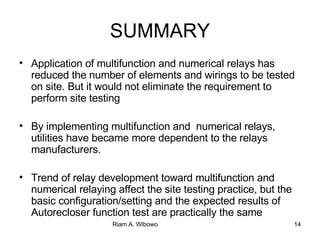
SUMMARY Application of multifunction and numerical relays has reduced the number of elements and wirings to be tested on site. But it would not eliminate the requirement to perform site testing By implementing multifunction and  numerical relays, utilities have became more dependent to the  relays manufacturers.  Trend of relay development toward multifunction and  numerical relaying affect the site testing practice, but the basic configuration/setting and the expected results of  Autorecloser function test are practically the same
Appendix Autorecloser Relay Block Diagram
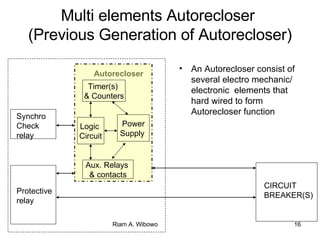
Multi elements Autorecloser  ( Previous Generation of Autorecloser) An Autorecloser consist of several electro mechanic/ electronic  elements that hard wired to form Autorecloser function Autorecloser Timer(s)  & Counters Aux. Relays  & contacts Logic  Circuit Power Supply  Protective relay CIRCUIT  BREAKER(S) Synchro  Check relay
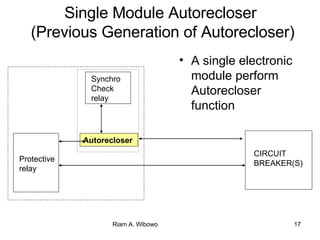
A single electronic module perform Autorecloser function  Autorecloser Single Module Autorecloser  ( Previous Generation of Autorecloser) Protective relay CIRCUIT  BREAKER(S) Synchro  Check relay
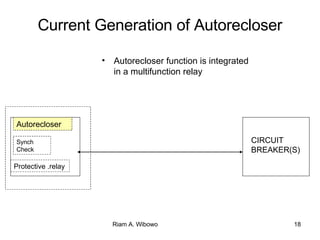
Current Generation of Autorecloser Autorecloser function is integrated in a multifunction relay Protective .relay Autorecloser Synch Check CIRCUIT  BREAKER(S)

Auto Reclose Testing

  • 1.
    ON SITE TESTING OF AUTO RECLOSER RELAYS Riam A. Wibowo
  • 2.
    Introduction Autorecloserrelays are widely implemented in the electric utilities Over Head Lines networks to improve power availability and to maintain system stability. Site testing need to be performed before operation to ensure proper function of Autoreclosers. There is not much manufacturer guidance in functional site testing of Autoreclosers. Therefore, testing engineers have to carry out the functional site tests according to specific requirements of the installations. Application of multifunction and numerical relays has reduced the number of elements and wirings to be tested on site, but it would not eliminate the requirement to perform site testing.
  • 3.
    An Over headline with Auto recloser relays A temporary fault occur Protective relays operate breaker tripped Power off Fault extinguished Autorecloser relays order the breaker to reclose Breaker reclose Power is restored automatically Utility Substation Customers
  • 4.
    An Over headline without Auto recloser relays A temporary fault occur Protective relays operate breaker tripped Power off Fault extinguished Breaker need to be closed manually to restore power Utility Substation Customers
  • 5.
    TYPICAL CONFIGURATION &SETTING of AUTORECLOSER RELAY in INDONESIA Currently under Construction 275kV Over Current Distance Relay Distance Relay Protective relay one One two (for “One & Half Breaker” S/S) two Number of Breakers three poles single and three poles single pole Single or Multi Pole single shot single shot single shot Number of shots   180 second   40 second 40 second  Reclaim Time Setting 60 second    1 second 0.7 or 0.9 second Dead Time Setting 20kV 150kV 500kV
  • 6.
    Basic Requirement ofAutorecloser Relay Performance The Autorecloser Relay should reclose the Breaker(s) whenever it is initiated by Protective Relay The Autorecloser Relay should not reclose the Breaker(s) if the initiation occurs during the Reclaim Time For single pole mode, the Autorecloser Relay should only reclose the Breaker(s) for single phase to earth fault. The Autorecloser Relay should never reclose the Breaker(s) if : no initiation from Protective Relay (e.g. when the Breaker(s) are intentionally opened by people) Any of the Breaker(s) is not ready it is not switched to active
  • 7.
    Basic Requirement ofAutorecloser Relay Performance (2) For single and three poles mode : The Autorecloser Relay should reclose the Breaker(s) for line-line fault under control of synchrocheck relay The Autorecloser Relay should reclose the Breaker(s) for single phase to earth fault Three poles reclosing should be under Synchro Check control (except for 20kV radial networks) Failure of reclosing after single pole tripping should be followed by tripping of all poles
  • 8.
    Specific requirement for 500 kV Autorecloser Relay The Autorecloser Relay should reclose the Breaker(s) when initiated by any Distance Relay (due to duplex configuration of 500 kV protection scheme) Since 500kV Substations are one & half breaker type, the Autorecloser Relay should be able to recognize and control each of the Breaker as “leader Breaker ” and “follower Breaker”
  • 9.
    TYPICAL SITE TESTSITEMS OF AUTORECLOSER RELAY INSTALLATION OPERATION Visual Check Check of the Power Supply Test of the Autorecloser settings Functional Testing (involving operation of Protective Relays & Circuit Breaker(s)
  • 10.
    Protective Relay technology development Multi elements Relays Single Module Relays Multifunction Relays Electro mechanical Electronic Digital/numerical
  • 11.
    Effect of relay technology development to Autorecloser site testing Many elements need to to be tested on site Many site wiring need to be tested Many problems can be detected early by visual inspection In most cases, defective in Autorecloser element can be repaired on site and replacements can be obtained in local market. The function of other elements are not effected by failure of an element. The site test engineers are less dependent on the manufacturer. Often, experienced engineers could perform the site test without reading the Manufacturer Manuals Site test can be performed using simple relay test set Multi elements (Several electro mechanic /electronic elements hard wired to perform Autorecloser function)   Disadvantage Advantage   Type of Autorecloser
  • 12.
    Effect of relay technology development to Autorecloser site testing Only few problems can be detected early by visual inspection Defective Autorecloser elements might effecting the whole functions of Autorecloser. and usually can not be repaired on site The site test is depend on the manufacturer. The test engineers need to study Manufacturer Manuals to perform the site test Elements to be tested on site are less than the multi elements type of Autorecloser Site wiring to be tested are less than the multi elements type of Autorecloser Often, relay power consumption is lower, Single modulo ( Single electronic module perform Autorecloser function)   Disadvantage Advantage   Type of Autorecloser
  • 13.
    Effect of relay technology development to Autorecloser site testing It is difficult to detect problems by visual inspection The site test is highly depend on the manufacturer. Even an experienced test engineers need to carefully study Manufacturer Manuals. Moreover a special software and hardware is needed to perform the site test. Defective in Autorecloser element can not be repaired on site. In some cases, the whole relay need to be replaced Modern and computerized relay test set is needed to perform the site test Elements to be tested on site are less then the single modulo type of Autorecloser Only few site wiring need to be tested Often, relay power consumption is lower, multifunction relay ( Autorecloser function integrated in a multifunction relay) Disadvantage Advantage   Type of Autorecloser
  • 14.
    SUMMARY Application ofmultifunction and numerical relays has reduced the number of elements and wirings to be tested on site. But it would not eliminate the requirement to perform site testing By implementing multifunction and numerical relays, utilities have became more dependent to the relays manufacturers. Trend of relay development toward multifunction and numerical relaying affect the site testing practice, but the basic configuration/setting and the expected results of Autorecloser function test are practically the same
  • 15.
  • 16.
    Multi elements Autorecloser ( Previous Generation of Autorecloser) An Autorecloser consist of several electro mechanic/ electronic elements that hard wired to form Autorecloser function Autorecloser Timer(s) & Counters Aux. Relays & contacts Logic Circuit Power Supply Protective relay CIRCUIT BREAKER(S) Synchro Check relay
  • 17.
    A single electronicmodule perform Autorecloser function Autorecloser Single Module Autorecloser ( Previous Generation of Autorecloser) Protective relay CIRCUIT BREAKER(S) Synchro Check relay
  • 18.
    Current Generation ofAutorecloser Autorecloser function is integrated in a multifunction relay Protective .relay Autorecloser Synch Check CIRCUIT BREAKER(S)