Autism Fiona Lanham Mr. Holley’s H.I. 2 nd  Period
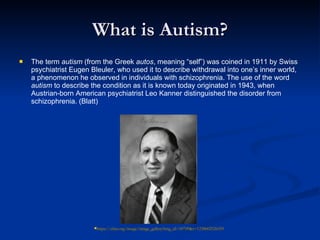
What is Autism? The term  autism  (from the Greek  autos , meaning “self”) was coined in 1911 by Swiss psychiatrist Eugen Bleuler, who used it to describe withdrawal into one’s inner world, a phenomenon he observed in individuals with schizophrenia. The use of the word  autism  to describe the condition as it is known today originated in 1943, when Austrian-born American psychiatrist Leo Kanner distinguished the disorder from schizophrenia. (Blatt)  https:// sfari.org/image/image_gallery?img_id =50709&t=1238002526359
Autism Characteristics  The symptoms of autism are variable, ranging from mild to moderate to severe in nature. There are three major categories of symptoms: (1) abnormalities in social interaction; (2) abnormalities in communication; and (3) abnormalities in behaviors, interests, and activities, which are usually restricted and repetitive. Social communication problems include a narrow range of facial expressions, poor eye contact during interactions, and difficulty establishing relationships with peers. Communication problems include delayed or lack of  spoken language , poor conversation skills, lack of appropriate developmental play, and diminished gestures. (Blatt) http://www.sfn.org/skins/main/images/brainbriefings/bb_May2006_large.jpg
Long-Term Effects Long-term effects of autism depend on how severe the symptoms are. Long-term effects also depend on how soon a person starts treatment. The symptoms of autism may last a lifetime, but the person's condition can often be improved with careful intervention and treatment. An individual with autism may develop seizure disorders and depression. (McLaughlin)   http://www.autismpda.org/images/autism_awareness_logo.jpg
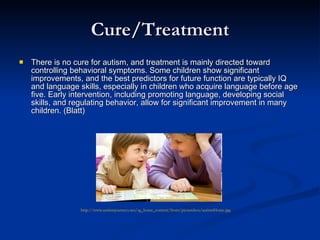
Cure/Treatment There is no cure for autism, and treatment is mainly directed toward controlling behavioral symptoms. Some children show significant improvements, and the best predictors for future function are typically IQ and language skills, especially in children who acquire language before age five. Early intervention, including promoting language, developing social skills, and regulating behavior, allow for significant improvement in many children. (Blatt) http://www.autismjourneys.net/sg_home_content/front/picturebox/autismHome.jpg
The End
Works Cited &quot;autism.&quot;  Encyclopædia Britannica. Encyclopædia Britannica Online . Encyclopædia Britannica, 2011. Web. 07 Apr. 2011. < http://www.britannica.com/EBchecked/topic/44667/autism >.   McLaughlin, Eileen. &quot;University of Illinois Medical Center:Health Library.&quot;  University of Illinois Medical Center . 08 Aug. 2000. Web. 07 Apr. 2011. < http:// uimc.discoveryhospital.com/main.php?id=2800 >.
Photo Credits https:// sfari.org/image/image_gallery?img_id=50709&t=1238002526359 http://www.sfn.org/skins/main/images/brainbriefings/bb_May2006_large.jpg http://www.autismpda.org/images/autism_awareness_logo.jpg http://www.autismjourneys.net/sg_home_content/front/picturebox/autismHome.jpg

H.I. Autism Powerpoint

  • 1.
    Autism Fiona LanhamMr. Holley’s H.I. 2 nd Period
  • 2.
    What is Autism?The term autism (from the Greek autos , meaning “self”) was coined in 1911 by Swiss psychiatrist Eugen Bleuler, who used it to describe withdrawal into one’s inner world, a phenomenon he observed in individuals with schizophrenia. The use of the word autism to describe the condition as it is known today originated in 1943, when Austrian-born American psychiatrist Leo Kanner distinguished the disorder from schizophrenia. (Blatt) https:// sfari.org/image/image_gallery?img_id =50709&t=1238002526359
  • 3.
    Autism Characteristics The symptoms of autism are variable, ranging from mild to moderate to severe in nature. There are three major categories of symptoms: (1) abnormalities in social interaction; (2) abnormalities in communication; and (3) abnormalities in behaviors, interests, and activities, which are usually restricted and repetitive. Social communication problems include a narrow range of facial expressions, poor eye contact during interactions, and difficulty establishing relationships with peers. Communication problems include delayed or lack of spoken language , poor conversation skills, lack of appropriate developmental play, and diminished gestures. (Blatt) http://www.sfn.org/skins/main/images/brainbriefings/bb_May2006_large.jpg
  • 4.
    Long-Term Effects Long-termeffects of autism depend on how severe the symptoms are. Long-term effects also depend on how soon a person starts treatment. The symptoms of autism may last a lifetime, but the person's condition can often be improved with careful intervention and treatment. An individual with autism may develop seizure disorders and depression. (McLaughlin) http://www.autismpda.org/images/autism_awareness_logo.jpg
  • 5.
    Cure/Treatment There isno cure for autism, and treatment is mainly directed toward controlling behavioral symptoms. Some children show significant improvements, and the best predictors for future function are typically IQ and language skills, especially in children who acquire language before age five. Early intervention, including promoting language, developing social skills, and regulating behavior, allow for significant improvement in many children. (Blatt) http://www.autismjourneys.net/sg_home_content/front/picturebox/autismHome.jpg
  • 6.
  • 7.
    Works Cited &quot;autism.&quot; Encyclopædia Britannica. Encyclopædia Britannica Online . Encyclopædia Britannica, 2011. Web. 07 Apr. 2011. < http://www.britannica.com/EBchecked/topic/44667/autism >. McLaughlin, Eileen. &quot;University of Illinois Medical Center:Health Library.&quot; University of Illinois Medical Center . 08 Aug. 2000. Web. 07 Apr. 2011. < http:// uimc.discoveryhospital.com/main.php?id=2800 >.
  • 8.
    Photo Credits https://sfari.org/image/image_gallery?img_id=50709&t=1238002526359 http://www.sfn.org/skins/main/images/brainbriefings/bb_May2006_large.jpg http://www.autismpda.org/images/autism_awareness_logo.jpg http://www.autismjourneys.net/sg_home_content/front/picturebox/autismHome.jpg