History of Australia


      Unit 10 Notes
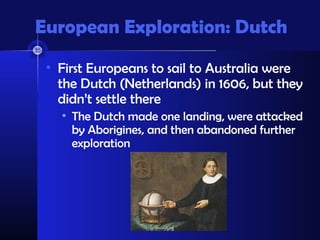
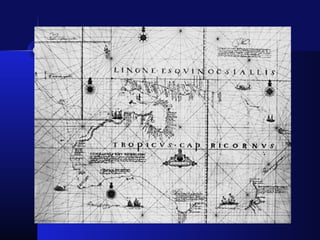
European Exploration: Dutch
 • First Europeans to sail to Australia were
   the Dutch (Netherlands) in 1606, but they
   didn’t settle there
   • The Dutch made one landing, were attacked
     by Aborigines, and then abandoned further
     exploration
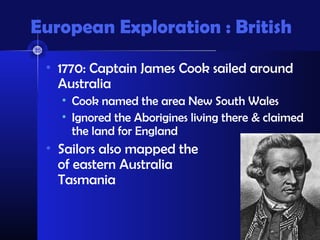
European Exploration : British
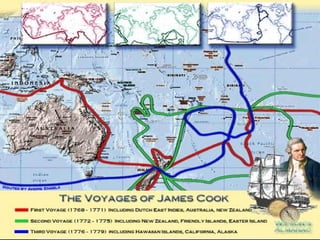
 • 1770: Captain James Cook sailed around
   Australia
   • Cook named the area New South Wales
   • Ignored the Aborigines living there & claimed
     the land for England
 • Sailors also mapped the                  coast
   of eastern Australia                &
   Tasmania
Prisoners as Colonists

• American Revolution forced the British to
  stop sending prisoners to Georgia (used as
  a penal colony at the time)
  • Great Britain had to start looking for another
    place to send its prisoners…
• Australia seemed like a good choice: no
  chance of escape, no colonies around it,
  and very few indigenous people lived
  there
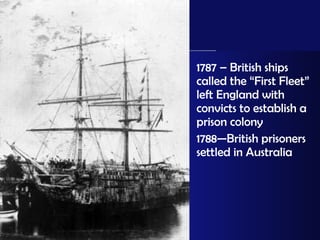
• 1787 – British ships
  called the “First Fleet”
  left England with
  convicts to establish a
  prison colony
• 1788—British prisoners
  settled in Australia
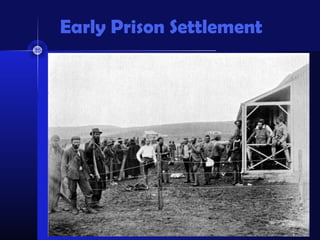
Early Prison Settlement
New South Wales
• 1788 to 1832: New South Wales was officially a
  penal (prison) colony consisting mainly of
  convicts, marines (guards), and the marines’
  families
   • Only 20% of the first convicts were women
• British transported prisoners to Australia until
  1868
• By this time, many free immigrants were settling
  there
   • They built businesses, trading posts, farms, etc.
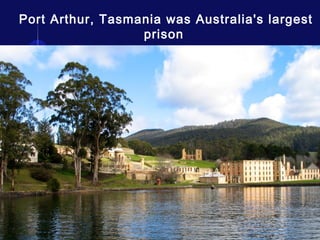
Port Arthur, Tasmania was Australia's largest
                  prison
Port Arthur, Tasmania
• From 1833, until the 1850s, it was the destination for the
  hardest of convicted British and Irish criminals, those who
  were secondary offenders having re-offended after their
  arrival in Australia.
   • In addition, Port Arthur had some of the strictest security
     measures of the British penal system.
• Some tales suggest that prisoners committed murder (an
  offence punishable by death) just to escape the
  desolation of life at the camp.
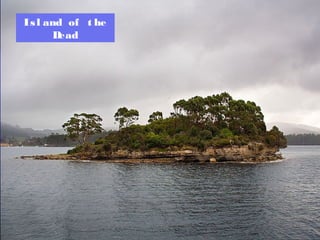
   • The Island of the Dead was the destination for all who died inside
     the prison camps.
Is l and of t he
       Dead
The Perfect Colony…

• Great Britain saw that Australia was a
  good location to base its navy in the South
  Pacific Ocean
  • Its location would make it possible for British
    ships to make repairs & get supplies
• Had many opportunities for trade with
  Asia and the Americas
Commonwealth of Australia

• Nonprisoner colonization continued…
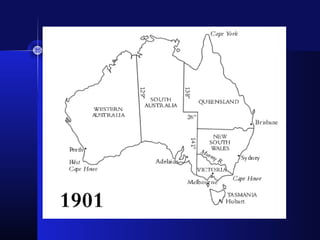
• Major coastal settlements became 7
  independent colonies
  • 1861: government officials created boundaries
    for the colonies that are still in place today
• January 1, 1901: the Commonwealth of
  Australia was established.
  • Melbourne served as the national capital until
    Canberra was completed in 1927
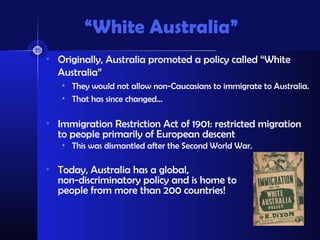
“White Australia”
• Originally, Australia promoted a policy called “White
  Australia”
   • They would not allow non-Caucasians to immigrate to Australia.
   • That has since changed…

• Immigration Restriction Act of 1901: restricted migration
  to people primarily of European descent
   • This was dismantled after the Second World War.

• Today, Australia has a global,
  non-discriminatory policy and is home to
  people from more than 200 countries!
Aborigines
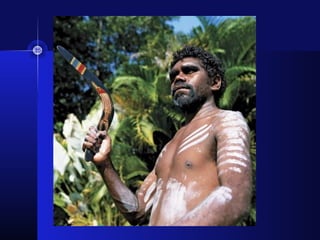
• Aborigines went through stages of being conquered
  through an 'invasion' and taking of their lands.
• European settlers often separated Aborigines from society
   • Some were removed from their families and placed into institutions
   • Others were killed because they were seen as a “nuisance”
• 1830s: remnants of the tribes in the settled areas were
  moved onto Reserves
   • They were forbidden from teaching their children their language and
     customs.
• During the 1900s, separation was an official government
  policy which lasted for many decades
• Today, many Aboriginal people do not know their
  origins: which tribe they are descended from or the
  names of their parents and or grandparents. They are a
  lost generation.
Aborigines
• 1967: federal government began to pass legislation to
  help the Aborigines
   • It was widely seen as affirmation of the Australian people’s wish
     to see its government take direct action to improve the living
     conditions of Aborigines
• In March, striking Aboriginal farmers changed political
  history by extending a demand for equal wages to a
  declaration of their rights of ownership of traditional
  lands.
   • This became one of Australia’s first successful land claims by its
     indigenous people.
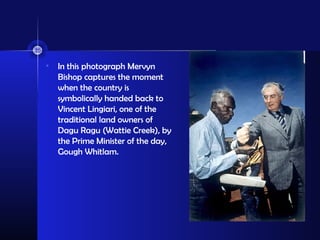
• In this photograph Mervyn
  Bishop captures the moment
  when the country is
  symbolically handed back to
  Vincent Lingiari, one of the
  traditional land owners of
  Dagu Ragu (Wattie Creek), by
  the Prime Minister of the day,
  Gough Whitlam.
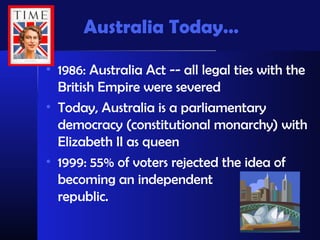
Australia Today…

• 1986: Australia Act -- all legal ties with the
  British Empire were severed
• Today, Australia is a parliamentary
  democracy (constitutional monarchy) with
  Elizabeth II as queen
• 1999: 55% of voters rejected the idea of
  becoming an independent
  republic.
Your Task:

• Use the website www.timetoast.com to
  create an interactive timeline of Australia’s
  history.
• Please include:
   • 10 events (dates)
   • A description of each event
   • An illustration to represent each event
• Email me your final product:
  ansleybennett@gmail.com
How to Use Timetoast:

•   Go to the site www.timetoast.com.
•   Create an account.
•   Title your project: “History of Australia”.
•   Click “Add Event”. Type the title, choose
    the date, write a description, & add an
    image
    • Use Google to find an image and save it to
      your H: drive.
    • Click on “Choose an Image” to insert your
      picture

Australian history

  • 1.
    History of Australia Unit 10 Notes
  • 2.
    European Exploration: Dutch • First Europeans to sail to Australia were the Dutch (Netherlands) in 1606, but they didn’t settle there • The Dutch made one landing, were attacked by Aborigines, and then abandoned further exploration
  • 4.
    European Exploration :British • 1770: Captain James Cook sailed around Australia • Cook named the area New South Wales • Ignored the Aborigines living there & claimed the land for England • Sailors also mapped the coast of eastern Australia & Tasmania
  • 6.
    Prisoners as Colonists •American Revolution forced the British to stop sending prisoners to Georgia (used as a penal colony at the time) • Great Britain had to start looking for another place to send its prisoners… • Australia seemed like a good choice: no chance of escape, no colonies around it, and very few indigenous people lived there
  • 7.
    • 1787 –British ships called the “First Fleet” left England with convicts to establish a prison colony • 1788—British prisoners settled in Australia
  • 8.
  • 9.
    New South Wales •1788 to 1832: New South Wales was officially a penal (prison) colony consisting mainly of convicts, marines (guards), and the marines’ families • Only 20% of the first convicts were women • British transported prisoners to Australia until 1868 • By this time, many free immigrants were settling there • They built businesses, trading posts, farms, etc.
  • 10.
    Port Arthur, Tasmaniawas Australia's largest prison
  • 11.
    Port Arthur, Tasmania •From 1833, until the 1850s, it was the destination for the hardest of convicted British and Irish criminals, those who were secondary offenders having re-offended after their arrival in Australia. • In addition, Port Arthur had some of the strictest security measures of the British penal system. • Some tales suggest that prisoners committed murder (an offence punishable by death) just to escape the desolation of life at the camp. • The Island of the Dead was the destination for all who died inside the prison camps.
  • 12.
    Is l andof t he Dead
  • 13.
    The Perfect Colony… •Great Britain saw that Australia was a good location to base its navy in the South Pacific Ocean • Its location would make it possible for British ships to make repairs & get supplies • Had many opportunities for trade with Asia and the Americas
  • 14.
    Commonwealth of Australia •Nonprisoner colonization continued… • Major coastal settlements became 7 independent colonies • 1861: government officials created boundaries for the colonies that are still in place today • January 1, 1901: the Commonwealth of Australia was established. • Melbourne served as the national capital until Canberra was completed in 1927
  • 16.
    “White Australia” • Originally,Australia promoted a policy called “White Australia” • They would not allow non-Caucasians to immigrate to Australia. • That has since changed… • Immigration Restriction Act of 1901: restricted migration to people primarily of European descent • This was dismantled after the Second World War. • Today, Australia has a global, non-discriminatory policy and is home to people from more than 200 countries!
  • 17.
    Aborigines • Aborigines wentthrough stages of being conquered through an 'invasion' and taking of their lands. • European settlers often separated Aborigines from society • Some were removed from their families and placed into institutions • Others were killed because they were seen as a “nuisance” • 1830s: remnants of the tribes in the settled areas were moved onto Reserves • They were forbidden from teaching their children their language and customs. • During the 1900s, separation was an official government policy which lasted for many decades • Today, many Aboriginal people do not know their origins: which tribe they are descended from or the names of their parents and or grandparents. They are a lost generation.
  • 19.
    Aborigines • 1967: federalgovernment began to pass legislation to help the Aborigines • It was widely seen as affirmation of the Australian people’s wish to see its government take direct action to improve the living conditions of Aborigines • In March, striking Aboriginal farmers changed political history by extending a demand for equal wages to a declaration of their rights of ownership of traditional lands. • This became one of Australia’s first successful land claims by its indigenous people.
  • 20.
    • In thisphotograph Mervyn Bishop captures the moment when the country is symbolically handed back to Vincent Lingiari, one of the traditional land owners of Dagu Ragu (Wattie Creek), by the Prime Minister of the day, Gough Whitlam.
  • 21.
    Australia Today… • 1986:Australia Act -- all legal ties with the British Empire were severed • Today, Australia is a parliamentary democracy (constitutional monarchy) with Elizabeth II as queen • 1999: 55% of voters rejected the idea of becoming an independent republic.
  • 22.
    Your Task: • Usethe website www.timetoast.com to create an interactive timeline of Australia’s history. • Please include: • 10 events (dates) • A description of each event • An illustration to represent each event • Email me your final product: ansleybennett@gmail.com
  • 23.
    How to UseTimetoast: • Go to the site www.timetoast.com. • Create an account. • Title your project: “History of Australia”. • Click “Add Event”. Type the title, choose the date, write a description, & add an image • Use Google to find an image and save it to your H: drive. • Click on “Choose an Image” to insert your picture