Australia is Discovered
Origin and History of the Name
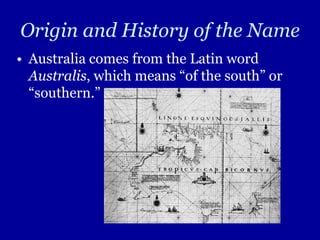
• Australia comes from the Latin word
  Australis, which means “of the south” or
  “southern.”
Origin and history of the name
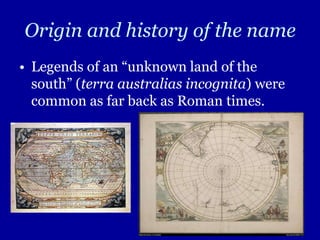
• Legends of an “unknown land of the
  south” (terra australias incognita) were
  common as far back as Roman times.
Origin and history of the name
• References to Australia were common in
  medieval geography.
• There was no evidence at the
  time of Australia.
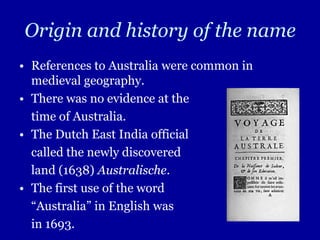
• The Dutch East India official
  called the newly discovered
  land (1638) Australische.
• The first use of the word
  “Australia” in English was
  in 1693.
European Exploration
• Many Europeans claimed to be the first to
  discover Australia.
  – French navigator Binot Paulimer de
    Gonneville in 1504 (actually landed in Brazil)
  – Spanish expedition commanded by Pedro
    Fernandez de Quiros and piloted by Luis vaez
    de Torres in 1605 (actually landed in New
    Hebrides, now known as Vanuatu)
  – Portuguese expedition led by Cristóvão de
    Mendonça in 1522
• None can be confirmed.
The Dutch
• The first undisputed European sighting occurred
  in 1606 by the Dutch.
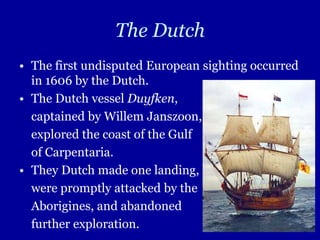
• The Dutch vessel Duyfken,
  captained by Willem Janszoon,
  explored the coast of the Gulf
  of Carpentaria.
• They Dutch made one landing,
  were promptly attacked by the
  Aborigines, and abandoned
  further exploration.
The Dutch
• The Dutch charted all of the western and
  northern coastlines of “New Holland”.
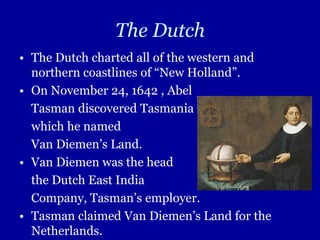
• On November 24, 1642 , Abel
  Tasman discovered Tasmania
  which he named
  Van Diemen’s Land.
• Van Diemen was the head
  the Dutch East India
  Company, Tasman’s employer.
• Tasman claimed Van Diemen’s Land for the
  Netherlands.
The British
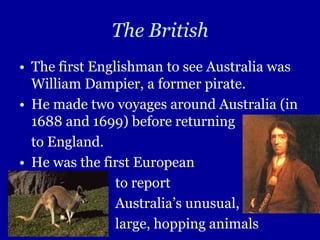
• The first Englishman to see Australia was
  William Dampier, a former pirate.
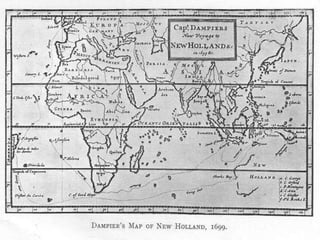
• He made two voyages around Australia (in
  1688 and 1699) before returning
  to England.
• He was the first European
                to report
                Australia’s unusual,
                large, hopping animals
The British
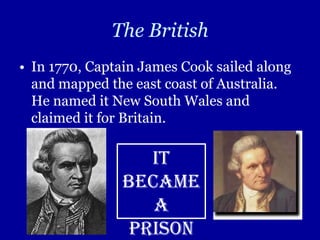
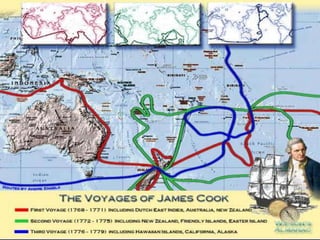
• In 1770, Captain James Cook sailed along
  and mapped the east coast of Australia.
  He named it New South Wales and
  claimed it for Britain.

                  It
               became
                  a
                prison
Australia is Discovered

Australia is Discovered

  • 1.
  • 2.
    Origin and Historyof the Name • Australia comes from the Latin word Australis, which means “of the south” or “southern.”
  • 3.
    Origin and historyof the name • Legends of an “unknown land of the south” (terra australias incognita) were common as far back as Roman times.
  • 4.
    Origin and historyof the name • References to Australia were common in medieval geography. • There was no evidence at the time of Australia. • The Dutch East India official called the newly discovered land (1638) Australische. • The first use of the word “Australia” in English was in 1693.
  • 5.
    European Exploration • ManyEuropeans claimed to be the first to discover Australia. – French navigator Binot Paulimer de Gonneville in 1504 (actually landed in Brazil) – Spanish expedition commanded by Pedro Fernandez de Quiros and piloted by Luis vaez de Torres in 1605 (actually landed in New Hebrides, now known as Vanuatu) – Portuguese expedition led by Cristóvão de Mendonça in 1522 • None can be confirmed.
  • 6.
    The Dutch • Thefirst undisputed European sighting occurred in 1606 by the Dutch. • The Dutch vessel Duyfken, captained by Willem Janszoon, explored the coast of the Gulf of Carpentaria. • They Dutch made one landing, were promptly attacked by the Aborigines, and abandoned further exploration.
  • 7.
    The Dutch • TheDutch charted all of the western and northern coastlines of “New Holland”. • On November 24, 1642 , Abel Tasman discovered Tasmania which he named Van Diemen’s Land. • Van Diemen was the head the Dutch East India Company, Tasman’s employer. • Tasman claimed Van Diemen’s Land for the Netherlands.
  • 8.
    The British • Thefirst Englishman to see Australia was William Dampier, a former pirate. • He made two voyages around Australia (in 1688 and 1699) before returning to England. • He was the first European to report Australia’s unusual, large, hopping animals
  • 10.
    The British • In1770, Captain James Cook sailed along and mapped the east coast of Australia. He named it New South Wales and claimed it for Britain. It became a prison