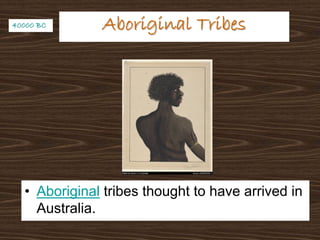
Aboriginal TribesAboriginal Tribes
• Aboriginal tribes thought to have arrived in
Australia.
40000 BC40000 BC
Dirk Hartog
• Dirk Hartog (1580 — 1621) was a 17th century Dutch sailor and explorer, whose
expedition was the second European group to land on Australian soil. He left behind
an artefact to record his visit, the Hartog plate. His name is sometimes alternately
spelled Dirck Hartog, Dirck Hartog or Dirch Hartichs. Ernest Giles referred to him
as Theodoric Hertoge.[1]
1616 AD1616 AD
Abel TasmanAbel Tasman
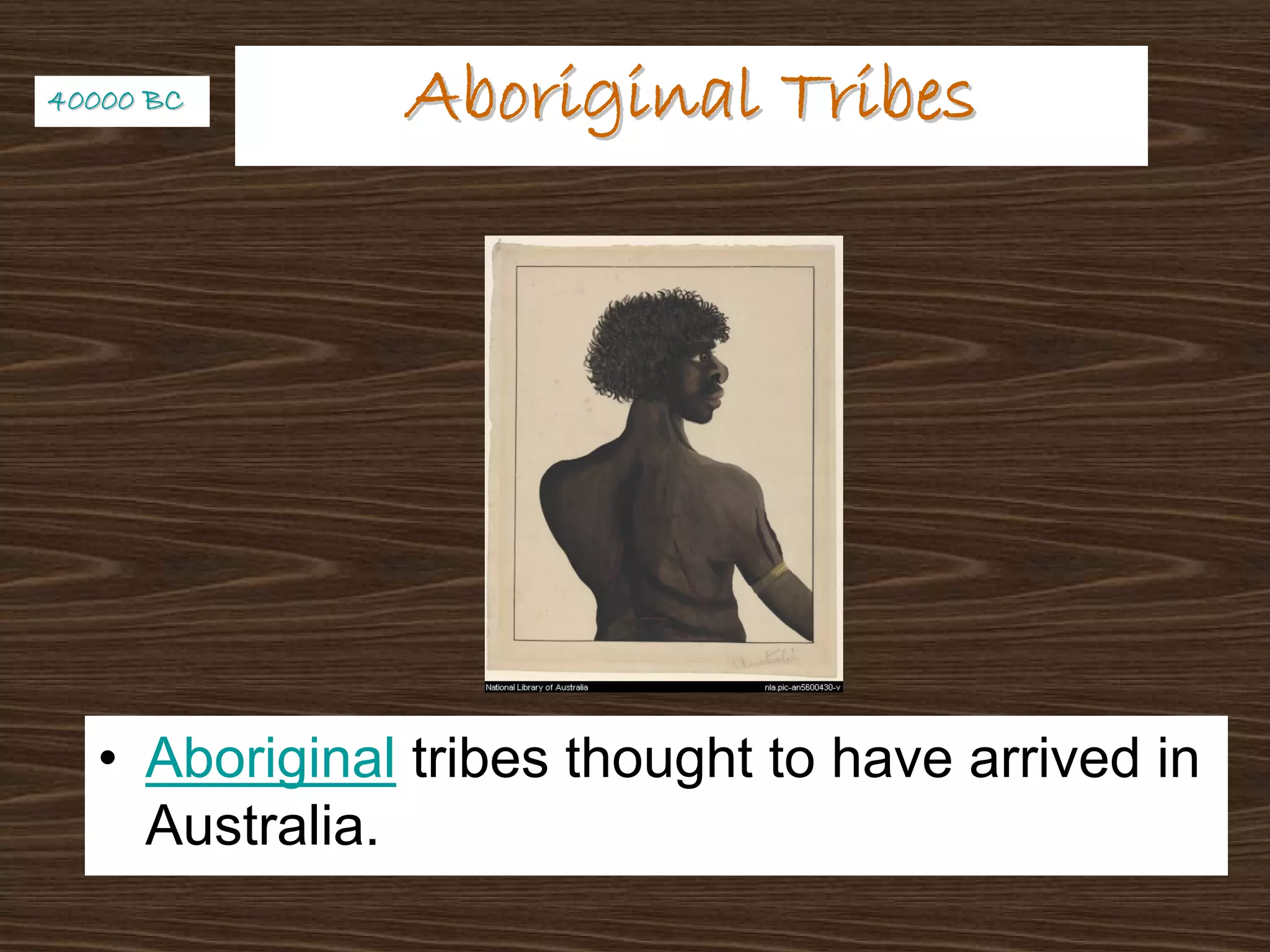
• New Holland is a historic name for the island continent of Australia. The
name was first applied to Australia in 1644 by the Dutch seafarer Abel
Tasman as Nova Hollandia, naming it after the Dutch province of Holland,
and remained in use for over 150 years.
1642 AD1642 AD
William DampierWilliam Dampier
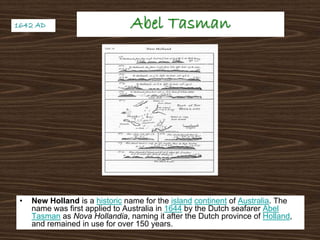
• Early in 1688 Cygnet was beached on the northwest coast of Australia, near King Sound. While
the ship was being careened Dampier made notes on the fauna and flora he found there. Later
that year, by agreement, he and two shipmates were marooned on one of the Nicobar Islands.
1617 AD1617 AD
Captain James CookCaptain James Cook
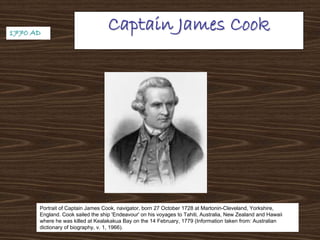
Portrait of Captain James Cook, navigator, born 27 October 1728 at Martonin-Cleveland, Yorkshire,
England. Cook sailed the ship 'Endeavour' on his voyages to Tahiti, Australia, New Zealand and Hawaii
where he was killed at Kealakakua Bay on the 14 February, 1779 (Information taken from: Australian
dictionary of biography, v. 1, 1966).
1770 AD1770 AD
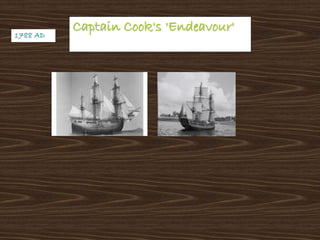
Captain Cook's 'Endeavour'Captain Cook's 'Endeavour'
1788 AD1788 AD
ConvictsConvicts
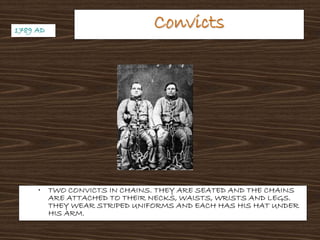
• TWO CONVICTS IN CHAINS. THEY ARE SEATED AND THE CHAINS
ARE ATTACHED TO THEIR NECKS, WAISTS, WRISTS AND LEGS.
THEY WEAR STRIPED UNIFORMS AND EACH HAS HIS HAT UNDER
HIS ARM.
1789 AD1789 AD
Matthew FlindersMatthew Flinders
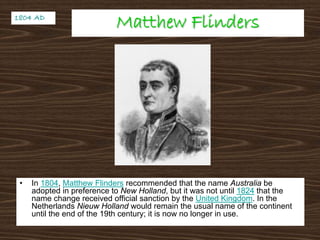
• In 1804, Matthew Flinders recommended that the name Australia be
adopted in preference to New Holland, but it was not until 1824 that the
name change received official sanction by the United Kingdom. In the
Netherlands Nieuw Holland would remain the usual name of the continent
until the end of the 19th century; it is now no longer in use.
1804 AD1804 AD
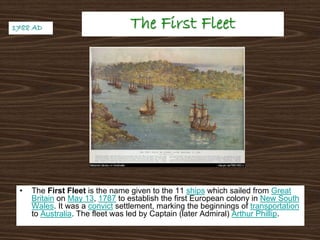
The First FleetThe First Fleet
• The First Fleet is the name given to the 11 ships which sailed from Great
Britain on May 13, 1787 to establish the first European colony in New South
Wales. It was a convict settlement, marking the beginnings of transportation
to Australia. The fleet was led by Captain (later Admiral) Arthur Phillip.
1788 AD1788 AD
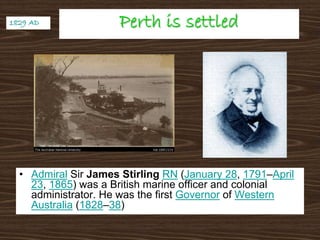
Perth is settledPerth is settled
• Admiral Sir James Stirling RN (January 28, 1791–April
23, 1865) was a British marine officer and colonial
administrator. He was the first Governor of Western
Australia (1828–38)
1829 AD1829 AD
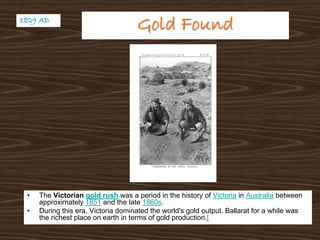
Gold FoundGold Found
• The Victorian gold rush was a period in the history of Victoria in Australia between
approximately 1851 and the late 1860s.
• During this era, Victoria dominated the world's gold output. Ballarat for a while was
the richest place on earth in terms of gold production.[
1829 AD1829 AD
Eureka StockadeEureka Stockade
• The Eureka Stockade was a gold miners' revolt in 1854 in Ballarat, Victoria,
Australia, against the officials supervising the mining of gold in the region of Ballarat.
It was prompted by grievances over heavily priced mining items, the expense of a
Miner's Licence, and taxation (licence) without representation and the actions of the
government and its agents (police, militia).[1] [2]
1854 AD1854 AD
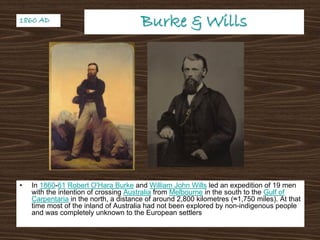
Burke & WillsBurke & Wills
• In 1860-61 Robert O'Hara Burke and William John Wills led an expedition of 19 men
with the intention of crossing Australia from Melbourne in the south to the Gulf of
Carpentaria in the north, a distance of around 2,800 kilometres (≈1,750 miles). At that
time most of the inland of Australia had not been explored by non-indigenous people
and was completely unknown to the European settlers
1860 AD1860 AD
Ayres Rock is NamedAyres Rock is Named
• The local Pitjantjatjara people call the landmark Uluṟu (IPA: [uluɻu]). On 19 July 1873,
the surveyor William Gosse visited Uluṟu and named it Ayers Rock in honour of the
then-Chief Secretary of South Australia, Sir Henry Ayers.[1] The Aboriginal name was
first recorded by the Wills expedition in 1903.[citation needed] Since then, both
names have been used, although Ayers Rock was the most common name used by
outsiders until recently.
1873 AD1873 AD
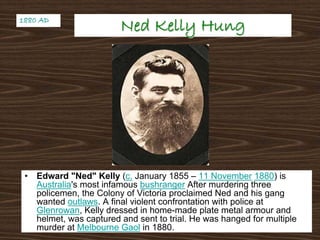
Ned Kelly HungNed Kelly Hung
• Edward "Ned" Kelly (c. January 1855 – 11 November 1880) is
Australia's most infamous bushranger After murdering three
policemen, the Colony of Victoria proclaimed Ned and his gang
wanted outlaws. A final violent confrontation with police at
Glenrowan, Kelly dressed in home-made plate metal armour and
helmet, was captured and sent to trial. He was hanged for multiple
murder at Melbourne Gaol in 1880.
1880 AD1880 AD
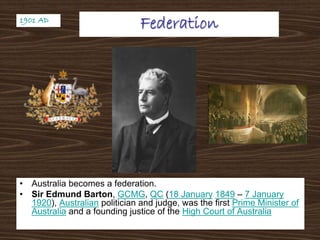
FederationFederation
• Australia becomes a federation.
• Sir Edmund Barton, GCMG, QC (18 January 1849 – 7 January
1920), Australian politician and judge, was the first Prime Minister of
Australia and a founding justice of the High Court of Australia
1901 AD1901 AD
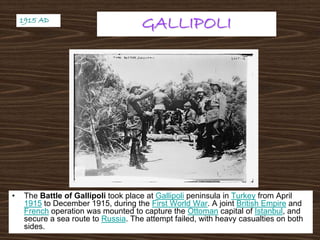
GALLIPOLIGALLIPOLI
• The Battle of Gallipoli took place at Gallipoli peninsula in Turkey from April
1915 to December 1915, during the First World War. A joint British Empire and
French operation was mounted to capture the Ottoman capital of Istanbul, and
secure a sea route to Russia. The attempt failed, with heavy casualties on both
sides.
1915 AD1915 AD
Vegemite producedVegemite produced
• Vegemite is made from leftover brewers' yeast extract, a by-product
of beer manufacture, and various vegetable and spice additives. The
taste may be described as salty, slightly bitter, and malty -
somewhat similar to the taste of beef bouillon
1923 AD1923 AD

Australian History Timeline Slides

  • 1.
    Aboriginal TribesAboriginal Tribes •Aboriginal tribes thought to have arrived in Australia. 40000 BC40000 BC
  • 2.
    Dirk Hartog • DirkHartog (1580 — 1621) was a 17th century Dutch sailor and explorer, whose expedition was the second European group to land on Australian soil. He left behind an artefact to record his visit, the Hartog plate. His name is sometimes alternately spelled Dirck Hartog, Dirck Hartog or Dirch Hartichs. Ernest Giles referred to him as Theodoric Hertoge.[1] 1616 AD1616 AD
  • 3.
    Abel TasmanAbel Tasman •New Holland is a historic name for the island continent of Australia. The name was first applied to Australia in 1644 by the Dutch seafarer Abel Tasman as Nova Hollandia, naming it after the Dutch province of Holland, and remained in use for over 150 years. 1642 AD1642 AD
  • 4.
    William DampierWilliam Dampier •Early in 1688 Cygnet was beached on the northwest coast of Australia, near King Sound. While the ship was being careened Dampier made notes on the fauna and flora he found there. Later that year, by agreement, he and two shipmates were marooned on one of the Nicobar Islands. 1617 AD1617 AD
  • 5.
    Captain James CookCaptainJames Cook Portrait of Captain James Cook, navigator, born 27 October 1728 at Martonin-Cleveland, Yorkshire, England. Cook sailed the ship 'Endeavour' on his voyages to Tahiti, Australia, New Zealand and Hawaii where he was killed at Kealakakua Bay on the 14 February, 1779 (Information taken from: Australian dictionary of biography, v. 1, 1966). 1770 AD1770 AD
  • 6.
    Captain Cook's 'Endeavour'CaptainCook's 'Endeavour' 1788 AD1788 AD
  • 7.
    ConvictsConvicts • TWO CONVICTSIN CHAINS. THEY ARE SEATED AND THE CHAINS ARE ATTACHED TO THEIR NECKS, WAISTS, WRISTS AND LEGS. THEY WEAR STRIPED UNIFORMS AND EACH HAS HIS HAT UNDER HIS ARM. 1789 AD1789 AD
  • 8.
    Matthew FlindersMatthew Flinders •In 1804, Matthew Flinders recommended that the name Australia be adopted in preference to New Holland, but it was not until 1824 that the name change received official sanction by the United Kingdom. In the Netherlands Nieuw Holland would remain the usual name of the continent until the end of the 19th century; it is now no longer in use. 1804 AD1804 AD
  • 9.
    The First FleetTheFirst Fleet • The First Fleet is the name given to the 11 ships which sailed from Great Britain on May 13, 1787 to establish the first European colony in New South Wales. It was a convict settlement, marking the beginnings of transportation to Australia. The fleet was led by Captain (later Admiral) Arthur Phillip. 1788 AD1788 AD
  • 10.
    Perth is settledPerthis settled • Admiral Sir James Stirling RN (January 28, 1791–April 23, 1865) was a British marine officer and colonial administrator. He was the first Governor of Western Australia (1828–38) 1829 AD1829 AD
  • 11.
    Gold FoundGold Found •The Victorian gold rush was a period in the history of Victoria in Australia between approximately 1851 and the late 1860s. • During this era, Victoria dominated the world's gold output. Ballarat for a while was the richest place on earth in terms of gold production.[ 1829 AD1829 AD
  • 12.
    Eureka StockadeEureka Stockade •The Eureka Stockade was a gold miners' revolt in 1854 in Ballarat, Victoria, Australia, against the officials supervising the mining of gold in the region of Ballarat. It was prompted by grievances over heavily priced mining items, the expense of a Miner's Licence, and taxation (licence) without representation and the actions of the government and its agents (police, militia).[1] [2] 1854 AD1854 AD
  • 13.
    Burke & WillsBurke& Wills • In 1860-61 Robert O'Hara Burke and William John Wills led an expedition of 19 men with the intention of crossing Australia from Melbourne in the south to the Gulf of Carpentaria in the north, a distance of around 2,800 kilometres (≈1,750 miles). At that time most of the inland of Australia had not been explored by non-indigenous people and was completely unknown to the European settlers 1860 AD1860 AD
  • 14.
    Ayres Rock isNamedAyres Rock is Named • The local Pitjantjatjara people call the landmark Uluṟu (IPA: [uluɻu]). On 19 July 1873, the surveyor William Gosse visited Uluṟu and named it Ayers Rock in honour of the then-Chief Secretary of South Australia, Sir Henry Ayers.[1] The Aboriginal name was first recorded by the Wills expedition in 1903.[citation needed] Since then, both names have been used, although Ayers Rock was the most common name used by outsiders until recently. 1873 AD1873 AD
  • 15.
    Ned Kelly HungNedKelly Hung • Edward "Ned" Kelly (c. January 1855 – 11 November 1880) is Australia's most infamous bushranger After murdering three policemen, the Colony of Victoria proclaimed Ned and his gang wanted outlaws. A final violent confrontation with police at Glenrowan, Kelly dressed in home-made plate metal armour and helmet, was captured and sent to trial. He was hanged for multiple murder at Melbourne Gaol in 1880. 1880 AD1880 AD
  • 16.
    FederationFederation • Australia becomesa federation. • Sir Edmund Barton, GCMG, QC (18 January 1849 – 7 January 1920), Australian politician and judge, was the first Prime Minister of Australia and a founding justice of the High Court of Australia 1901 AD1901 AD
  • 17.
    GALLIPOLIGALLIPOLI • The Battleof Gallipoli took place at Gallipoli peninsula in Turkey from April 1915 to December 1915, during the First World War. A joint British Empire and French operation was mounted to capture the Ottoman capital of Istanbul, and secure a sea route to Russia. The attempt failed, with heavy casualties on both sides. 1915 AD1915 AD
  • 18.
    Vegemite producedVegemite produced •Vegemite is made from leftover brewers' yeast extract, a by-product of beer manufacture, and various vegetable and spice additives. The taste may be described as salty, slightly bitter, and malty - somewhat similar to the taste of beef bouillon 1923 AD1923 AD