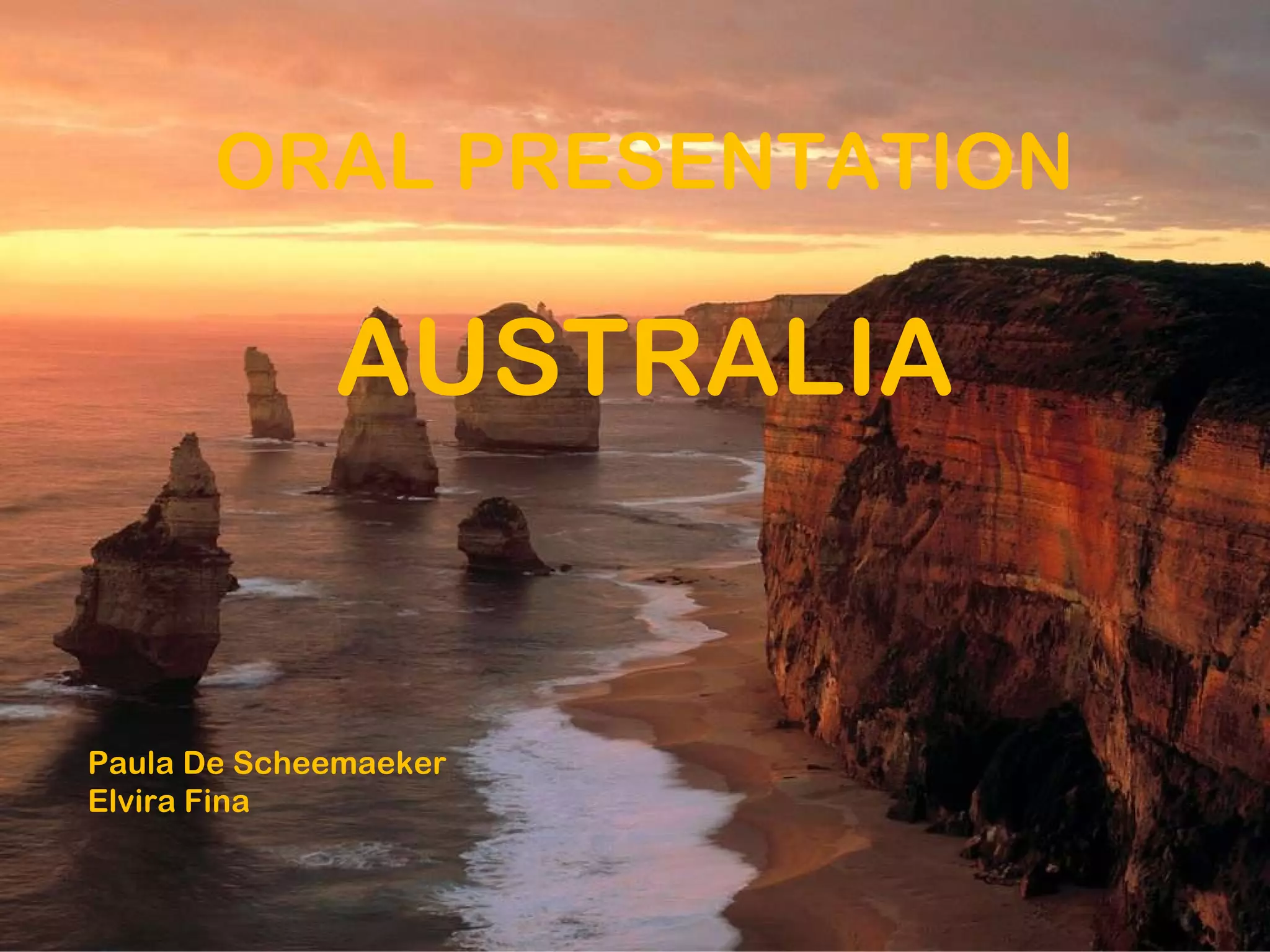
ORAL PRESENTATION AUSTRALIA Paula De Scheemaeker  Elvira Fina
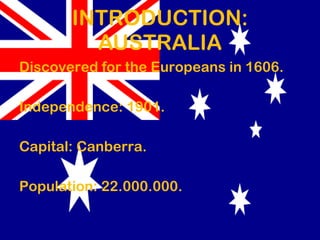
INTRODUCTION: AUSTRALIA Discovered for the Europeans in 1606. Independence: 1901. Capital: Canberra. Population: 22.000.000.
WILDLIFE
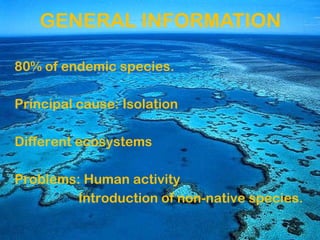
GENERAL INFORMATION 80% of endemic species.  Principal cause: Isolation Different ecosystems Problems: Human activity  Introduction of non-native species.
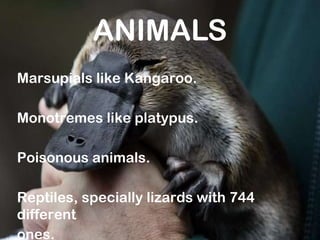
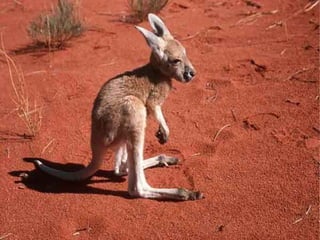
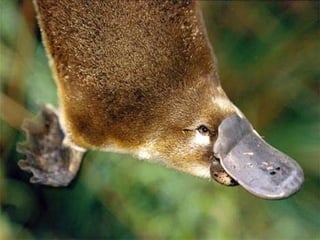
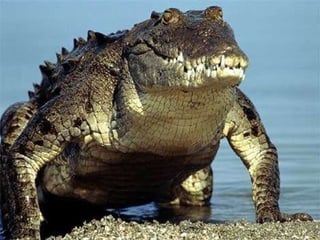
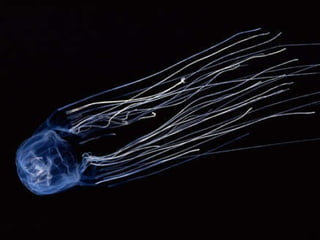
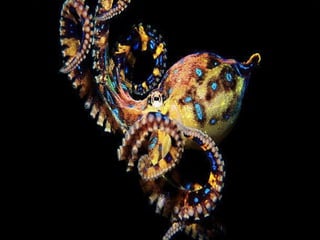
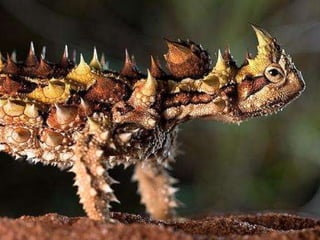
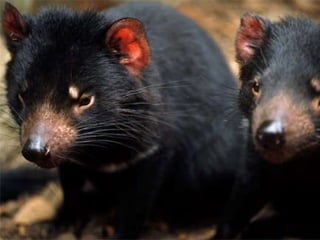
ANIMALS Marsupials like Kangaroo.  Monotremes like platypus. Poisonous animals. Reptiles, specially lizards with 744 different ones.  4400 different fishes.


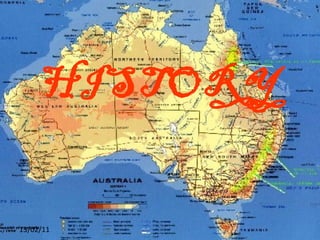
HISTORY 13/02/11
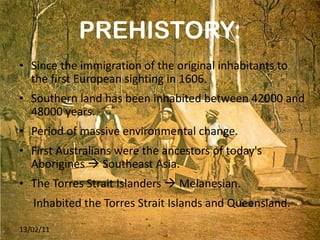
PREHISTORY: Since the immigration of the original inhabitants to the first European sighting in 1606. Southern land has been inhabited between 42000 and 48000 years. Period of massive environmental change. First Australians were the ancestors of today's Aborigines    Southeast Asia. The Torres Strait Islanders    Melanesian.  Inhabited the Torres Strait Islands and Queensland. 13/02/11
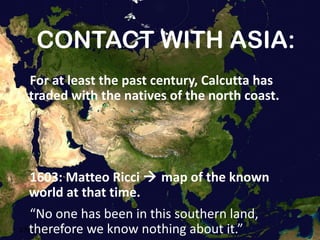
CONTACT WITH ASIA: For at least the past century, Calcutta has traded with the natives of the north coast. 1603:  Matteo Ricci    map of the known world at that time. “ No one has been in this southern land, therefore we know nothing about it.” 13/02/11
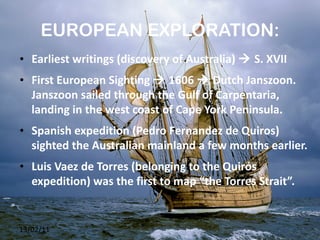
EUROPEAN EXPLORATION: Earliest writings (discovery of Australia)    S. XVII First European Sighting    1606    Dutch Janszoon. Janszoon sailed through the Gulf of Carpentaria, landing in the west coast of Cape York Peninsula.  Spanish expedition (Pedro Fernandez de Quiros) sighted the Australian mainland a few months earlier. Luis Vaez de Torres (belonging to the Quirós expedition) was the first to map “the Torres Strait”. 13/02/11
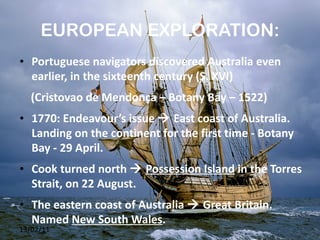
EUROPEAN EXPLORATION: Portuguese navigators discovered Australia even earlier, in the sixteenth century (S. XVI) (Cristovao de Mendonça – Botany Bay – 1522) 1770: Endeavour’s issue    East coast of Australia. Landing on the continent for the first time - Botany Bay - 29 April. Cook turned north     Possession Island  in the Torres Strait, on 22 August.  The eastern coast of Australia    Great Britain. Named  New South Wales . 13/02/11
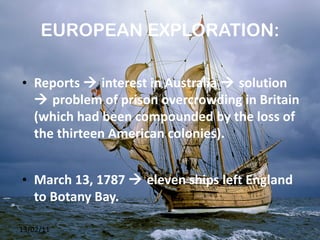
EUROPEAN EXPLORATION: Reports    interest in Australia    solution    problem of prison overcrowding in Britain (which had been compounded by the loss of the thirteen American colonies). March 13, 1787    eleven ships left England to Botany Bay. 13/02/11
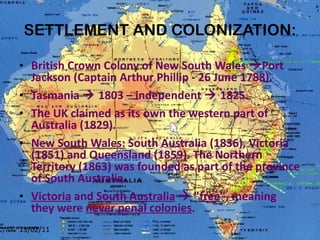
SETTLEMENT AND COLONIZATION: British Crown Colony of New South Wales   Port Jackson (Captain Arthur Phillip - 26 June 1788). Tasmania    1803 – independent    1825. The UK claimed as its own the western part of Australia (1829). New South Wales:  South Australia (1836), Victoria (1851) and Queensland (1859). The Northern Territory (1863) was founded as part of the province of South Australia. Victoria  and  South Australia     " free ", meaning they were  never penal colonies . 13/02/11
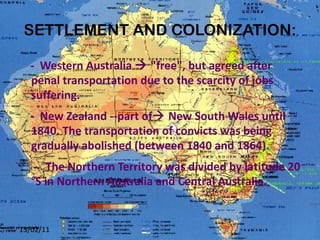
SETTLEMENT AND COLONIZATION: -  Western Australia    "free", but agreed after penal transportation due to the scarcity of jobs suffering. -  New Zealand --part of   New South Wales until 1840. The transportation of convicts was being gradually abolished (between 1840 and 1864). -  The Northern Territory was divided by latitude 20 °S in Northern Australia and Central Australia. 13/02/11
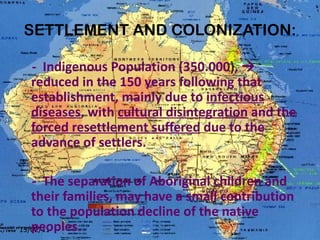
SETTLEMENT AND COLONIZATION: -  Indigenous Population (350.000),    reduced in the 150 years following that establishment, mainly due to  infectious diseases , with  cultural disintegration  and the  forced resettlement suffered  due to the advance of settlers. -  The separation of Aboriginal children and their families, may have a small contribution to the population decline of the native peoples. 13/02/11
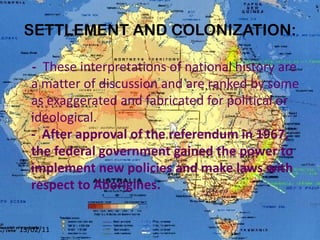
SETTLEMENT AND COLONIZATION: -   These  interpretations of national history are a matter of discussion and are ranked by some as exaggerated and fabricated for political or ideological. -  After approval of the referendum in 1967, the federal government gained the power to implement new policies and make laws with respect to Aborigines. 13/02/11
THANK  YOU  FOR  LISTENING! 13/02/11
13/02/11 B.Amarjargal

Australia

  • 1.
    ORAL PRESENTATION AUSTRALIAPaula De Scheemaeker Elvira Fina
  • 2.
    INTRODUCTION: AUSTRALIA Discoveredfor the Europeans in 1606. Independence: 1901. Capital: Canberra. Population: 22.000.000.
  • 3.
  • 4.
    GENERAL INFORMATION 80%of endemic species. Principal cause: Isolation Different ecosystems Problems: Human activity Introduction of non-native species.
  • 5.
    ANIMALS Marsupials likeKangaroo. Monotremes like platypus. Poisonous animals. Reptiles, specially lizards with 744 different ones. 4400 different fishes.
  • 6.
  • 7.
  • 8.
  • 9.
  • 10.
  • 11.
  • 12.
  • 13.
  • 14.
  • 15.
    PREHISTORY: Since theimmigration of the original inhabitants to the first European sighting in 1606. Southern land has been inhabited between 42000 and 48000 years. Period of massive environmental change. First Australians were the ancestors of today's Aborigines  Southeast Asia. The Torres Strait Islanders  Melanesian. Inhabited the Torres Strait Islands and Queensland. 13/02/11
  • 16.
    CONTACT WITH ASIA:For at least the past century, Calcutta has traded with the natives of the north coast. 1603: Matteo Ricci  map of the known world at that time. “ No one has been in this southern land, therefore we know nothing about it.” 13/02/11
  • 17.
    EUROPEAN EXPLORATION: Earliestwritings (discovery of Australia)  S. XVII First European Sighting  1606  Dutch Janszoon. Janszoon sailed through the Gulf of Carpentaria, landing in the west coast of Cape York Peninsula. Spanish expedition (Pedro Fernandez de Quiros) sighted the Australian mainland a few months earlier. Luis Vaez de Torres (belonging to the Quirós expedition) was the first to map “the Torres Strait”. 13/02/11
  • 18.
    EUROPEAN EXPLORATION: Portuguesenavigators discovered Australia even earlier, in the sixteenth century (S. XVI) (Cristovao de Mendonça – Botany Bay – 1522) 1770: Endeavour’s issue  East coast of Australia. Landing on the continent for the first time - Botany Bay - 29 April. Cook turned north  Possession Island in the Torres Strait, on 22 August. The eastern coast of Australia  Great Britain. Named New South Wales . 13/02/11
  • 19.
    EUROPEAN EXPLORATION: Reports  interest in Australia  solution  problem of prison overcrowding in Britain (which had been compounded by the loss of the thirteen American colonies). March 13, 1787  eleven ships left England to Botany Bay. 13/02/11
  • 20.
    SETTLEMENT AND COLONIZATION:British Crown Colony of New South Wales  Port Jackson (Captain Arthur Phillip - 26 June 1788). Tasmania  1803 – independent  1825. The UK claimed as its own the western part of Australia (1829). New South Wales: South Australia (1836), Victoria (1851) and Queensland (1859). The Northern Territory (1863) was founded as part of the province of South Australia. Victoria and South Australia  " free ", meaning they were never penal colonies . 13/02/11
  • 21.
    SETTLEMENT AND COLONIZATION:- Western Australia  "free", but agreed after penal transportation due to the scarcity of jobs suffering. - New Zealand --part of  New South Wales until 1840. The transportation of convicts was being gradually abolished (between 1840 and 1864). - The Northern Territory was divided by latitude 20 °S in Northern Australia and Central Australia. 13/02/11
  • 22.
    SETTLEMENT AND COLONIZATION:- Indigenous Population (350.000),  reduced in the 150 years following that establishment, mainly due to infectious diseases , with cultural disintegration and the forced resettlement suffered due to the advance of settlers. - The separation of Aboriginal children and their families, may have a small contribution to the population decline of the native peoples. 13/02/11
  • 23.
    SETTLEMENT AND COLONIZATION:- These interpretations of national history are a matter of discussion and are ranked by some as exaggerated and fabricated for political or ideological. - After approval of the referendum in 1967, the federal government gained the power to implement new policies and make laws with respect to Aborigines. 13/02/11
  • 24.
    THANK YOU FOR LISTENING! 13/02/11
  • 25.