
Page 1
The New Auditor’s Report
Overview of the New and Revised Auditor
Reporting Standards and Related
Conforming Amendments
March 2015
Page 2
Background Information
• These slides have been prepared by the IAASB’s Auditor
Reporting Implementation Working Group
– They form part of the Auditor Reporting Toolkit, and are intended to
assist IAASB members, national standard setters, auditors and
others in promoting the new and revised Auditor Reporting
standards within their respective jurisdictions.
• The IAASB staff-prepared At a Glance publication
complements this slide presentation, includes an
illustration of the new auditor’s report and is available at
www.iaasb.org/auditor-reporting.
Page 3
Index
• Project Overview and Introduction
• Key Audit Matters (KAM)
• Going Concern (GC)
• Other Changes to the Auditor’s Report
• Auditor Reporting Implementation
Page 4
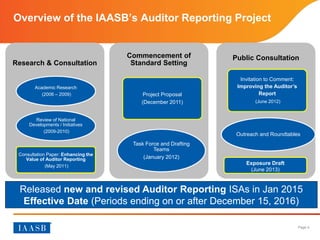
Overview of the IAASB’s Auditor Reporting Project
Research & Consultation
Academic Research
(2006 – 2009)
Review of National
Developments / Initiatives
(2009-2010)
Consultation Paper: Enhancing the
Value of Auditor Reporting
(May 2011)
Commencement of
Standard Setting
Project Proposal
(December 2011)
Task Force and Drafting
Teams
(January 2012)
Public Consultation
Invitation to Comment:
Improving the Auditor’s
Report
(June 2012)
Outreach and Roundtables
Released new and revised Auditor Reporting ISAs in Jan 2015
Effective Date – Periods ending on or after December 15, 2016
Exposure Draft
(June 2013)
Page 5
Why Change the Auditor’s Report Now?
• Foundation for the future of global auditor reporting
and improved auditor communications
• Essential to the continued relevance of the audit
profession globally
– Audit opinion is valued, but could be more
informative
– Users want more relevant and decision-useful
information about the entity and the financial
statement audit
Page 6
Expected Benefits of the New Auditor’s Report
• Enhanced communicative value to users
• More robust interactions and communication among
users, auditors and those charged with governance
(TCWG)
• Increased attention by management and TCWG to the
disclosures referred to in the KAM section of the
auditor’s report
• Increased professional skepticism in areas where KAM
are identified
• Increased audit quality or users’ perception of audit
quality
Page 7
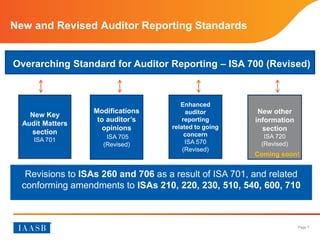
New and Revised Auditor Reporting Standards
Overarching Standard for Auditor Reporting – ISA 700 (Revised)
Revisions to ISAs 260 and 706 as a result of ISA 701, and related
conforming amendments to ISAs 210, 220, 230, 510, 540, 600, 710
Modifications
to auditor’s
opinions
ISA 705
(Revised)
New Key
Audit Matters
section
ISA 701
Enhanced
auditor
reporting
related to going
concern
ISA 570
(Revised)
New other
information
section
ISA 720
(Revised)
Coming soon!
Page 8
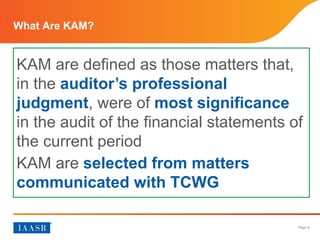
What Are KAM?
KAM are defined as those matters that,
in the auditor’s professional
judgment, were of most significance
in the audit of the financial statements of
the current period
KAM are selected from matters
communicated with TCWG
Page 9
Which Auditor’s Reports Will Include a KAM Section?
• KAM is required to be communicated in the auditor’s report
for audits of financial statements of listed entities in
accordance with new ISA 701
– Law or regulation may require KAM for audits of entities other than
listed entities (e.g., “public interest entities”, or public sector entities)
– Auditors may voluntarily, or at the request of management or
TCWG, communicate KAM in the auditor’s report for entities other
than listed entities
Page 10
Are KAM Always Communicated in the Auditor’s Report?
• Auditor is required to include each KAM unless
– Law or regulation precludes disclosure
– In extremely rare circumstances, the auditor determines that the matter
should not be communicated
 Adverse consequences of communicating the KAM would reasonably be
expected to outweigh the public interest benefits of such communication
• KAM is prohibited for a disclaimer of opinion, but required for
a qualified or adverse opinion
• In certain limited circumstances, there may be no KAM to be
communicated
Page 11
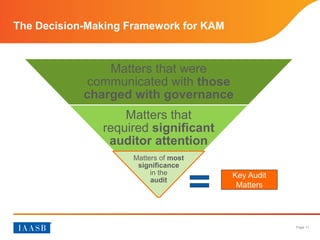
The Decision-Making Framework for KAM
Matters that were
communicated with those
charged with governance
Matters that
required significant
auditor attention
Matters of most
significance
in the
audit
Key Audit
Matters
Page 12
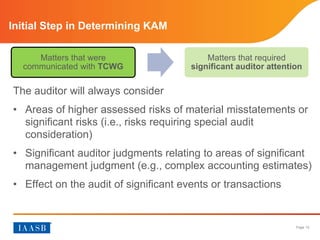
Initial Step in Determining KAM
The auditor will always consider
• Areas of higher assessed risks of material misstatements or
significant risks (i.e., risks requiring special audit
consideration)
• Significant auditor judgments relating to areas of significant
management judgment (e.g., complex accounting estimates)
• Effect on the audit of significant events or transactions
Matters that were
communicated with TCWG
Matters that required
significant auditor attention
Page 13
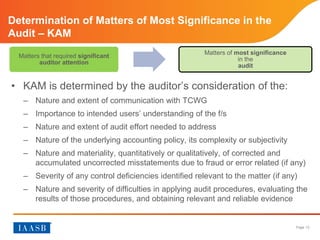
Determination of Matters of Most Significance in the
Audit – KAM
• KAM is determined by the auditor’s consideration of the
– Nature and extent of communication with TCWG
– Importance to intended users’ understanding of the f/s
– Nature and extent of audit effort needed to address
– Nature of the underlying accounting policy, its complexity or subjectivity
– Nature and materiality, quantitatively or qualitatively, of corrected and
accumulated uncorrected misstatements due to fraud or error (if any)
– Severity of any control deficiencies identified relevant to the matter (if any)
– Nature and severity of difficulties in applying audit procedures, evaluating the
results of those procedures, and obtaining relevant and reliable evidence
Matters that required significant
auditor attention
Matters of most significance
in the
audit
Page 14
KAM – What Is Included in the Description?
• The description always includes
– Why the matter was considered to be a KAM
– How the matter was addressed in the audit
– Reference to the related disclosure(s), if any
• The description of how the matter was addressed in the audit
may include
– Aspects of the auditor’s response or approach
– Brief overview of procedures performed
– Indication of the outcome of the auditor’s procedures
– Key observations with respect to the matter
Page 15
Considerations in Describing KAM
• KAM should be entity-specific and avoid standardized or
overly technical language
• Description of a KAM should not
– Imply that the matter has not been appropriately resolved by the
auditor in forming the opinion on the financial statements
– Contain or imply discrete opinions on separate elements of the
financial statements (a “piecemeal opinion”)
Page 16
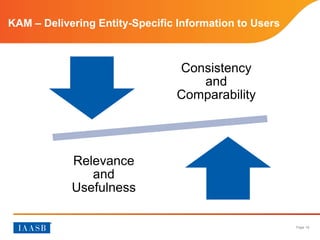
KAM – Delivering Entity-Specific Information to Users
Consistency
and
Comparability
Relevance
and
Usefulness
Page 17
KAM – Relationship to Emphasis of Matter (EOM) and
Other Matter (OM) Paragraphs and Modified Opinions
• Concepts of EOM and OM paragraphs are retained
• EOM and OM paragraphs cannot be used as a substitute
for communicating a matter determined to be a KAM
• New requirement to use the term “Emphasis of Matter” in
the heading in the auditor’s report when an EOM paragraph
is included
• Matters that give rise to a modified opinion are, by their
nature, KAM
Page 18
KAM – What Are the Documentation Requirements?
• In accordance with ISA 230, ISA 701 requires the auditor to
document the professional judgments made about
– Why a matter that required significant auditor attention is or is not a
KAM
– If there are no KAM, the rationale why
– Why a matter determined to be a KAM is not communicated
• No requirement to document the rationale for why matters
communicated to TCWG were not matters that required
significant auditor attention
More information about KAM is available in the Auditor Reporting
Toolkit at: www.iaasb.org/auditor-reporting.
Page 19
Enhanced Auditor Reporting on GC
• Changes to ISAs and the auditor's report to focus more on
GC
– Explicit description of the respective responsibilities of management
and the auditor in all auditor’s reports
– Separate GC section required when material uncertainty exists, with
a heading “Material Uncertainty Related to Going Concern”
– New requirement to challenge adequacy of disclosures for GC “close
calls”
Page 20
Interaction Between KAM and GC
• Matters relating to GC, including “close calls”, may be
determined to be KAM and communicated in the auditor’s
report in accordance with new ISA 701
• When a material uncertainty related to GC exists, it is by
nature a KAM, but is reported separately in the “Material
Uncertainty Related to Going Concern” section of the auditor’s
report
More information about GC is available in the Auditor Reporting
Toolkit at: www.iaasb.org/auditor-reporting.
Page 21
• Further work on the topic of GC by both
accounting and auditing standard setters
– Possible opportunity for research?
– IAASB to continue to monitor GC developments
and, as appropriate, engage in discussions with
the International Accounting Standards Board
– Consider whether further work in the area of
auditor reporting on GC is needed as part of the
planned post-implementation review of the new
and revised Auditor Reporting standards
GC – Next Steps
Page 22
Other Changes to the Auditor’s Report
• Auditor’s opinion required to be presented first
• Required Basis for Opinion section for unmodified opinions
• Statement about independence and other ethical
responsibilities
• Naming of the engagement partner (listed entities only)
• Enhanced description of auditor responsibilities and key
features of the audit
• Required identification section when TCWG are separate from
management
Page 23
Auditor Reporting and Law or Regulation
• New and revised Auditor Reporting standards continue to
allow for
– Reference to the ISAs in the auditor’s report when law or
regulation in a jurisdiction specify the layout or wording of the
auditor’s report, provided that certain requirements are met
– Any other reporting responsibilities (ORR) prescribed by law or
regulation in addition to those required by the ISAs, reported either
 In a separate section in the auditor’s report; or
 If addressing the same topics required by ISAs, in the same section,
provided the auditor’s report clearly differentiates the ORR from the reporting
required by the ISAs
Page 24
• IAASB-supported “roll-out plan” with objectives of
– Promoting awareness
– Informing and educating users
– Learning about experiences of those responsible for adopting and
implementing the standards
– Preparing for post-implementation review
• Planned activities
– Outreach and other communications
– Auditor Reporting Toolkit
Auditor Reporting Implementation Support
Page 25
• New auditor reporting webpage:
www.iaasb.org/auditor-reporting
• Available now
– Auditor Reporting Fact Sheet
– Basis for Conclusions
– “At a Glance” publication
– Publications on GC and KAM
• Coming soon
− Illustrative KAM examples
− Listings and extracts of illustrative auditor’s reports
− Webcast and podcasts
Resources – Auditor Reporting Toolkit
www.iaasb.org

The New Auditor’s Report

  • 1.
    Page 1 The NewAuditor’s Report Overview of the New and Revised Auditor Reporting Standards and Related Conforming Amendments March 2015
  • 2.
    Page 2 Background Information •These slides have been prepared by the IAASB’s Auditor Reporting Implementation Working Group – They form part of the Auditor Reporting Toolkit, and are intended to assist IAASB members, national standard setters, auditors and others in promoting the new and revised Auditor Reporting standards within their respective jurisdictions. • The IAASB staff-prepared At a Glance publication complements this slide presentation, includes an illustration of the new auditor’s report and is available at www.iaasb.org/auditor-reporting.
  • 3.
    Page 3 Index • ProjectOverview and Introduction • Key Audit Matters (KAM) • Going Concern (GC) • Other Changes to the Auditor’s Report • Auditor Reporting Implementation
  • 4.
    Page 4 Overview ofthe IAASB’s Auditor Reporting Project Research & Consultation Academic Research (2006 – 2009) Review of National Developments / Initiatives (2009-2010) Consultation Paper: Enhancing the Value of Auditor Reporting (May 2011) Commencement of Standard Setting Project Proposal (December 2011) Task Force and Drafting Teams (January 2012) Public Consultation Invitation to Comment: Improving the Auditor’s Report (June 2012) Outreach and Roundtables Released new and revised Auditor Reporting ISAs in Jan 2015 Effective Date – Periods ending on or after December 15, 2016 Exposure Draft (June 2013)
  • 5.
    Page 5 Why Changethe Auditor’s Report Now? • Foundation for the future of global auditor reporting and improved auditor communications • Essential to the continued relevance of the audit profession globally – Audit opinion is valued, but could be more informative – Users want more relevant and decision-useful information about the entity and the financial statement audit
  • 6.
    Page 6 Expected Benefitsof the New Auditor’s Report • Enhanced communicative value to users • More robust interactions and communication among users, auditors and those charged with governance (TCWG) • Increased attention by management and TCWG to the disclosures referred to in the KAM section of the auditor’s report • Increased professional skepticism in areas where KAM are identified • Increased audit quality or users’ perception of audit quality
  • 7.
    Page 7 New andRevised Auditor Reporting Standards Overarching Standard for Auditor Reporting – ISA 700 (Revised) Revisions to ISAs 260 and 706 as a result of ISA 701, and related conforming amendments to ISAs 210, 220, 230, 510, 540, 600, 710 Modifications to auditor’s opinions ISA 705 (Revised) New Key Audit Matters section ISA 701 Enhanced auditor reporting related to going concern ISA 570 (Revised) New other information section ISA 720 (Revised) Coming soon!
  • 8.
    Page 8 What AreKAM? KAM are defined as those matters that, in the auditor’s professional judgment, were of most significance in the audit of the financial statements of the current period KAM are selected from matters communicated with TCWG
  • 9.
    Page 9 Which Auditor’sReports Will Include a KAM Section? • KAM is required to be communicated in the auditor’s report for audits of financial statements of listed entities in accordance with new ISA 701 – Law or regulation may require KAM for audits of entities other than listed entities (e.g., “public interest entities”, or public sector entities) – Auditors may voluntarily, or at the request of management or TCWG, communicate KAM in the auditor’s report for entities other than listed entities
  • 10.
    Page 10 Are KAMAlways Communicated in the Auditor’s Report? • Auditor is required to include each KAM unless – Law or regulation precludes disclosure – In extremely rare circumstances, the auditor determines that the matter should not be communicated  Adverse consequences of communicating the KAM would reasonably be expected to outweigh the public interest benefits of such communication • KAM is prohibited for a disclaimer of opinion, but required for a qualified or adverse opinion • In certain limited circumstances, there may be no KAM to be communicated
  • 11.
    Page 11 The Decision-MakingFramework for KAM Matters that were communicated with those charged with governance Matters that required significant auditor attention Matters of most significance in the audit Key Audit Matters
  • 12.
    Page 12 Initial Stepin Determining KAM The auditor will always consider • Areas of higher assessed risks of material misstatements or significant risks (i.e., risks requiring special audit consideration) • Significant auditor judgments relating to areas of significant management judgment (e.g., complex accounting estimates) • Effect on the audit of significant events or transactions Matters that were communicated with TCWG Matters that required significant auditor attention
  • 13.
    Page 13 Determination ofMatters of Most Significance in the Audit – KAM • KAM is determined by the auditor’s consideration of the – Nature and extent of communication with TCWG – Importance to intended users’ understanding of the f/s – Nature and extent of audit effort needed to address – Nature of the underlying accounting policy, its complexity or subjectivity – Nature and materiality, quantitatively or qualitatively, of corrected and accumulated uncorrected misstatements due to fraud or error (if any) – Severity of any control deficiencies identified relevant to the matter (if any) – Nature and severity of difficulties in applying audit procedures, evaluating the results of those procedures, and obtaining relevant and reliable evidence Matters that required significant auditor attention Matters of most significance in the audit
  • 14.
    Page 14 KAM –What Is Included in the Description? • The description always includes – Why the matter was considered to be a KAM – How the matter was addressed in the audit – Reference to the related disclosure(s), if any • The description of how the matter was addressed in the audit may include – Aspects of the auditor’s response or approach – Brief overview of procedures performed – Indication of the outcome of the auditor’s procedures – Key observations with respect to the matter
  • 15.
    Page 15 Considerations inDescribing KAM • KAM should be entity-specific and avoid standardized or overly technical language • Description of a KAM should not – Imply that the matter has not been appropriately resolved by the auditor in forming the opinion on the financial statements – Contain or imply discrete opinions on separate elements of the financial statements (a “piecemeal opinion”)
  • 16.
    Page 16 KAM –Delivering Entity-Specific Information to Users Consistency and Comparability Relevance and Usefulness
  • 17.
    Page 17 KAM –Relationship to Emphasis of Matter (EOM) and Other Matter (OM) Paragraphs and Modified Opinions • Concepts of EOM and OM paragraphs are retained • EOM and OM paragraphs cannot be used as a substitute for communicating a matter determined to be a KAM • New requirement to use the term “Emphasis of Matter” in the heading in the auditor’s report when an EOM paragraph is included • Matters that give rise to a modified opinion are, by their nature, KAM
  • 18.
    Page 18 KAM –What Are the Documentation Requirements? • In accordance with ISA 230, ISA 701 requires the auditor to document the professional judgments made about – Why a matter that required significant auditor attention is or is not a KAM – If there are no KAM, the rationale why – Why a matter determined to be a KAM is not communicated • No requirement to document the rationale for why matters communicated to TCWG were not matters that required significant auditor attention More information about KAM is available in the Auditor Reporting Toolkit at: www.iaasb.org/auditor-reporting.
  • 19.
    Page 19 Enhanced AuditorReporting on GC • Changes to ISAs and the auditor's report to focus more on GC – Explicit description of the respective responsibilities of management and the auditor in all auditor’s reports – Separate GC section required when material uncertainty exists, with a heading “Material Uncertainty Related to Going Concern” – New requirement to challenge adequacy of disclosures for GC “close calls”
  • 20.
    Page 20 Interaction BetweenKAM and GC • Matters relating to GC, including “close calls”, may be determined to be KAM and communicated in the auditor’s report in accordance with new ISA 701 • When a material uncertainty related to GC exists, it is by nature a KAM, but is reported separately in the “Material Uncertainty Related to Going Concern” section of the auditor’s report More information about GC is available in the Auditor Reporting Toolkit at: www.iaasb.org/auditor-reporting.
  • 21.
    Page 21 • Furtherwork on the topic of GC by both accounting and auditing standard setters – Possible opportunity for research? – IAASB to continue to monitor GC developments and, as appropriate, engage in discussions with the International Accounting Standards Board – Consider whether further work in the area of auditor reporting on GC is needed as part of the planned post-implementation review of the new and revised Auditor Reporting standards GC – Next Steps
  • 22.
    Page 22 Other Changesto the Auditor’s Report • Auditor’s opinion required to be presented first • Required Basis for Opinion section for unmodified opinions • Statement about independence and other ethical responsibilities • Naming of the engagement partner (listed entities only) • Enhanced description of auditor responsibilities and key features of the audit • Required identification section when TCWG are separate from management
  • 23.
    Page 23 Auditor Reportingand Law or Regulation • New and revised Auditor Reporting standards continue to allow for – Reference to the ISAs in the auditor’s report when law or regulation in a jurisdiction specify the layout or wording of the auditor’s report, provided that certain requirements are met – Any other reporting responsibilities (ORR) prescribed by law or regulation in addition to those required by the ISAs, reported either  In a separate section in the auditor’s report; or  If addressing the same topics required by ISAs, in the same section, provided the auditor’s report clearly differentiates the ORR from the reporting required by the ISAs
  • 24.
    Page 24 • IAASB-supported“roll-out plan” with objectives of – Promoting awareness – Informing and educating users – Learning about experiences of those responsible for adopting and implementing the standards – Preparing for post-implementation review • Planned activities – Outreach and other communications – Auditor Reporting Toolkit Auditor Reporting Implementation Support
  • 25.
    Page 25 • Newauditor reporting webpage: www.iaasb.org/auditor-reporting • Available now – Auditor Reporting Fact Sheet – Basis for Conclusions – “At a Glance” publication – Publications on GC and KAM • Coming soon − Illustrative KAM examples − Listings and extracts of illustrative auditor’s reports − Webcast and podcasts Resources – Auditor Reporting Toolkit
  • 26.

Editor's Notes

  • #12  The auditor’s decision-making process is a two-step process, beginning first with the narrowing of matters to those that required significant auditor attention and then a further narrowing of matters to those matters to the matters of most significance.
  • #13 As an initial step in determining KAM, ISA 701 requires the auditor to determine, from the matters that were communicated with TCWG, those matters that required significant auditor attention. The three bullets on this slide are the considerations for the auditor in determining matters requiring significant auditor attention.
  • #17 The framework in ISA 701 provides auditors with a decision-making process to determine KAM. It builds on, and is conditioned on, the auditor’s application of a risk-based approach in conducting the ISA audit. Therefore, while entities themselves may have similar sets of facts and circumstances, audits of similar entities may not be conducted in the same way. The manner in which ISA 701 is drafted achieves an appropriate balance between prescription to promote consistency in which matters are determined and communicated as KAM. It also provides guidance to auditors to describe KAM in a manner that is specific to the particular entity and the audit engagement that was performed, thereby making it most useful and relevant to investors and other users. The description of a KAM will naturally refer to any related disclosures in the financial statements. However, the level of detail for each individual KAM description is a matter of professional judgment, and may vary depending on the specific facts and circumstances of the particular engagement. The flexibility that ISA 701 allows is intended to enable auditors to be as entity-specific and audit-specific as possible in describing each KAM so that they continue to be relevant and useful to investors and other users.
  • #22 ED responses indicated strong support for a holistic approach to reporting on GC, and encouraged the IAASB to work with the IASB and others IASB decided not to pursue revisions to IAS 1 IFRIC agenda decision (July 2014) provided a "hook" for consideration of adequacy of GC disclosures in "close call" situations IAASB continues to believe that auditor reporting on GC is in the public interest, but to provide explicit statements in the auditor’s report may expand the expectation gap if users if users do not understand that such statements are not a guarantee as to the entity’s future viability, or if the meaning of the term “material uncertainty” and the requirements for disclosure of such uncertainties are not clearly defined across different financial reporting frameworks. Emphasis on GC in final auditor reporting standards Description of respective responsibilities of management and auditor in all auditor’s reports New requirement to challenge adequacy of disclosures for "close calls“
  • #23 Auditor’s opinion required to be presented first, but law or regulation may prescribe alternate presentation provided certain requirements are met Statement about independence and other ethical responsibilities – Either (i) Disclosure of the sources of relevant ethical requirements; (ii) Jurisdiction of origin; or (iii) Reference to the International Ethics Standards Board for Accountants’ Code of Ethics for Professional Accountants (IESBA Code) Enhanced description of auditor responsibilities and key features of the audit – may be placed in appendix or where law or regulation permits, on a website of appropriate authority
  • #24 Paragraph 49 in ISA 700 (Revised) requires an ISA auditor’s report to include certain minimum elements, if the auditor is required by law or regulation of a specific jurisdiction to use a specific layout, or wording of the auditor’s report. Additional flexibility for auditors to address similar topics in the same section as the related ISA elements