
The Future of Audit 
Warren Allen, President 
International Federation of Accountants 
September 19, 2014 
Institute of Certified Public Accountants of Greece 
Athens, Greece 
Page 1 | Confidential and Proprietary Information
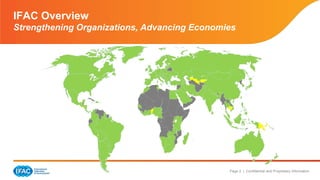
IFAC Overview 
Strengthening Organizations, Advancing Economies 
Page 2 | Confidential and Proprietary Information
Page 3 | Confidential and Proprietary Information 
IFAC Overview 
• Supporting standards 
development 
• Improving quality and 
capacity 
• Supporting the profession 
• Global representation and 
advocacy
Page 4 | Confidential and Proprietary Information 
The Changing Audit Environment 
• Significant regulatory change has 
occurred over the last 20 years 
• The global financial crisis has triggered 
more questions 
• There is increased complexity in 
financial reporting and global business 
activity
Page 5 | Confidential and Proprietary Information 
The Changing Audit Environment 
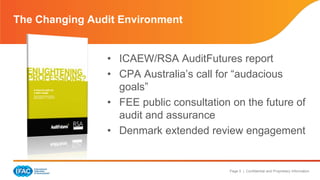
• ICAEW/RSA AuditFutures report 
• CPA Australia’s call for “audacious 
goals” 
• FEE public consultation on the future of 
audit and assurance 
• Denmark extended review engagement
Page 6 | Confidential and Proprietary Information 
The Changing Audit Environment 
• In response to the FEE discussion 
paper, IFAC stated that: 
– The accountancy profession must be 
“forward-looking” 
– There must be an open discussion on 
alternatives to an audit 
– The accountancy profession must 
undertake critical self-examination
The IAASB’s Response as a Global Standard-Setter 
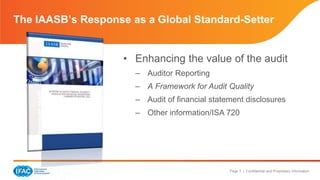
• Enhancing the value of the audit 
– Auditor Reporting 
– A Framework for Audit Quality 
– Audit of financial statement disclosures 
– Other information/ISA 720 
Page 7 | Confidential and Proprietary Information
Page 8 | Confidential and Proprietary Information 
A Framework for Audit Quality 
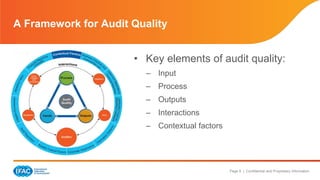
• Key elements of audit quality: 
– Input 
– Process 
– Outputs 
– Interactions 
– Contextual factors
Page 9 | Confidential and Proprietary Information 
Beyond Audits 
• ISAE 3000 (Revised) 
• Revision of standards for Review 
and Compilation Engagements 
• Monitoring reporting trends
Page 10 | Confidential and Proprietary Information 
Why Change the Auditor’s Report Now? 
• Building a foundation 
• Remaining relevant 
• Enhancing public trust 
• Meeting user demand for 
information
Revised Requirements for Determining KAM 
Page 11 | Confidential and Proprietary Information 
• Focus on matters that required 
“significant auditor attention” but revised 
considerations in light of feedback 
• More closely linked to matters likely to 
be disclosed in the financial statement 
• Second “filter” to select the matters “of 
most significance”
Revised Requirements for Communicating KAM 
• The IAASB has agreed to 
retain flexibility in describing a 
KAM 
• The IAASB will provide further 
guidance to support providing 
relevant information 
Page 12 | Confidential and Proprietary Information
Page 13 | Confidential and Proprietary Information 
Feedback on Going Concern 
• Respondents continue to 
advocate a holistic approach 
• The IAASB to revert to 
exception-based reporting 
based on feedback to the 
Exposure Draft 
• The IAASB continues to work 
with IASB and regulators
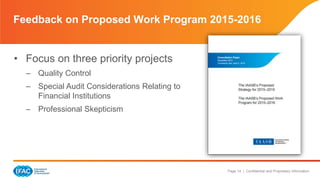
Feedback on Proposed Work Program 2015-2016 
Page 14 | Confidential and Proprietary Information 
• Focus on three priority projects 
– Quality Control 
– Special Audit Considerations Relating to 
Financial Institutions 
– Professional Skepticism
Page 15 | Confidential and Proprietary Information 
IAASB Innovation Working Group 
• Exploration of emerging 
developments 
• Possible actions 
• Areas of Priority 
– Integrated Reporting 
– Effect of evolving use of technology on 
audits
Will you join the global accountancy 
community in Rome in November 2014? 
www.wcoa2014rome.com 
www.ifac.org

The Future of Audit

  • 1.
    The Future ofAudit Warren Allen, President International Federation of Accountants September 19, 2014 Institute of Certified Public Accountants of Greece Athens, Greece Page 1 | Confidential and Proprietary Information
  • 2.
    IFAC Overview StrengtheningOrganizations, Advancing Economies Page 2 | Confidential and Proprietary Information
  • 3.
    Page 3 |Confidential and Proprietary Information IFAC Overview • Supporting standards development • Improving quality and capacity • Supporting the profession • Global representation and advocacy
  • 4.
    Page 4 |Confidential and Proprietary Information The Changing Audit Environment • Significant regulatory change has occurred over the last 20 years • The global financial crisis has triggered more questions • There is increased complexity in financial reporting and global business activity
  • 5.
    Page 5 |Confidential and Proprietary Information The Changing Audit Environment • ICAEW/RSA AuditFutures report • CPA Australia’s call for “audacious goals” • FEE public consultation on the future of audit and assurance • Denmark extended review engagement
  • 6.
    Page 6 |Confidential and Proprietary Information The Changing Audit Environment • In response to the FEE discussion paper, IFAC stated that: – The accountancy profession must be “forward-looking” – There must be an open discussion on alternatives to an audit – The accountancy profession must undertake critical self-examination
  • 7.
    The IAASB’s Responseas a Global Standard-Setter • Enhancing the value of the audit – Auditor Reporting – A Framework for Audit Quality – Audit of financial statement disclosures – Other information/ISA 720 Page 7 | Confidential and Proprietary Information
  • 8.
    Page 8 |Confidential and Proprietary Information A Framework for Audit Quality • Key elements of audit quality: – Input – Process – Outputs – Interactions – Contextual factors
  • 9.
    Page 9 |Confidential and Proprietary Information Beyond Audits • ISAE 3000 (Revised) • Revision of standards for Review and Compilation Engagements • Monitoring reporting trends
  • 10.
    Page 10 |Confidential and Proprietary Information Why Change the Auditor’s Report Now? • Building a foundation • Remaining relevant • Enhancing public trust • Meeting user demand for information
  • 11.
    Revised Requirements forDetermining KAM Page 11 | Confidential and Proprietary Information • Focus on matters that required “significant auditor attention” but revised considerations in light of feedback • More closely linked to matters likely to be disclosed in the financial statement • Second “filter” to select the matters “of most significance”
  • 12.
    Revised Requirements forCommunicating KAM • The IAASB has agreed to retain flexibility in describing a KAM • The IAASB will provide further guidance to support providing relevant information Page 12 | Confidential and Proprietary Information
  • 13.
    Page 13 |Confidential and Proprietary Information Feedback on Going Concern • Respondents continue to advocate a holistic approach • The IAASB to revert to exception-based reporting based on feedback to the Exposure Draft • The IAASB continues to work with IASB and regulators
  • 14.
    Feedback on ProposedWork Program 2015-2016 Page 14 | Confidential and Proprietary Information • Focus on three priority projects – Quality Control – Special Audit Considerations Relating to Financial Institutions – Professional Skepticism
  • 15.
    Page 15 |Confidential and Proprietary Information IAASB Innovation Working Group • Exploration of emerging developments • Possible actions • Areas of Priority – Integrated Reporting – Effect of evolving use of technology on audits
  • 16.
    Will you jointhe global accountancy community in Rome in November 2014? www.wcoa2014rome.com www.ifac.org