Auditing in the Public Sector


  Ian Ball
  CEO
  International Federation of Accountants


  European Study Day
  10 February, 2012
  Brussels, Belgium
Auditing in the Public Sector


IFAC Comments on European Commission Proposed Legislation

The International Federation of Accountants (IFAC), the global organization for the accountancy
profession with members and to continually improve audit quality, enhance the role of audit, and
   IFAC supports initiatives associates in 127 countries, today commented on the European
Commission (EC)’s proposed legislation, issued this week.
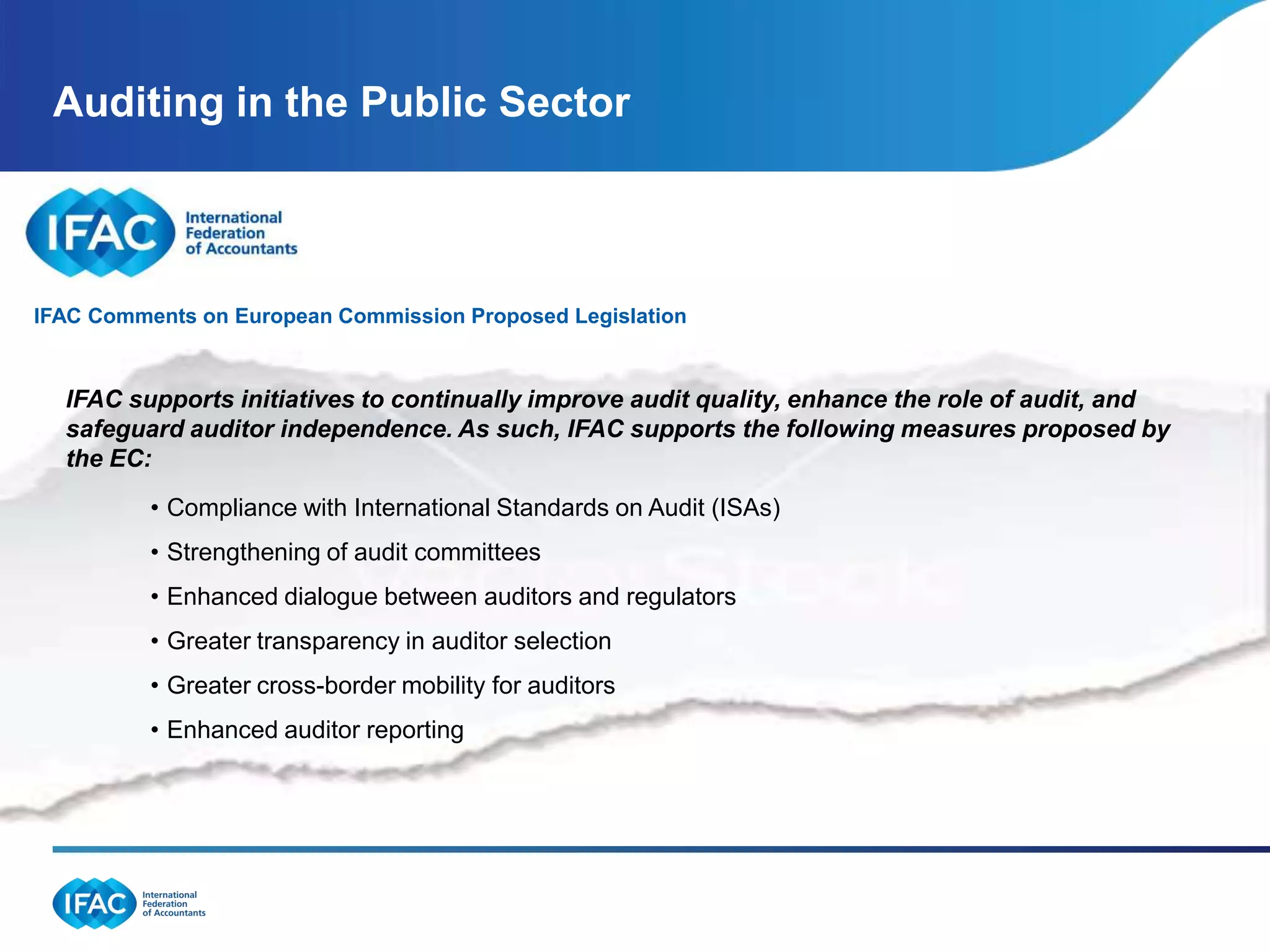
   safeguard auditor independence. As such, IFAC supports the following measures proposed by
   the EC:
IFAC supports initiatives to continually improve audit quality, enhance the role of audit, and safeguard
auditor independence, and believes that innovation and evolution are essential for this vital service to
            • Compliance with International Standards on Audit (ISAs)
maintain its relevance and meet the needs of investors and other stakeholders. As such, IFAC supports
            • measures proposed by the EC, which we believe are consistent with views widely
the followingStrengthening of audit committees
expressed in response to the Green Paper:
            • Enhanced dialogue between auditors and regulators
          • Greater transparency in auditor selection
          • Greater cross-border mobility for auditors
          • Enhanced auditor reporting
Auditing in the Public Sector


 IFAC Comments on European Commission Proposed Legislation

The International Federation of Accountants (IFAC), the global organization for the accountancy
profession with members and associates in 127because there iscommented on evidence that they will have a
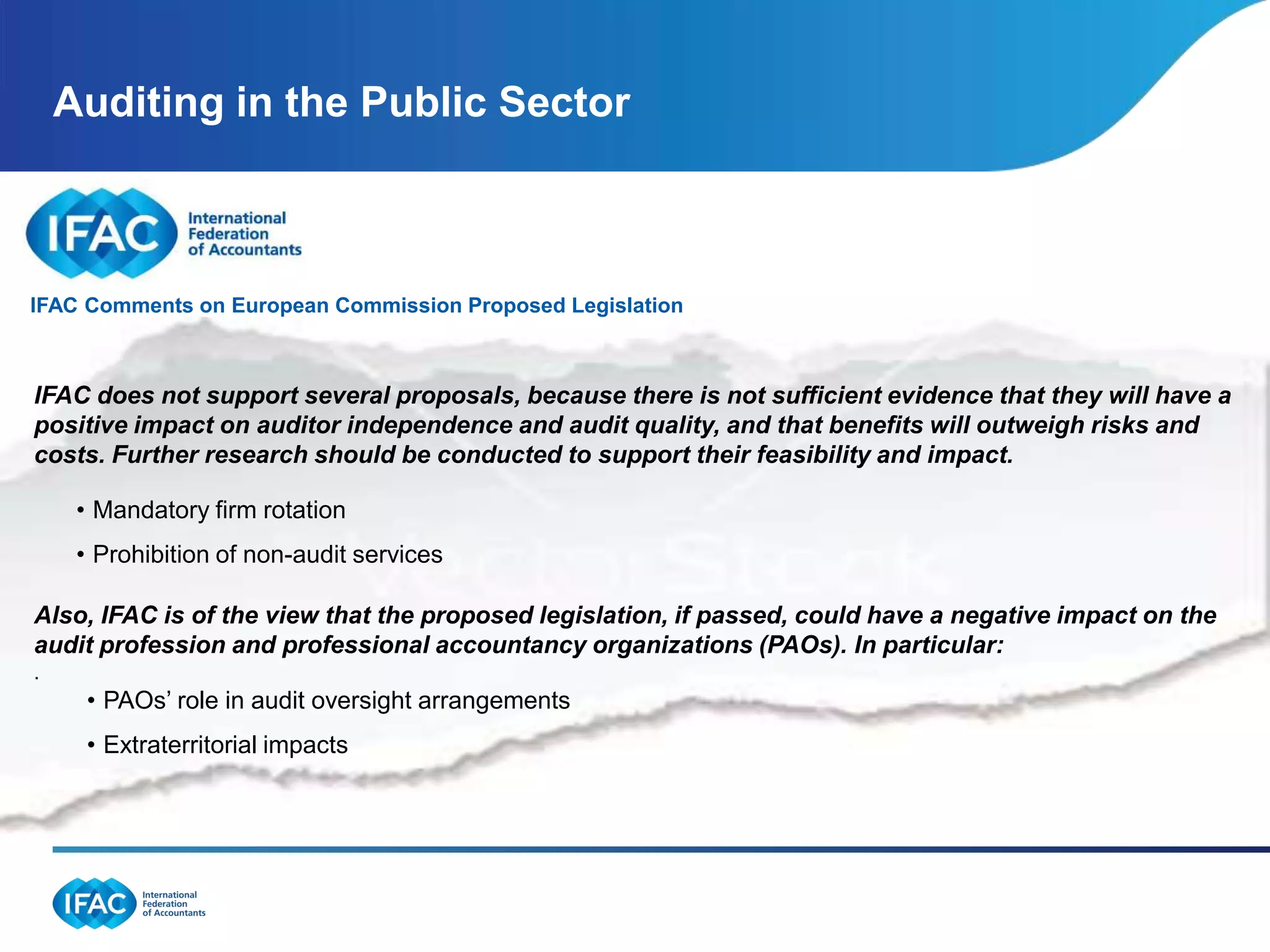
  IFAC does not support several proposals, countries, today not sufficient the European
Commission (EC)’son auditorlegislation, issued this week.
  positive impact proposed independence and audit quality, and that benefits will outweigh risks and
IFAC supports initiatives to continually improve audit quality, enhance the role of audit, and safeguard
  costs. Further research should be conducted to support their feasibility and impact.
auditor independence, and believes that innovation and evolution are essential for this vital service to
      • Mandatory firm rotation
maintain its relevance and meet the needs of investors and other stakeholders. As such, IFAC supports
the following measures proposed by the EC, which we believe are consistent with views widely
      • Prohibition of non-audit services
expressed in response to the Green Paper:
 Also, IFAC is of the view that the proposed legislation, if passed, could have a negative impact on the
 audit profession and professional accountancy organizations (PAOs). In particular:
 .
      • PAOs’ role in audit oversight arrangements
      • Extraterritorial impacts
Auditing in the Public Sector


                       2.1
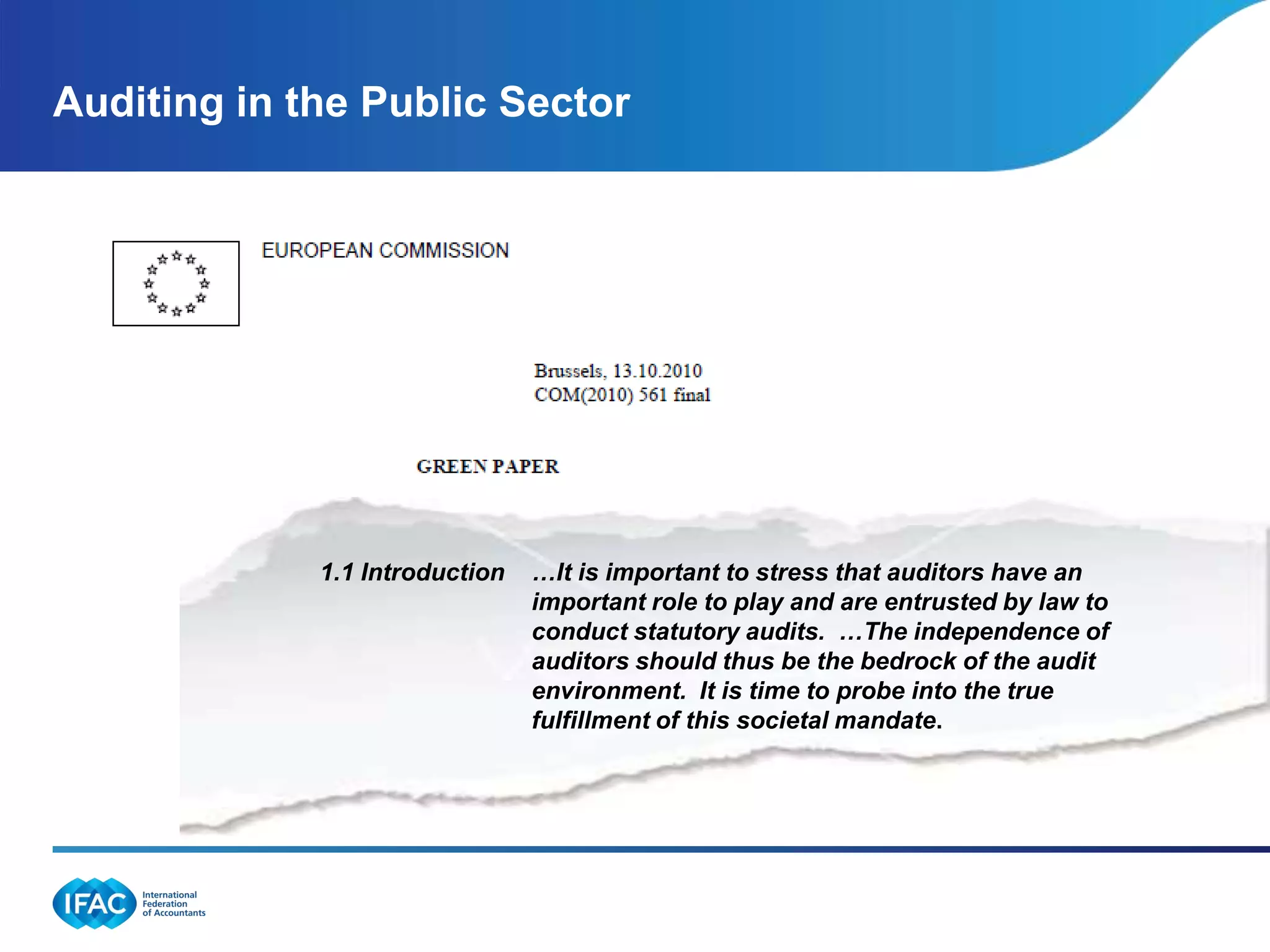
             1.1 Introduction   …It is important to stress that auditors have an
                                important role to play and are entrusted by law to
                        .       conduct statutory audits. …The independence of
                                auditors should thus be the bedrock of the audit
                                environment. It is time to probe into the true
                                fulfillment of this societal mandate.
Auditing in the Public Sector


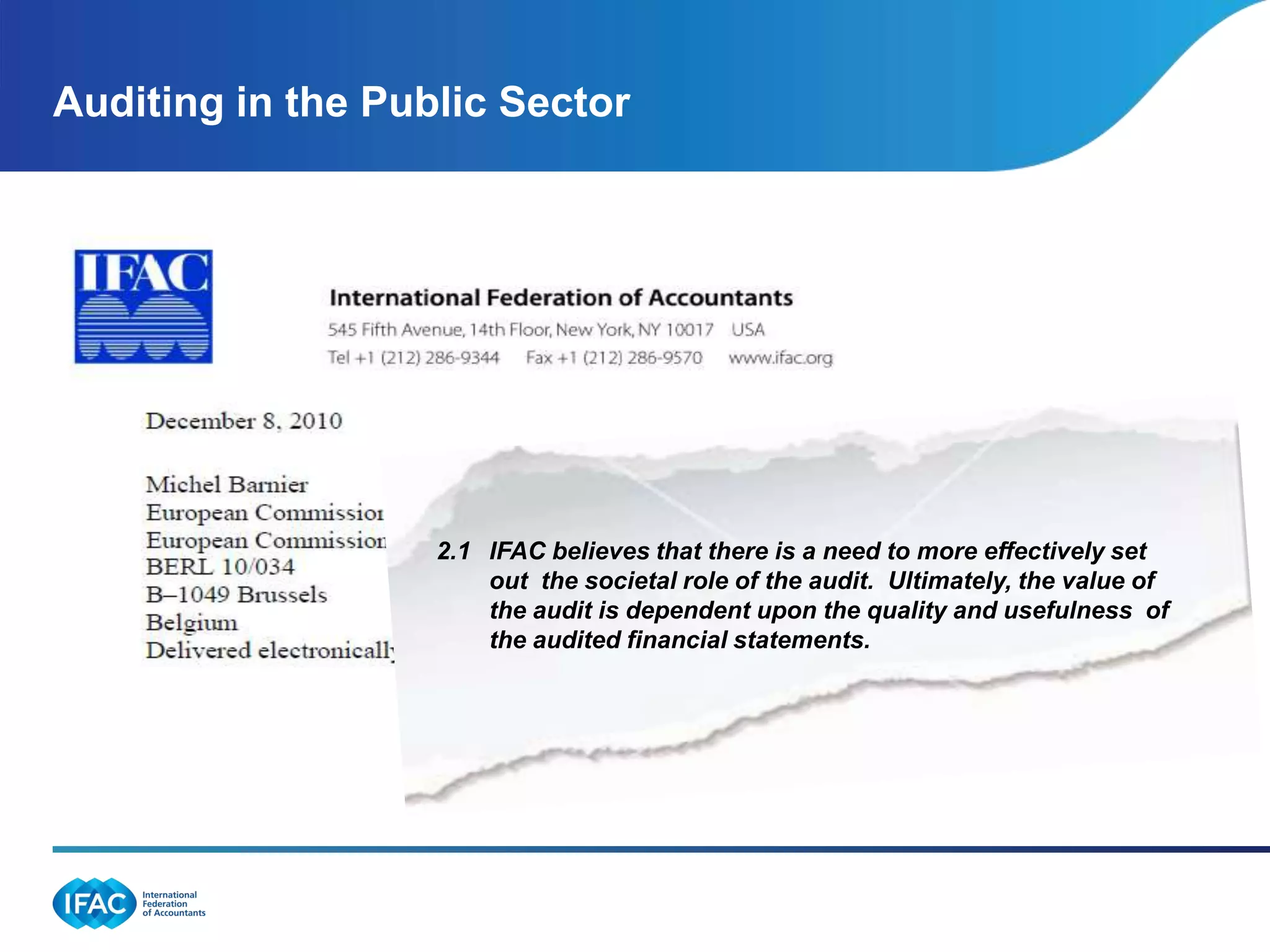
                   2.1 IFAC believes that there is a need to more effectively set
                       out the societal role of the audit. Ultimately, the value of
                       the audit is dependent upon the quality and usefulness of
                     . the audited financial statements.
Auditing in the Public Sector


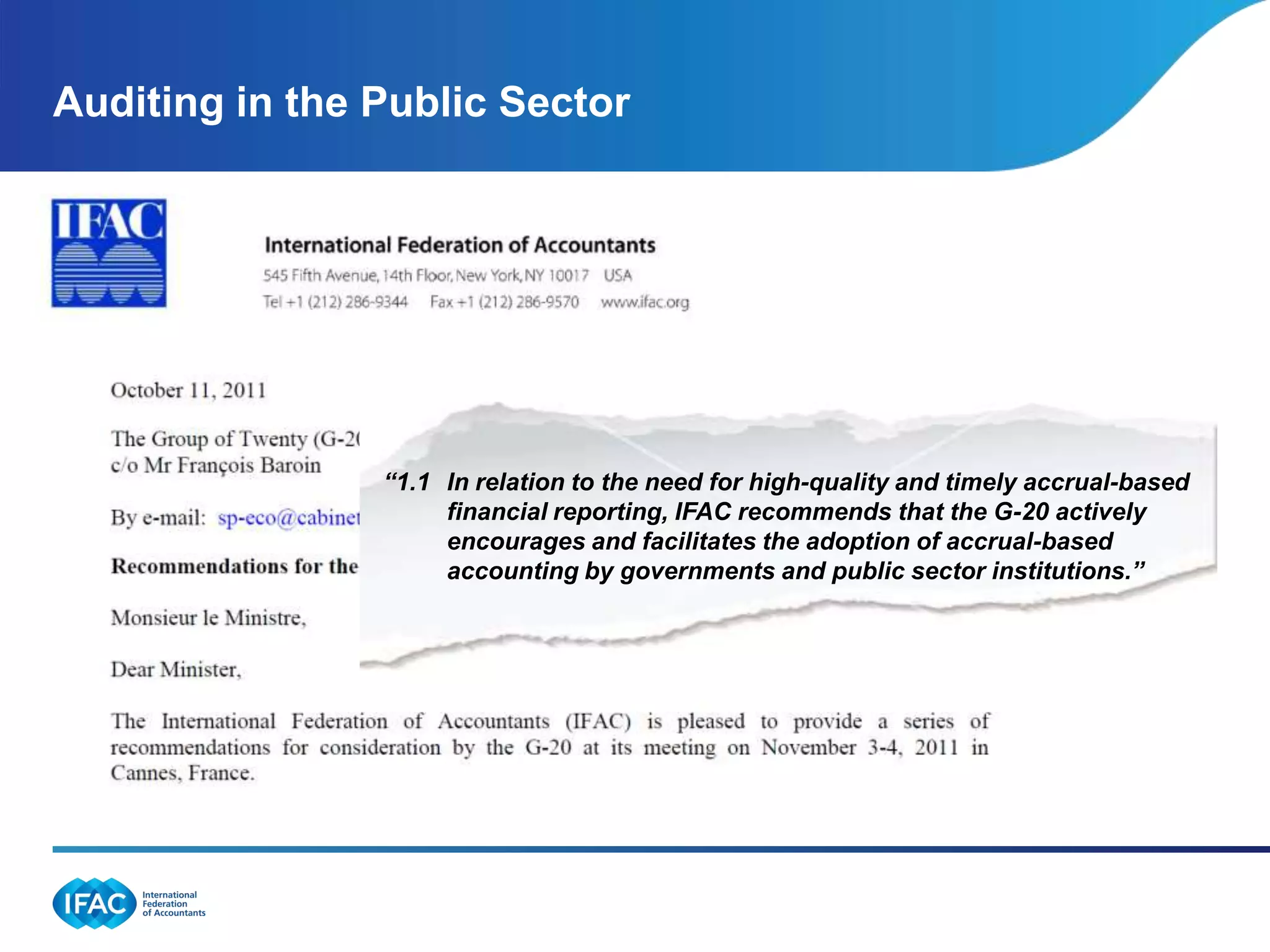
                “1.1 In relation to the need for high-quality and timely accrual-based
                     financial reporting, IFAC recommends that the G-20 actively
                     encourages and facilitates the adoption of accrual-based
                     accounting by governments and public sector institutions.”
Auditing in the Public Sector


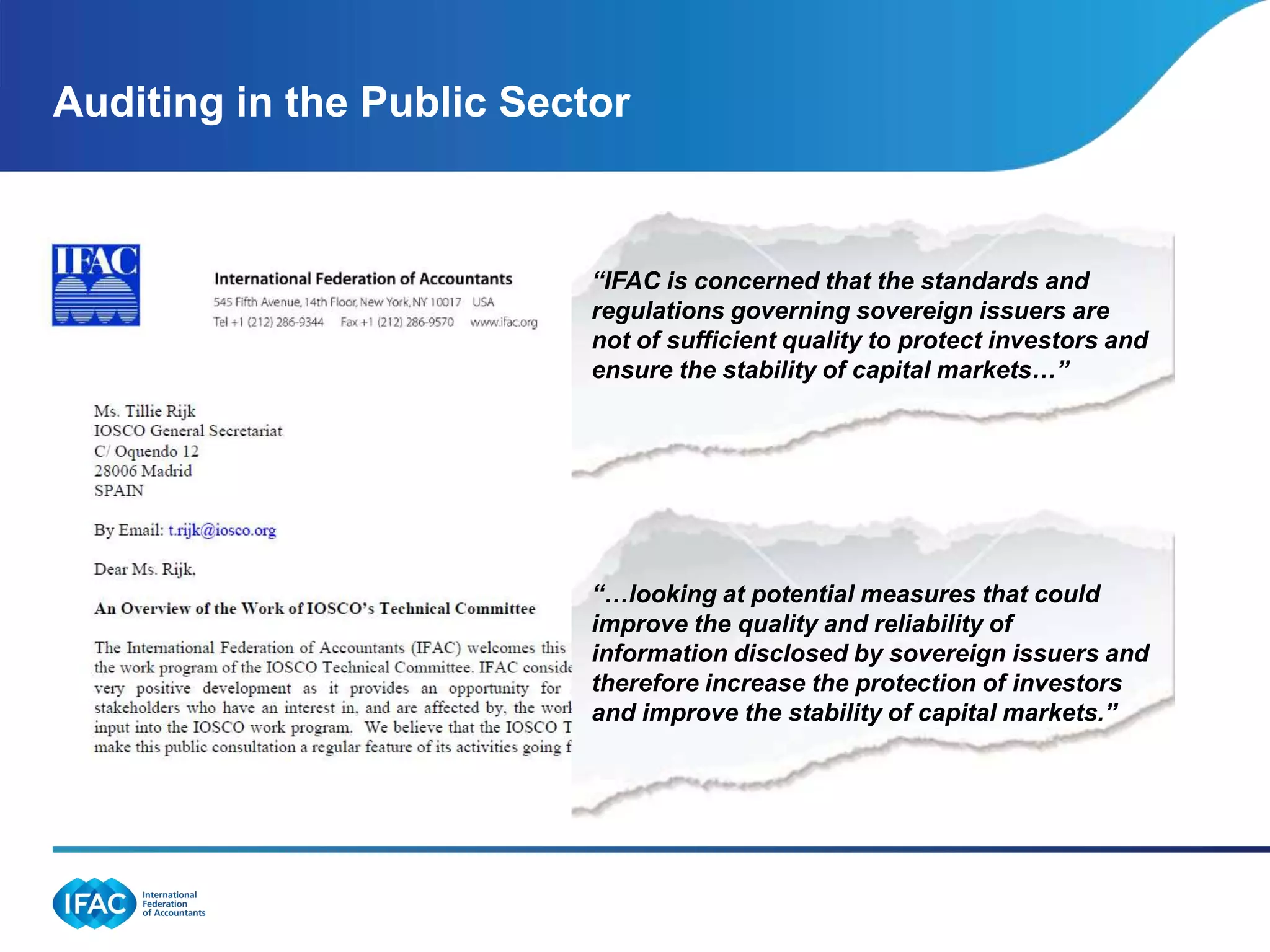
                           “IFAC is concerned that the standards and
                           regulations governing sovereign issuers are
                           not of sufficient quality to protect investors and
                           ensure the stability of capital markets…”


                           “…looking at potential measures that could
                           improve the quality and reliability of
                           information disclosed by sovereign issuers and
                           therefore increase the protection of investors
                           and improve the stability of capital markets.”
Auditing in the Public Sector


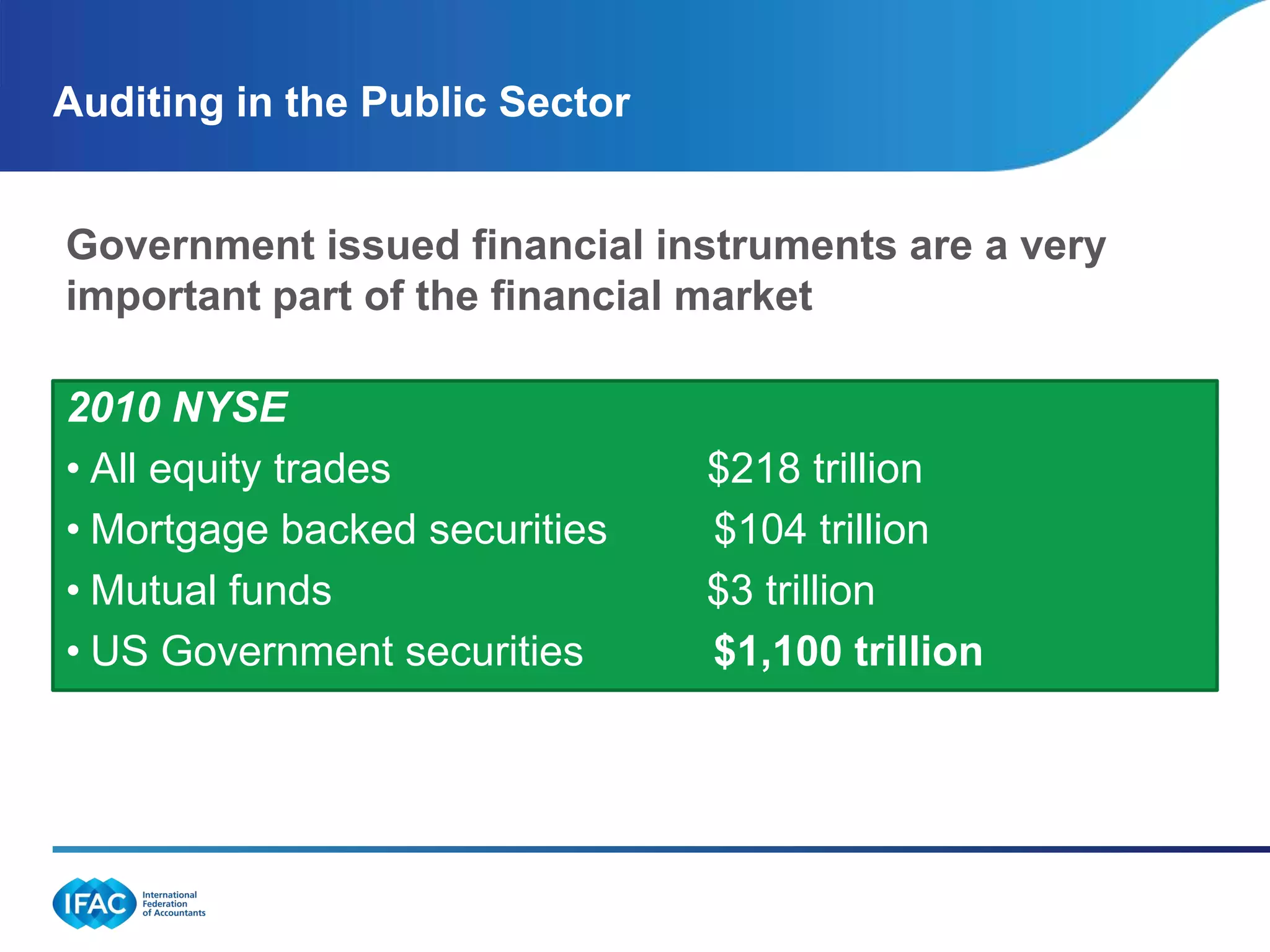
Government issued financial instruments are a very
important part of the financial market

2010 NYSE
• All equity trades             $218 trillion
• Mortgage backed securities    $104 trillion
• Mutual funds                  $3 trillion
• US Government securities      $1,100 trillion
Auditing in the Public Sector


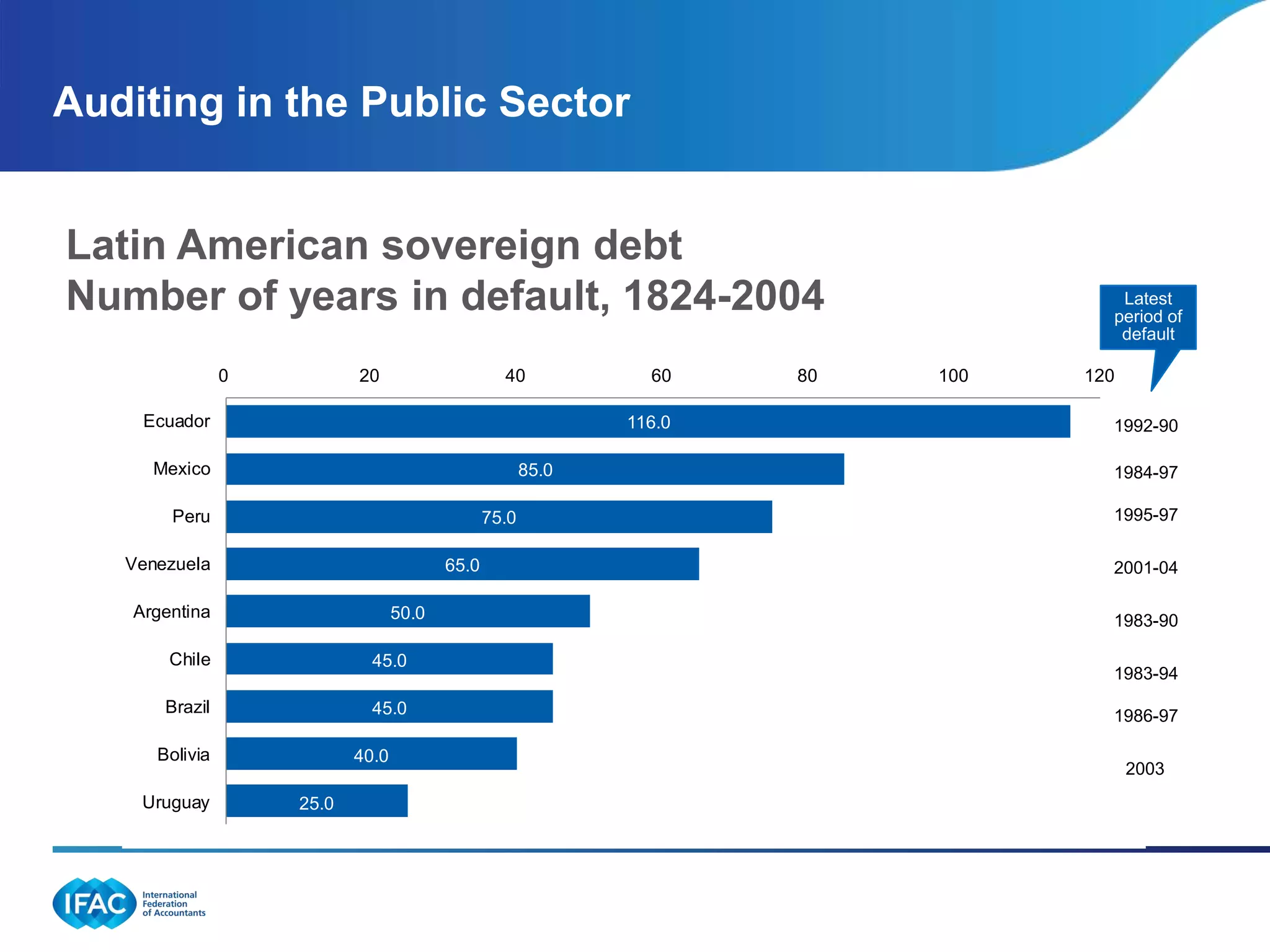
Latin American sovereign debt
Number of years in default, 1824-2004                                               Latest
                                                                                   period of
                                                                                    default

                0          20                     40            60    80   100   120

     Ecuador                                                  116.0                1992-90

      Mexico                                           85.0                        1984-97

        Peru                                    75.0                               1995-97

   Venezuela                             65.0                                      2001-04

    Argentina                     50.0                                             1983-90

        Chile                45.0
                                                                                   1983-94
       Brazil                45.0                                                  1986-97

      Bolivia              40.0
                                                                                       2003
     Uruguay        25.0
Auditing in the Public Sector


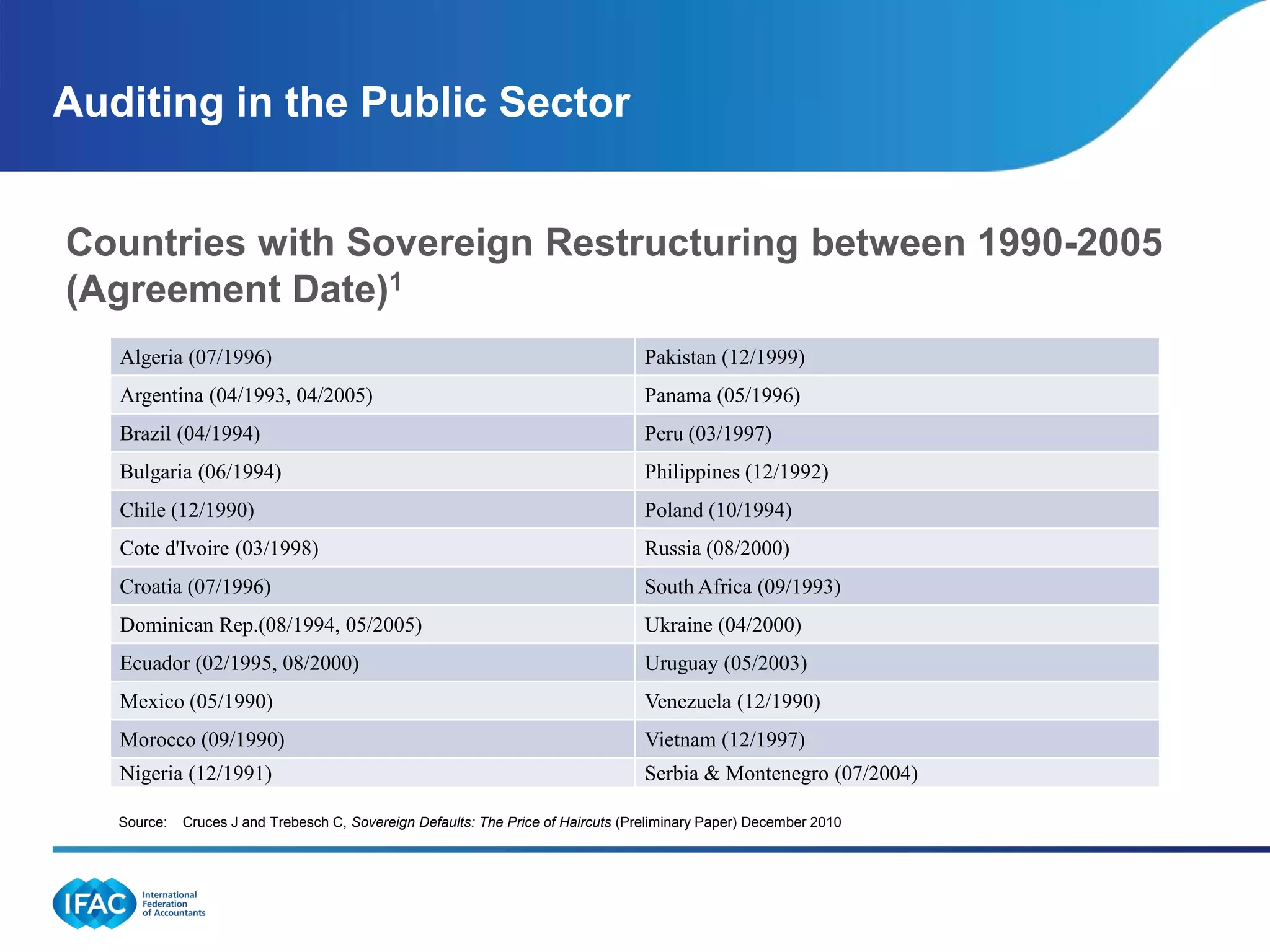
Countries with Sovereign Restructuring between 1990-2005
(Agreement Date)1
   Algeria (07/1996)                                                               Pakistan (12/1999)
   Argentina (04/1993, 04/2005)                                                    Panama (05/1996)
   Brazil (04/1994)                                                                Peru (03/1997)
   Bulgaria (06/1994)                                                              Philippines (12/1992)
   Chile (12/1990)                                                                 Poland (10/1994)
   Cote d'Ivoire (03/1998)                                                         Russia (08/2000)
   Croatia (07/1996)                                                               South Africa (09/1993)
   Dominican Rep.(08/1994, 05/2005)                                                Ukraine (04/2000)
   Ecuador (02/1995, 08/2000)                                                      Uruguay (05/2003)
   Mexico (05/1990)                                                                Venezuela (12/1990)
   Morocco (09/1990)                                                               Vietnam (12/1997)
   Nigeria (12/1991)                                                               Serbia & Montenegro (07/2004)

   Source:   Cruces J and Trebesch C, Sovereign Defaults: The Price of Haircuts (Preliminary Paper) December 2010
Auditing in the Public Sector


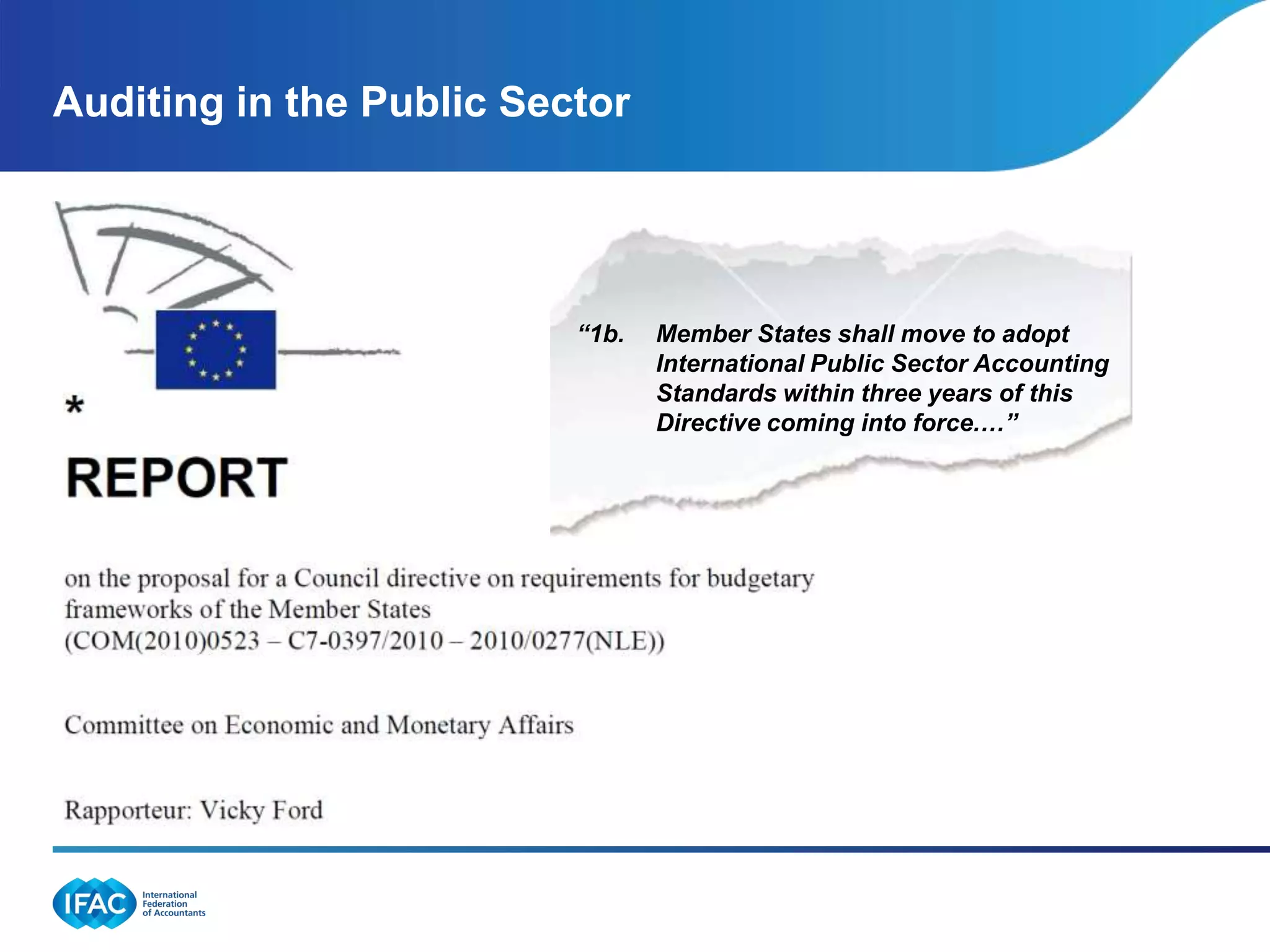
                          “1b.   Member States shall move to adopt
                                 International Public Sector Accounting
                                 Standards within three years of this
                                 Directive coming into force.…”
Auditing in the Public Sector

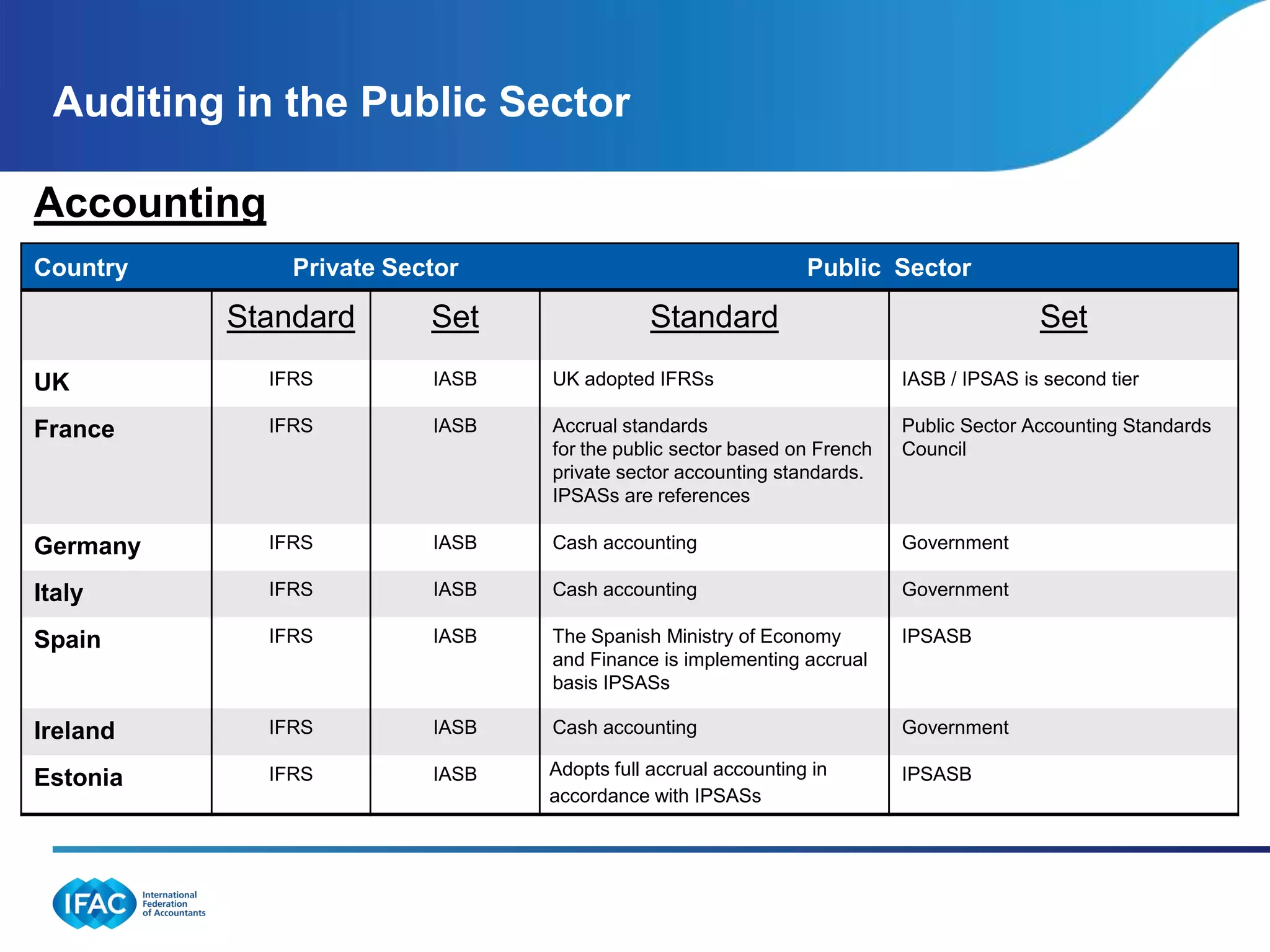
Accounting
Country        Private Sector                                  Public Sector

          Standard        Set               Standard                                    Set
UK           IFRS         IASB   UK adopted IFRSs                        IASB / IPSAS is second tier

France       IFRS         IASB   Accrual standards                       Public Sector Accounting Standards
                                 for the public sector based on French   Council
                                 private sector accounting standards.
                                 IPSASs are references

Germany      IFRS         IASB   Cash accounting                         Government

Italy        IFRS         IASB   Cash accounting                         Government

Spain        IFRS         IASB   The Spanish Ministry of Economy         IPSASB
                                 and Finance is implementing accrual
                                 basis IPSASs

Ireland      IFRS         IASB   Cash accounting                         Government

             IFRS         IASB   Adopts full accrual accounting in       IPSASB
Estonia
                                 accordance with IPSASs
Auditing in the Public Sector


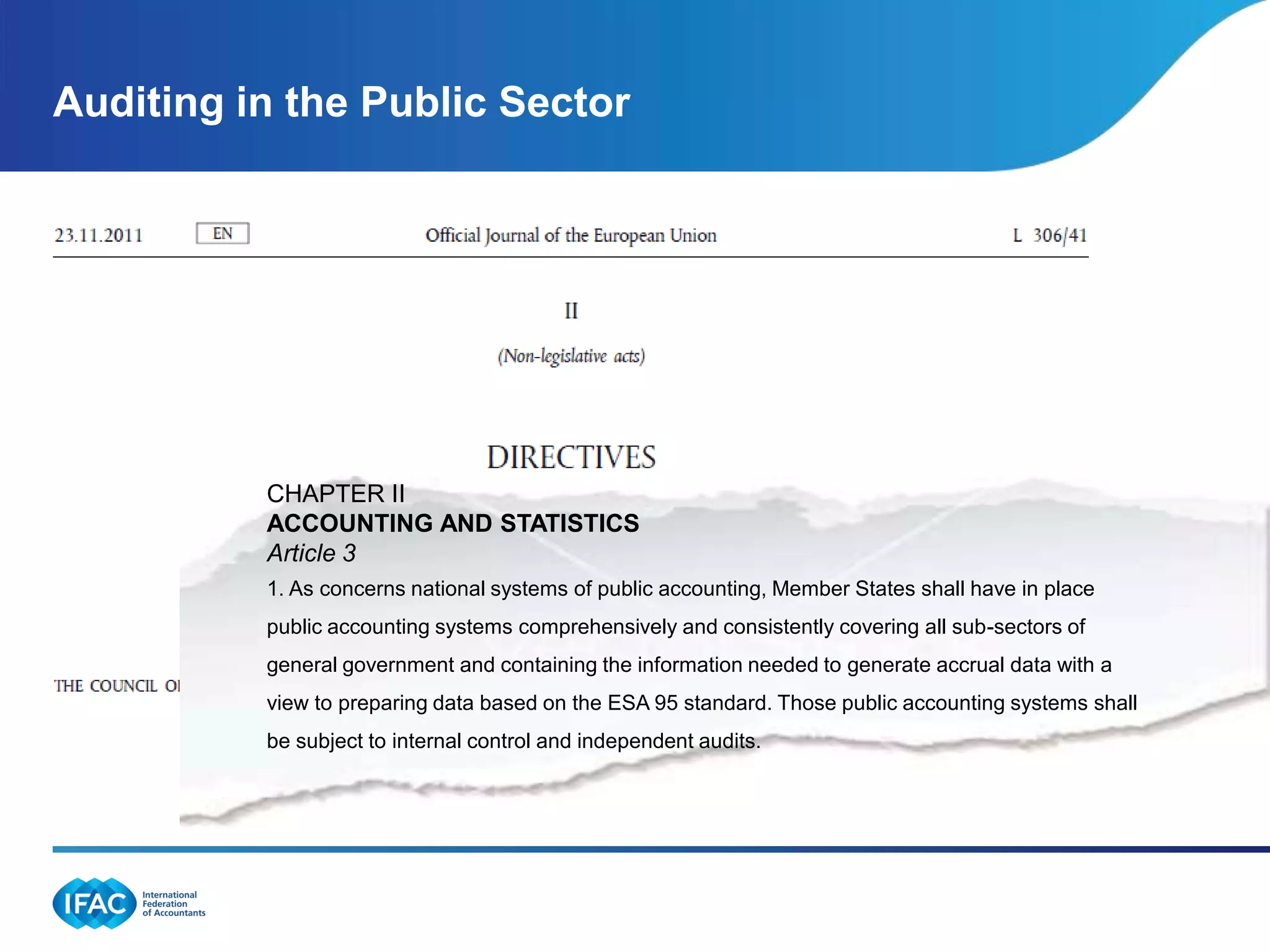
          CHAPTER II
          ACCOUNTING AND STATISTICS
          Article 3  2.1
          1. As concerns national systems of public accounting, Member States shall have in place
                              .
          public accounting systems comprehensively and consistently covering all sub-sectors of
          general government and containing the information needed to generate accrual data with a
          view to preparing data based on the ESA 95 standard. Those public accounting systems shall
          be subject to internal control and independent audits.
Auditing in the Public Sector

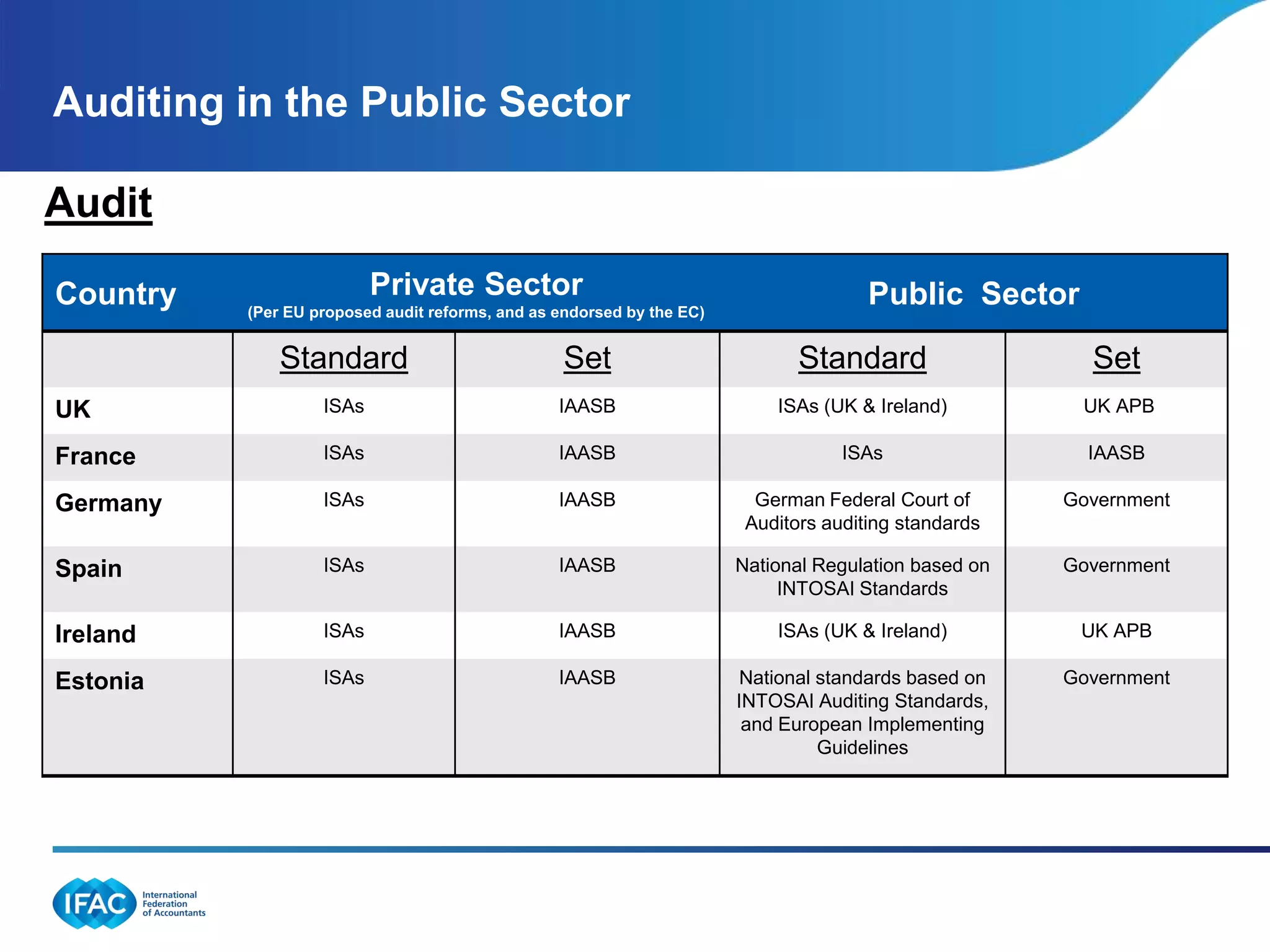
Audit

Country                   Private Sector                                              Public Sector
          (Per EU proposed audit reforms, and as endorsed by the EC)


              Standard                            Set                         Standard                  Set
UK                 ISAs                          IAASB                     ISAs (UK & Ireland)         UK APB

France             ISAs                          IAASB                             ISAs                 IAASB

Germany            ISAs                          IAASB                   German Federal Court of      Government
                                                                        Auditors auditing standards

Spain              ISAs                          IAASB                 National Regulation based on   Government
                                                                            INTOSAI Standards

Ireland            ISAs                          IAASB                     ISAs (UK & Ireland)         UK APB

Estonia            ISAs                          IAASB                  National standards based on   Government
                                                                       INTOSAI Auditing Standards,
                                                                        and European Implementing
                                                                                 Guidelines
Auditing in the Public Sector


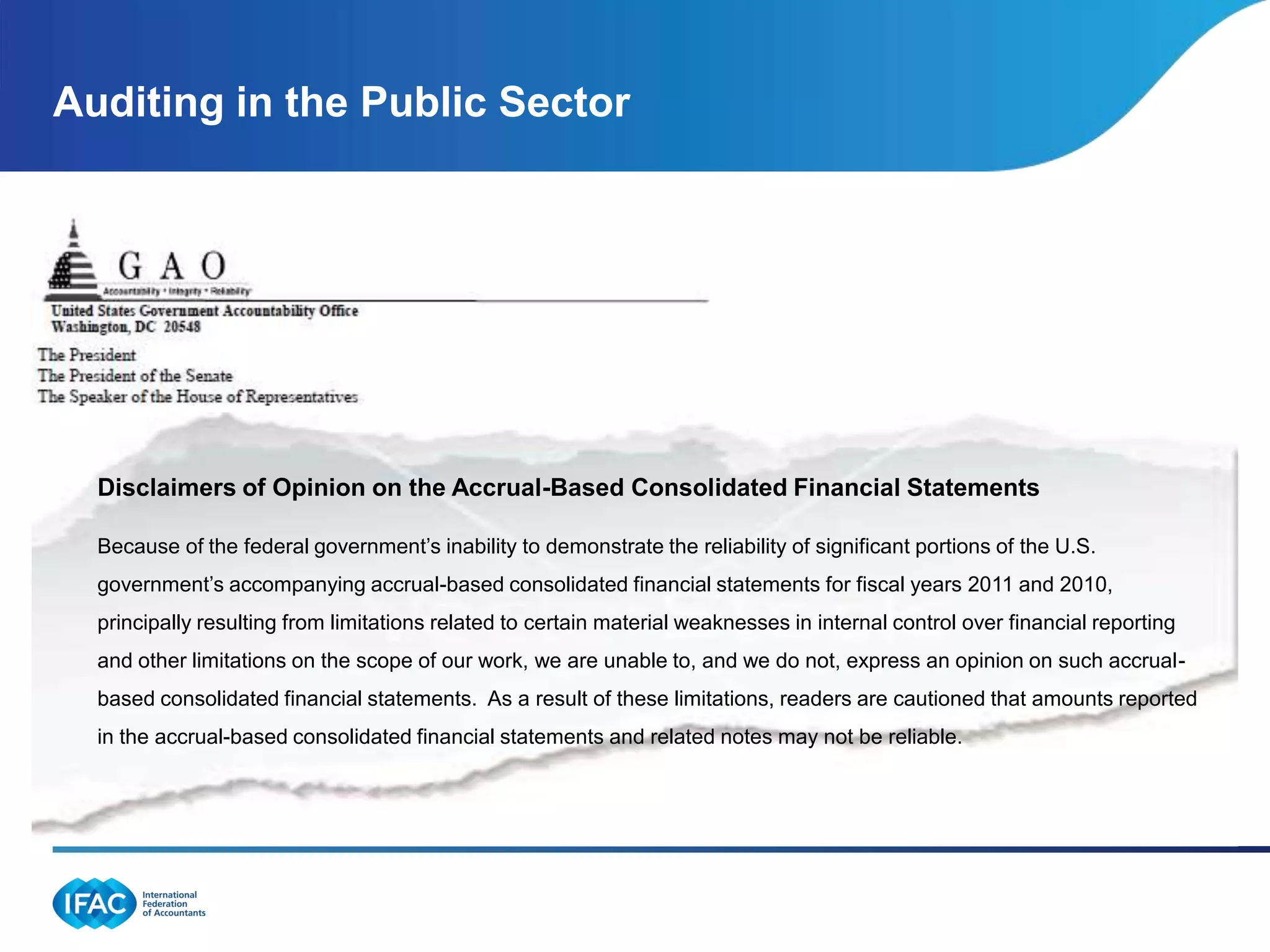
  Disclaimers of Opinion on the Accrual-Based Consolidated Financial Statements

  Because of the federal government’s inability to demonstrate the reliability of significant portions of the U.S.
  government’s accompanying accrual-based consolidated financial statements for fiscal years 2011 and 2010,
  principally resulting from limitations related to certain material weaknesses in internal control over financial reporting
  and other limitations on the scope of our work, we are unable to, and we do not, express an opinion on such accrual-
  based consolidated financial statements. As a result of these limitations, readers are cautioned that amounts reported
  in the accrual-based consolidated financial statements and related notes may not be reliable.
Auditing in the Public Sector


The material weaknesses that contributed to our disclaimer of opinion on the accrual-based
consolidated financial statements were the federal government’s inability to
• satisfactorily determine that property, plant, and equipment and inventories and related property, primarily held by
  DOD, were properly reported in the accrual-based consolidated financial statements;

• reasonably estimate or adequately support amounts reported for certain liabilities, such as environmental and
  disposal liabilities, or determine whether commitments and contingencies were complete and properly reported;

• support significant portions of the reported total net cost of operations, most notably related to DOD, and adequately
  reconcile disbursement activity at certain federal entities;

• adequately account for and reconcile intragovernmental activity and balances between federal entities; and

• ensure that the federal government’s accrual-based consolidated financial statements were (1)
 consistent with the underlying audited entities’ financial statements, (2) properly balanced, and (3) in
 conformity with GAAP.
Auditing in the Public Sector


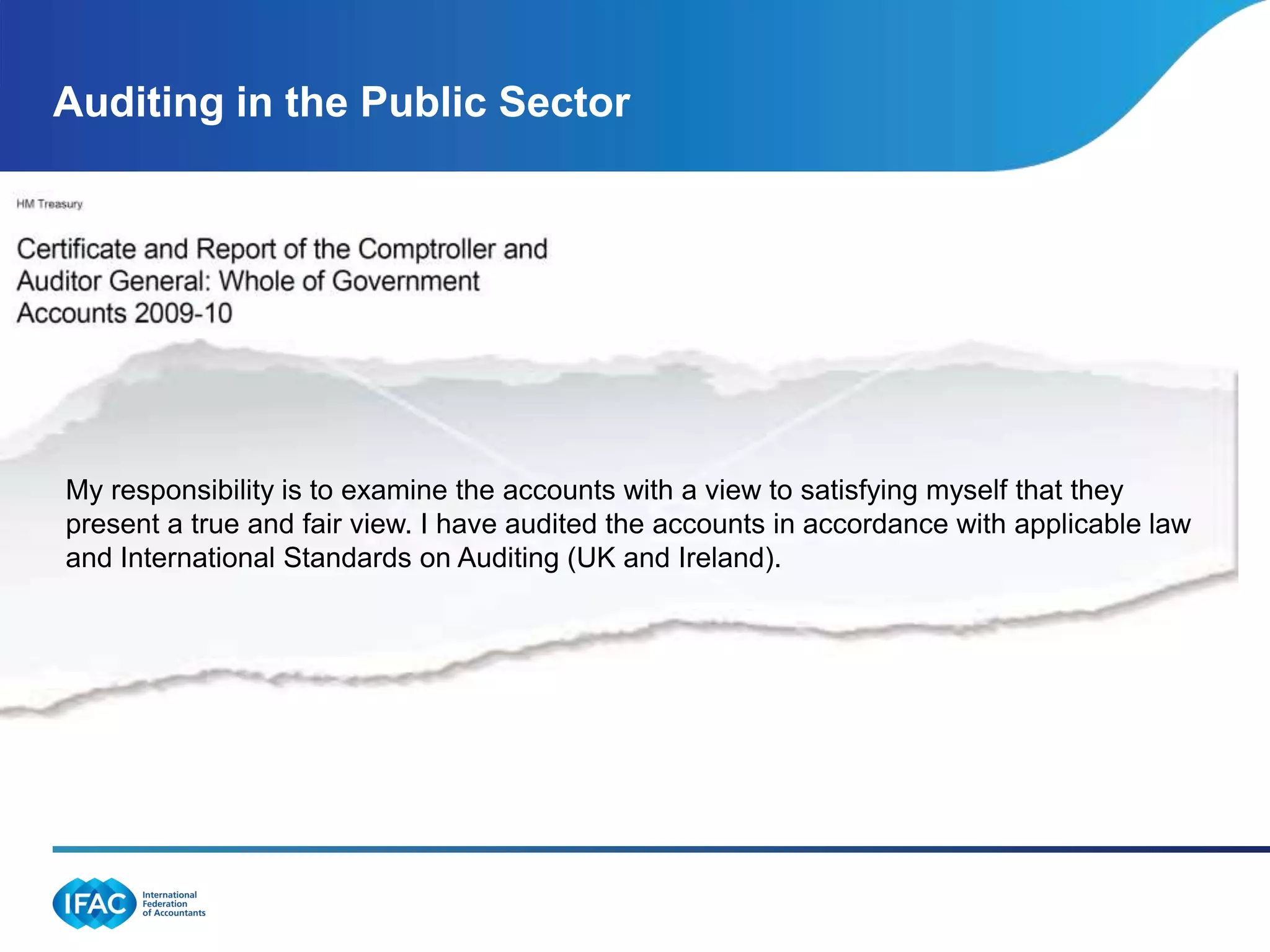
My responsibility is to examine the accounts with a view to satisfying myself that they
present a true and fair view. I have audited the accounts in accordance with applicable law
and International Standards on Auditing (UK and Ireland).
Auditing in the Public Sector


    Basis for qualification on accounts
   • Qualification arising from disagreement relating to inconsistent application of accounting policies

   • Qualification arising from limitation in audit scope due to lack of evidence supporting the
     completeness of the elimination of intra-government transactions and balances

   • Qualification arising from disagreement in the accounting for 3G licences

   • Qualification arising from disagreement and limitation in audit scope from underlying
     statutory audits of bodies falling within the Accounts
Auditing in the Public Sector


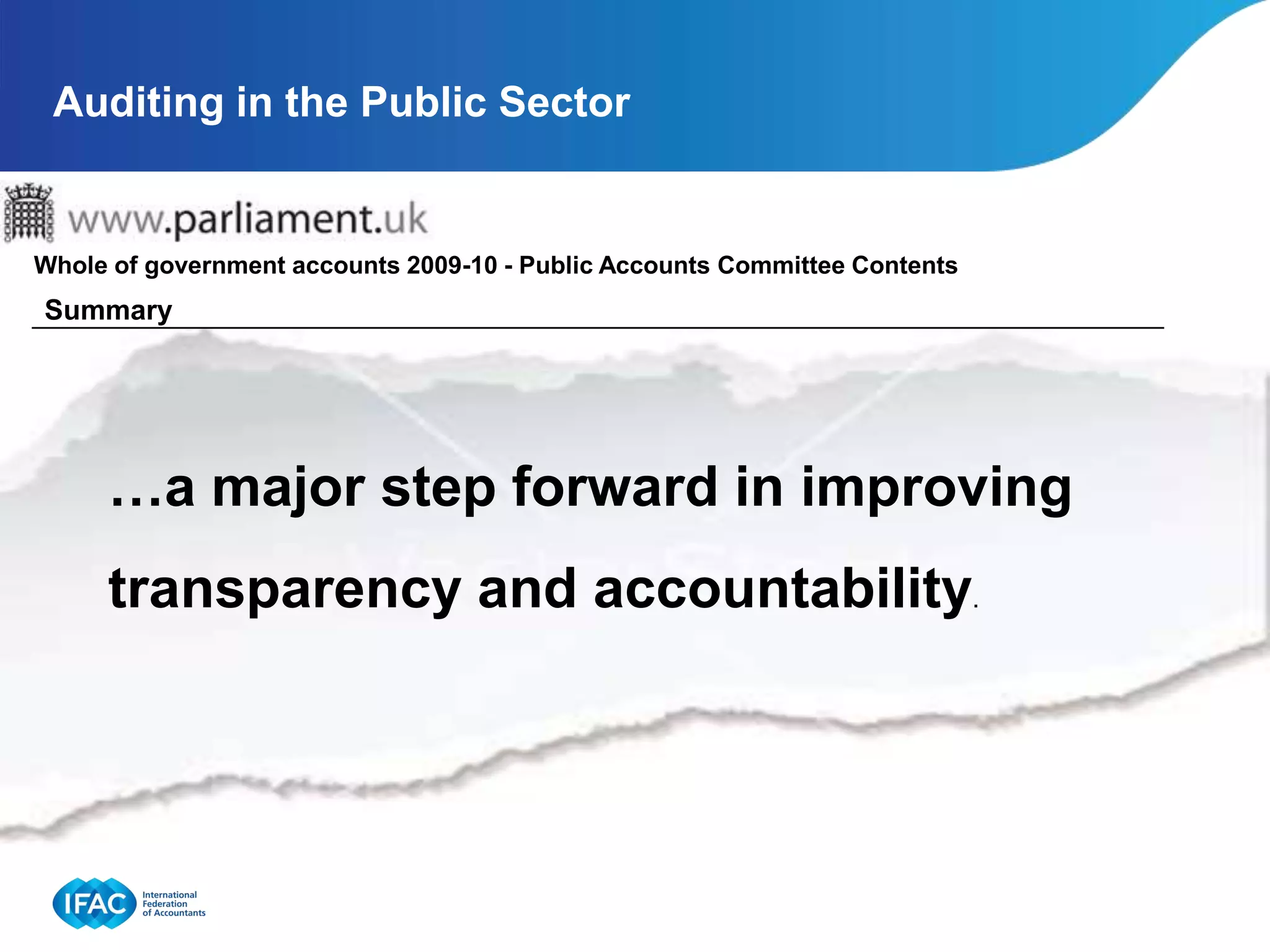
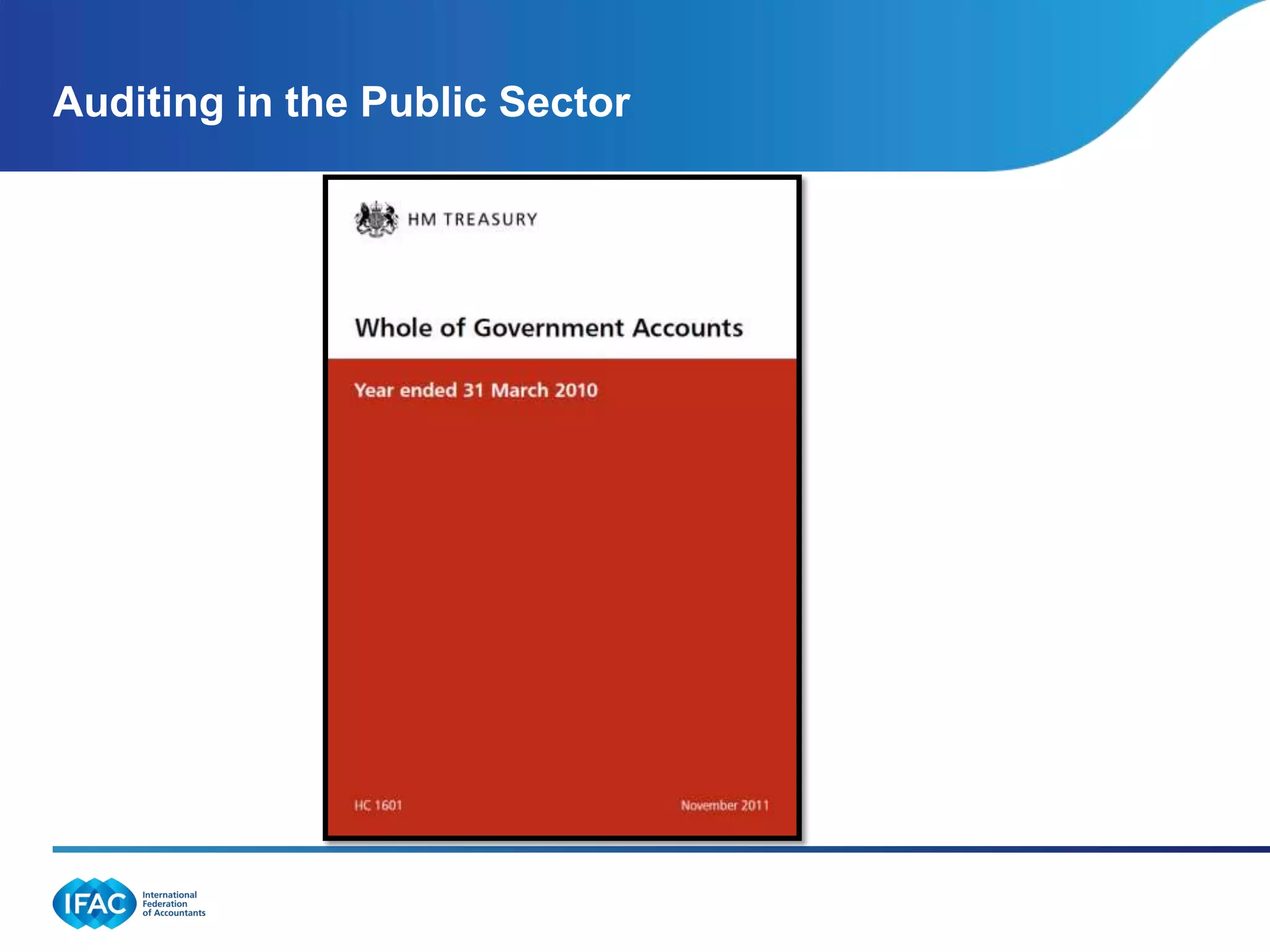
Whole of government accounts 2009-10 - Public Accounts Committee Contents
Summary


     …a major step forward in improving
     transparency and accountability.
Auditing in the Public Sector


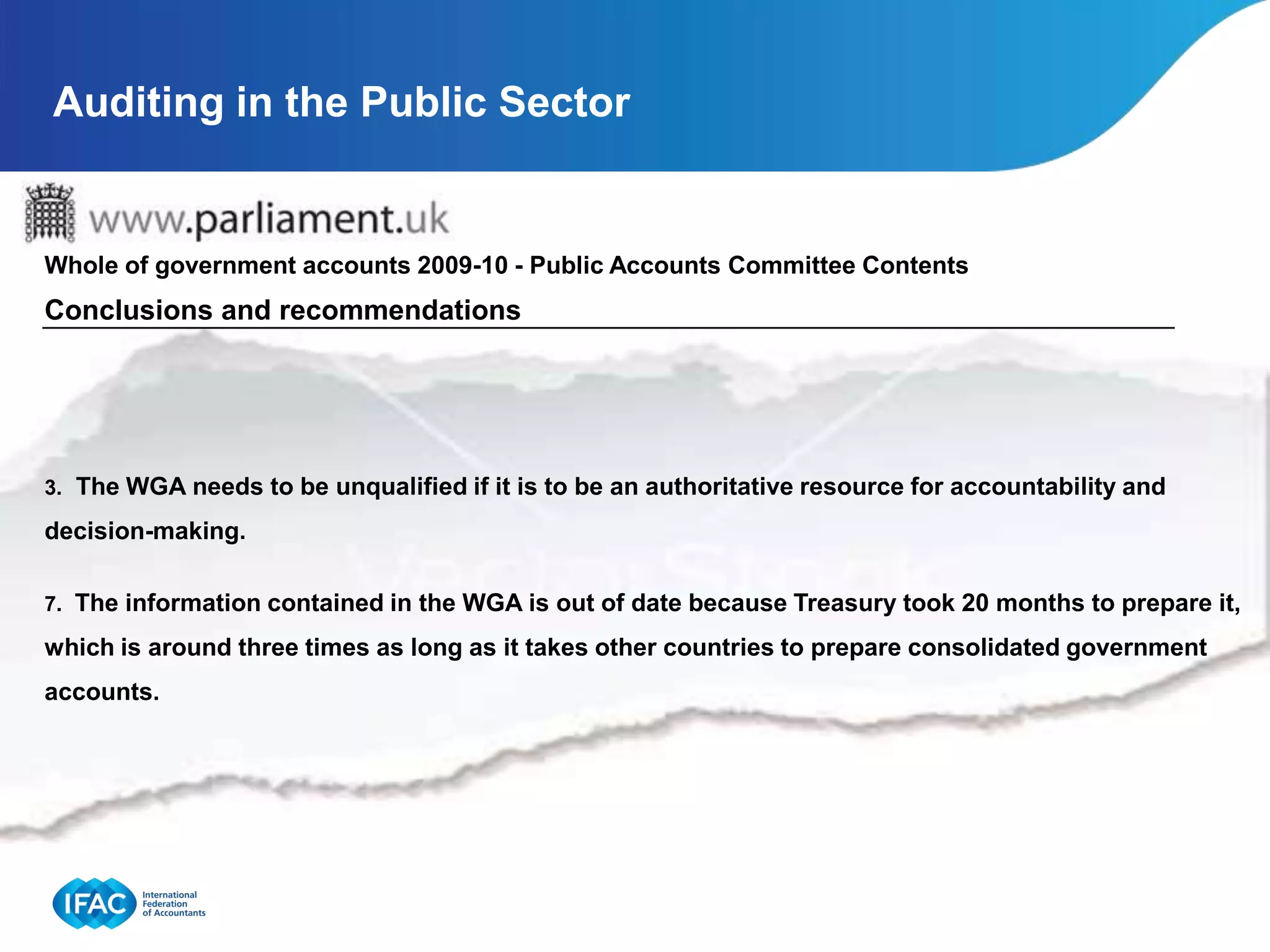
Whole of government accounts 2009-10 - Public Accounts Committee Contents
Conclusions and recommendations


3. The WGA needs to be unqualified if it is to be an authoritative resource for accountability and

decision-making.

7. The information contained in the WGA is out of date because Treasury took 20 months to prepare it,

which is around three times as long as it takes other countries to prepare consolidated government
accounts.
Auditing in the Public Sector


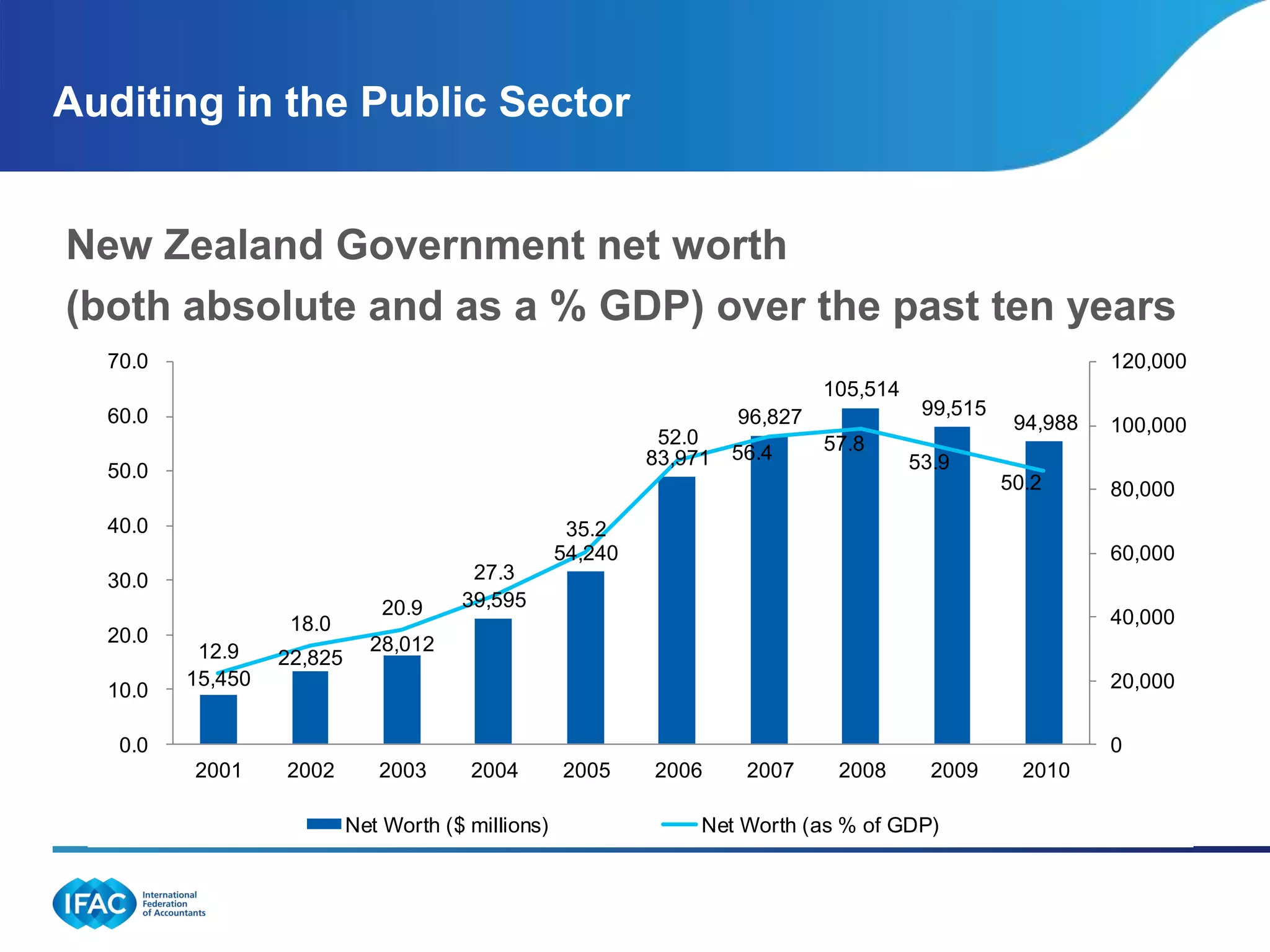
New Zealand Government net worth
(both absolute and as a % GDP) over the past ten years
  70.0                                                                                                       120,000
                                                                               105,514
  60.0                                                                96,827              99,515
                                                                                                    94,988   100,000
                                                              52.0             57.8
                                                             83,971   56.4               53.9
  50.0
                                                                                                   50.2      80,000
  40.0                                               35.2
                                                    54,240                                                   60,000
  30.0                                  27.3
                              20.9     39,595
                   18.0                                                                                      40,000
  20.0                       28,012
          12.9    22,825
         15,450                                                                                              20,000
  10.0

   0.0                                                                                                       0
         2001     2002        2003      2004        2005     2006      2007     2008       2009      2010

                           Net Worth ($ millions)                 Net Worth (as % of GDP)
Auditing in the Public Sector
www.ifac.org

Auditing in the Public Sector

  • 1.
    Auditing in thePublic Sector Ian Ball CEO International Federation of Accountants European Study Day 10 February, 2012 Brussels, Belgium
  • 2.
    Auditing in thePublic Sector IFAC Comments on European Commission Proposed Legislation The International Federation of Accountants (IFAC), the global organization for the accountancy profession with members and to continually improve audit quality, enhance the role of audit, and IFAC supports initiatives associates in 127 countries, today commented on the European Commission (EC)’s proposed legislation, issued this week. safeguard auditor independence. As such, IFAC supports the following measures proposed by the EC: IFAC supports initiatives to continually improve audit quality, enhance the role of audit, and safeguard auditor independence, and believes that innovation and evolution are essential for this vital service to • Compliance with International Standards on Audit (ISAs) maintain its relevance and meet the needs of investors and other stakeholders. As such, IFAC supports • measures proposed by the EC, which we believe are consistent with views widely the followingStrengthening of audit committees expressed in response to the Green Paper: • Enhanced dialogue between auditors and regulators • Greater transparency in auditor selection • Greater cross-border mobility for auditors • Enhanced auditor reporting
  • 3.
    Auditing in thePublic Sector IFAC Comments on European Commission Proposed Legislation The International Federation of Accountants (IFAC), the global organization for the accountancy profession with members and associates in 127because there iscommented on evidence that they will have a IFAC does not support several proposals, countries, today not sufficient the European Commission (EC)’son auditorlegislation, issued this week. positive impact proposed independence and audit quality, and that benefits will outweigh risks and IFAC supports initiatives to continually improve audit quality, enhance the role of audit, and safeguard costs. Further research should be conducted to support their feasibility and impact. auditor independence, and believes that innovation and evolution are essential for this vital service to • Mandatory firm rotation maintain its relevance and meet the needs of investors and other stakeholders. As such, IFAC supports the following measures proposed by the EC, which we believe are consistent with views widely • Prohibition of non-audit services expressed in response to the Green Paper: Also, IFAC is of the view that the proposed legislation, if passed, could have a negative impact on the audit profession and professional accountancy organizations (PAOs). In particular: . • PAOs’ role in audit oversight arrangements • Extraterritorial impacts
  • 4.
    Auditing in thePublic Sector 2.1 1.1 Introduction …It is important to stress that auditors have an important role to play and are entrusted by law to . conduct statutory audits. …The independence of auditors should thus be the bedrock of the audit environment. It is time to probe into the true fulfillment of this societal mandate.
  • 5.
    Auditing in thePublic Sector 2.1 IFAC believes that there is a need to more effectively set out the societal role of the audit. Ultimately, the value of the audit is dependent upon the quality and usefulness of . the audited financial statements.
  • 6.
    Auditing in thePublic Sector “1.1 In relation to the need for high-quality and timely accrual-based financial reporting, IFAC recommends that the G-20 actively encourages and facilitates the adoption of accrual-based accounting by governments and public sector institutions.”
  • 7.
    Auditing in thePublic Sector “IFAC is concerned that the standards and regulations governing sovereign issuers are not of sufficient quality to protect investors and ensure the stability of capital markets…” “…looking at potential measures that could improve the quality and reliability of information disclosed by sovereign issuers and therefore increase the protection of investors and improve the stability of capital markets.”
  • 8.
    Auditing in thePublic Sector Government issued financial instruments are a very important part of the financial market 2010 NYSE • All equity trades $218 trillion • Mortgage backed securities $104 trillion • Mutual funds $3 trillion • US Government securities $1,100 trillion
  • 9.
    Auditing in thePublic Sector Latin American sovereign debt Number of years in default, 1824-2004 Latest period of default 0 20 40 60 80 100 120 Ecuador 116.0 1992-90 Mexico 85.0 1984-97 Peru 75.0 1995-97 Venezuela 65.0 2001-04 Argentina 50.0 1983-90 Chile 45.0 1983-94 Brazil 45.0 1986-97 Bolivia 40.0 2003 Uruguay 25.0
  • 10.
    Auditing in thePublic Sector Countries with Sovereign Restructuring between 1990-2005 (Agreement Date)1 Algeria (07/1996) Pakistan (12/1999) Argentina (04/1993, 04/2005) Panama (05/1996) Brazil (04/1994) Peru (03/1997) Bulgaria (06/1994) Philippines (12/1992) Chile (12/1990) Poland (10/1994) Cote d'Ivoire (03/1998) Russia (08/2000) Croatia (07/1996) South Africa (09/1993) Dominican Rep.(08/1994, 05/2005) Ukraine (04/2000) Ecuador (02/1995, 08/2000) Uruguay (05/2003) Mexico (05/1990) Venezuela (12/1990) Morocco (09/1990) Vietnam (12/1997) Nigeria (12/1991) Serbia & Montenegro (07/2004) Source: Cruces J and Trebesch C, Sovereign Defaults: The Price of Haircuts (Preliminary Paper) December 2010
  • 11.
    Auditing in thePublic Sector
  • 12.
    Auditing in thePublic Sector
  • 13.
    Auditing in thePublic Sector “1b. Member States shall move to adopt International Public Sector Accounting Standards within three years of this Directive coming into force.…”
  • 14.
    Auditing in thePublic Sector Accounting Country Private Sector Public Sector Standard Set Standard Set UK IFRS IASB UK adopted IFRSs IASB / IPSAS is second tier France IFRS IASB Accrual standards Public Sector Accounting Standards for the public sector based on French Council private sector accounting standards. IPSASs are references Germany IFRS IASB Cash accounting Government Italy IFRS IASB Cash accounting Government Spain IFRS IASB The Spanish Ministry of Economy IPSASB and Finance is implementing accrual basis IPSASs Ireland IFRS IASB Cash accounting Government IFRS IASB Adopts full accrual accounting in IPSASB Estonia accordance with IPSASs
  • 15.
    Auditing in thePublic Sector CHAPTER II ACCOUNTING AND STATISTICS Article 3 2.1 1. As concerns national systems of public accounting, Member States shall have in place . public accounting systems comprehensively and consistently covering all sub-sectors of general government and containing the information needed to generate accrual data with a view to preparing data based on the ESA 95 standard. Those public accounting systems shall be subject to internal control and independent audits.
  • 16.
    Auditing in thePublic Sector Audit Country Private Sector Public Sector (Per EU proposed audit reforms, and as endorsed by the EC) Standard Set Standard Set UK ISAs IAASB ISAs (UK & Ireland) UK APB France ISAs IAASB ISAs IAASB Germany ISAs IAASB German Federal Court of Government Auditors auditing standards Spain ISAs IAASB National Regulation based on Government INTOSAI Standards Ireland ISAs IAASB ISAs (UK & Ireland) UK APB Estonia ISAs IAASB National standards based on Government INTOSAI Auditing Standards, and European Implementing Guidelines
  • 17.
    Auditing in thePublic Sector Disclaimers of Opinion on the Accrual-Based Consolidated Financial Statements Because of the federal government’s inability to demonstrate the reliability of significant portions of the U.S. government’s accompanying accrual-based consolidated financial statements for fiscal years 2011 and 2010, principally resulting from limitations related to certain material weaknesses in internal control over financial reporting and other limitations on the scope of our work, we are unable to, and we do not, express an opinion on such accrual- based consolidated financial statements. As a result of these limitations, readers are cautioned that amounts reported in the accrual-based consolidated financial statements and related notes may not be reliable.
  • 18.
    Auditing in thePublic Sector The material weaknesses that contributed to our disclaimer of opinion on the accrual-based consolidated financial statements were the federal government’s inability to • satisfactorily determine that property, plant, and equipment and inventories and related property, primarily held by DOD, were properly reported in the accrual-based consolidated financial statements; • reasonably estimate or adequately support amounts reported for certain liabilities, such as environmental and disposal liabilities, or determine whether commitments and contingencies were complete and properly reported; • support significant portions of the reported total net cost of operations, most notably related to DOD, and adequately reconcile disbursement activity at certain federal entities; • adequately account for and reconcile intragovernmental activity and balances between federal entities; and • ensure that the federal government’s accrual-based consolidated financial statements were (1) consistent with the underlying audited entities’ financial statements, (2) properly balanced, and (3) in conformity with GAAP.
  • 19.
    Auditing in thePublic Sector My responsibility is to examine the accounts with a view to satisfying myself that they present a true and fair view. I have audited the accounts in accordance with applicable law and International Standards on Auditing (UK and Ireland).
  • 20.
    Auditing in thePublic Sector Basis for qualification on accounts • Qualification arising from disagreement relating to inconsistent application of accounting policies • Qualification arising from limitation in audit scope due to lack of evidence supporting the completeness of the elimination of intra-government transactions and balances • Qualification arising from disagreement in the accounting for 3G licences • Qualification arising from disagreement and limitation in audit scope from underlying statutory audits of bodies falling within the Accounts
  • 21.
    Auditing in thePublic Sector Whole of government accounts 2009-10 - Public Accounts Committee Contents Summary …a major step forward in improving transparency and accountability.
  • 22.
    Auditing in thePublic Sector Whole of government accounts 2009-10 - Public Accounts Committee Contents Conclusions and recommendations 3. The WGA needs to be unqualified if it is to be an authoritative resource for accountability and decision-making. 7. The information contained in the WGA is out of date because Treasury took 20 months to prepare it, which is around three times as long as it takes other countries to prepare consolidated government accounts.
  • 23.
    Auditing in thePublic Sector
  • 24.
    Auditing in thePublic Sector
  • 25.
    Auditing in thePublic Sector
  • 26.
    Auditing in thePublic Sector
  • 27.
    Auditing in thePublic Sector New Zealand Government net worth (both absolute and as a % GDP) over the past ten years 70.0 120,000 105,514 60.0 96,827 99,515 94,988 100,000 52.0 57.8 83,971 56.4 53.9 50.0 50.2 80,000 40.0 35.2 54,240 60,000 30.0 27.3 20.9 39,595 18.0 40,000 20.0 28,012 12.9 22,825 15,450 20,000 10.0 0.0 0 2001 2002 2003 2004 2005 2006 2007 2008 2009 2010 Net Worth ($ millions) Net Worth (as % of GDP)
  • 28.
    Auditing in thePublic Sector
  • 29.
    Auditing in thePublic Sector
  • 30.
    Auditing in thePublic Sector
  • 31.
    Auditing in thePublic Sector
  • 32.