

Why accruals based financial 
reporting? 
Page 1 
Andreas Bergmann, Chair IPSASB 
29 September 2014 
ADB Regional Workshop on 
Public Sector Accounting
Page 2 
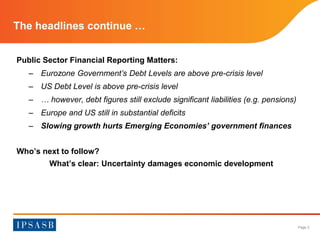
The headlines continue … 
Public Sector Financial Reporting Matters: 
– Eurozone Government’s Debt Levels are above pre-crisis level 
– US Debt Level is above pre-crisis level 
– … however, debt figures still exclude significant liabilities (e.g. pensions) 
– Europe and US still in substantial deficits 
– Slowing growth hurts Emerging Economies’ government finances 
Who’s next to follow? 
What’s clear: Uncertainty damages economic development
Page 3 
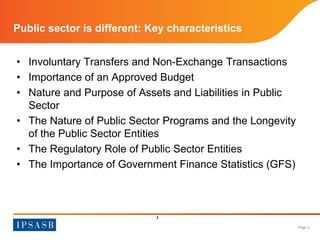
Public sector is different: Key characteristics 
• Involuntary Transfers and Non-Exchange Transactions 
• Importance of an Approved Budget 
• Nature and Purpose of Assets and Liabilities in Public 
Sector 
• The Nature of Public Sector Programs and the Longevity 
of the Public Sector Entities 
• The Regulatory Role of Public Sector Entities 
• The Importance of Government Finance Statistics (GFS) 
3
Page 4 
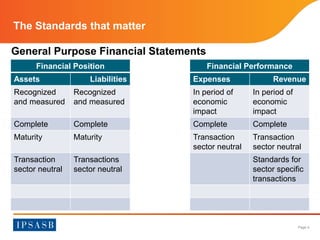
The Standards that matter 
Financial Position Financial Performance 
Assets Liabilities Expenses Revenue 
Recognized 
Recognized 
and measured 
and measured 
In period of 
economic 
impact 
In period of 
economic 
impact 
Complete Complete Complete Complete 
Maturity Maturity Transaction 
sector neutral 
Transaction 
sector neutral 
Transaction 
sector neutral 
Transactions 
sector neutral 
Standards for 
sector specific 
transactions 
General Purpose Financial Statements
Page 5 
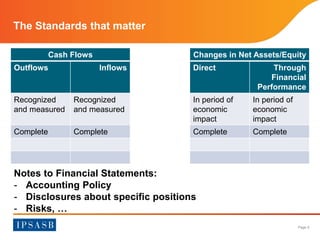
The Standards that matter 
Cash Flows Changes in Net Assets/Equity 
Outflows Inflows Direct Through 
Financial 
Performance 
Recognized 
and measured 
Recognized 
and measured 
In period of 
economic 
impact 
In period of 
economic 
impact 
Complete Complete Complete Complete 
Notes to Financial Statements: 
- Accounting Policy 
- Disclosures about specific positions 
- Risks, …
Page 6 
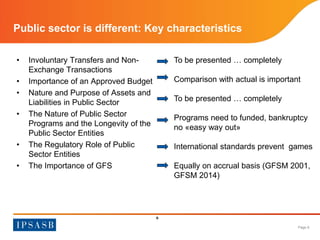
Public sector is different: Key characteristics 
• Involuntary Transfers and Non- 
Exchange Transactions 
• Importance of an Approved Budget 
• Nature and Purpose of Assets and 
Liabilities in Public Sector 
• The Nature of Public Sector 
Programs and the Longevity of the 
Public Sector Entities 
• The Regulatory Role of Public 
Sector Entities 
• The Importance of GFS 
6 
To be presented … completely 
Comparison with actual is important 
To be presented … completely 
Programs need to funded, bankruptcy 
no «easy way out» 
International standards prevent games 
Equally on accrual basis (GFSM 2001, 
GFSM 2014)
Page 7 
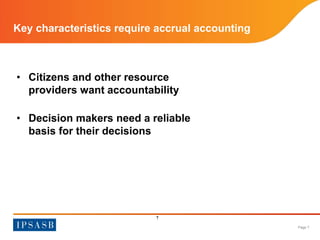
Key characteristics require accrual accounting 
• Citizens and other resource 
providers want accountability 
• Decision makers need a reliable 
basis for their decisions 
7
Page 8 
Common obstacles – the reasons “why not” 
• Budgets on cash and accounting on accruals 
– Quite common 
– Possible, but requires some reconciliation 
• GFS still based on cash-based GFS86 … well, needs to 
be changed since 2001 … 
• Obstruction by certain line ministries, often Defense 
– Reassured that secretive details are not presented (aggregation) 
• Cost for IT, training 
– But usually around 0.01% of budget incl IT … and this spread 
over approx. 5 – 7 years 
• Duration and complexity of project
Page 9 
Benefits 
• Better balance sheet management  lower debt, better 
interaction with fiscal rules 
– Better asset management  “finding assets”, higher efficiency 
– Better liabilities management  lower interest rates, lower debt 
• Acceptance on financial markets  lower interest rate 
• Less likely economic shocks  lower risk, lower interest 
rate
Page 10 
Benefits 
• IMF-FAD addressing issue of transparency in a 
comprehensive paper 
– Fiscal transparency does matter 
– Harmonization of Accounting and Statistics needed 
– ROSC initiative should be followed up 
• Eurostat Report 
– Endorsement mechanism as expected 
– Alignment with GFS is an emphasis 
– Some caution the risk of dual standards (EPSAS) and of a backward 
step for those on IFRS/IPSAS (e.g. UK, Spain, Austria, Baltic countries) 
• G20 Finance Ministers press release February 2013 
– Strengthening government balance sheet 
– Looking at governmental financial reporting
Page 11 
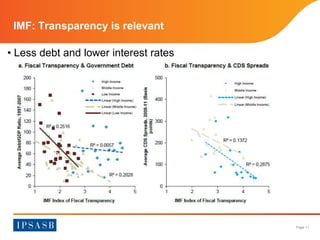
IMF: Transparency is relevant 
• Less debt and lower interest rates
Page 12 
IMF: Transparency is relevant 
• Fiskal Risk: 
– Government financial reporting responsible for increase of 
government debt during financial crisis 
• 23% of increase in debt due to incomplete information 
• 37% of increase in debt due to underestimating likelyhood and 
impact of economic shocks 
– Critical are off-balance sheet items, such as 
• State owned enterprises (if there is no consolidation …) 
• PPP (if there’s no accounting for them) 
– Critical are also financial statements without impairment testing 
and/or current value measurement
Page 13 
Transparency is relevant 
• Significant correlation between PEFA indicator 
(PI25) and overall PEFA performance (Vany, 
2010) 
• Main advantages: 
– Financial planning 
– Financial control, debt, investment and 
liquidity management 
– Reliable base for audit
But implementation cost is substantial 
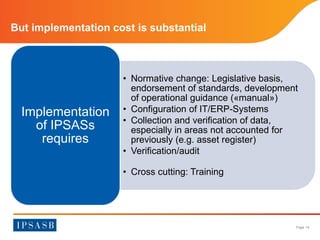
• Normative change: Legislative basis, 
endorsement of standards, development 
of operational guidance («manual») 
• Configuration of IT/ERP-Systems 
• Collection and verification of data, 
especially in areas not accounted for 
previously (e.g. asset register) 
• Verification/audit 
Page 14 
• Cross cutting: Training 
Implementation 
of IPSASs 
requires
But implementation cost is substantial 
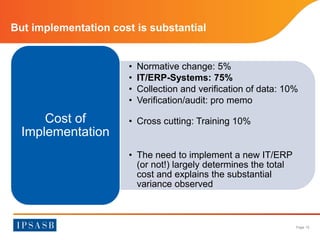
• Normative change: 5% 
• IT/ERP-Systems: 75% 
• Collection and verification of data: 10% 
• Verification/audit: pro memo 
Page 15 
• Cross cutting: Training 10% 
• The need to implement a new IT/ERP 
(or not!) largely determines the total 
cost and explains the substantial 
variance observed 
Cost of 
Implementation
Page 16 
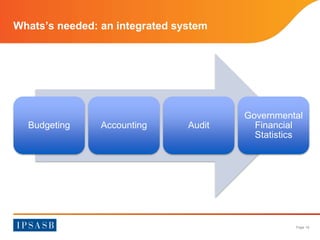
Whats’s needed: an integrated system 
Budgeting Accounting Audit 
Governmental 
Financial 
Statistics
Page 17 
But return is easily higher than cost: 
The Swiss Experience 
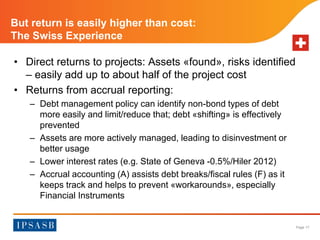
• Direct returns to projects: Assets «found», risks identified 
– easily add up to about half of the project cost 
• Returns from accrual reporting: 
– Debt management policy can identify non-bond types of debt 
more easily and limit/reduce that; debt «shifting» is effectively 
prevented 
– Assets are more actively managed, leading to disinvestment or 
better usage 
– Lower interest rates (e.g. State of Geneva -0.5%/Hiler 2012) 
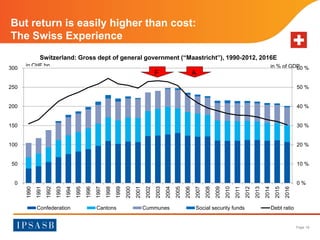
– Accrual accounting (A) assists debt breaks/fiscal rules (F) as it 
keeps track and helps to prevent «workarounds», especially 
Financial Instruments
But return is easily higher than cost: 
The Swiss Experience 
in CHF bn in % of GDP 
60 % 
50 % 
40 % 
30 % 
20 % 
10 % 
0 % 
Page 18 
300 
250 
200 
150 
100 
50 
0 
Switzerland: Gross dept of general government (“Maastricht”), 1990-2012, 2016E 
F A 
1990 
1991 
1992 
1993 
1994 
1995 
1996 
1997 
1998 
1999 
2000 
2001 
2002 
2003 
2004 
2005 
2006 
2007 
2008 
2009 
2010 
2011 
2012 
2013 
2014 
2015 
2016 
Confederation Cantons Cummunes Social security funds Debt ratio
Page 19 
But return is easily higher than cost: 
The Chilean Experience 
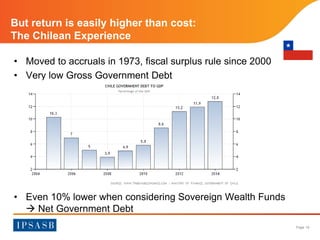
• Moved to accruals in 1973, fiscal surplus rule since 2000 
• Very low Gross Government Debt 
• Even 10% lower when considering Sovereign Wealth Funds 
 Net Government Debt
Page 20 
But return is easily higher than cost: 
The Chilean Experience 
• Exemplary management of PPPs 
– Management of contracting by central PPP competence 
center 
– All airports and many roads are financed through PPPs 
– Liabilities (if there are any) on balance sheet
Page 21 
Conclusion 
• Standards based accrual accounting of governments is 
essential for economic growth and prosperity 
• IPSASs are a full suite of standards, designed for the 
public sector, set by an independent, international 
standard setter 
• Time and cost required for implementation are 
substantial – but economic returns are much higher
Page 22 
Questions Discussion & Further Information 
• Visit our webpage http://www.ipsasb.org/ 
• Or contact us by e-mail : 
Chair IPSASB: andreasbergmann@ifac.org 
Technical Director: stepheniefox@ifac.org

Why Accruals Based Financial Reporting

  • 1.
    Why accruals basedfinancial reporting? Page 1 Andreas Bergmann, Chair IPSASB 29 September 2014 ADB Regional Workshop on Public Sector Accounting
  • 2.
    Page 2 Theheadlines continue … Public Sector Financial Reporting Matters: – Eurozone Government’s Debt Levels are above pre-crisis level – US Debt Level is above pre-crisis level – … however, debt figures still exclude significant liabilities (e.g. pensions) – Europe and US still in substantial deficits – Slowing growth hurts Emerging Economies’ government finances Who’s next to follow? What’s clear: Uncertainty damages economic development
  • 3.
    Page 3 Publicsector is different: Key characteristics • Involuntary Transfers and Non-Exchange Transactions • Importance of an Approved Budget • Nature and Purpose of Assets and Liabilities in Public Sector • The Nature of Public Sector Programs and the Longevity of the Public Sector Entities • The Regulatory Role of Public Sector Entities • The Importance of Government Finance Statistics (GFS) 3
  • 4.
    Page 4 TheStandards that matter Financial Position Financial Performance Assets Liabilities Expenses Revenue Recognized Recognized and measured and measured In period of economic impact In period of economic impact Complete Complete Complete Complete Maturity Maturity Transaction sector neutral Transaction sector neutral Transaction sector neutral Transactions sector neutral Standards for sector specific transactions General Purpose Financial Statements
  • 5.
    Page 5 TheStandards that matter Cash Flows Changes in Net Assets/Equity Outflows Inflows Direct Through Financial Performance Recognized and measured Recognized and measured In period of economic impact In period of economic impact Complete Complete Complete Complete Notes to Financial Statements: - Accounting Policy - Disclosures about specific positions - Risks, …
  • 6.
    Page 6 Publicsector is different: Key characteristics • Involuntary Transfers and Non- Exchange Transactions • Importance of an Approved Budget • Nature and Purpose of Assets and Liabilities in Public Sector • The Nature of Public Sector Programs and the Longevity of the Public Sector Entities • The Regulatory Role of Public Sector Entities • The Importance of GFS 6 To be presented … completely Comparison with actual is important To be presented … completely Programs need to funded, bankruptcy no «easy way out» International standards prevent games Equally on accrual basis (GFSM 2001, GFSM 2014)
  • 7.
    Page 7 Keycharacteristics require accrual accounting • Citizens and other resource providers want accountability • Decision makers need a reliable basis for their decisions 7
  • 8.
    Page 8 Commonobstacles – the reasons “why not” • Budgets on cash and accounting on accruals – Quite common – Possible, but requires some reconciliation • GFS still based on cash-based GFS86 … well, needs to be changed since 2001 … • Obstruction by certain line ministries, often Defense – Reassured that secretive details are not presented (aggregation) • Cost for IT, training – But usually around 0.01% of budget incl IT … and this spread over approx. 5 – 7 years • Duration and complexity of project
  • 9.
    Page 9 Benefits • Better balance sheet management  lower debt, better interaction with fiscal rules – Better asset management  “finding assets”, higher efficiency – Better liabilities management  lower interest rates, lower debt • Acceptance on financial markets  lower interest rate • Less likely economic shocks  lower risk, lower interest rate
  • 10.
    Page 10 Benefits • IMF-FAD addressing issue of transparency in a comprehensive paper – Fiscal transparency does matter – Harmonization of Accounting and Statistics needed – ROSC initiative should be followed up • Eurostat Report – Endorsement mechanism as expected – Alignment with GFS is an emphasis – Some caution the risk of dual standards (EPSAS) and of a backward step for those on IFRS/IPSAS (e.g. UK, Spain, Austria, Baltic countries) • G20 Finance Ministers press release February 2013 – Strengthening government balance sheet – Looking at governmental financial reporting
  • 11.
    Page 11 IMF:Transparency is relevant • Less debt and lower interest rates
  • 12.
    Page 12 IMF:Transparency is relevant • Fiskal Risk: – Government financial reporting responsible for increase of government debt during financial crisis • 23% of increase in debt due to incomplete information • 37% of increase in debt due to underestimating likelyhood and impact of economic shocks – Critical are off-balance sheet items, such as • State owned enterprises (if there is no consolidation …) • PPP (if there’s no accounting for them) – Critical are also financial statements without impairment testing and/or current value measurement
  • 13.
    Page 13 Transparencyis relevant • Significant correlation between PEFA indicator (PI25) and overall PEFA performance (Vany, 2010) • Main advantages: – Financial planning – Financial control, debt, investment and liquidity management – Reliable base for audit
  • 14.
    But implementation costis substantial • Normative change: Legislative basis, endorsement of standards, development of operational guidance («manual») • Configuration of IT/ERP-Systems • Collection and verification of data, especially in areas not accounted for previously (e.g. asset register) • Verification/audit Page 14 • Cross cutting: Training Implementation of IPSASs requires
  • 15.
    But implementation costis substantial • Normative change: 5% • IT/ERP-Systems: 75% • Collection and verification of data: 10% • Verification/audit: pro memo Page 15 • Cross cutting: Training 10% • The need to implement a new IT/ERP (or not!) largely determines the total cost and explains the substantial variance observed Cost of Implementation
  • 16.
    Page 16 Whats’sneeded: an integrated system Budgeting Accounting Audit Governmental Financial Statistics
  • 17.
    Page 17 Butreturn is easily higher than cost: The Swiss Experience • Direct returns to projects: Assets «found», risks identified – easily add up to about half of the project cost • Returns from accrual reporting: – Debt management policy can identify non-bond types of debt more easily and limit/reduce that; debt «shifting» is effectively prevented – Assets are more actively managed, leading to disinvestment or better usage – Lower interest rates (e.g. State of Geneva -0.5%/Hiler 2012) – Accrual accounting (A) assists debt breaks/fiscal rules (F) as it keeps track and helps to prevent «workarounds», especially Financial Instruments
  • 18.
    But return iseasily higher than cost: The Swiss Experience in CHF bn in % of GDP 60 % 50 % 40 % 30 % 20 % 10 % 0 % Page 18 300 250 200 150 100 50 0 Switzerland: Gross dept of general government (“Maastricht”), 1990-2012, 2016E F A 1990 1991 1992 1993 1994 1995 1996 1997 1998 1999 2000 2001 2002 2003 2004 2005 2006 2007 2008 2009 2010 2011 2012 2013 2014 2015 2016 Confederation Cantons Cummunes Social security funds Debt ratio
  • 19.
    Page 19 Butreturn is easily higher than cost: The Chilean Experience • Moved to accruals in 1973, fiscal surplus rule since 2000 • Very low Gross Government Debt • Even 10% lower when considering Sovereign Wealth Funds  Net Government Debt
  • 20.
    Page 20 Butreturn is easily higher than cost: The Chilean Experience • Exemplary management of PPPs – Management of contracting by central PPP competence center – All airports and many roads are financed through PPPs – Liabilities (if there are any) on balance sheet
  • 21.
    Page 21 Conclusion • Standards based accrual accounting of governments is essential for economic growth and prosperity • IPSASs are a full suite of standards, designed for the public sector, set by an independent, international standard setter • Time and cost required for implementation are substantial – but economic returns are much higher
  • 22.
    Page 22 QuestionsDiscussion & Further Information • Visit our webpage http://www.ipsasb.org/ • Or contact us by e-mail : Chair IPSASB: andreasbergmann@ifac.org Technical Director: stepheniefox@ifac.org