HOME
       ABOUT
       ADMISSIONS
       ACADEMICS
       ATHLETICS
       STUDENT LIFE

Tuesday July 17, 2012


       Undergraduate
       |
       Graduate
       |
       International

Internal Audit
Internal Audit Menu Internal Audit Home Internal Audit Charter Yearly Risk Assessment
Internal Audit Process Advisory Services Fiscal Misconduct Policy and Q&A FAQ USG, State,
and Other Quick Links Internship Program Ethics and Reporting Hotline or Call: (877) 516-3432


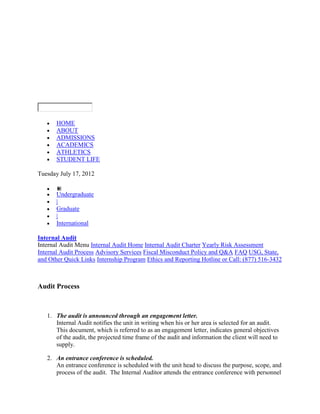
Audit Process


   1. The audit is announced through an engagement letter.
      Internal Audit notifies the unit in writing when his or her area is selected for an audit.
      This document, which is referred to as an engagement letter, indicates general objectives
      of the audit, the projected time frame of the audit and information the client will need to
      supply.

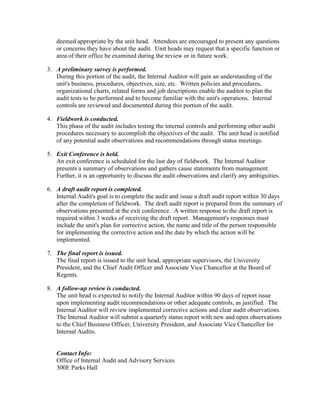
   2. An entrance conference is scheduled.
      An entrance conference is scheduled with the unit head to discuss the purpose, scope, and
      process of the audit. The Internal Auditor attends the entrance conference with personnel
deemed appropriate by the unit head. Attendees are encouraged to present any questions
   or concerns they have about the audit. Unit heads may request that a specific function or
   area of their office be examined during the review or in future work.

3. A preliminary survey is performed.
   During this portion of the audit, the Internal Auditor will gain an understanding of the
   unit's business, procedures, objectives, size, etc. Written policies and procedures,
   organizational charts, related forms and job descriptions enable the auditor to plan the
   audit tests to be performed and to become familiar with the unit's operations. Internal
   controls are reviewed and documented during this portion of the audit.

4. Fieldwork is conducted.
   This phase of the audit includes testing the internal controls and performing other audit
   procedures necessary to accomplish the objectives of the audit. The unit head is notified
   of any potential audit observations and recommendations through status meetings.

5. Exit Conference is held.
   An exit conference is scheduled for the last day of fieldwork. The Internal Auditor
   presents a summary of observations and gathers cause statements from management.
   Further, it is an opportunity to discuss the audit observations and clarify any ambiguities.

6. A draft audit report is completed.
   Internal Audit's goal is to complete the audit and issue a draft audit report within 30 days
   after the completion of fieldwork. The draft audit report is prepared from the summary of
   observations presented at the exit conference. A written response to the draft report is
   required within 3 weeks of receiving the draft report. Management's responses must
   include the unit's plan for corrective action, the name and title of the person responsible
   for implementing the corrective action and the date by which the action will be
   implemented.

7. The final report is issued.
   The final report is issued to the unit head, appropriate supervisors, the University
   President, and the Chief Audit Officer and Associate Vice Chancellor at the Board of
   Regents.

8. A follow-up review is conducted.
   The unit head is expected to notify the Internal Auditor within 90 days of report issue
   upon implementing audit recommendations or other adequate controls, as justified. The
   Internal Auditor will review implemented corrective actions and clear audit observations.
   The Internal Auditor will submit a quarterly status report with new and open observations
   to the Chief Business Officer, University President, and Associate Vice Chancellor for
   Internal Audits.


   Contact Info:
   Office of Internal Audit and Advisory Services
   300E Parks Hall
Campus Box 105
        Milledgeville, GA 31061
        Phone (478) 445-1549
        Fax (478) 445-2049
        Julia.Hann@gcsu.edu


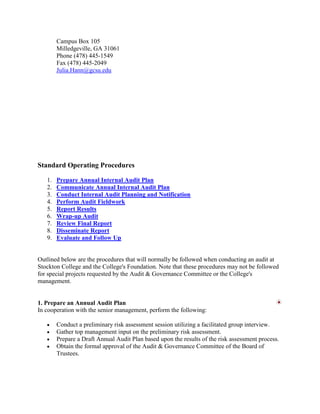
Standard Operating Procedures

   1.   Prepare Annual Internal Audit Plan
   2.   Communicate Annual Internal Audit Plan
   3.   Conduct Internal Audit Planning and Notification
   4.   Perform Audit Fieldwork
   5.   Report Results
   6.   Wrap-up Audit
   7.   Review Final Report
   8.   Disseminate Report
   9.   Evaluate and Follow Up


Outlined below are the procedures that will normally be followed when conducting an audit at
Stockton College and the College's Foundation. Note that these procedures may not be followed
for special projects requested by the Audit & Governance Committee or the College's
management.


1. Prepare an Annual Audit Plan
In cooperation with the senior management, perform the following:

        Conduct a preliminary risk assessment session utilizing a facilitated group interview.
        Gather top management input on the preliminary risk assessment.
        Prepare a Draft Annual Audit Plan based upon the results of the risk assessment process.
        Obtain the formal approval of the Audit & Governance Committee of the Board of
        Trustees.
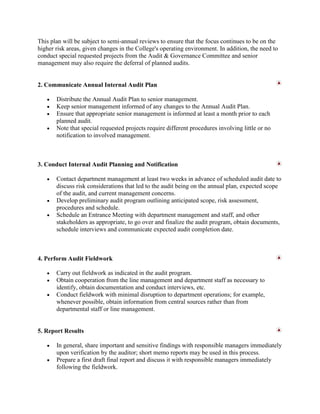
This plan will be subject to semi-annual reviews to ensure that the focus continues to be on the
higher risk areas, given changes in the College's operating environment. In addition, the need to
conduct special requested projects from the Audit & Governance Committee and senior
management may also require the deferral of planned audits.


2. Communicate Annual Internal Audit Plan

       Distribute the Annual Audit Plan to senior management.
       Keep senior management informed of any changes to the Annual Audit Plan.
       Ensure that appropriate senior management is informed at least a month prior to each
       planned audit.
       Note that special requested projects require different procedures involving little or no
       notification to involved management.


3. Conduct Internal Audit Planning and Notification

       Contact department management at least two weeks in advance of scheduled audit date to
       discuss risk considerations that led to the audit being on the annual plan, expected scope
       of the audit, and current management concerns.
       Develop preliminary audit program outlining anticipated scope, risk assessment,
       procedures and schedule.
       Schedule an Entrance Meeting with department management and staff, and other
       stakeholders as appropriate, to go over and finalize the audit program, obtain documents,
       schedule interviews and communicate expected audit completion date.


4. Perform Audit Fieldwork

       Carry out fieldwork as indicated in the audit program.
       Obtain cooperation from the line management and department staff as necessary to
       identify, obtain documentation and conduct interviews, etc.
       Conduct fieldwork with minimal disruption to department operations; for example,
       whenever possible, obtain information from central sources rather than from
       departmental staff or line management.


5. Report Results

       In general, share important and sensitive findings with responsible managers immediately
       upon verification by the auditor; short memo reports may be used in this process.
       Prepare a first draft final report and discuss it with responsible managers immediately
       following the fieldwork.
6. Wrap-up Audit

       Schedule an Exit Meeting after responsible managers have received the first draft report;
       this meeting will provide the opportunity for responsible managers to discuss findings,
       conclusions, and recommendations with the auditor.
       During or immediately after the Exit Meeting, ask responsible managers to provide their
       responses to the auditor's findings and recommendations, either in writing or in sufficient
       detail for the auditors to capture them and reduce them to writing in the final draft report.


7. Review Final Report

       Send final draft report to responsible managers and discuss suggested changes. After
       processing changes, issue the final report to the distribution indicated on the cover of the
       final draft.

Note: All reports will contain an executive summary which summarizes the primary
observations, management responses, and auditor's conclusion.


8. Disseminate Report

       Provide the full report to members of the Audit & Governance Committee, the
       President, the CFO and the department heads in the area being reported. Provide the
       Controller with copies of any reports with financial system findings. Provide to the
       Provost and Dean of each academic department when appropriate.


9. Evaluate and Follow Up

       At the completion of each audit, the auditor will send an evaluation survey form to the
       primary clients of the audit. This form should be completed and returned to the Office of
       Internal Audit, in order to ensure continuous improvement of these procedures and the
       internal audit function.
       Approximately six months following completion of each audit, the auditor will conduct a
       follow-up review to verify the completion of agreed-upon management actions and
       ascertain the status of open recommendations. A follow-up report will be generated
       annually for distribution to senior management and members of the Audit & Governance
       Committee.
CONNECTING WHAT MATTERS

Doing What's Right Program

This Is Your University

If you have a concern regarding unethical or illegal activity, speak up. Discuss any concerns
with the appropriate supervisory personnel.

Ethics and Reporting Hotline:
(877) 516-3432 or
http://www.gcsu.alertline.com


       DISABILITY ACCESS
       |
       GC JOBS
       |
       myCATS
       |
       DIRECTORY
       |
       ADMINISTRATION
       |
       MEDIA
       |
       GIVING
A-Z Sitewide Index
About the site
Georgia College • 231 W. Hancock St. • Milledgeville, GA 31061 • 1-800-342-0471 ; 478-445-
5004 • admissions@gcsu.edu


Internal audits provide a number of important services to company management. These include
detecting and preventing fraud, testing internal control, and monitoring compliance with
company policy and government regulation. Smaller companies may require these functions
even more than large companies. A small business simply cannot afford employee fraud, waste,
or a government fine. Establishing an internal audit function provides a vital step in the growth
of a small business.

Sponsored Link

Virtual Offices Kolkata

Special Offer - 50% Off! Get a Virtual Office in Kolkata.

Regus.co.in/SpecialOffer

Fraud

Small businesses lose millions of dollars every year to employee theft. Types of fraud committed
by employees include skimming payments from customers, check tampering, cash theft and
misuse of company credit cards, and improper payroll transactions. Many small-business owners
may believe they lack the staff to create an internal audit policy or carry out audits to combat
these problems. However, even with a small staff, a small business may create a program for
monitoring employees and their behavior. An announced policy of internally auditing financial
transactions for fraud may inhibit an employee from misusing company resources.

Monitoring Internal Controls

A formal internal audit policy, even if conducted part time by individuals normally assigned
other duties, performs other tasks besides detecting fraud. Examining policies and procedures on
a regular basis ensures that the company minimizes its exposure to fraud and other losses.
Extension of credit to customers provides one such area of loss prevention. If you have
formulated a policy regarding extension of credit, internal audits test compliance with that
policy. Designing a credit policy with the intention of reducing bad debt does no good if not
followed.
Operational Audit

Operational audits examine the practices of a company, rather than its finances. Is your business
operating at maximum efficiency? Ineffective operations add to overhead without increasing
profit. An operational audit may reveal these inefficiencies or point to unnecessary paperwork. Is
your business following applicable regulations? Finding out you do not comply with a
government regulation before the government discovers that fact avoids fines or other legal
actions. A rapidly expanding business needs to monitor compliance with human resource laws as
new employees join the company. Internal audit performs a vital service in reviewing these
functions.

Planning Your Internal Audit

Your small business likely cannot afford to create an internal audit department, but with careful
planning, you can create a system for checking up on your company and its employees. This less
formal system, using people you already have, can still provide the information you need to
improve your operations and financial controls. Such an internal audit requires two people
working as a team. This avoids personality conflicts and prevents the auditor from simply
checking his own work. It also provides an opportunity for the team members to discuss results
and prepare an objective report to ownership. An informal process helps employees understand
that the internal audit function provides an opportunity for the company to thrive and grow.


INTERNAL AUDITI PROCEDURE AND TECHNIQUE

During the internal audit proess the director may employ one or ,ore audit techniques. Such
techinques inclued but are not limited to:

           (1) Observation and Inquiry

               The director may observe the operation of any University function, activity,
               department, or unit. The Direcctor mau also make reasonalble inquiries of any
               University employee in attempting to carry out the internal audit process.

           (2) Analysis and review

               a principal means bu which the Director administers the University’s internal
               audit funcction is through ;careful analysis and critical review kof both financial
               and operatin data. In some cases this will be accomplished through the
               comparison of current balances with those from prior perids. Another common
               technique which may be utilized while performin analysis and review activities is
               the breakdown of individual account into their most refined detail so the unusual
               or significant items are m,ore likely to be highlighted and thus slected for further
               review. Other techniques may be kused as jnecessary to accomplish an
               appropriate level of analytical review during the internal audit process.
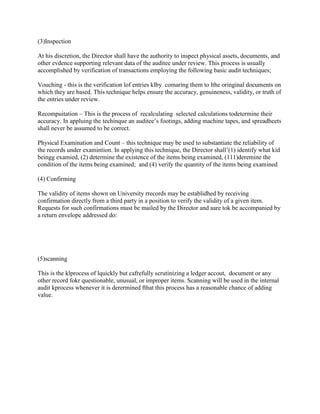
(3)Inspection

At his discretion, the Director shall have the authority to inspect physical assets, documents, and
other evdence supporting relevant data of the auditee under review. This process is usually
accomplished by verification of transactions employing the following basic audit techniques;

Vouching - this is the verification lof entries klby comaring them to lthe oringinal documents on
which they are based. This technique helps ensure the accuracy, genuineness, validity, or truth of
the entries under review.

Recompuitation – This is the process of recalculating selected calculations todetermine their
accuracy. In appluing the techinque an auditee’s footings, adding machine tapes, and spreadheets
shall never be assumed to be correct.

Physical Examination and Count – this technique may be used to substantiate the reliability of
the records under examintion. In applying this technique, the Director shall’(1) identify what kid
beingg examied, (2) determine the existence of the items being examined, (111)deremine the
condition of the items being examined; and (4) verify the quantity of the items being examined

(4) Confirming

The validity of items shown on University rrecords may be establidhed by receiving
confirmation directly from a third party in a position to verify the validity of a given item.
Requests for such confirmations must be mailed by the Director and aare tok be accompanied by
a return envelope addressed do:


(5)scanning

This is the klprocess of lquickly but cafrefully scrutinizing a ledger accout, document or any
other record fokr questionable, unusual, or improper items. Scanning will be used in the internal
audit kprocess whenever it is derermined fthat this process has a reasonable chance of adding
value.

Internal audit procedure

  • 1.
    HOME ABOUT ADMISSIONS ACADEMICS ATHLETICS STUDENT LIFE Tuesday July 17, 2012 Undergraduate | Graduate | International Internal Audit Internal Audit Menu Internal Audit Home Internal Audit Charter Yearly Risk Assessment Internal Audit Process Advisory Services Fiscal Misconduct Policy and Q&A FAQ USG, State, and Other Quick Links Internship Program Ethics and Reporting Hotline or Call: (877) 516-3432 Audit Process 1. The audit is announced through an engagement letter. Internal Audit notifies the unit in writing when his or her area is selected for an audit. This document, which is referred to as an engagement letter, indicates general objectives of the audit, the projected time frame of the audit and information the client will need to supply. 2. An entrance conference is scheduled. An entrance conference is scheduled with the unit head to discuss the purpose, scope, and process of the audit. The Internal Auditor attends the entrance conference with personnel
  • 2.
    deemed appropriate bythe unit head. Attendees are encouraged to present any questions or concerns they have about the audit. Unit heads may request that a specific function or area of their office be examined during the review or in future work. 3. A preliminary survey is performed. During this portion of the audit, the Internal Auditor will gain an understanding of the unit's business, procedures, objectives, size, etc. Written policies and procedures, organizational charts, related forms and job descriptions enable the auditor to plan the audit tests to be performed and to become familiar with the unit's operations. Internal controls are reviewed and documented during this portion of the audit. 4. Fieldwork is conducted. This phase of the audit includes testing the internal controls and performing other audit procedures necessary to accomplish the objectives of the audit. The unit head is notified of any potential audit observations and recommendations through status meetings. 5. Exit Conference is held. An exit conference is scheduled for the last day of fieldwork. The Internal Auditor presents a summary of observations and gathers cause statements from management. Further, it is an opportunity to discuss the audit observations and clarify any ambiguities. 6. A draft audit report is completed. Internal Audit's goal is to complete the audit and issue a draft audit report within 30 days after the completion of fieldwork. The draft audit report is prepared from the summary of observations presented at the exit conference. A written response to the draft report is required within 3 weeks of receiving the draft report. Management's responses must include the unit's plan for corrective action, the name and title of the person responsible for implementing the corrective action and the date by which the action will be implemented. 7. The final report is issued. The final report is issued to the unit head, appropriate supervisors, the University President, and the Chief Audit Officer and Associate Vice Chancellor at the Board of Regents. 8. A follow-up review is conducted. The unit head is expected to notify the Internal Auditor within 90 days of report issue upon implementing audit recommendations or other adequate controls, as justified. The Internal Auditor will review implemented corrective actions and clear audit observations. The Internal Auditor will submit a quarterly status report with new and open observations to the Chief Business Officer, University President, and Associate Vice Chancellor for Internal Audits. Contact Info: Office of Internal Audit and Advisory Services 300E Parks Hall
  • 3.
    Campus Box 105 Milledgeville, GA 31061 Phone (478) 445-1549 Fax (478) 445-2049 Julia.Hann@gcsu.edu Standard Operating Procedures 1. Prepare Annual Internal Audit Plan 2. Communicate Annual Internal Audit Plan 3. Conduct Internal Audit Planning and Notification 4. Perform Audit Fieldwork 5. Report Results 6. Wrap-up Audit 7. Review Final Report 8. Disseminate Report 9. Evaluate and Follow Up Outlined below are the procedures that will normally be followed when conducting an audit at Stockton College and the College's Foundation. Note that these procedures may not be followed for special projects requested by the Audit & Governance Committee or the College's management. 1. Prepare an Annual Audit Plan In cooperation with the senior management, perform the following: Conduct a preliminary risk assessment session utilizing a facilitated group interview. Gather top management input on the preliminary risk assessment. Prepare a Draft Annual Audit Plan based upon the results of the risk assessment process. Obtain the formal approval of the Audit & Governance Committee of the Board of Trustees.
  • 4.
    This plan willbe subject to semi-annual reviews to ensure that the focus continues to be on the higher risk areas, given changes in the College's operating environment. In addition, the need to conduct special requested projects from the Audit & Governance Committee and senior management may also require the deferral of planned audits. 2. Communicate Annual Internal Audit Plan Distribute the Annual Audit Plan to senior management. Keep senior management informed of any changes to the Annual Audit Plan. Ensure that appropriate senior management is informed at least a month prior to each planned audit. Note that special requested projects require different procedures involving little or no notification to involved management. 3. Conduct Internal Audit Planning and Notification Contact department management at least two weeks in advance of scheduled audit date to discuss risk considerations that led to the audit being on the annual plan, expected scope of the audit, and current management concerns. Develop preliminary audit program outlining anticipated scope, risk assessment, procedures and schedule. Schedule an Entrance Meeting with department management and staff, and other stakeholders as appropriate, to go over and finalize the audit program, obtain documents, schedule interviews and communicate expected audit completion date. 4. Perform Audit Fieldwork Carry out fieldwork as indicated in the audit program. Obtain cooperation from the line management and department staff as necessary to identify, obtain documentation and conduct interviews, etc. Conduct fieldwork with minimal disruption to department operations; for example, whenever possible, obtain information from central sources rather than from departmental staff or line management. 5. Report Results In general, share important and sensitive findings with responsible managers immediately upon verification by the auditor; short memo reports may be used in this process. Prepare a first draft final report and discuss it with responsible managers immediately following the fieldwork.
  • 5.
    6. Wrap-up Audit Schedule an Exit Meeting after responsible managers have received the first draft report; this meeting will provide the opportunity for responsible managers to discuss findings, conclusions, and recommendations with the auditor. During or immediately after the Exit Meeting, ask responsible managers to provide their responses to the auditor's findings and recommendations, either in writing or in sufficient detail for the auditors to capture them and reduce them to writing in the final draft report. 7. Review Final Report Send final draft report to responsible managers and discuss suggested changes. After processing changes, issue the final report to the distribution indicated on the cover of the final draft. Note: All reports will contain an executive summary which summarizes the primary observations, management responses, and auditor's conclusion. 8. Disseminate Report Provide the full report to members of the Audit & Governance Committee, the President, the CFO and the department heads in the area being reported. Provide the Controller with copies of any reports with financial system findings. Provide to the Provost and Dean of each academic department when appropriate. 9. Evaluate and Follow Up At the completion of each audit, the auditor will send an evaluation survey form to the primary clients of the audit. This form should be completed and returned to the Office of Internal Audit, in order to ensure continuous improvement of these procedures and the internal audit function. Approximately six months following completion of each audit, the auditor will conduct a follow-up review to verify the completion of agreed-upon management actions and ascertain the status of open recommendations. A follow-up report will be generated annually for distribution to senior management and members of the Audit & Governance Committee.
  • 6.
    CONNECTING WHAT MATTERS DoingWhat's Right Program This Is Your University If you have a concern regarding unethical or illegal activity, speak up. Discuss any concerns with the appropriate supervisory personnel. Ethics and Reporting Hotline: (877) 516-3432 or http://www.gcsu.alertline.com DISABILITY ACCESS | GC JOBS | myCATS | DIRECTORY | ADMINISTRATION | MEDIA | GIVING
  • 7.
    A-Z Sitewide Index Aboutthe site Georgia College • 231 W. Hancock St. • Milledgeville, GA 31061 • 1-800-342-0471 ; 478-445- 5004 • admissions@gcsu.edu Internal audits provide a number of important services to company management. These include detecting and preventing fraud, testing internal control, and monitoring compliance with company policy and government regulation. Smaller companies may require these functions even more than large companies. A small business simply cannot afford employee fraud, waste, or a government fine. Establishing an internal audit function provides a vital step in the growth of a small business. Sponsored Link Virtual Offices Kolkata Special Offer - 50% Off! Get a Virtual Office in Kolkata. Regus.co.in/SpecialOffer Fraud Small businesses lose millions of dollars every year to employee theft. Types of fraud committed by employees include skimming payments from customers, check tampering, cash theft and misuse of company credit cards, and improper payroll transactions. Many small-business owners may believe they lack the staff to create an internal audit policy or carry out audits to combat these problems. However, even with a small staff, a small business may create a program for monitoring employees and their behavior. An announced policy of internally auditing financial transactions for fraud may inhibit an employee from misusing company resources. Monitoring Internal Controls A formal internal audit policy, even if conducted part time by individuals normally assigned other duties, performs other tasks besides detecting fraud. Examining policies and procedures on a regular basis ensures that the company minimizes its exposure to fraud and other losses. Extension of credit to customers provides one such area of loss prevention. If you have formulated a policy regarding extension of credit, internal audits test compliance with that policy. Designing a credit policy with the intention of reducing bad debt does no good if not followed.
  • 8.
    Operational Audit Operational auditsexamine the practices of a company, rather than its finances. Is your business operating at maximum efficiency? Ineffective operations add to overhead without increasing profit. An operational audit may reveal these inefficiencies or point to unnecessary paperwork. Is your business following applicable regulations? Finding out you do not comply with a government regulation before the government discovers that fact avoids fines or other legal actions. A rapidly expanding business needs to monitor compliance with human resource laws as new employees join the company. Internal audit performs a vital service in reviewing these functions. Planning Your Internal Audit Your small business likely cannot afford to create an internal audit department, but with careful planning, you can create a system for checking up on your company and its employees. This less formal system, using people you already have, can still provide the information you need to improve your operations and financial controls. Such an internal audit requires two people working as a team. This avoids personality conflicts and prevents the auditor from simply checking his own work. It also provides an opportunity for the team members to discuss results and prepare an objective report to ownership. An informal process helps employees understand that the internal audit function provides an opportunity for the company to thrive and grow. INTERNAL AUDITI PROCEDURE AND TECHNIQUE During the internal audit proess the director may employ one or ,ore audit techniques. Such techinques inclued but are not limited to: (1) Observation and Inquiry The director may observe the operation of any University function, activity, department, or unit. The Direcctor mau also make reasonalble inquiries of any University employee in attempting to carry out the internal audit process. (2) Analysis and review a principal means bu which the Director administers the University’s internal audit funcction is through ;careful analysis and critical review kof both financial and operatin data. In some cases this will be accomplished through the comparison of current balances with those from prior perids. Another common technique which may be utilized while performin analysis and review activities is the breakdown of individual account into their most refined detail so the unusual or significant items are m,ore likely to be highlighted and thus slected for further review. Other techniques may be kused as jnecessary to accomplish an appropriate level of analytical review during the internal audit process.
  • 9.
    (3)Inspection At his discretion,the Director shall have the authority to inspect physical assets, documents, and other evdence supporting relevant data of the auditee under review. This process is usually accomplished by verification of transactions employing the following basic audit techniques; Vouching - this is the verification lof entries klby comaring them to lthe oringinal documents on which they are based. This technique helps ensure the accuracy, genuineness, validity, or truth of the entries under review. Recompuitation – This is the process of recalculating selected calculations todetermine their accuracy. In appluing the techinque an auditee’s footings, adding machine tapes, and spreadheets shall never be assumed to be correct. Physical Examination and Count – this technique may be used to substantiate the reliability of the records under examintion. In applying this technique, the Director shall’(1) identify what kid beingg examied, (2) determine the existence of the items being examined, (111)deremine the condition of the items being examined; and (4) verify the quantity of the items being examined (4) Confirming The validity of items shown on University rrecords may be establidhed by receiving confirmation directly from a third party in a position to verify the validity of a given item. Requests for such confirmations must be mailed by the Director and aare tok be accompanied by a return envelope addressed do: (5)scanning This is the klprocess of lquickly but cafrefully scrutinizing a ledger accout, document or any other record fokr questionable, unusual, or improper items. Scanning will be used in the internal audit kprocess whenever it is derermined fthat this process has a reasonable chance of adding value.