INELUCTABLE MODALITY
OF LINUX AUDIT
A story of hate and delectation
Faster & Smarter IR
SUMUS
Mark Ellzey
@strcpy - @threatstack
Software for down there.
!! WARNING !!
If you are a current employee of RedHat (specifically on
the auditd codebase), and have an extensive
background in martial arts, please leave the room now.
I would rather not spend the night in a hospital.
BLATANT MARKETING SLIDE
The contents within are the result of making this product a reality.
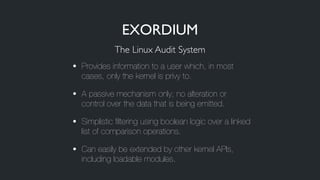
• Provides information to a user which, in most
cases, only the kernel is privy to.
• A passive mechanism only; no alteration or
control over the data that is being emitted.
• Simplistic filtering using boolean logic over a linked
list of comparison operations.
• Can easily be extended by other kernel APIs,
including loadable modules.
The Linux Audit System
EXORDIUM
WRONG!
Wait for the din of shocked gasps to become quiescent, then proceed
AUDITD & AUDIT ARE MUTUALLY
EXCLUSIVE
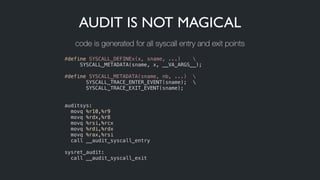
AUDIT IS NOT MAGICAL
#define SYSCALL_DEFINEx(x, sname, ...) 
     SYSCALL_METADATA(sname, x, __VA_ARGS__);
!
#define SYSCALL_METADATA(sname, nb, ...)  
SYSCALL_TRACE_ENTER_EVENT(sname); 
       SYSCALL_TRACE_EXIT_EVENT(sname);
!
!
auditsys:
  movq %r10,%r9
  movq %rdx,%r8
  movq %rsi,%rcx
  movq %rdi,%rdx
  movq %rax,%rsi
  call __audit_syscall_entry
 
sysret_audit:
  call __audit_syscall_exit
code is generated for all syscall entry and exit points
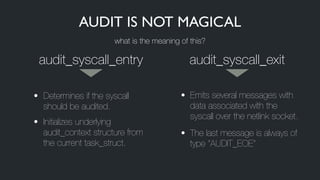
audit_syscall_entry audit_syscall_exit
• Determines if the syscall
should be audited.
• Initializes underlying
audit_context structure from
the current task_struct.
• Emits several messages with
data associated with the
syscall over the netlink socket.
• The last message is always of
type “AUDIT_EOE”
AUDIT IS NOT MAGICAL
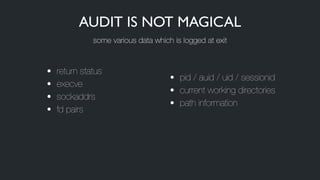
what is the meaning of this?
• return status
• execve
• sockaddrs
• fd pairs
• pid / auid / uid / sessionid
• current working directories
• path information
AUDIT IS NOT MAGICAL
some various data which is logged at exit
CAN’T STOP HERE,THIS
IS BAT COUNTRY
FEAR AND LOATHING IN KERNEL/AUDIT.C
there can be only one
Only one process can read from the audit netlink socket
this is a good thing - the kernel only has to maintain one buffer
Creating a second reader will hijack the first and will not be restored on exit
I get it, otherwise the kernel would be required to keep a backlog stack of processes
FEAR AND LOATHING IN KERNEL/AUDIT.C
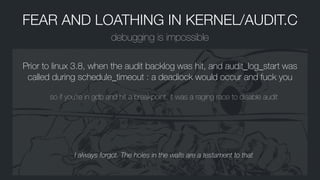
debugging is impossible
Prior to linux 3.8, when the audit backlog was hit, and audit_log_start was
called during schedule_timeout : a deadlock would occur and fuck you
so if you’re in gdb and hit a breakpoint, it was a raging race to disable audit
I always forgot. The holes in the walls are a testament to that
FORMAT DISAPPROBATION :(
The kernel is to blame for this shameful log format!
audit_log_format(ab,"a0=%lx a1=%lx a2=%lx a3=%lx items=%d"
" ppid=%d pid=%d auid=%u uid=%u gid=%u"
" euid=%u suid=%u fsuid=%u"
  " egid=%u sgid=%u fsgid=%u tty=%s ses=%u",
   context->argv[0], context->argv[1], ...);
b u t w h a t i s t h e a l t e r n a t i v e ?
You’re insane. A JSON encoder in the kernel?
You’re insane.
An overly complex binary
message format?
How about this JSON thing I’ve
been hearing so much about?
• Everything that comes from the kernel
is a key value pair, treat it like so.
• Unquoted values are (usually) deemed
as “untrusted” strings, encoded as
ascii-hex.
• The “serial number” is the kernel’s way
of designating multiple messages into
a single group. It is up to the user-land
application to reassemble.
• User-land sourced messages are
always encapsulated in a key of “msg”
• If you were like me, stop bitching and
deal with it.
Just follow these simple rules
FORMAT APPROBATION :)
• Performance problems under load.
• Limited output format.
• Difficult to extend.
• Impossible to read.
• Poorly designed (opinion).
• Did I mention performance issues?
• I’ve seen better code in openssl.
THINE ENEMY LIES WITHIN LEGACY
AUDITING AUDITD
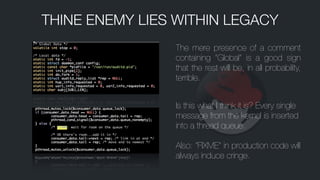
The mere presence of a comment
containing “Global” is a good sign
that the rest will be, in all probability,
terrible.
Is this what I think it is? Every single
message from the kernel is inserted
into a thread queue.
!
Also: “FIXME” in production code will
always induce cringe.
THINE ENEMY LIES WITHIN LEGACY
GOALS
• Lower resource utilization
under high load
• Extend (or create) logging
and filtering capabilities
• Keep some backwards
compatibility with auditd
• Don’t reinvent the wheel, if
the wheel isn’t broken
• Abstract EVERYTHING
• Follow all of the rules in the
next slide.
DEPRECATION
RULE ONE THROUGH ∞
An afterthought in auditd.
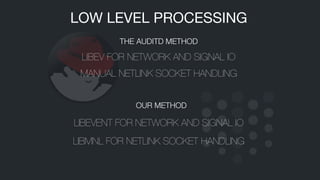
LIBEV FOR NETWORK AND SIGNAL IO
MANUAL NETLINK SOCKET HANDLING
LIBEVENT FOR NETWORK AND SIGNAL IO
LIBMNL FOR NETLINK SOCKET HANDLING
LOW LEVEL PROCESSING
THE AUDITD METHOD
OUR METHOD
!! WARNING !!
No statements about how libev is faster than libevent.
These comments are usually some variant of
regurgitated information based on the flawed
performance comparisons found on the libev website.
“It’s only cheating if you do it on purpose.”
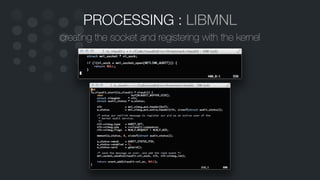
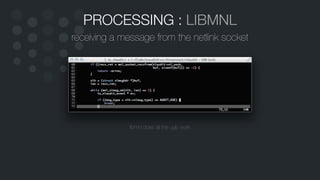
PROCESSING : LIBMNL
creating the socket and registering with the kernel
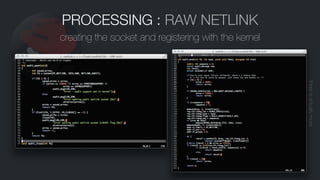
PROCESSING : RAW NETLINK
creating the socket and registering with the kernel
thereisactuallymore
PROCESSING : LIBMNL
receiving a message from the netlink socket
libmnl does all the ugly work
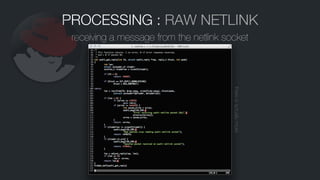
PROCESSING : RAW NETLINK
receiving a message from the netlink socket
thereisactuallymore
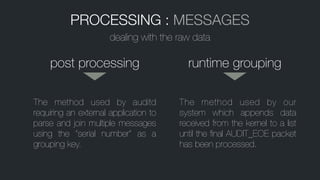
PROCESSING : MESSAGES
post processing runtime grouping
The method used by auditd
requiring an external application to
parse and join multiple messages
using the “serial number” as a
grouping key.
dealing with the raw data
The method used by our
system which appends data
received from the kernel to a list
until the final AUDIT_EOE packet
has been processed.
PROCESSING : MESSAGE GROUPS
an abstract example; executing “tail -f tsaudit.log”
- serial=43480, type=SYSCALL, syscall=“sys_execve”, exe=“/usr/bin/tail”
- serial=43480, type=EXECVE, argc=2, a0=“tail”, a1=“tsaudit.log”
- serial=43480, type=CWD, cwd=“/var/log”
- serial=43480, type=PATH, name=“/usr/bin/tail”
- serial=43480, type=EOE
ungrouped
grouped
[	
{	
“type" : "SYSCALL",	
“syscall" : "execve",	
“exe" : "/usr/bin/tail"	
},	
{	
“type" : "EXECVE",	
“argc" : 2,	
“argv” : [ “tail”, “tsaudit.log” ],	
},	
{	
“type" : "CWD",	
“cwd" : "/var/log"	
},	
{	
"type": "PATH",	
"name": "/usr/bin/tail"	
}	
]
PROCESSING : MESSAGE GROUPSA few more fun examples of grouping.
[	
{	
"exe": "/bin/cat",	
"comm": "cat",	
"ses": 10,	
"auid": 4294967295,	
"pid": 31335,	
"ppid": 31334,	
"items": 2,	
"exit": 0,	
"success": "yes",	
"syscall": "execve",	
"epoch": 1399248110,	
"serial": 855516,	
"type": "SYSCALL"	
},	
{	
"a1": "eth0.dhclient",	
"a0": "cat",	
"argc": 2,	
"epoch": 1399248110,	
"type": "EXECVE"	
},	
{	
"cwd": "/run/resolvconf/interface",	
"epoch": 1399248110,	
"type": "CWD"	
},	
{	
"name": "/bin/cat",	
"epoch": 1399248110,	
"type": "PATH"	
}	
]
[	
{	
"res": "success",	
"terminal": "ssh",	
"addr": "192.168.56.1",	
"hostname": "babby.local",	
"exe": "/usr/sbin/sshd",	
"acct": "mthomas",	
"op": "PAM:session_open",	
"ses": 24,	
"auid": 1000,	
"uid": 0,	
"pid": 10469,	
"epoch": 1393886985,	
"serial": 3393,	
"type": "USER_START"	
}	
]
[	
{	
"exe": "/usr/sbin/nginx",	
"comm": "nginx",	
"ses": 238,	
"pid": 966,	
"ppid": 965,	
"items": 1,	
"a3": "fffffffffffffffb",	
"a2": 0,	
"a1": "800",	
"a0": "ee7c05",	
"exit": 13,	
"success": "yes",	
"syscall": "open",	
"epoch": 1392316421,	
"serial": 301316,	
"type": "SYSCALL"	
},	
{	
"cwd": "/",	
"type": "CWD"	
},	
{	
"ogid": 0,	
"name": "/www/index.html",	
"type": "PATH"	
}	
]
[	
{	
"exe": "/usr/sbin/nginx",	
"comm": "nginx",	
"ses": 238,	
"pid": 966,	
"ppid": 965,	
"items": 0,	
"a3": "800",	
"a2": "7fff8afba6cc",	
"a1": "7fff8afba6d0",	
"a0": 0,	
"exit": 12,	
"success": "yes",	
"syscall": "accept4",	
"epoch": 1392316421,	
"serial": 301314,	
"type": "SYSCALL"	
},	
{	
"saddr": "192.168.56.1",	
"port": 51997,	
"prot": "ipv4",	
"type": "SOCKADDR"	
}	
]
/var/resolvconf/interface$ cat eth0.dhclient nginx: int fd = open(“/www/index.html”); // fd == 13 fd = accept(“192.168.56.1:51997”); user “mthomas” started a pam session
PARSING
“Every year, one out of ten programmers will commit suicide due to
maintaining parsers written in C”
Every C developer who has had to maintain a parser in C
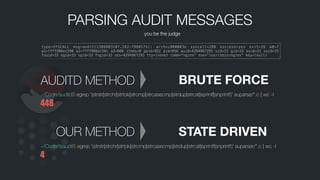
PARSING AUDIT MESSAGES
you be the judge
type=SYSCALL msg=audit(1386803107.182:7960575): arch=c000003e syscall=288 success=yes exit=26 a0=7
a1=7fff986ec590 a2=7fff986ec58c a3=800 items=0 ppid=952 pid=956 auid=4294967295 uid=33 gid=33 euid=33 suid=33
fsuid=33 egid=33 sgid=33 fsgid=33 ses=4294967295 tty=(none) comm="nginx" exe="/usr/sbin/nginx" key=(null)
BRUTE FORCE
~/Code/auditd$ egrep '(strstr|strchr|strtok|strcmp|strcasecmp|strdup|strcat|sprintf|snprintf)' auparse/*.c | wc -l
448
STATE DRIVEN
~/Code/tsaudit$ egrep '(strstr|strchr|strtok|strcmp|strcasecmp|strdup|strcat|sprintf|snprintf)' auparser/*.c | wc -l
4
AUDITD METHOD
OUR METHOD
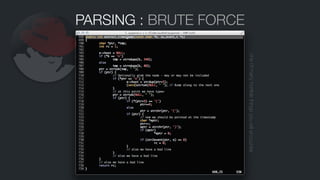
PARSING : BRUTE FORCE
oneofmanyhorriblethingsyouwillencounter
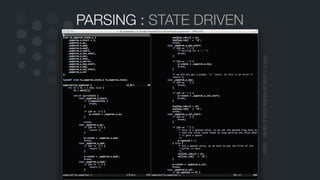
PARSING : STATE DRIVEN
switch/casegenerateslookuptables-faster
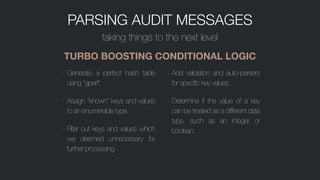
PARSING AUDIT MESSAGES
taking things to the next level
TURBO BOOSTING CONDITIONAL LOGIC
- Generate a perfect hash table
using “gperf”.
- Assign “known” keys and values
to an enumerable type.
- Filter out keys and values which
we deemed unnecessary for
further processing
- Add validation and auto-parsers
for specific key values.
- Determine if the value of a key
can be treated as a different data
type, such as an integer or
boolean.
SO WE CAN DO STUFF LIKE THIS
with perfect hash tables - lookups are O(1)
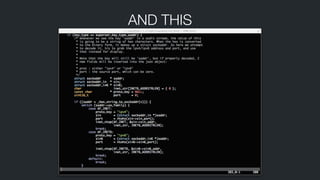
AND THIS
FILTERING
optionally preprocess data before it is logged
-Load per-instance or per-output LUA script during
startup.
-Convert the grouped messages to a native LUA table.
-Call a pre-defined LUA function.
-A non-zero return will drop the message.
-A zero return will continue processing the message
-If a LUA table is returned, it is converted to JSON and
used as the output.
FILTERING
Example : simple boolean filter
FILTERING
Example : return a table which is converted to JSON on output
function find_set(k, set)	
for _,v in pairs(set) do	
if k == v then	
return 1	
end	
end	
return 0	
end	
!
!
function tsaudit_filter(data)	
local ret = {}	
local comms = { 'irqbalance', 'whoopsie', 'top', 'dhclient' }	
!
for k,ent in pairs(data) do	
if find_set(ent['comm'], comms) == 1 then	
-- if any of the keys are found, return this table which will be	
-- transformed into the JSON { "this" : "filtered", "dont" : "log" }	
ret = {this="filtered", dont="log" }	
end	
!
if ent['success'] == 'no' then	
-- if the syscall did not succeed, then return 1 which will not generate a	
-- log.	
ret = 1	
end	
end	
!
return ret	
end
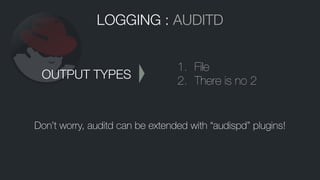
LOGGING : AUDITD
1. File
2. There is no 2
OUTPUT TYPES
Don’t worry, auditd can be extended with “audispd” plugins!
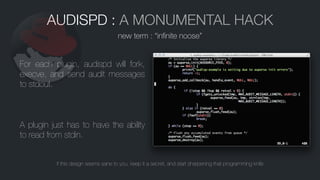
AUDISPD : A MONUMENTAL HACK
For each plugin, audispd will fork,
execve, and send audit messages
to stdout.
A plugin just has to have the ability
to read from stdin.
if this design seems sane to you, keep it a secret, and start sharpening that programming knife
new term : “infinite noose”
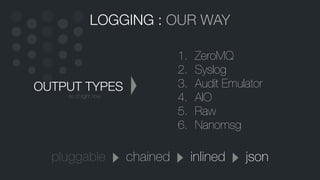
LOGGING : OUR WAY
1. ZeroMQ
2. Syslog
3. Audit Emulator
4. AIO
5. Raw
6. Nanomsg
jsonpluggable chained inlined
OUTPUT TYPES
as of right now
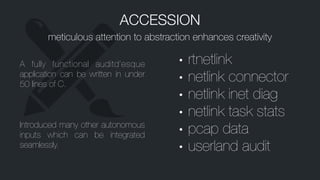
ACCESSION
meticulous attention to abstraction enhances creativity
A fully functional auditd’esque
application can be written in under
50 lines of C.
Introduced many other autonomous
inputs which can be integrated
seamlessly.
• rtnetlink
• netlink connector
• netlink inet diag
• netlink task stats
• pcap data
• userland audit
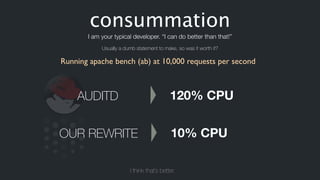
consummation
I am your typical developer. “I can do better than that!”
Usually a dumb statement to make, so was it worth it?
Running apache bench (ab) at 10,000 requests per second
AUDITD 120% CPU
OUR REWRITE 10% CPU
I think that’s better.
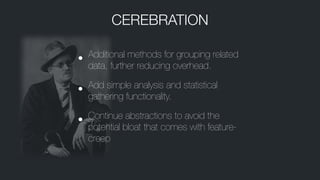
• Additional methods for grouping related
data, further reducing overhead.
• Add simple analysis and statistical
gathering functionality.
• Continue abstractions to avoid the
potential bloat that comes with feature-
creep
CEREBRATION
COME WORK WITH
US
@threatstack

Audit

  • 1.
    INELUCTABLE MODALITY OF LINUXAUDIT A story of hate and delectation Faster & Smarter IR
  • 2.
    SUMUS Mark Ellzey @strcpy -@threatstack Software for down there.
  • 3.
    !! WARNING !! Ifyou are a current employee of RedHat (specifically on the auditd codebase), and have an extensive background in martial arts, please leave the room now. I would rather not spend the night in a hospital.
  • 4.
    BLATANT MARKETING SLIDE Thecontents within are the result of making this product a reality.
  • 5.
    • Provides informationto a user which, in most cases, only the kernel is privy to. • A passive mechanism only; no alteration or control over the data that is being emitted. • Simplistic filtering using boolean logic over a linked list of comparison operations. • Can easily be extended by other kernel APIs, including loadable modules. The Linux Audit System EXORDIUM
  • 6.
    WRONG! Wait for thedin of shocked gasps to become quiescent, then proceed AUDITD & AUDIT ARE MUTUALLY EXCLUSIVE
  • 7.
    AUDIT IS NOTMAGICAL #define SYSCALL_DEFINEx(x, sname, ...)      SYSCALL_METADATA(sname, x, __VA_ARGS__); ! #define SYSCALL_METADATA(sname, nb, ...)   SYSCALL_TRACE_ENTER_EVENT(sname);        SYSCALL_TRACE_EXIT_EVENT(sname); ! ! auditsys:   movq %r10,%r9   movq %rdx,%r8   movq %rsi,%rcx   movq %rdi,%rdx   movq %rax,%rsi   call __audit_syscall_entry   sysret_audit:   call __audit_syscall_exit code is generated for all syscall entry and exit points
  • 8.
    audit_syscall_entry audit_syscall_exit • Determinesif the syscall should be audited. • Initializes underlying audit_context structure from the current task_struct. • Emits several messages with data associated with the syscall over the netlink socket. • The last message is always of type “AUDIT_EOE” AUDIT IS NOT MAGICAL what is the meaning of this?
  • 9.
    • return status •execve • sockaddrs • fd pairs • pid / auid / uid / sessionid • current working directories • path information AUDIT IS NOT MAGICAL some various data which is logged at exit
  • 10.
  • 11.
    FEAR AND LOATHINGIN KERNEL/AUDIT.C there can be only one Only one process can read from the audit netlink socket this is a good thing - the kernel only has to maintain one buffer Creating a second reader will hijack the first and will not be restored on exit I get it, otherwise the kernel would be required to keep a backlog stack of processes
  • 12.
    FEAR AND LOATHINGIN KERNEL/AUDIT.C debugging is impossible Prior to linux 3.8, when the audit backlog was hit, and audit_log_start was called during schedule_timeout : a deadlock would occur and fuck you so if you’re in gdb and hit a breakpoint, it was a raging race to disable audit I always forgot. The holes in the walls are a testament to that
  • 13.
    FORMAT DISAPPROBATION :( Thekernel is to blame for this shameful log format! audit_log_format(ab,"a0=%lx a1=%lx a2=%lx a3=%lx items=%d" " ppid=%d pid=%d auid=%u uid=%u gid=%u" " euid=%u suid=%u fsuid=%u"   " egid=%u sgid=%u fsgid=%u tty=%s ses=%u",    context->argv[0], context->argv[1], ...); b u t w h a t i s t h e a l t e r n a t i v e ? You’re insane. A JSON encoder in the kernel? You’re insane. An overly complex binary message format? How about this JSON thing I’ve been hearing so much about?
  • 14.
    • Everything thatcomes from the kernel is a key value pair, treat it like so. • Unquoted values are (usually) deemed as “untrusted” strings, encoded as ascii-hex. • The “serial number” is the kernel’s way of designating multiple messages into a single group. It is up to the user-land application to reassemble. • User-land sourced messages are always encapsulated in a key of “msg” • If you were like me, stop bitching and deal with it. Just follow these simple rules FORMAT APPROBATION :)
  • 15.
    • Performance problemsunder load. • Limited output format. • Difficult to extend. • Impossible to read. • Poorly designed (opinion). • Did I mention performance issues? • I’ve seen better code in openssl. THINE ENEMY LIES WITHIN LEGACY AUDITING AUDITD
  • 16.
    The mere presenceof a comment containing “Global” is a good sign that the rest will be, in all probability, terrible. Is this what I think it is? Every single message from the kernel is inserted into a thread queue. ! Also: “FIXME” in production code will always induce cringe. THINE ENEMY LIES WITHIN LEGACY
  • 17.
    GOALS • Lower resourceutilization under high load • Extend (or create) logging and filtering capabilities • Keep some backwards compatibility with auditd • Don’t reinvent the wheel, if the wheel isn’t broken • Abstract EVERYTHING • Follow all of the rules in the next slide. DEPRECATION
  • 18.
    RULE ONE THROUGH∞ An afterthought in auditd.
  • 19.
    LIBEV FOR NETWORKAND SIGNAL IO MANUAL NETLINK SOCKET HANDLING LIBEVENT FOR NETWORK AND SIGNAL IO LIBMNL FOR NETLINK SOCKET HANDLING LOW LEVEL PROCESSING THE AUDITD METHOD OUR METHOD
  • 20.
    !! WARNING !! Nostatements about how libev is faster than libevent. These comments are usually some variant of regurgitated information based on the flawed performance comparisons found on the libev website. “It’s only cheating if you do it on purpose.”
  • 21.
    PROCESSING : LIBMNL creatingthe socket and registering with the kernel
  • 22.
    PROCESSING : RAWNETLINK creating the socket and registering with the kernel thereisactuallymore
  • 23.
    PROCESSING : LIBMNL receivinga message from the netlink socket libmnl does all the ugly work
  • 24.
    PROCESSING : RAWNETLINK receiving a message from the netlink socket thereisactuallymore
  • 25.
    PROCESSING : MESSAGES postprocessing runtime grouping The method used by auditd requiring an external application to parse and join multiple messages using the “serial number” as a grouping key. dealing with the raw data The method used by our system which appends data received from the kernel to a list until the final AUDIT_EOE packet has been processed.
  • 26.
    PROCESSING : MESSAGEGROUPS an abstract example; executing “tail -f tsaudit.log” - serial=43480, type=SYSCALL, syscall=“sys_execve”, exe=“/usr/bin/tail” - serial=43480, type=EXECVE, argc=2, a0=“tail”, a1=“tsaudit.log” - serial=43480, type=CWD, cwd=“/var/log” - serial=43480, type=PATH, name=“/usr/bin/tail” - serial=43480, type=EOE ungrouped grouped [ { “type" : "SYSCALL", “syscall" : "execve", “exe" : "/usr/bin/tail" }, { “type" : "EXECVE", “argc" : 2, “argv” : [ “tail”, “tsaudit.log” ], }, { “type" : "CWD", “cwd" : "/var/log" }, { "type": "PATH", "name": "/usr/bin/tail" } ]
  • 27.
    PROCESSING : MESSAGEGROUPSA few more fun examples of grouping. [ { "exe": "/bin/cat", "comm": "cat", "ses": 10, "auid": 4294967295, "pid": 31335, "ppid": 31334, "items": 2, "exit": 0, "success": "yes", "syscall": "execve", "epoch": 1399248110, "serial": 855516, "type": "SYSCALL" }, { "a1": "eth0.dhclient", "a0": "cat", "argc": 2, "epoch": 1399248110, "type": "EXECVE" }, { "cwd": "/run/resolvconf/interface", "epoch": 1399248110, "type": "CWD" }, { "name": "/bin/cat", "epoch": 1399248110, "type": "PATH" } ] [ { "res": "success", "terminal": "ssh", "addr": "192.168.56.1", "hostname": "babby.local", "exe": "/usr/sbin/sshd", "acct": "mthomas", "op": "PAM:session_open", "ses": 24, "auid": 1000, "uid": 0, "pid": 10469, "epoch": 1393886985, "serial": 3393, "type": "USER_START" } ] [ { "exe": "/usr/sbin/nginx", "comm": "nginx", "ses": 238, "pid": 966, "ppid": 965, "items": 1, "a3": "fffffffffffffffb", "a2": 0, "a1": "800", "a0": "ee7c05", "exit": 13, "success": "yes", "syscall": "open", "epoch": 1392316421, "serial": 301316, "type": "SYSCALL" }, { "cwd": "/", "type": "CWD" }, { "ogid": 0, "name": "/www/index.html", "type": "PATH" } ] [ { "exe": "/usr/sbin/nginx", "comm": "nginx", "ses": 238, "pid": 966, "ppid": 965, "items": 0, "a3": "800", "a2": "7fff8afba6cc", "a1": "7fff8afba6d0", "a0": 0, "exit": 12, "success": "yes", "syscall": "accept4", "epoch": 1392316421, "serial": 301314, "type": "SYSCALL" }, { "saddr": "192.168.56.1", "port": 51997, "prot": "ipv4", "type": "SOCKADDR" } ] /var/resolvconf/interface$ cat eth0.dhclient nginx: int fd = open(“/www/index.html”); // fd == 13 fd = accept(“192.168.56.1:51997”); user “mthomas” started a pam session
  • 28.
    PARSING “Every year, oneout of ten programmers will commit suicide due to maintaining parsers written in C” Every C developer who has had to maintain a parser in C
  • 29.
    PARSING AUDIT MESSAGES yoube the judge type=SYSCALL msg=audit(1386803107.182:7960575): arch=c000003e syscall=288 success=yes exit=26 a0=7 a1=7fff986ec590 a2=7fff986ec58c a3=800 items=0 ppid=952 pid=956 auid=4294967295 uid=33 gid=33 euid=33 suid=33 fsuid=33 egid=33 sgid=33 fsgid=33 ses=4294967295 tty=(none) comm="nginx" exe="/usr/sbin/nginx" key=(null) BRUTE FORCE ~/Code/auditd$ egrep '(strstr|strchr|strtok|strcmp|strcasecmp|strdup|strcat|sprintf|snprintf)' auparse/*.c | wc -l 448 STATE DRIVEN ~/Code/tsaudit$ egrep '(strstr|strchr|strtok|strcmp|strcasecmp|strdup|strcat|sprintf|snprintf)' auparser/*.c | wc -l 4 AUDITD METHOD OUR METHOD
  • 30.
    PARSING : BRUTEFORCE oneofmanyhorriblethingsyouwillencounter
  • 31.
    PARSING : STATEDRIVEN switch/casegenerateslookuptables-faster
  • 32.
    PARSING AUDIT MESSAGES takingthings to the next level TURBO BOOSTING CONDITIONAL LOGIC - Generate a perfect hash table using “gperf”. - Assign “known” keys and values to an enumerable type. - Filter out keys and values which we deemed unnecessary for further processing - Add validation and auto-parsers for specific key values. - Determine if the value of a key can be treated as a different data type, such as an integer or boolean.
  • 33.
    SO WE CANDO STUFF LIKE THIS with perfect hash tables - lookups are O(1)
  • 34.
  • 35.
    FILTERING optionally preprocess databefore it is logged -Load per-instance or per-output LUA script during startup. -Convert the grouped messages to a native LUA table. -Call a pre-defined LUA function. -A non-zero return will drop the message. -A zero return will continue processing the message -If a LUA table is returned, it is converted to JSON and used as the output.
  • 36.
  • 37.
    FILTERING Example : returna table which is converted to JSON on output function find_set(k, set) for _,v in pairs(set) do if k == v then return 1 end end return 0 end ! ! function tsaudit_filter(data) local ret = {} local comms = { 'irqbalance', 'whoopsie', 'top', 'dhclient' } ! for k,ent in pairs(data) do if find_set(ent['comm'], comms) == 1 then -- if any of the keys are found, return this table which will be -- transformed into the JSON { "this" : "filtered", "dont" : "log" } ret = {this="filtered", dont="log" } end ! if ent['success'] == 'no' then -- if the syscall did not succeed, then return 1 which will not generate a -- log. ret = 1 end end ! return ret end
  • 38.
    LOGGING : AUDITD 1.File 2. There is no 2 OUTPUT TYPES Don’t worry, auditd can be extended with “audispd” plugins!
  • 39.
    AUDISPD : AMONUMENTAL HACK For each plugin, audispd will fork, execve, and send audit messages to stdout. A plugin just has to have the ability to read from stdin. if this design seems sane to you, keep it a secret, and start sharpening that programming knife new term : “infinite noose”
  • 40.
    LOGGING : OURWAY 1. ZeroMQ 2. Syslog 3. Audit Emulator 4. AIO 5. Raw 6. Nanomsg jsonpluggable chained inlined OUTPUT TYPES as of right now
  • 41.
    ACCESSION meticulous attention toabstraction enhances creativity A fully functional auditd’esque application can be written in under 50 lines of C. Introduced many other autonomous inputs which can be integrated seamlessly. • rtnetlink • netlink connector • netlink inet diag • netlink task stats • pcap data • userland audit
  • 42.
    consummation I am yourtypical developer. “I can do better than that!” Usually a dumb statement to make, so was it worth it? Running apache bench (ab) at 10,000 requests per second AUDITD 120% CPU OUR REWRITE 10% CPU I think that’s better.
  • 43.
    • Additional methodsfor grouping related data, further reducing overhead. • Add simple analysis and statistical gathering functionality. • Continue abstractions to avoid the potential bloat that comes with feature- creep CEREBRATION
  • 44.