PURE TONE
AUDIOMETRY
BY DR KANAV(PGT-1)
DEFINITIONS
AUDIOLOGY AND ACOUSTICS:
 Audiology refers to the study of hearing disorders through the
hearing evaluation as well as the rehabilitation of the patients.
 Acoustic pertains to hearing and perception of sounds.
Acoustics is the science that deals with the sounds and their
perception.
SOUND:
 Sound is a form of energy, produced by any vibrating object.
 Produced by compression and rarefaction of molecules of
medium in which it travels.
FREQUENCY AND PITCH:
 Frequency refers to the number of cycles per second. Hertz (Hz).
(Hz).
 Pitch is a subjective sensation produced by frequency of sound.
PURE TONE:
 A single frequency sound is called a pure tone such as 250, 500 or
1,000 Hz.
 Threshold is the lowest sound pressure level at which under
specified conditions the person gives predetermined percentage
of correct responses on repeated trials.
 In PTA, thresholds of hearing in decibels for various pure tones
from 250 to 8,000 Hz are measured.
COMPLEX TONE:
 The sound, which has more than one frequency, is called a
complex sound such as voice and speech.
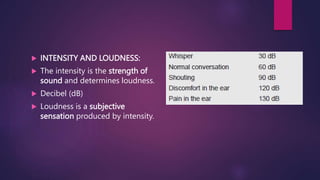
 INTENSITY AND LOUDNESS:
 The intensity is the strength of
sound and determines loudness.
 Decibel (dB)
 Loudness is a subjective
sensation produced by intensity.
TYPES OF HEARING LOSS
1.Conductive hearing loss:
 Diseases, which interfere with conduction of sound from
external ear to the stapedio-vestibular joint, result in
conductive hearing loss (CHL).
 1. External auditory canal obstructions: wax and inflammatory
swelling.
 2. Tympanic membrane perforation: Traumatic, AOM and
COM.
 3. Eustachian tube obstruction
 4. Middle ear fluid: OME.
 5. Ossicles fixation: Otosclerosis , tympanosclerosis.
 6. Ossicles disruption
2.Sensorineural hearing loss:
 The diseases of cochlea (sensory type) and CN VIII and its
central connections (neural type) result in sensorineural
hearing loss (SNHL).
 Retrocochlear HL refers to lesions of 8th nerve and central
auditory connections.
 Sensory (Cochlear): Presbycusis, mumps, noise-induced.
 Neural: Neural presbycusis and acoustic neuroma.
3.Mixed hearing loss:
 Has elements of both conductive and SNHL.
 The air-bone gap in PTA indicates conductive element while
while impairment of bone conduction indicates SNHL.
 The most common causes of mixed hearing loss (MHL) are
otosclerosis and COM.
Need for evaluating the hearing loss:
Hearing assessment facilitates in finding out following
features of hearing loss:-
 „
Type of hearing loss: Conductive, sensorineural or mixed.
 „Severity of hearing loss: Mild, moderate, moderately severe,
severe, profound or total.
 „Site of lesion: The diseases of external ear, tympanic
membrane and middle ear result in CHL. Clinical examination
and audiometry are helpful in finding site of lesion.
 Special hearing tests can differentiate between different types
of SNHL such as cochlear, retrocochlear and central.
 „Cause of hearing loss: may be congenital, traumatic, infective,
neoplastic, degenerative, metabolic, ototoxic, vascular or
autoimmune process.
Methods of hearing evaluation are classified into two
groups subjective and objective:
 Subjective methods which need patient’s co-operation and
reliability Tuning fork test, PTA and speech audiometry.
 Objective methods which can be done even in children
include impedance, electrocochleography (EcoG), BERA and
oto-acoustic emission.
PTA
 Non-invasive subjective test is a
graphic recording of hearing level
both quantitatively and
qualitatively.
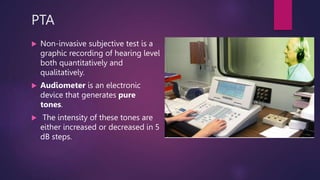
 Audiometer is an electronic
device that generates pure
tones.
 The intensity of these tones are
either increased or decreased in 5
dB steps.
 Audiometer is so calibrated that the
hearing of a normal person is at zero
dB level.
 AC thresholds are measured usually
for tones of 250, 500, 1,000, 2,000,
4,000 and 8,000 Hz.
 BC thresholds are measured usually
for 250, 500, 1,000, 2,000 and 4,000
Hz.
 Speech frequencies range from 500–
2,000 Hz
 PURE TONE AVERAGE: The pure
tone average is an average of the
AC thresholds at 500, 1,000, and
2,000 Hz frequencies.
 „AIR-BONE GAP:
 The BC thresholds are measure of
cochlear function.
 The difference between the
thresholds of AC and BC called
air-bone gap (A-B gap) is a
measure of CHL.
 „Decibel: A decibel is an
arbitrary logarithmic unit of
intensity of sound. Hearing is
measured on a biologic scale.
Method:
 Audiometry is done in a
soundproof room (ideal) or a
quite room.
 First AC and then BC is
recorded separately for each
ear.
 The pure tones are presented
to the ears by headphone (for
AC) and vibrator (for BC).
 The graph on which these
thresholds are charted is
called audiogram.
 For right ear red color and
for left ear blue color pencils
are used.
 AC continuous line, BC
interrupted (broken) line is
used for recording.
MASKING:
 Air conduction sounds “crossover” occurs when a 45-50 dB
difference exists between AC thresholds of two ears.
 BC sounds “crossover” may occur even at 0 dB difference
between the BC thresholds of the two ears.
 The narrow-band noise in the non-test ear (better hearing) is
employed for the masking.
 Presenting a noise into the non test ear so that its blocked
acoustically and does not participate in hearing test.
 In AC masking is required if the AC of testing ear is >45dB, as
the lower limit of inter-aural attenuation(IA) is 40-45dB.
 Cross hearing is suspected if AC(TEST)-BC(NON TEST) > IA
 If masking sound presented to the non test ear is not loud
enough to eliminate the non test ear from participating in the
test, it is undermasking.
 if masking presented to non test ear is loud and crosses and
blocks the cochlea of test ear, it is overmasking.
 When difference between the AC of
two ears is 40 dB or more, the better
ear is masked.
 Masking avoids getting a shadow
curve from the better ear.
 Masking of the non-test ear is
necessary during the BC studies.
SOUNDS USED FOR MASKING:
► White noise(wideband/broadband noise)
► Narrow band noise(more effective)
► Complex noise
INTERPRETATION OF PTA:
► AC threshold
► BC threshold
► A-B gap
Conductive hearing loss:
 AC threshold > 30dB
 BC threshold < 20dB
 A-B gap > 25dB
Sensorineural hearing loss:
 AC threshold > 30dB
 BC threshold > 20dB
 A-B gap < 20dB
Mixed hearing loss:
 AC threshold > 45dB
 BC threshold > 20dB
 A-B gap > 20dB
USES OF PTA:
 Measure of thresholds of AC and BC tells the degree and type
of hearing loss (mild-profound, CHL/SNHL).
 The progress of the disease and response to the treatment can
be documented (improving/progressive).
 The type and necessary setting of hearing aids can be
determined.
 The degree of handicap for medico-legal purposes can be
determined.
 Speech reception threshold (SRT) can be predicted.
Limitations of PTA
 Inaccuracy of audiogram due to improper technique/examiner/test
condition/audiometer.
 Subjective and time consuming test.
 Does not assess all features of hearing.
 Does not identify the nature of pathology.
 Multiple factors dependency.
Thank you

PURE TONE AUDIOMETRY.pptx

  • 1.
  • 2.
    DEFINITIONS AUDIOLOGY AND ACOUSTICS: Audiology refers to the study of hearing disorders through the hearing evaluation as well as the rehabilitation of the patients.  Acoustic pertains to hearing and perception of sounds. Acoustics is the science that deals with the sounds and their perception.
  • 3.
    SOUND:  Sound isa form of energy, produced by any vibrating object.  Produced by compression and rarefaction of molecules of medium in which it travels. FREQUENCY AND PITCH:  Frequency refers to the number of cycles per second. Hertz (Hz). (Hz).  Pitch is a subjective sensation produced by frequency of sound.
  • 4.
    PURE TONE:  Asingle frequency sound is called a pure tone such as 250, 500 or 1,000 Hz.  Threshold is the lowest sound pressure level at which under specified conditions the person gives predetermined percentage of correct responses on repeated trials.  In PTA, thresholds of hearing in decibels for various pure tones from 250 to 8,000 Hz are measured. COMPLEX TONE:  The sound, which has more than one frequency, is called a complex sound such as voice and speech.
  • 5.
     INTENSITY ANDLOUDNESS:  The intensity is the strength of sound and determines loudness.  Decibel (dB)  Loudness is a subjective sensation produced by intensity.
  • 6.
    TYPES OF HEARINGLOSS 1.Conductive hearing loss:  Diseases, which interfere with conduction of sound from external ear to the stapedio-vestibular joint, result in conductive hearing loss (CHL).  1. External auditory canal obstructions: wax and inflammatory swelling.
  • 7.
     2. Tympanicmembrane perforation: Traumatic, AOM and COM.  3. Eustachian tube obstruction  4. Middle ear fluid: OME.  5. Ossicles fixation: Otosclerosis , tympanosclerosis.  6. Ossicles disruption
  • 8.
    2.Sensorineural hearing loss: The diseases of cochlea (sensory type) and CN VIII and its central connections (neural type) result in sensorineural hearing loss (SNHL).  Retrocochlear HL refers to lesions of 8th nerve and central auditory connections.  Sensory (Cochlear): Presbycusis, mumps, noise-induced.  Neural: Neural presbycusis and acoustic neuroma.
  • 9.
    3.Mixed hearing loss: Has elements of both conductive and SNHL.  The air-bone gap in PTA indicates conductive element while while impairment of bone conduction indicates SNHL.  The most common causes of mixed hearing loss (MHL) are otosclerosis and COM.
  • 10.
    Need for evaluatingthe hearing loss: Hearing assessment facilitates in finding out following features of hearing loss:-  „ Type of hearing loss: Conductive, sensorineural or mixed.  „Severity of hearing loss: Mild, moderate, moderately severe, severe, profound or total.
  • 11.
     „Site oflesion: The diseases of external ear, tympanic membrane and middle ear result in CHL. Clinical examination and audiometry are helpful in finding site of lesion.  Special hearing tests can differentiate between different types of SNHL such as cochlear, retrocochlear and central.
  • 12.
     „Cause ofhearing loss: may be congenital, traumatic, infective, neoplastic, degenerative, metabolic, ototoxic, vascular or autoimmune process.
  • 13.
    Methods of hearingevaluation are classified into two groups subjective and objective:  Subjective methods which need patient’s co-operation and reliability Tuning fork test, PTA and speech audiometry.  Objective methods which can be done even in children include impedance, electrocochleography (EcoG), BERA and oto-acoustic emission.
  • 14.
    PTA  Non-invasive subjectivetest is a graphic recording of hearing level both quantitatively and qualitatively.  Audiometer is an electronic device that generates pure tones.  The intensity of these tones are either increased or decreased in 5 dB steps.
  • 15.
     Audiometer isso calibrated that the hearing of a normal person is at zero dB level.  AC thresholds are measured usually for tones of 250, 500, 1,000, 2,000, 4,000 and 8,000 Hz.  BC thresholds are measured usually for 250, 500, 1,000, 2,000 and 4,000 Hz.  Speech frequencies range from 500– 2,000 Hz
  • 16.
     PURE TONEAVERAGE: The pure tone average is an average of the AC thresholds at 500, 1,000, and 2,000 Hz frequencies.  „AIR-BONE GAP:  The BC thresholds are measure of cochlear function.
  • 17.
     The differencebetween the thresholds of AC and BC called air-bone gap (A-B gap) is a measure of CHL.  „Decibel: A decibel is an arbitrary logarithmic unit of intensity of sound. Hearing is measured on a biologic scale.
  • 18.
    Method:  Audiometry isdone in a soundproof room (ideal) or a quite room.  First AC and then BC is recorded separately for each ear.  The pure tones are presented to the ears by headphone (for AC) and vibrator (for BC).
  • 20.
     The graphon which these thresholds are charted is called audiogram.  For right ear red color and for left ear blue color pencils are used.  AC continuous line, BC interrupted (broken) line is used for recording.
  • 22.
    MASKING:  Air conductionsounds “crossover” occurs when a 45-50 dB difference exists between AC thresholds of two ears.  BC sounds “crossover” may occur even at 0 dB difference between the BC thresholds of the two ears.  The narrow-band noise in the non-test ear (better hearing) is employed for the masking.
  • 23.
     Presenting anoise into the non test ear so that its blocked acoustically and does not participate in hearing test.  In AC masking is required if the AC of testing ear is >45dB, as the lower limit of inter-aural attenuation(IA) is 40-45dB.  Cross hearing is suspected if AC(TEST)-BC(NON TEST) > IA
  • 24.
     If maskingsound presented to the non test ear is not loud enough to eliminate the non test ear from participating in the test, it is undermasking.  if masking presented to non test ear is loud and crosses and blocks the cochlea of test ear, it is overmasking.
  • 26.
     When differencebetween the AC of two ears is 40 dB or more, the better ear is masked.  Masking avoids getting a shadow curve from the better ear.  Masking of the non-test ear is necessary during the BC studies.
  • 27.
    SOUNDS USED FORMASKING: ► White noise(wideband/broadband noise) ► Narrow band noise(more effective) ► Complex noise
  • 28.
    INTERPRETATION OF PTA: ►AC threshold ► BC threshold ► A-B gap Conductive hearing loss:  AC threshold > 30dB  BC threshold < 20dB  A-B gap > 25dB
  • 29.
    Sensorineural hearing loss: AC threshold > 30dB  BC threshold > 20dB  A-B gap < 20dB Mixed hearing loss:  AC threshold > 45dB  BC threshold > 20dB  A-B gap > 20dB
  • 38.
    USES OF PTA: Measure of thresholds of AC and BC tells the degree and type of hearing loss (mild-profound, CHL/SNHL).  The progress of the disease and response to the treatment can be documented (improving/progressive).  The type and necessary setting of hearing aids can be determined.
  • 39.
     The degreeof handicap for medico-legal purposes can be determined.  Speech reception threshold (SRT) can be predicted.
  • 40.
    Limitations of PTA Inaccuracy of audiogram due to improper technique/examiner/test condition/audiometer.  Subjective and time consuming test.  Does not assess all features of hearing.  Does not identify the nature of pathology.  Multiple factors dependency.
  • 41.