In order to create an audience
profile, I need to assess my primary
audience and trends.
 Primary Audience: 35-55 year old males and females
 Secondary Audience: their partners
 Niche audience...
 Class: A/B income bracket
 Race: (Primarily) White
 Age: 35-55 years olds
 Gender: Female and Male
 Sexuality: Heterosexual Females and Males
 Nationality: British
Gender:
• I believe the female audience are
more likely to buy my magazine
product (as females are known to buy
magazines more than men; older
males are more likely to buy
newspapers than magazines – and if
this is the case, they’ll only read a
regional magazine usually to receive
some information & surveillance).
• However, I will still be appealing the
male audience with my potential
magazine containing advertisements
based on homing properties, building
tools or gardening.
• There will be adverts/articles based
on fashion, jewellery or cooking also
to appeal the female readers.
 Older,
 Sophisticated/Refined,
 Affluent,
 Therefore, my target audience will be high in the income
bracket, which is A/B income bracket – Upper Middle and
Middle Class.
 Have a lot of free time to spare learning new things;
enjoying the outdoors.
 Fully aware of their surroundings and society.
 Most likely to relax and read a sophisticated magazine,
once back from their long walk to the house.
 VAL/Lifestyle Types:
Materialists –
- Like stuff, own things and want high brands.
Achievers –
- They are a high-resource group.
- In order to feel motivated, they want something that reflects their own achievement.
- No need to buy expensive stuff.
- They are successful, work-oriented people who receive their fulfilment from their families and
jobs.
- Politically conservative, respect authority and the status quo.
- They prefer established products and services that show off their success to their peers.
 The achievers are the particular VAL Type my regional magazine will be targeting as they are
high in the income bracket, therefore, have a successful and well-paid job; they will be able to
portray their peers what they can achieve with their lifestyle by reading my magazine product
– have a reasonably high amount of money (may be inherited but worked hard for disposable
income) = are motivated by achievement.
(They are hedgehog thinkers: they are older, sophisticated and like to thoroughly read heavy
text; they’re not like fox thinkers who quickly scan over the text and miss sections out)
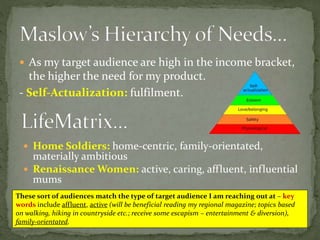
 As my target audience are high in the income bracket,
the higher the need for my product.
- Self-Actualization: fulfilment.
 Home Soldiers: home-centric, family-orientated,
materially ambitious
 Renaissance Women: active, caring, affluent, influential
mums
These sort of audiences match the type of target audience I am reaching out at – key
words include affluent, active (will be beneficial reading my regional magazine; topics based
on walking, hiking in countryside etc.; receive some escapism – entertainment & diversion),
family-orientated.
 Succeeders:
- People who have already got status and control.
- Therefore, as the target audience are high in the
income bracket and are 35-55 ear olds, they’ll most
likely have a busy/well-paid job (so have some form
of status and control) – they may like to read my
regional magazine to receive some escapism
(entertainment & diversion) as well as information &
surveillance.
I don’t think my primary audience are reformers because I believe this is too ‘edgy’
for my rather settled and suburban audience.
 Recent figures show that an increasing amount of adults (the older
generation) are using social media networks – they’re becoming digital
natives themselves (e.g. 45% of 65 years or older currently use
‘Facebook’).
 They even use other popular sites such as ‘LinkedIn’, ‘Snapchat’ and
‘Pinterest’).
 This indicates that my regional magazine product should contain pages
based on some social media network comments/feedback, such as
‘Twitter’ or ‘Facebook’ comments, as the older generation maybe
interested and want to scan over this – e.g. there could be a ‘Top Tweets’
page based on the target audiences’ feedback about their life in South
Yorkshire.
 THE DEMOGRAPHICS:
- men tend to use ‘LinkedIn’ more than women, however, women use all
other social media sites more than the men.
- ‘LinkedIn’: used more by older/educated/wealthy audience.
- ‘Pinterest’: (normally affluent) women outnumber men more than 4-
to-1.
 Moreover, I am aiming at affluent suburbia, and
focusing on a specific aspect of the white working
class history – therefore, I would suggest the race of
my target audience is white.
 Furthermore, I think this is important as rural
Yorkshire is VERY distinct from urban
multicultural Yorkshire cities; e.g. Bradford,
Sheffield and the media stereotype of this area.
 To understand these details a little more, I’ve had a
look at Yorkshire’s demographic as a whole– the
image of the article, containing useful statistics, is
shown below, which particularly distinguishes the
area from other locations of Yorkshire.
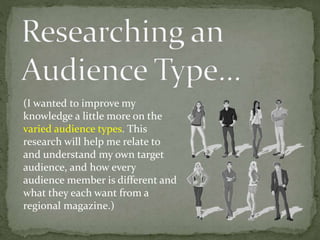
(I wanted to improve my
knowledge a little more on the
varied audience types. This
research will help me relate to
and understand my own target
audience, and how every
audience member is different and
what they each want from a
regional magazine.)
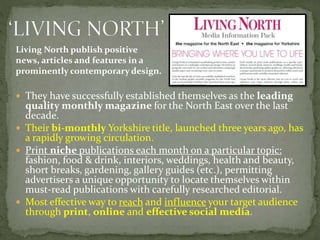
 They have successfully established themselves as the leading
quality monthly magazine for the North East over the last
decade.
 Their bi-monthly Yorkshire title, launched three years ago, has
a rapidly growing circulation.
 Print niche publications each month on a particular topic:
fashion, food & drink, interiors, weddings, health and beauty,
short breaks, gardening, gallery guides (etc.), permitting
advertisers a unique opportunity to locate themselves within
must-read publications with carefully researched editorial.
 Most effective way to reach and influence your target audience
through print, online and effective social media.
Living North publish positive
news, articles and features in a
prominently contemporary design.
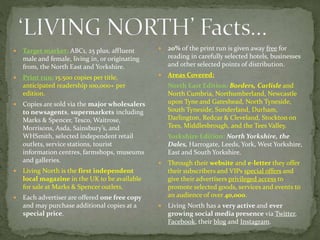
 Target market: ABC1, 25 plus, affluent
male and female, living in, or originating
from, the North East and Yorkshire.
 Print run: 15,500 copies per title,
anticipated readership 100,000+ per
edition.
 Copies are sold via the major wholesalers
to newsagents, supermarkets including
Marks & Spencer, Tesco, Waitrose,
Morrisons, Asda, Sainsbury’s, and
WHSmith, selected independent retail
outlets, service stations, tourist
information centres, farmshops, museums
and galleries.
 Living North is the first independent
local magazine in the UK to be available
for sale at Marks & Spencer outlets.
 Each advertiser are offered one free copy
and may purchase additional copies at a
special price.
 20% of the print run is given away free for
reading in carefully selected hotels, businesses
and other selected points of distribution.
 Areas Covered:
- North East Edition: Borders, Carlisle and
North Cumbria, Northumberland, Newcastle
upon Tyne and Gateshead, North Tyneside,
South Tyneside, Sunderland, Durham,
Darlington, Redcar & Cleveland, Stockton on
Tees, Middlesbrough, and the Tees Valley.
- Yorkshire Edition: North Yorkshire, the
Dales, Harrogate, Leeds, York, West Yorkshire,
East and South Yorkshire.
 Through their website and e-letter they offer
their subscribers and VIPs special offers and
give their advertisers privileged access to
promote selected goods, services and events to
an audience of over 40,000.
 Living North has a very active and ever
growing social media presence via Twitter,
Facebook, their blog and Instagram.
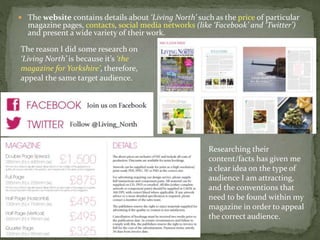
 The website contains details about ‘Living North’ such as the price of particular
magazine pages, contacts, social media networks (like ‘Facebook’ and ‘Twitter’)
and present a wide variety of their work.
The reason I did some research on
‘Living North’ is because it’s ‘the
magazine for Yorkshire’, therefore,
appeal the same target audience.
Researching their
content/facts has given me
a clear idea on the type of
audience I am attracting,
and the conventions that
need to be found within my
magazine in order to appeal
the correct audience.

Audience Profiling

  • 1.
    In order tocreate an audience profile, I need to assess my primary audience and trends.
  • 2.
     Primary Audience:35-55 year old males and females  Secondary Audience: their partners  Niche audience...  Class: A/B income bracket  Race: (Primarily) White  Age: 35-55 years olds  Gender: Female and Male  Sexuality: Heterosexual Females and Males  Nationality: British Gender: • I believe the female audience are more likely to buy my magazine product (as females are known to buy magazines more than men; older males are more likely to buy newspapers than magazines – and if this is the case, they’ll only read a regional magazine usually to receive some information & surveillance). • However, I will still be appealing the male audience with my potential magazine containing advertisements based on homing properties, building tools or gardening. • There will be adverts/articles based on fashion, jewellery or cooking also to appeal the female readers.
  • 3.
     Older,  Sophisticated/Refined, Affluent,  Therefore, my target audience will be high in the income bracket, which is A/B income bracket – Upper Middle and Middle Class.  Have a lot of free time to spare learning new things; enjoying the outdoors.  Fully aware of their surroundings and society.  Most likely to relax and read a sophisticated magazine, once back from their long walk to the house.
  • 4.
     VAL/Lifestyle Types: Materialists– - Like stuff, own things and want high brands. Achievers – - They are a high-resource group. - In order to feel motivated, they want something that reflects their own achievement. - No need to buy expensive stuff. - They are successful, work-oriented people who receive their fulfilment from their families and jobs. - Politically conservative, respect authority and the status quo. - They prefer established products and services that show off their success to their peers.  The achievers are the particular VAL Type my regional magazine will be targeting as they are high in the income bracket, therefore, have a successful and well-paid job; they will be able to portray their peers what they can achieve with their lifestyle by reading my magazine product – have a reasonably high amount of money (may be inherited but worked hard for disposable income) = are motivated by achievement. (They are hedgehog thinkers: they are older, sophisticated and like to thoroughly read heavy text; they’re not like fox thinkers who quickly scan over the text and miss sections out)
  • 5.
     As mytarget audience are high in the income bracket, the higher the need for my product. - Self-Actualization: fulfilment.  Home Soldiers: home-centric, family-orientated, materially ambitious  Renaissance Women: active, caring, affluent, influential mums These sort of audiences match the type of target audience I am reaching out at – key words include affluent, active (will be beneficial reading my regional magazine; topics based on walking, hiking in countryside etc.; receive some escapism – entertainment & diversion), family-orientated.
  • 6.
     Succeeders: - Peoplewho have already got status and control. - Therefore, as the target audience are high in the income bracket and are 35-55 ear olds, they’ll most likely have a busy/well-paid job (so have some form of status and control) – they may like to read my regional magazine to receive some escapism (entertainment & diversion) as well as information & surveillance. I don’t think my primary audience are reformers because I believe this is too ‘edgy’ for my rather settled and suburban audience.
  • 7.
     Recent figuresshow that an increasing amount of adults (the older generation) are using social media networks – they’re becoming digital natives themselves (e.g. 45% of 65 years or older currently use ‘Facebook’).  They even use other popular sites such as ‘LinkedIn’, ‘Snapchat’ and ‘Pinterest’).  This indicates that my regional magazine product should contain pages based on some social media network comments/feedback, such as ‘Twitter’ or ‘Facebook’ comments, as the older generation maybe interested and want to scan over this – e.g. there could be a ‘Top Tweets’ page based on the target audiences’ feedback about their life in South Yorkshire.  THE DEMOGRAPHICS: - men tend to use ‘LinkedIn’ more than women, however, women use all other social media sites more than the men. - ‘LinkedIn’: used more by older/educated/wealthy audience. - ‘Pinterest’: (normally affluent) women outnumber men more than 4- to-1.
  • 8.
     Moreover, Iam aiming at affluent suburbia, and focusing on a specific aspect of the white working class history – therefore, I would suggest the race of my target audience is white.  Furthermore, I think this is important as rural Yorkshire is VERY distinct from urban multicultural Yorkshire cities; e.g. Bradford, Sheffield and the media stereotype of this area.  To understand these details a little more, I’ve had a look at Yorkshire’s demographic as a whole– the image of the article, containing useful statistics, is shown below, which particularly distinguishes the area from other locations of Yorkshire.
  • 9.
    (I wanted toimprove my knowledge a little more on the varied audience types. This research will help me relate to and understand my own target audience, and how every audience member is different and what they each want from a regional magazine.)
  • 10.
     They havesuccessfully established themselves as the leading quality monthly magazine for the North East over the last decade.  Their bi-monthly Yorkshire title, launched three years ago, has a rapidly growing circulation.  Print niche publications each month on a particular topic: fashion, food & drink, interiors, weddings, health and beauty, short breaks, gardening, gallery guides (etc.), permitting advertisers a unique opportunity to locate themselves within must-read publications with carefully researched editorial.  Most effective way to reach and influence your target audience through print, online and effective social media. Living North publish positive news, articles and features in a prominently contemporary design.
  • 11.
     Target market:ABC1, 25 plus, affluent male and female, living in, or originating from, the North East and Yorkshire.  Print run: 15,500 copies per title, anticipated readership 100,000+ per edition.  Copies are sold via the major wholesalers to newsagents, supermarkets including Marks & Spencer, Tesco, Waitrose, Morrisons, Asda, Sainsbury’s, and WHSmith, selected independent retail outlets, service stations, tourist information centres, farmshops, museums and galleries.  Living North is the first independent local magazine in the UK to be available for sale at Marks & Spencer outlets.  Each advertiser are offered one free copy and may purchase additional copies at a special price.  20% of the print run is given away free for reading in carefully selected hotels, businesses and other selected points of distribution.  Areas Covered: - North East Edition: Borders, Carlisle and North Cumbria, Northumberland, Newcastle upon Tyne and Gateshead, North Tyneside, South Tyneside, Sunderland, Durham, Darlington, Redcar & Cleveland, Stockton on Tees, Middlesbrough, and the Tees Valley. - Yorkshire Edition: North Yorkshire, the Dales, Harrogate, Leeds, York, West Yorkshire, East and South Yorkshire.  Through their website and e-letter they offer their subscribers and VIPs special offers and give their advertisers privileged access to promote selected goods, services and events to an audience of over 40,000.  Living North has a very active and ever growing social media presence via Twitter, Facebook, their blog and Instagram.
  • 12.
     The websitecontains details about ‘Living North’ such as the price of particular magazine pages, contacts, social media networks (like ‘Facebook’ and ‘Twitter’) and present a wide variety of their work. The reason I did some research on ‘Living North’ is because it’s ‘the magazine for Yorkshire’, therefore, appeal the same target audience. Researching their content/facts has given me a clear idea on the type of audience I am attracting, and the conventions that need to be found within my magazine in order to appeal the correct audience.