Unit G321: Foundation
Portfolio in Media
Preliminary Task, Log Book and
Evaluation
Amelia Springthorpe
Candidate Number:6502
Center Name: St Paul’s Catholic College
Center Number: 64770
Music Magazine
Genre Research
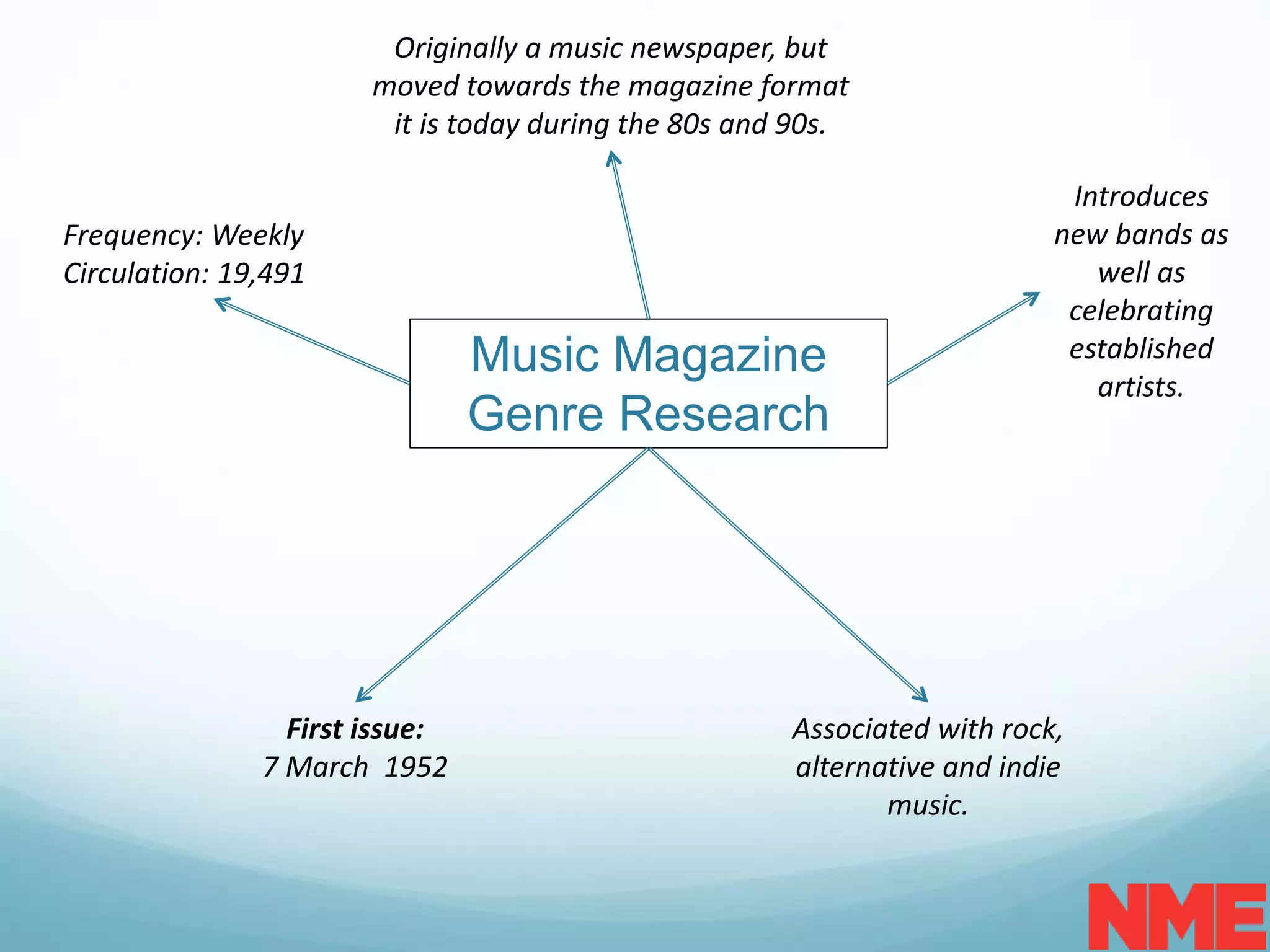
Frequency: Weekly
Circulation: 19,491
Associated with rock,
alternative and indie
music.
Originally a music newspaper, but
moved towards the magazine format
it is today during the 80s and 90s.
Introduces
new bands as
well as
celebrating
established
artists.
First issue:
7 March 1952
Why NME?
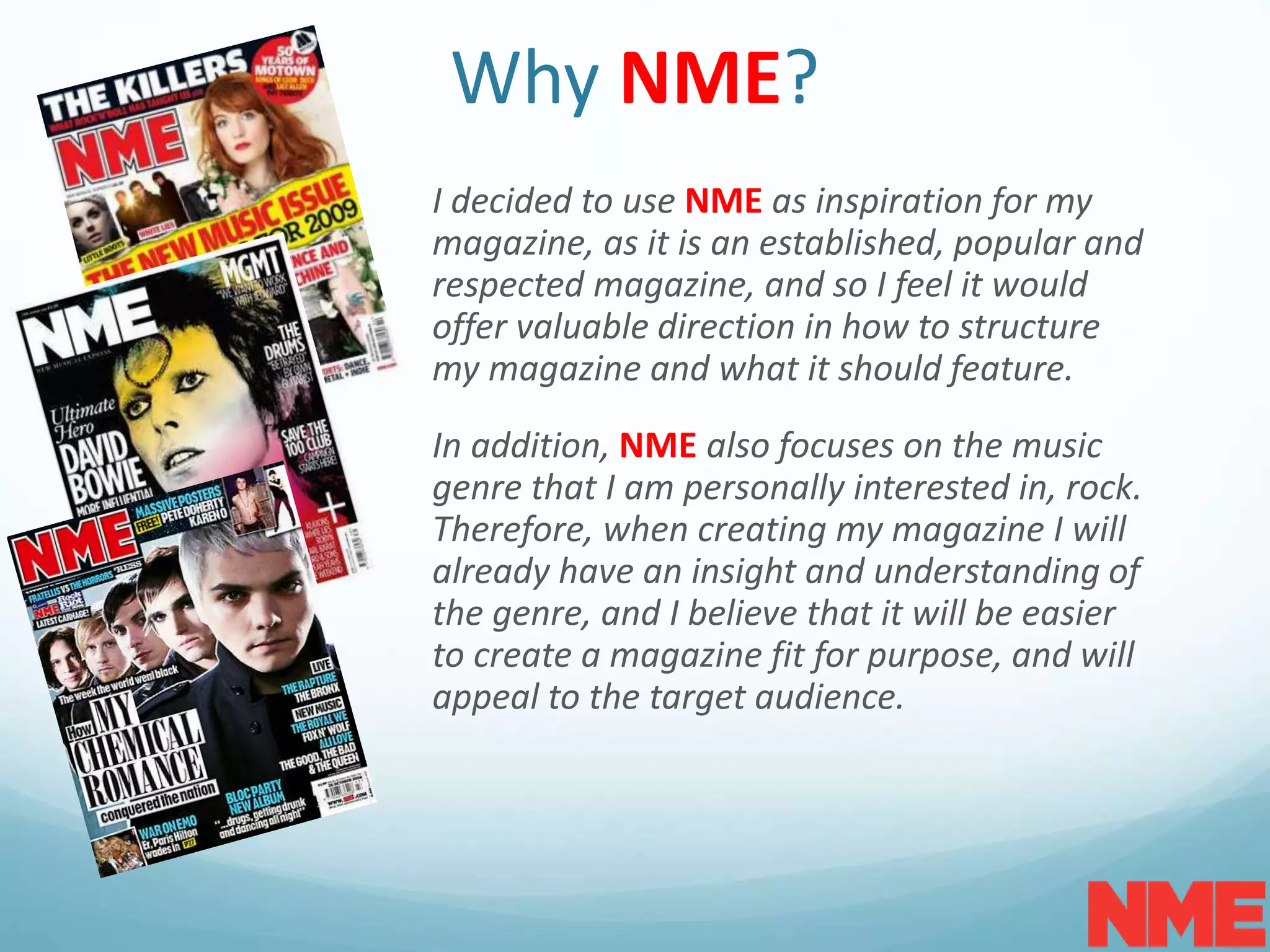
I decided to use NME as inspiration for my
magazine, as it is an established, popular and
respected magazine, and so I feel it would
offer valuable direction in how to structure
my magazine and what it should feature.
In addition, NME also focuses on the music
genre that I am personally interested in, rock.
Therefore, when creating my magazine I will
already have an insight and understanding of
the genre, and I believe that it will be easier
to create a magazine fit for purpose, and will
appeal to the target audience.
Established magazine research
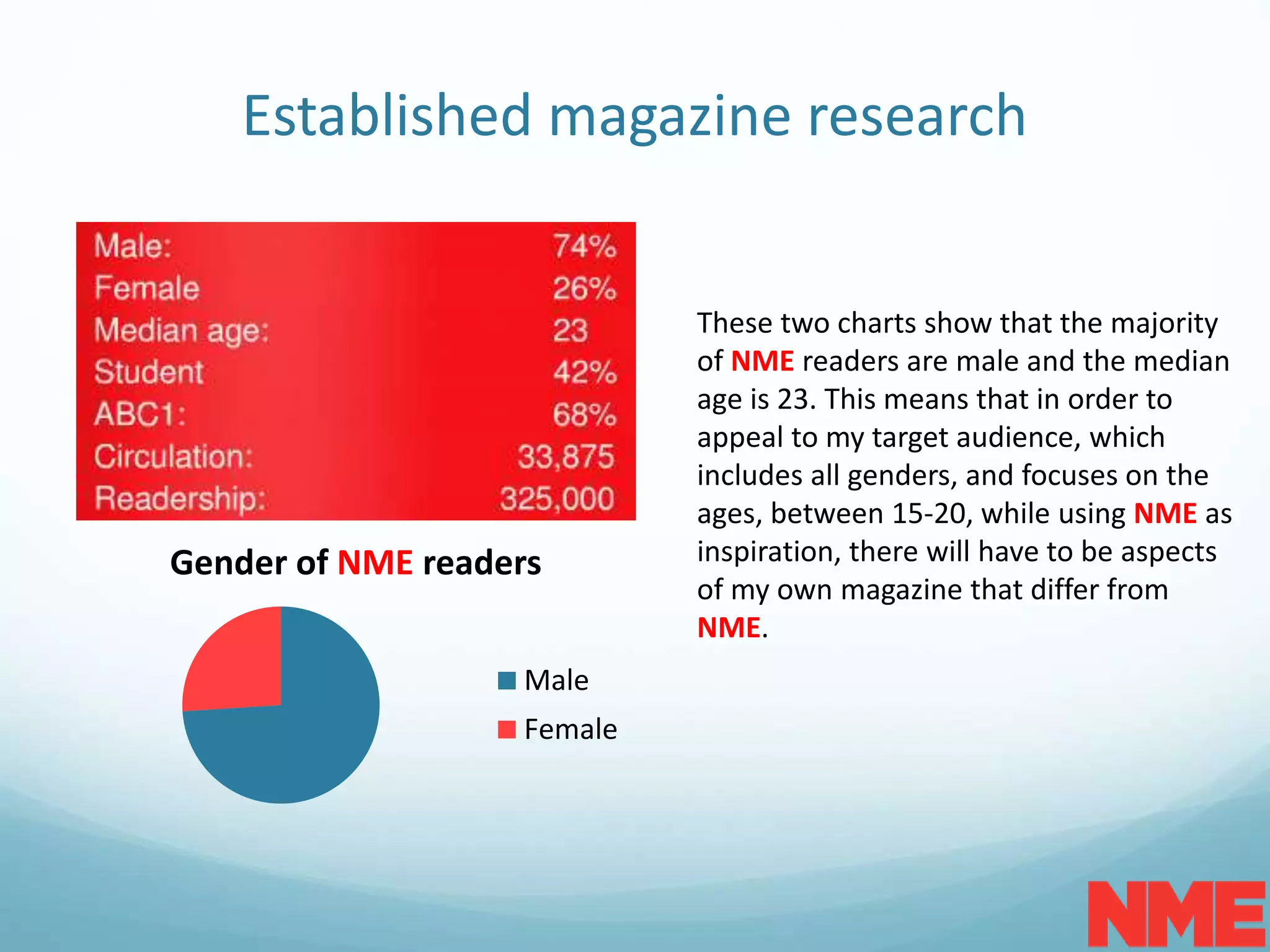
Gender of NME readers
Male
Female
These two charts show that the majority
of NME readers are male and the median
age is 23. This means that in order to
appeal to my target audience, which
includes all genders, and focuses on the
ages, between 15-20, while using NME as
inspiration, there will have to be aspects
of my own magazine that differ from
NME.
Target Audience – Katz, Maslow, Hartley and/or socio-economic needs.
The target audience for NME magazine can be denoted as, primarily people who
are interested in music; more specifically people who have an interest in new and
upcoming artists as well as established and ‘classic’ bands/ artists, for example,
‘The Rolling Stones’ and David Bowie. This can be denoted from the line on the
front cover of the magazine which reads ‘The Past, Present and Future of Music.’
What is the USP of this Magazine? Refer to specific conventions/ stories from
your research.
The Unique Selling Point of this magazine is the genre of music that it focuses on.
Music magazines, regardless of genre, tend to focus on mainstream artists, while,
although NME features established artists, such as, David Bowie, The Rolling
Stones & Radiohead, the magazine also introduces new and emerging artists to
the audience.
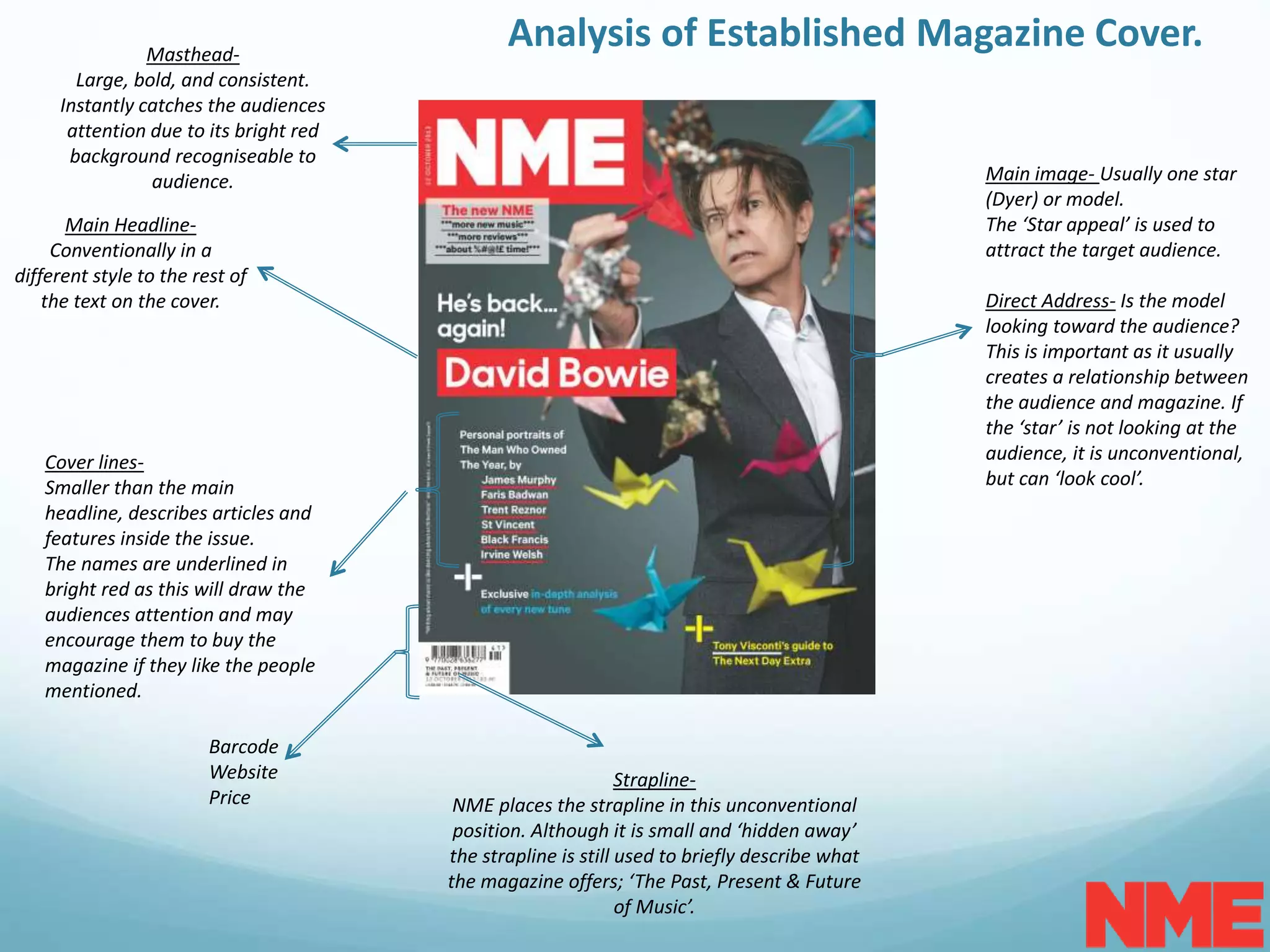
Analysis of Established Magazine Cover.Masthead-
Large, bold, and consistent.
Instantly catches the audiences
attention due to its bright red
background recogniseable to
audience. Main image- Usually one star
(Dyer) or model.
The ‘Star appeal’ is used to
attract the target audience.
Direct Address- Is the model
looking toward the audience?
This is important as it usually
creates a relationship between
the audience and magazine. If
the ‘star’ is not looking at the
audience, it is unconventional,
but can ‘look cool’.
Cover lines-
Smaller than the main
headline, describes articles and
features inside the issue.
The names are underlined in
bright red as this will draw the
audiences attention and may
encourage them to buy the
magazine if they like the people
mentioned.
Barcode
Website
Price
Main Headline-
Conventionally in a
different style to the rest of
the text on the cover.
Strapline-
NME places the strapline in this unconventional
position. Although it is small and ‘hidden away’
the strapline is still used to briefly describe what
the magazine offers; ‘The Past, Present & Future
of Music’.
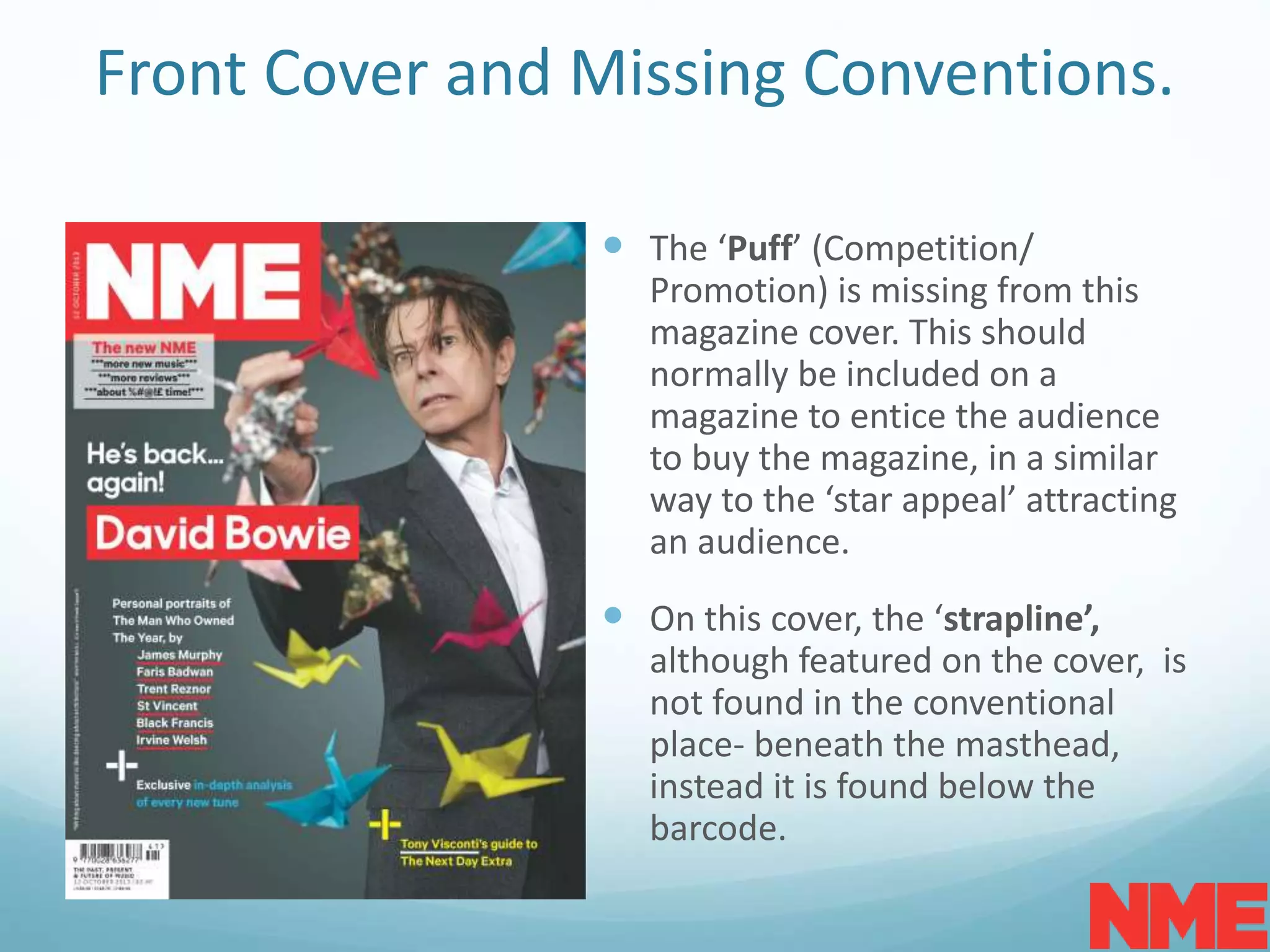
Front Cover and Missing Conventions.
 The ‘Puff’ (Competition/
Promotion) is missing from this
magazine cover. This should
normally be included on a
magazine to entice the audience
to buy the magazine, in a similar
way to the ‘star appeal’ attracting
an audience.
 On this cover, the ‘strapline’,
although featured on the cover, is
not found in the conventional
place- beneath the masthead,
instead it is found below the
barcode.
Publisher Research.
American New York-bases
publishing company
“Time Inc. is one of the largest
media companies in the world
reaching more than 130million
consumers each month across
multiple platforms through
influential brands such as Time,
People, Sports Illustrated,
InStyle, Real Simple, Travel +
Leisure, Food & Wine,
Wallpaper and NME.” – Taken
from the Time Inc. Website.
Publishes over 90 magazines.
In 1990, Time, Inc. merged with
Warner Communications to form the
media conglomerate Time Warner.
This merger lasted until the company
was spun off on June 9th, 2014.
Founded 1922.
“Time Inc. brands attract
young and affluent
consumers; 2 out of 3 have
incomes over $100,000+
and more than half are 18-
34”
“CONSUMERS INTERACT WITH
OUR BRANDS MORE THAN A
QUARTER OF A BILLION TIMES
A YEAR - THAT’S OVER 10
MEANINGFUL INTERACTIONS
PER SECOND.”
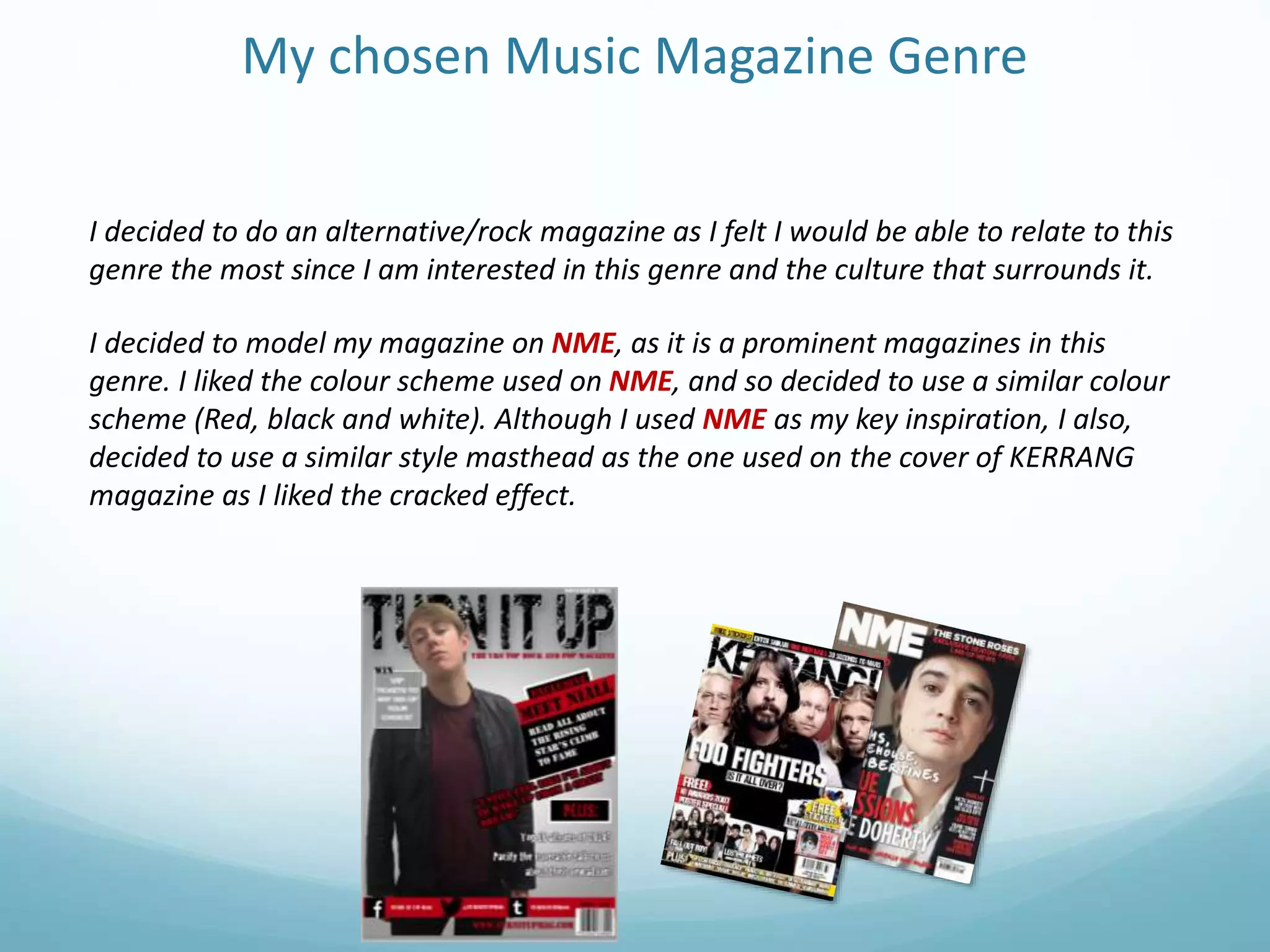
My chosen Music Magazine Genre
I decided to do an alternative/rock magazine as I felt I would be able to relate to this
genre the most since I am interested in this genre and the culture that surrounds it.
I decided to model my magazine on NME, as it is a prominent magazines in this
genre. I liked the colour scheme used on NME, and so decided to use a similar colour
scheme (Red, black and white). Although I used NME as my key inspiration, I also,
decided to use a similar style masthead as the one used on the cover of KERRANG
magazine as I liked the cracked effect.
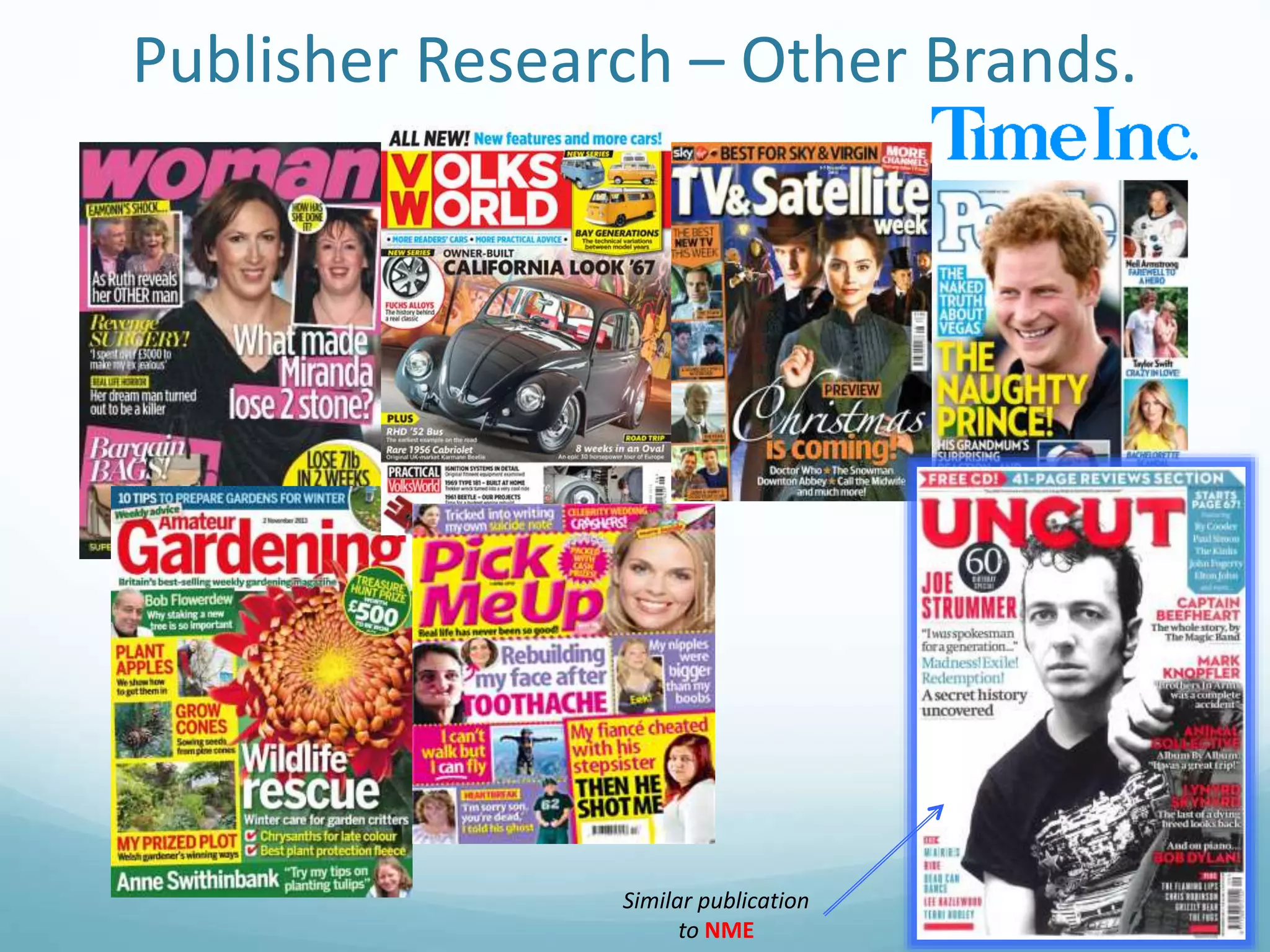
Publisher Research – Other Brands.
Similar publication
to NME

Log book

  • 1.
    Unit G321: Foundation Portfolioin Media Preliminary Task, Log Book and Evaluation Amelia Springthorpe Candidate Number:6502 Center Name: St Paul’s Catholic College Center Number: 64770
  • 2.
    Music Magazine Genre Research Frequency:Weekly Circulation: 19,491 Associated with rock, alternative and indie music. Originally a music newspaper, but moved towards the magazine format it is today during the 80s and 90s. Introduces new bands as well as celebrating established artists. First issue: 7 March 1952
  • 3.
    Why NME? I decidedto use NME as inspiration for my magazine, as it is an established, popular and respected magazine, and so I feel it would offer valuable direction in how to structure my magazine and what it should feature. In addition, NME also focuses on the music genre that I am personally interested in, rock. Therefore, when creating my magazine I will already have an insight and understanding of the genre, and I believe that it will be easier to create a magazine fit for purpose, and will appeal to the target audience.
  • 4.
    Established magazine research Genderof NME readers Male Female These two charts show that the majority of NME readers are male and the median age is 23. This means that in order to appeal to my target audience, which includes all genders, and focuses on the ages, between 15-20, while using NME as inspiration, there will have to be aspects of my own magazine that differ from NME.
  • 5.
    Target Audience –Katz, Maslow, Hartley and/or socio-economic needs. The target audience for NME magazine can be denoted as, primarily people who are interested in music; more specifically people who have an interest in new and upcoming artists as well as established and ‘classic’ bands/ artists, for example, ‘The Rolling Stones’ and David Bowie. This can be denoted from the line on the front cover of the magazine which reads ‘The Past, Present and Future of Music.’ What is the USP of this Magazine? Refer to specific conventions/ stories from your research. The Unique Selling Point of this magazine is the genre of music that it focuses on. Music magazines, regardless of genre, tend to focus on mainstream artists, while, although NME features established artists, such as, David Bowie, The Rolling Stones & Radiohead, the magazine also introduces new and emerging artists to the audience.
  • 6.
    Analysis of EstablishedMagazine Cover.Masthead- Large, bold, and consistent. Instantly catches the audiences attention due to its bright red background recogniseable to audience. Main image- Usually one star (Dyer) or model. The ‘Star appeal’ is used to attract the target audience. Direct Address- Is the model looking toward the audience? This is important as it usually creates a relationship between the audience and magazine. If the ‘star’ is not looking at the audience, it is unconventional, but can ‘look cool’. Cover lines- Smaller than the main headline, describes articles and features inside the issue. The names are underlined in bright red as this will draw the audiences attention and may encourage them to buy the magazine if they like the people mentioned. Barcode Website Price Main Headline- Conventionally in a different style to the rest of the text on the cover. Strapline- NME places the strapline in this unconventional position. Although it is small and ‘hidden away’ the strapline is still used to briefly describe what the magazine offers; ‘The Past, Present & Future of Music’.
  • 7.
    Front Cover andMissing Conventions.  The ‘Puff’ (Competition/ Promotion) is missing from this magazine cover. This should normally be included on a magazine to entice the audience to buy the magazine, in a similar way to the ‘star appeal’ attracting an audience.  On this cover, the ‘strapline’, although featured on the cover, is not found in the conventional place- beneath the masthead, instead it is found below the barcode.
  • 8.
    Publisher Research. American NewYork-bases publishing company “Time Inc. is one of the largest media companies in the world reaching more than 130million consumers each month across multiple platforms through influential brands such as Time, People, Sports Illustrated, InStyle, Real Simple, Travel + Leisure, Food & Wine, Wallpaper and NME.” – Taken from the Time Inc. Website. Publishes over 90 magazines. In 1990, Time, Inc. merged with Warner Communications to form the media conglomerate Time Warner. This merger lasted until the company was spun off on June 9th, 2014. Founded 1922. “Time Inc. brands attract young and affluent consumers; 2 out of 3 have incomes over $100,000+ and more than half are 18- 34” “CONSUMERS INTERACT WITH OUR BRANDS MORE THAN A QUARTER OF A BILLION TIMES A YEAR - THAT’S OVER 10 MEANINGFUL INTERACTIONS PER SECOND.”
  • 9.
    My chosen MusicMagazine Genre I decided to do an alternative/rock magazine as I felt I would be able to relate to this genre the most since I am interested in this genre and the culture that surrounds it. I decided to model my magazine on NME, as it is a prominent magazines in this genre. I liked the colour scheme used on NME, and so decided to use a similar colour scheme (Red, black and white). Although I used NME as my key inspiration, I also, decided to use a similar style masthead as the one used on the cover of KERRANG magazine as I liked the cracked effect.
  • 10.
    Publisher Research –Other Brands. Similar publication to NME