Entrepreneurship
Prepared by: Genevieve L. Cavaiani
Entrepreneurship
 Entre means to enter
 Pre means before and
 Neur means never center
 Shefsky’s practical view on the term leads to a definition of the word
someone who enters a business- any business- in time to form or change
substantially that business nerve center.
 All that matter is that individuals develop or change the nerve center of the
business
 Prof. Robert Nelson: a person who is able to look at the environment, identify
opportunities to improve the environment, marshal resources and implement
action to maximize those opportunities.
Another definition
 The ability and build vision from practically nothing. The vision requires a
willingness to take calculated risks-both personal and financial- and then do
everything possible to reduce the chances of failure.
 Is the process creating different with value of devoting the necessary time
and effort, assuming the accompanying financial and social risks, and
receiving the resulting rewards of monetary and personal satisfaction
 It is a person who is able to look the environment, identify opportunities to
improve the environment, marshall resources, and implement action to
maximize those opportunities.
 Is an inventor and developer of ideas, change agent, creative persistent and
a class of his own having his own value system
Entrepreneurship is a process and
approach
 According to Albert Shapero: Entrepreneur is a dynamic process of innovation
and new venture creation through five major dimensions:
 Individuals
 Organization
 Environment
 Process
 Institution
Process of Entrepreneurial Activity
 Initiative: an individual or group takes the intiative
 Organization: resources are brought together in organization to accomplish
some objective ( or the resources in existing organization are reorganized)
Socio-economic benefits from
entrepreneurship
1. Promotes self help and unemployment
2. Mobilizes capital- ideal capital kept in vaults of households will now be utilized
and pumped into the financial system which means helps the economy grow and
create more business options and more income in returns
3. Provides taxes to the economy
4. Empower individuals- possibility of wealth accumulation. High income-earning
potentials
5. Enhance national identity and pride-the quality of products and service produced
by entrepreneurs is a source of pride and identity for a country
6. Enhance competitive consciousness
7. Improves quality of life
8. Enhances equitable distribution of income and wealth
 Another advantage of being an entrepreneur is the unlimited economic and
social opportunities. They can become rich and famous.
 However, entrepreneur has the ability to relate well with customers, suppliers
and employees. He must be innovative, hardworking and risk-taker
Question:
 Why does the economy need entrepreneurs?
 What are the challenges to entrepreneurs in the light of the so-called
borderless world? Explain.
Role of Entrepreneurship in economic
development
1. Entrepreneur offers an economical and faster method of distributing goods
and services that accelerates economic development.
2. Entrepreneurship is capable of generating more jobs, income, goods and
services.
3. Entrepreneurship improves quality of life.
4. Entrepreneurship utilizes and mobilizes resources to make the country
productive
5. Entrepreneurship bring social benefits through the government.
Entrepreneurial Competencies
1. Integrity- the entrepreneur has a clear sense of values and beliefs that under
spin the creative and business decision that they make; and that influence
the actions they take.
2. Conceptual thinking- the entrepreneur is prepared to use fresh approaches,
comes up with crazy ideas, that may just work, leading to radical change or
significant improvement.
3. Risk taking- the entrepreneur understands that networking is a key business
activity which can provide access to information which helps achieve the
desired results.
4. Networking- entrepreneur understands that networking is a key business
activity which can provide access to information which helps achieve the
desired results.
5. Strategic thinking- the entrepreneur understand and values the planning
process, thinking and planning over a significant timescale, recognizes
external trends and opportunities
6. Commercial aptitude- the entrepreneur keeps up to date with developments
in the sector, seeks out best practice and identifies opportunities.
7. Decisiveness- the entrepreneur resolves issues as they arise; does not get
bogged down in analysis during decision making and responds flexibility to
deal with changing priorities.
8. Optimism- the entrepreneur persists in pursuing goals despite obstacles and
setbacks; operates from hope of success rather than from fear of failures.
9. Customer sensibility- the entrepreneur builds trusts and long term
relationships with customer and regularly exceeds customer expectations.
10. People focus- the entrepreneur creates common purpose with colleagues
through shared vision and values and always considers the principles of
inclusiveness in planning and dealing with others.
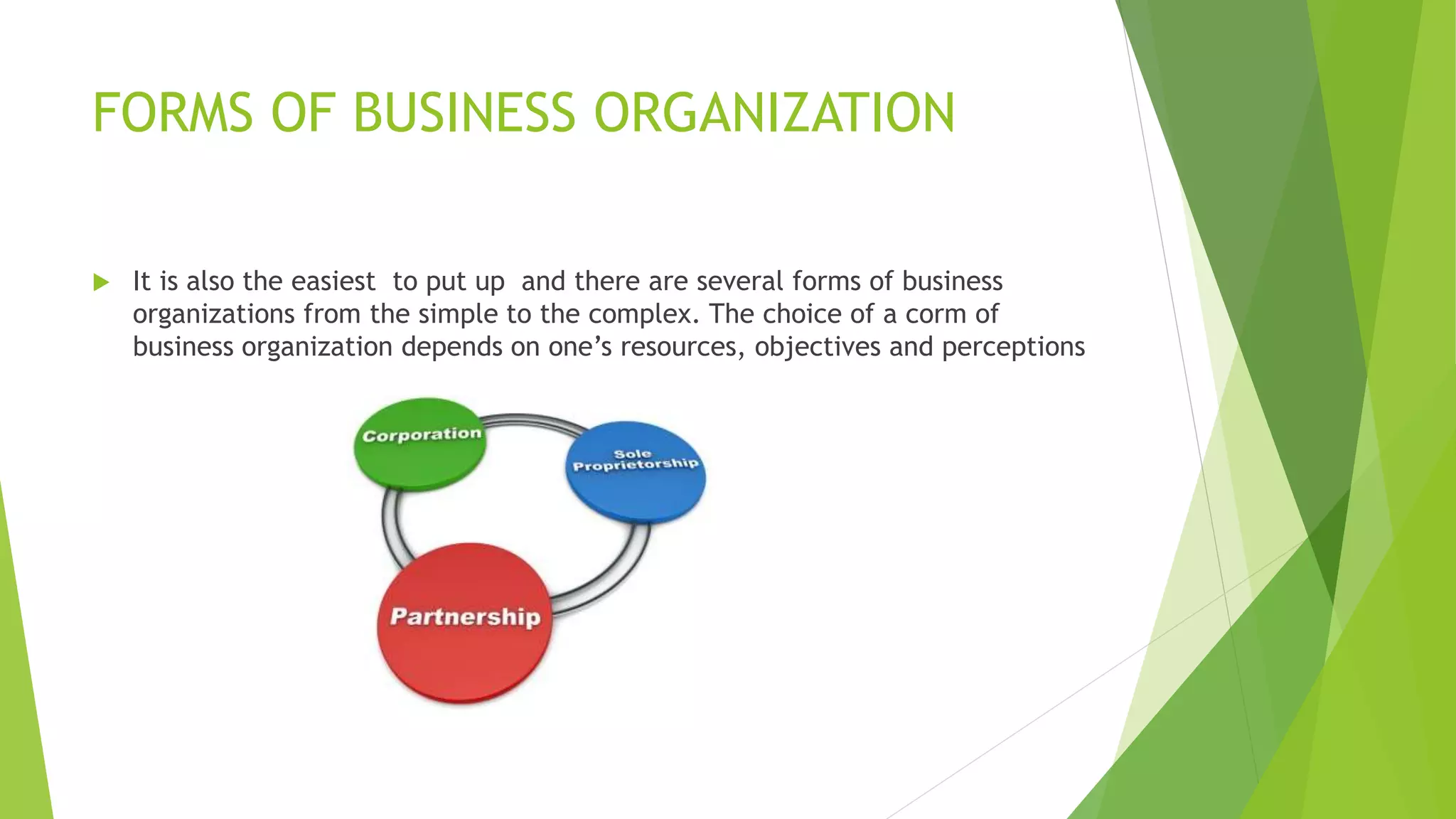
FORMS OF BUSINESS ORGANIZATION
 It is also the easiest to put up and there are several forms of business
organizations from the simple to the complex. The choice of a corm of
business organization depends on one’s resources, objectives and perceptions
THREE MOST COMMON BUSINESS
ORGANIZATION
1. Single/ Sole proprietorship- this is owned and usually managed by one person.
It is the oldest and simplest form of business.
2. Partnership – is an association of two or more persons who are co-owners of a
business.
3. Corporation- it is an artificial being created by operation of law, having the
right of succession and the powers, attributes, and properties expressedly
authorized by law or incident to its existence.
STOCKS- the shares or certificates of ownership of a corporation.
STOCKHOLDERS- the owner of the stocks.
ADVANTAGE DISADVANTAGE
1. It is easy to form and dissolve- it
requires a small capital and there
are no legal papers needed except
the usual business license.
Likewise, it easy to close.
2. All profits belong to the business
owner.
3. The owner is the boss.
4. Tax advantage and less government
regulation
1. Unlimited liability
2. Lack of stability- if the owner dies, it is the
end of business unless members of the
family or relatives can continue the
business.
3. Limited access to credit- bank and other
financial institution are now willing to lend
big money to single proprietorship. Assets
of owner are generally too small to be used
as security.
4. Limited a business knowledge and skills- in
many cases, the owners is the manager,
and janitor. There is no specialization by
means of division of labor
PARTNERSHIP
 ADVANTAGES:
 It is easy to organize.
 Availability of more capital and
credit
 The partners get all the profits
 More and better knowledge and
skills
 DISADVANTAGES:
 Unlimited liability
 Lack of stability-death, withdrawal
 Management disagreement
 Idle investment- when a partner
decides to leave the organization,
his remaining partners may not buy
his shares
ADVANTAGES
CORPORTATION
 LIMITED LIABILITY- THE LEIABILITY OF A STOCKHOLDER IS LIMITED TO HIS
SHARES OF STOCK
 Easy to raise capital
 Perpetual life- the life of a corporation does not end with the withdrawal or
death of the key owners. It can exist for 50 years and is subject for renewal.
 Specialized management- a corporation can hire professional managers or
specialist. It has funds to develop its human resources
DISADVANTAGES
CORPORTATION
 Difficult to organize and quite expensive to organize a corporation. It requires
the services of a lawyer to prepare legal forms and accountant to prepare
financial documents. Legal requirements include submission of articles of
incorporation and by law to SEC, registration to SSS, BIR and DOLE
 Strictly regulated and supervised by the government- government regulation
and supervision are closet compared with other forms of business
organizations
 Some corporation are socially irresponsible-they pollute the environment and
sell standard goods
 Formal and impersonal employer- employee relationship- a corporation has
several layers of management. The president and BOD seldom or do not
associate with the workers or clerks of the corporation
COOPERATIVE
 Republic Act 6938, otherwise known as the Cooperative
Code of the Philippines, defined cooperative as a duly
registered association of persons, with a common bond of
interest, who have voluntarily joined together to achieve
a lawful common social or economic end, making
equitable contributions to the capital required, and
accepting affair share of the risks and benefits of the
undertaking in accordance with universally accepted
cooperative principles
Principles of Cooperative
1. Open and voluntary
2. Democratic control- affairs of the co-organization are administered by the
personnel elected or a appointed in accordance with their approved of
Constitution and By-Laws
3. Limited interest on capital
4. Division on net surplus-net surplus belongs to the members of the cooperative
5. Cooperative education- all cooperatives are mandated to make provision for
the education of their members, officers and employees.
6. Cooperation among cooperatives- all cooperatives have to actively cooperate
with other cooperatives at local, national and international levels.
NATURE OF ENVIROMENTAL SCANNING
 In the context of strategizing for the purpose of making the business
organization competitive and sustainable over a long-term period
environmental scanning is extremely important
 It is critical in the sense that the business organization has to be responsive

Entrepreneurship module 1

  • 1.
  • 2.
    Entrepreneurship  Entre meansto enter  Pre means before and  Neur means never center  Shefsky’s practical view on the term leads to a definition of the word someone who enters a business- any business- in time to form or change substantially that business nerve center.  All that matter is that individuals develop or change the nerve center of the business  Prof. Robert Nelson: a person who is able to look at the environment, identify opportunities to improve the environment, marshal resources and implement action to maximize those opportunities.
  • 3.
    Another definition  Theability and build vision from practically nothing. The vision requires a willingness to take calculated risks-both personal and financial- and then do everything possible to reduce the chances of failure.  Is the process creating different with value of devoting the necessary time and effort, assuming the accompanying financial and social risks, and receiving the resulting rewards of monetary and personal satisfaction  It is a person who is able to look the environment, identify opportunities to improve the environment, marshall resources, and implement action to maximize those opportunities.  Is an inventor and developer of ideas, change agent, creative persistent and a class of his own having his own value system
  • 4.
    Entrepreneurship is aprocess and approach  According to Albert Shapero: Entrepreneur is a dynamic process of innovation and new venture creation through five major dimensions:  Individuals  Organization  Environment  Process  Institution
  • 5.
    Process of EntrepreneurialActivity  Initiative: an individual or group takes the intiative  Organization: resources are brought together in organization to accomplish some objective ( or the resources in existing organization are reorganized)
  • 6.
    Socio-economic benefits from entrepreneurship 1.Promotes self help and unemployment 2. Mobilizes capital- ideal capital kept in vaults of households will now be utilized and pumped into the financial system which means helps the economy grow and create more business options and more income in returns 3. Provides taxes to the economy 4. Empower individuals- possibility of wealth accumulation. High income-earning potentials 5. Enhance national identity and pride-the quality of products and service produced by entrepreneurs is a source of pride and identity for a country 6. Enhance competitive consciousness 7. Improves quality of life 8. Enhances equitable distribution of income and wealth
  • 7.
     Another advantageof being an entrepreneur is the unlimited economic and social opportunities. They can become rich and famous.  However, entrepreneur has the ability to relate well with customers, suppliers and employees. He must be innovative, hardworking and risk-taker
  • 8.
    Question:  Why doesthe economy need entrepreneurs?  What are the challenges to entrepreneurs in the light of the so-called borderless world? Explain.
  • 9.
    Role of Entrepreneurshipin economic development 1. Entrepreneur offers an economical and faster method of distributing goods and services that accelerates economic development. 2. Entrepreneurship is capable of generating more jobs, income, goods and services. 3. Entrepreneurship improves quality of life. 4. Entrepreneurship utilizes and mobilizes resources to make the country productive 5. Entrepreneurship bring social benefits through the government.
  • 10.
    Entrepreneurial Competencies 1. Integrity-the entrepreneur has a clear sense of values and beliefs that under spin the creative and business decision that they make; and that influence the actions they take. 2. Conceptual thinking- the entrepreneur is prepared to use fresh approaches, comes up with crazy ideas, that may just work, leading to radical change or significant improvement. 3. Risk taking- the entrepreneur understands that networking is a key business activity which can provide access to information which helps achieve the desired results. 4. Networking- entrepreneur understands that networking is a key business activity which can provide access to information which helps achieve the desired results.
  • 11.
    5. Strategic thinking-the entrepreneur understand and values the planning process, thinking and planning over a significant timescale, recognizes external trends and opportunities 6. Commercial aptitude- the entrepreneur keeps up to date with developments in the sector, seeks out best practice and identifies opportunities. 7. Decisiveness- the entrepreneur resolves issues as they arise; does not get bogged down in analysis during decision making and responds flexibility to deal with changing priorities. 8. Optimism- the entrepreneur persists in pursuing goals despite obstacles and setbacks; operates from hope of success rather than from fear of failures.
  • 12.
    9. Customer sensibility-the entrepreneur builds trusts and long term relationships with customer and regularly exceeds customer expectations. 10. People focus- the entrepreneur creates common purpose with colleagues through shared vision and values and always considers the principles of inclusiveness in planning and dealing with others.
  • 13.
    FORMS OF BUSINESSORGANIZATION  It is also the easiest to put up and there are several forms of business organizations from the simple to the complex. The choice of a corm of business organization depends on one’s resources, objectives and perceptions
  • 15.
    THREE MOST COMMONBUSINESS ORGANIZATION 1. Single/ Sole proprietorship- this is owned and usually managed by one person. It is the oldest and simplest form of business. 2. Partnership – is an association of two or more persons who are co-owners of a business. 3. Corporation- it is an artificial being created by operation of law, having the right of succession and the powers, attributes, and properties expressedly authorized by law or incident to its existence. STOCKS- the shares or certificates of ownership of a corporation. STOCKHOLDERS- the owner of the stocks.
  • 17.
    ADVANTAGE DISADVANTAGE 1. Itis easy to form and dissolve- it requires a small capital and there are no legal papers needed except the usual business license. Likewise, it easy to close. 2. All profits belong to the business owner. 3. The owner is the boss. 4. Tax advantage and less government regulation 1. Unlimited liability 2. Lack of stability- if the owner dies, it is the end of business unless members of the family or relatives can continue the business. 3. Limited access to credit- bank and other financial institution are now willing to lend big money to single proprietorship. Assets of owner are generally too small to be used as security. 4. Limited a business knowledge and skills- in many cases, the owners is the manager, and janitor. There is no specialization by means of division of labor
  • 18.
    PARTNERSHIP  ADVANTAGES:  Itis easy to organize.  Availability of more capital and credit  The partners get all the profits  More and better knowledge and skills  DISADVANTAGES:  Unlimited liability  Lack of stability-death, withdrawal  Management disagreement  Idle investment- when a partner decides to leave the organization, his remaining partners may not buy his shares
  • 19.
    ADVANTAGES CORPORTATION  LIMITED LIABILITY-THE LEIABILITY OF A STOCKHOLDER IS LIMITED TO HIS SHARES OF STOCK  Easy to raise capital  Perpetual life- the life of a corporation does not end with the withdrawal or death of the key owners. It can exist for 50 years and is subject for renewal.  Specialized management- a corporation can hire professional managers or specialist. It has funds to develop its human resources
  • 20.
    DISADVANTAGES CORPORTATION  Difficult toorganize and quite expensive to organize a corporation. It requires the services of a lawyer to prepare legal forms and accountant to prepare financial documents. Legal requirements include submission of articles of incorporation and by law to SEC, registration to SSS, BIR and DOLE  Strictly regulated and supervised by the government- government regulation and supervision are closet compared with other forms of business organizations  Some corporation are socially irresponsible-they pollute the environment and sell standard goods  Formal and impersonal employer- employee relationship- a corporation has several layers of management. The president and BOD seldom or do not associate with the workers or clerks of the corporation
  • 21.
    COOPERATIVE  Republic Act6938, otherwise known as the Cooperative Code of the Philippines, defined cooperative as a duly registered association of persons, with a common bond of interest, who have voluntarily joined together to achieve a lawful common social or economic end, making equitable contributions to the capital required, and accepting affair share of the risks and benefits of the undertaking in accordance with universally accepted cooperative principles
  • 22.
    Principles of Cooperative 1.Open and voluntary 2. Democratic control- affairs of the co-organization are administered by the personnel elected or a appointed in accordance with their approved of Constitution and By-Laws 3. Limited interest on capital 4. Division on net surplus-net surplus belongs to the members of the cooperative 5. Cooperative education- all cooperatives are mandated to make provision for the education of their members, officers and employees. 6. Cooperation among cooperatives- all cooperatives have to actively cooperate with other cooperatives at local, national and international levels.
  • 23.
    NATURE OF ENVIROMENTALSCANNING  In the context of strategizing for the purpose of making the business organization competitive and sustainable over a long-term period environmental scanning is extremely important  It is critical in the sense that the business organization has to be responsive