PresentationPresentation
Name:Name:
Ahsan RiazAhsan Riaz
Reg:Reg:
Sp13-Bse-123Sp13-Bse-123
11
22
Attitudes & BehaviorAttitudes & Behavior
33
What is an Attitude?What is an Attitude?
A positive, negative,A positive, negative,
or mixed reaction to a person,or mixed reaction to a person,
object, or idea, expressed atobject, or idea, expressed at
some level of intensity (e.g.,some level of intensity (e.g.,
love, like, dislike, detest)love, like, dislike, detest)
44
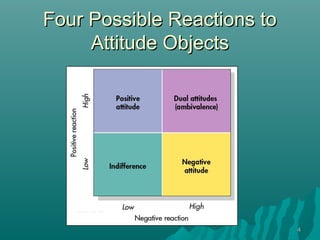
Four Possible Reactions toFour Possible Reactions to
Attitude ObjectsAttitude Objects
Cacciopo, et al. 1997
55
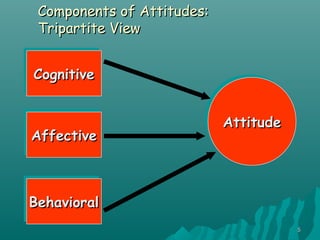
Components of Attitudes:Components of Attitudes:
Tripartite ViewTripartite View
CognitiveCognitiveCognitiveCognitive
AffectiveAffectiveAffectiveAffective
BehavioralBehavioralBehavioralBehavioral
AttitudeAttitudeAttitudeAttitude
66
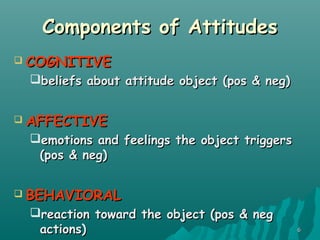
Components of AttitudesComponents of Attitudes
 COGNITIVECOGNITIVE
beliefs about attitude object (pos & neg)beliefs about attitude object (pos & neg)
 AFFECTIVEAFFECTIVE
emotions and feelings the object triggersemotions and feelings the object triggers
(pos & neg)(pos & neg)
 BEHAVIORALBEHAVIORAL
reaction toward the object (pos & negreaction toward the object (pos & neg
actions)actions)
77
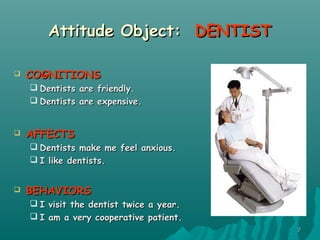
Attitude Object:Attitude Object: DENTISTDENTIST
 COGNITIONSCOGNITIONS
 Dentists are friendly.Dentists are friendly.
 Dentists are expensive.Dentists are expensive.
 AFFECTSAFFECTS
 Dentists make me feel anxious.Dentists make me feel anxious.
 I like dentists.I like dentists.
 BEHAVIORSBEHAVIORS
 I visit the dentist twice a year.I visit the dentist twice a year.
 I am a very cooperative patient.I am a very cooperative patient.
88
Why People Have AttitudesWhy People Have Attitudes
 Value-Expressive function: Express whoValue-Expressive function: Express who
we arewe are
 Ego-defensive function: Protect Self-Ego-defensive function: Protect Self-
EsteemEsteem
 Instrumental function: Obtain awards,Instrumental function: Obtain awards,
avoid punishmentsavoid punishments
 Knowledge function: understand peopleKnowledge function: understand people
and eventsand events
99
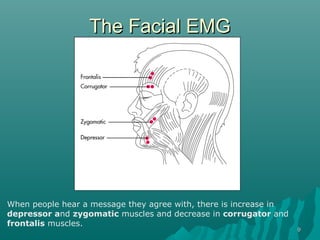
The Facial EMGThe Facial EMG
When people hear a message they agree with, there is increase in
depressor and zygomatic muscles and decrease in corrugator and
frontalis muscles.
1010
Where do attitudesWhere do attitudes
come from?come from?
1111
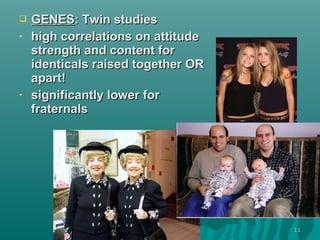
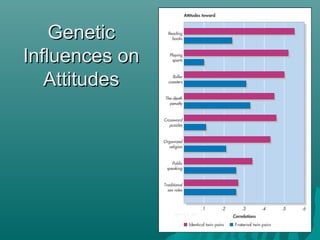
 GENESGENES: Twin studies: Twin studies
• high correlations on attitudehigh correlations on attitude
strength and content forstrength and content for
identicals raised together ORidenticals raised together OR
apart!apart!
• significantly lower forsignificantly lower for
fraternalsfraternals
1212
GeneticGenetic
Influences onInfluences on
AttitudesAttitudes
Olson et al., 2001.
1313
Origins of Attitudes:Origins of Attitudes:
Social ExperiencesSocial Experiences
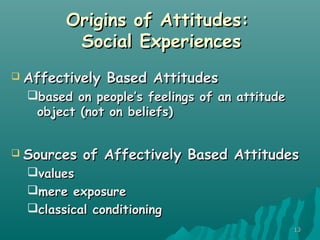
 Affectively Based AttitudesAffectively Based Attitudes
based on people’s feelings of an attitudebased on people’s feelings of an attitude
object (not on beliefs)object (not on beliefs)
 Sources of Affectively Based AttitudesSources of Affectively Based Attitudes
valuesvalues
mere exposuremere exposure
classical conditioningclassical conditioning
1414
Classical ConditioningClassical Conditioning
The case whereby a stimulus that elicitsThe case whereby a stimulus that elicits
an emotional response is repeatedlyan emotional response is repeatedly
experienced along with a neutralexperienced along with a neutral
stimulus that does not, until the neutralstimulus that does not, until the neutral
stimulus takes on the emotionalstimulus takes on the emotional
properties of the first stimulusproperties of the first stimulus
1515
Where Do Attitudes Come From?Where Do Attitudes Come From?
 GENESGENES
Twin studyTwin study
 SOCIAL EXPERIENCESSOCIAL EXPERIENCES
affectively basedaffectively based
behaviorally basedbehaviorally based
1616
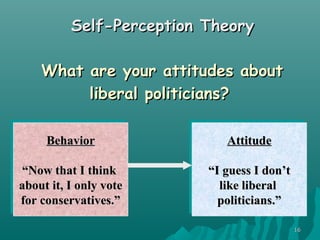
What are your attitudes aboutWhat are your attitudes about
liberal politicians?liberal politicians?
BehaviorBehavior
““Now that I thinkNow that I think
about it, I only voteabout it, I only vote
for conservatives.”for conservatives.”
BehaviorBehavior
““Now that I thinkNow that I think
about it, I only voteabout it, I only vote
for conservatives.”for conservatives.”
AttitudeAttitude
““I guess I don’tI guess I don’t
like liberallike liberal
politicians.”politicians.”
AttitudeAttitude
““I guess I don’tI guess I don’t
like liberallike liberal
politicians.”politicians.”
Self-Perception TheorySelf-Perception Theory
For any query Feel Free to askFor any query Feel Free to ask
1717

Attitude in psychology

  • 1.
  • 2.
  • 3.
    33 What is anAttitude?What is an Attitude? A positive, negative,A positive, negative, or mixed reaction to a person,or mixed reaction to a person, object, or idea, expressed atobject, or idea, expressed at some level of intensity (e.g.,some level of intensity (e.g., love, like, dislike, detest)love, like, dislike, detest)
  • 4.
    44 Four Possible ReactionstoFour Possible Reactions to Attitude ObjectsAttitude Objects Cacciopo, et al. 1997
  • 5.
    55 Components of Attitudes:Componentsof Attitudes: Tripartite ViewTripartite View CognitiveCognitiveCognitiveCognitive AffectiveAffectiveAffectiveAffective BehavioralBehavioralBehavioralBehavioral AttitudeAttitudeAttitudeAttitude
  • 6.
    66 Components of AttitudesComponentsof Attitudes  COGNITIVECOGNITIVE beliefs about attitude object (pos & neg)beliefs about attitude object (pos & neg)  AFFECTIVEAFFECTIVE emotions and feelings the object triggersemotions and feelings the object triggers (pos & neg)(pos & neg)  BEHAVIORALBEHAVIORAL reaction toward the object (pos & negreaction toward the object (pos & neg actions)actions)
  • 7.
    77 Attitude Object:Attitude Object:DENTISTDENTIST  COGNITIONSCOGNITIONS  Dentists are friendly.Dentists are friendly.  Dentists are expensive.Dentists are expensive.  AFFECTSAFFECTS  Dentists make me feel anxious.Dentists make me feel anxious.  I like dentists.I like dentists.  BEHAVIORSBEHAVIORS  I visit the dentist twice a year.I visit the dentist twice a year.  I am a very cooperative patient.I am a very cooperative patient.
  • 8.
    88 Why People HaveAttitudesWhy People Have Attitudes  Value-Expressive function: Express whoValue-Expressive function: Express who we arewe are  Ego-defensive function: Protect Self-Ego-defensive function: Protect Self- EsteemEsteem  Instrumental function: Obtain awards,Instrumental function: Obtain awards, avoid punishmentsavoid punishments  Knowledge function: understand peopleKnowledge function: understand people and eventsand events
  • 9.
    99 The Facial EMGTheFacial EMG When people hear a message they agree with, there is increase in depressor and zygomatic muscles and decrease in corrugator and frontalis muscles.
  • 10.
    1010 Where do attitudesWheredo attitudes come from?come from?
  • 11.
    1111  GENESGENES: Twinstudies: Twin studies • high correlations on attitudehigh correlations on attitude strength and content forstrength and content for identicals raised together ORidenticals raised together OR apart!apart! • significantly lower forsignificantly lower for fraternalsfraternals
  • 12.
  • 13.
    1313 Origins of Attitudes:Originsof Attitudes: Social ExperiencesSocial Experiences  Affectively Based AttitudesAffectively Based Attitudes based on people’s feelings of an attitudebased on people’s feelings of an attitude object (not on beliefs)object (not on beliefs)  Sources of Affectively Based AttitudesSources of Affectively Based Attitudes valuesvalues mere exposuremere exposure classical conditioningclassical conditioning
  • 14.
    1414 Classical ConditioningClassical Conditioning Thecase whereby a stimulus that elicitsThe case whereby a stimulus that elicits an emotional response is repeatedlyan emotional response is repeatedly experienced along with a neutralexperienced along with a neutral stimulus that does not, until the neutralstimulus that does not, until the neutral stimulus takes on the emotionalstimulus takes on the emotional properties of the first stimulusproperties of the first stimulus
  • 15.
    1515 Where Do AttitudesCome From?Where Do Attitudes Come From?  GENESGENES Twin studyTwin study  SOCIAL EXPERIENCESSOCIAL EXPERIENCES affectively basedaffectively based behaviorally basedbehaviorally based
  • 16.
    1616 What are yourattitudes aboutWhat are your attitudes about liberal politicians?liberal politicians? BehaviorBehavior ““Now that I thinkNow that I think about it, I only voteabout it, I only vote for conservatives.”for conservatives.” BehaviorBehavior ““Now that I thinkNow that I think about it, I only voteabout it, I only vote for conservatives.”for conservatives.” AttitudeAttitude ““I guess I don’tI guess I don’t like liberallike liberal politicians.”politicians.” AttitudeAttitude ““I guess I don’tI guess I don’t like liberallike liberal politicians.”politicians.” Self-Perception TheorySelf-Perception Theory
  • 17.
    For any queryFeel Free to askFor any query Feel Free to ask 1717