Implicit and Explicit
Attitudes
M. Borowik
S. Carroll
M. Cicero
J. Ellis
An Overview of Causal Factors Implicated in
Divergence of Attitude Measures
What are Attitudes, and How do we Form
Them?
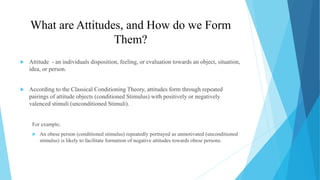
 Attitude - an individuals disposition, feeling, or evaluation towards an object, situation,
idea, or person.
 According to the Classical Conditioning Theory, attitudes form through repeated
pairings of attitude objects (conditioned Stimulus) with positively or negatively
valenced stimuli (unconditioned Stimuli).
For example;
 An obese person (conditioned stimulus) repeatedly portrayed as unmotivated (unconditioned
stimulus) is likely to facilitate formation of negative attitudes towards obese persons.
What is the Difference Between Implicit and
Explicit Attitudes
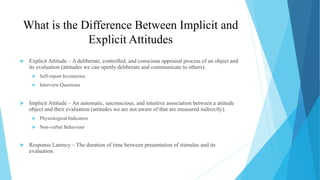
 Explicit Attitude – A deliberate, controlled, and conscious appraisal process of an object and
its evaluation (attitudes we can openly deliberate and communicate to others).
 Self-report Inventories
 Interview Questions
 Implicit Attitude – An automatic, unconscious, and intuitive association between a attitude
object and their evaluation (attitudes we are not aware of that are measured indirectly).
 Physiological Indicators
 Non-verbal Behaviour
 Response Latency – The duration of time between presentation of stimulus and its
evaluation.
Group Results
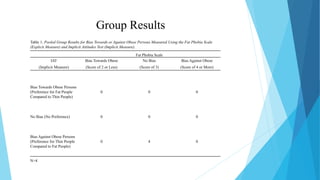
Table 1. Pooled Group Results for Bias Towards or Against Obese Persons Measured Using the Fat Phobia Scale
(Explicit Measure) and Implicit Attitudes Test (Implicit Measure).
Fat Phobia Scale
IAT Bias Towards Obese No Bias Bias Against Obese
(Implicit Measure) (Score of 2 or Less) (Score of 3) (Score of 4 or More)
Bias Towards Obese Persons
(Preference for Fat People
Compared to Thin People)
0 0 0
No Bias (No Preference) 0 0 0
Bias Against Obese Persons
(Preference for Thin People
Compared to Fat People)
0 4 0
N=4
Aetiology of Explicit and Implicit Attitudes
 Early Experiences
 Stemming form past and present experiences.
 Affective Experiences
 Mediated by biological underpinnings.
 Cultural Biases
 Influenced by our own cultural milieu.
 Cognitive Principles
 Shaped by our inate need for consistency.
Early Experiences
 Implicit attitudes stem from early, and largely forgotten experiences with an attitude
object.
 Smokers early experiences with cigarettes tended to co-vary with their implicit attitudes.
 Persons raised primarily by their mothers tend to have an implicit preference towards women.
 Women with implicit preferences for chivalry tended to show less interest in power,
economics, and education.
 Explicit attitudes stem from more recent, and accessible events.
 Smokers recent experiences with cigarettes tend to co-vary with their self-reported attitudes
towards smoking.
 An explicit attitude towards a parent does not predict who the primary caretaker was.
 Women's explicit fantasies towards chivalry do not predict interest towards power,
economics, and education.
Affective Experiences – Different Pathways
 Implicit attitudes are associated with activation in the amygdala, and tend to be more
sensitive towards affective experiences.
 Implicit attitudes form through automatic reactions to stimuli.
 Are influenced by affective priming.
 Changes in implicit attitudes are linked to emotional-based predictors (i.e quality of interaction with
an attitude object).
 Mental imagining of attitude objects can alter its implicit association.
 Explicit attitudes are associated with activation in the frontal lobes, and are more cognitively
controlled.
 Change in explicit attitudes is associated with increased awareness and desire to change one’s
attitude.
 Change of explicit attitudes depends on cognitive and motivational factors.
 Explicit attitudes tend not to be influenced by affective priming.
Cultural Biases
 Societal evaluations influence implicit in-group attitudes
 Systematic, culturally held appraisal can bias peoples automatic attitudes irrespective of their self-
reported attitude.
 People exhibit greater implicit in-group bias to the extent they are immersed in their cultural
heritage.
 Minorities unconsciously rationalise their lower status by internalising societies negative attitude
towards their group (i.e poor and overweight people tend to show an implicit preference for rich and
thin out-group members)
 Cultural In-group bias tends not to influence explicit attitudes
 The link between cultural influence and attitudes is less apparent when using self-report measures of
attitudes (i.e extent of cultural immersion tends not to predict explicit in-group bias).
 Explicit in-group bias in minorities tends to be unrelated to their status.
Cognitive Consistency Principles
 Implicit Attitudes;
 People tend to prefer consonant evaluations of relative attitude objects (i.e If I am good and I
am thin, than thin is also good).
 Cultural groups who showed high self-esteem, and who identified with their cultural group
also tended to implicitly prefer their cultural group.
 Explicit Attitudes;
 Cognitive consistency principles measured using self-reports tended not to conform to self
concepts.
 Persons who associate themselves with ‘warmth’ or ‘power’ tended not to explicitly associate
‘warmth’ or ‘power’ with their own gender.

Implicit and explicit attitudes presentation

  • 1.
    Implicit and Explicit Attitudes M.Borowik S. Carroll M. Cicero J. Ellis An Overview of Causal Factors Implicated in Divergence of Attitude Measures
  • 2.
    What are Attitudes,and How do we Form Them?  Attitude - an individuals disposition, feeling, or evaluation towards an object, situation, idea, or person.  According to the Classical Conditioning Theory, attitudes form through repeated pairings of attitude objects (conditioned Stimulus) with positively or negatively valenced stimuli (unconditioned Stimuli). For example;  An obese person (conditioned stimulus) repeatedly portrayed as unmotivated (unconditioned stimulus) is likely to facilitate formation of negative attitudes towards obese persons.
  • 3.
    What is theDifference Between Implicit and Explicit Attitudes  Explicit Attitude – A deliberate, controlled, and conscious appraisal process of an object and its evaluation (attitudes we can openly deliberate and communicate to others).  Self-report Inventories  Interview Questions  Implicit Attitude – An automatic, unconscious, and intuitive association between a attitude object and their evaluation (attitudes we are not aware of that are measured indirectly).  Physiological Indicators  Non-verbal Behaviour  Response Latency – The duration of time between presentation of stimulus and its evaluation.
  • 4.
    Group Results Table 1.Pooled Group Results for Bias Towards or Against Obese Persons Measured Using the Fat Phobia Scale (Explicit Measure) and Implicit Attitudes Test (Implicit Measure). Fat Phobia Scale IAT Bias Towards Obese No Bias Bias Against Obese (Implicit Measure) (Score of 2 or Less) (Score of 3) (Score of 4 or More) Bias Towards Obese Persons (Preference for Fat People Compared to Thin People) 0 0 0 No Bias (No Preference) 0 0 0 Bias Against Obese Persons (Preference for Thin People Compared to Fat People) 0 4 0 N=4
  • 5.
    Aetiology of Explicitand Implicit Attitudes  Early Experiences  Stemming form past and present experiences.  Affective Experiences  Mediated by biological underpinnings.  Cultural Biases  Influenced by our own cultural milieu.  Cognitive Principles  Shaped by our inate need for consistency.
  • 6.
    Early Experiences  Implicitattitudes stem from early, and largely forgotten experiences with an attitude object.  Smokers early experiences with cigarettes tended to co-vary with their implicit attitudes.  Persons raised primarily by their mothers tend to have an implicit preference towards women.  Women with implicit preferences for chivalry tended to show less interest in power, economics, and education.  Explicit attitudes stem from more recent, and accessible events.  Smokers recent experiences with cigarettes tend to co-vary with their self-reported attitudes towards smoking.  An explicit attitude towards a parent does not predict who the primary caretaker was.  Women's explicit fantasies towards chivalry do not predict interest towards power, economics, and education.
  • 7.
    Affective Experiences –Different Pathways  Implicit attitudes are associated with activation in the amygdala, and tend to be more sensitive towards affective experiences.  Implicit attitudes form through automatic reactions to stimuli.  Are influenced by affective priming.  Changes in implicit attitudes are linked to emotional-based predictors (i.e quality of interaction with an attitude object).  Mental imagining of attitude objects can alter its implicit association.  Explicit attitudes are associated with activation in the frontal lobes, and are more cognitively controlled.  Change in explicit attitudes is associated with increased awareness and desire to change one’s attitude.  Change of explicit attitudes depends on cognitive and motivational factors.  Explicit attitudes tend not to be influenced by affective priming.
  • 8.
    Cultural Biases  Societalevaluations influence implicit in-group attitudes  Systematic, culturally held appraisal can bias peoples automatic attitudes irrespective of their self- reported attitude.  People exhibit greater implicit in-group bias to the extent they are immersed in their cultural heritage.  Minorities unconsciously rationalise their lower status by internalising societies negative attitude towards their group (i.e poor and overweight people tend to show an implicit preference for rich and thin out-group members)  Cultural In-group bias tends not to influence explicit attitudes  The link between cultural influence and attitudes is less apparent when using self-report measures of attitudes (i.e extent of cultural immersion tends not to predict explicit in-group bias).  Explicit in-group bias in minorities tends to be unrelated to their status.
  • 9.
    Cognitive Consistency Principles Implicit Attitudes;  People tend to prefer consonant evaluations of relative attitude objects (i.e If I am good and I am thin, than thin is also good).  Cultural groups who showed high self-esteem, and who identified with their cultural group also tended to implicitly prefer their cultural group.  Explicit Attitudes;  Cognitive consistency principles measured using self-reports tended not to conform to self concepts.  Persons who associate themselves with ‘warmth’ or ‘power’ tended not to explicitly associate ‘warmth’ or ‘power’ with their own gender.

Editor's Notes

  • #7 Developmental events form a source for implicit attitudes, while explicit attitudes reflect re-evaluations of these experiences.
  • #8 Early experiences reconciles with affective experiences. Early experiences (Ii.e smoking, maternal bonding, romantic fantasies) are emotion-evoking