ATTITUDE
Concept and Types of Attitude
- In psychology, an Attitude refers to a set of emotions, beliefs, and
behaviors toward a particular object, person, thing, or event. Attitudes are
often the result of experience or upbringing, and they can have a powerful
influence over behavior.
Definitions:
• According to Gordon Allport, “An attitude is a mental and neural
state of readiness, organized through experience, exerting a directive
or dynamic influence upon the individual’s response to all objects
and situations with which it is related.”
• Frank Freeman said, “An attitude is a dispositional readiness to
respond to certain institutions, persons or objects in a consistent
manner which has been learned and has become one’s typical mode
of response.”
• Thurstone said, “An attitude denotes the sum total of man’s
inclinations and feelings, prejudice or bias, preconceived notions,
ideas, fears, threats, and other any specific topic.”
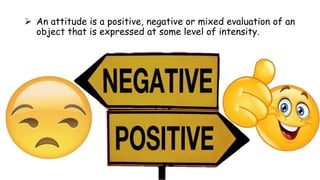
 An attitude is a positive, negative or mixed evaluation of an
object that is expressed at some level of intensity.
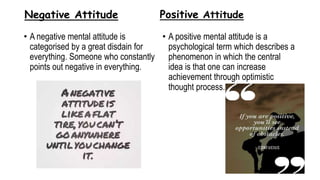
Negative Attitude
• A negative mental attitude is
categorised by a great disdain for
everything. Someone who constantly
points out negative in everything.
Positive Attitude
• A positive mental attitude is a
psychological term which describes a
phenomenon in which the central
idea is that one can increase
achievement through optimistic
thought process.
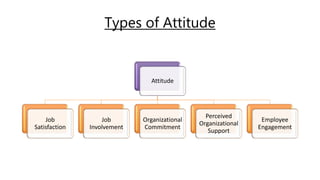
Types of Attitude
Attitude
Job
Satisfaction
Job
Involvement
Organizational
Commitment
Perceived
Organizational
Support
Employee
Engagement
1) Job Satisfaction
• A collection of positive and/or negative feelings that an individual
holds towards his or her job. This feeling is mainly based on an
individual’s perception of satisfaction.
• A person with a high level of job satisfaction holds positive attitudes
about the job, while a person who is dissatisfied with his or her job
holds a negative attitude about the job.
2) Job Involvement
• Identifying with the job, actively participating in it, and considering
performance important to self-worth.
• Job involvement refers to the degree with which an individual
identifies psychologically with his or her job and perceives his or her
perceived performance level important to self-worth.
• High levels of job involvement are related to fewer absences and lower
resignation rates.
3) Organizational Commitment
• Identifying with a particular organization and its goals, and wishing to
maintain membership in the organization
• Affective, normative, and continuance commitment – Note: what are
these? Why are they different? Please be sure you know Job-attitude.
• The last job-attitude refers to organizational commitment. It is
understood as one’s identification with his or her organization and feels
proud of being its employee.
• It is defined as a state in which an employee identifies with a particular
organization and, its goals, and wishes to maintain membership in the
organization.
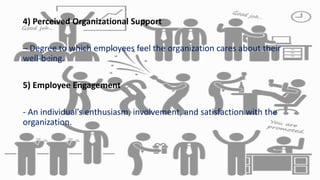
4) Perceived Organizational Support
– Degree to which employees feel the organization cares about their
well-being.
5) Employee Engagement
- An individual’s enthusiasm, involvement, and satisfaction with the
organization.
Organisational Behaviour
By- Preeti Priya Kangale
BBA (SY) HRM
Roll no. 20190203041
Under the guidance of:
- Prof. Priya Barhate
Suryadatta College Management,
Information Research &
Technology, Bavdhan, Pune.

Attitude

  • 1.
  • 3.
    - In psychology,an Attitude refers to a set of emotions, beliefs, and behaviors toward a particular object, person, thing, or event. Attitudes are often the result of experience or upbringing, and they can have a powerful influence over behavior.
  • 4.
    Definitions: • According toGordon Allport, “An attitude is a mental and neural state of readiness, organized through experience, exerting a directive or dynamic influence upon the individual’s response to all objects and situations with which it is related.” • Frank Freeman said, “An attitude is a dispositional readiness to respond to certain institutions, persons or objects in a consistent manner which has been learned and has become one’s typical mode of response.” • Thurstone said, “An attitude denotes the sum total of man’s inclinations and feelings, prejudice or bias, preconceived notions, ideas, fears, threats, and other any specific topic.”
  • 5.
     An attitudeis a positive, negative or mixed evaluation of an object that is expressed at some level of intensity.
  • 6.
    Negative Attitude • Anegative mental attitude is categorised by a great disdain for everything. Someone who constantly points out negative in everything. Positive Attitude • A positive mental attitude is a psychological term which describes a phenomenon in which the central idea is that one can increase achievement through optimistic thought process.
  • 8.
  • 9.
    1) Job Satisfaction •A collection of positive and/or negative feelings that an individual holds towards his or her job. This feeling is mainly based on an individual’s perception of satisfaction. • A person with a high level of job satisfaction holds positive attitudes about the job, while a person who is dissatisfied with his or her job holds a negative attitude about the job.
  • 10.
    2) Job Involvement •Identifying with the job, actively participating in it, and considering performance important to self-worth. • Job involvement refers to the degree with which an individual identifies psychologically with his or her job and perceives his or her perceived performance level important to self-worth. • High levels of job involvement are related to fewer absences and lower resignation rates.
  • 11.
    3) Organizational Commitment •Identifying with a particular organization and its goals, and wishing to maintain membership in the organization • Affective, normative, and continuance commitment – Note: what are these? Why are they different? Please be sure you know Job-attitude. • The last job-attitude refers to organizational commitment. It is understood as one’s identification with his or her organization and feels proud of being its employee. • It is defined as a state in which an employee identifies with a particular organization and, its goals, and wishes to maintain membership in the organization.
  • 12.
    4) Perceived OrganizationalSupport – Degree to which employees feel the organization cares about their well-being. 5) Employee Engagement - An individual’s enthusiasm, involvement, and satisfaction with the organization.
  • 14.
    Organisational Behaviour By- PreetiPriya Kangale BBA (SY) HRM Roll no. 20190203041 Under the guidance of: - Prof. Priya Barhate Suryadatta College Management, Information Research & Technology, Bavdhan, Pune.