NUTRITIONAL DISEASES: HOW TO
EXPLAIN THE PROBLEMS
SCIENCE BLOG-NUTRITIONAL DISEASES
INTRODUCTION:
Intestine part of the alimentary canal is prone to many infections which we term as nutritional diseases which
may lead to its inflammation. The various infectious agents causing nutritional disorders are bacteria, virus,
tapeworms, roundworms, threadworms, hookworm, pin worm etc. Here are some common nutritional
diseases or disorders of the digestive system :
NAME OF
THE DISEASE
CAUSE SYMPTOM PREVENTION/TREATMENT
KWASHIORKO
R(protein energy
malnutrition)
Protein deficient
diet
Underweight Stunted
growth Poor brain
development Loss of
appetite Anemia Protr
uding belly with
bulging eye.
Infant between 1 o 3 ears are
affected ; the must get protein-
rich food to overcome this
nutritional diseases.
MARASMUS
(protein energy
malnutrition)
Simultaneous
deficiency of protein
and carbohydrate.
Ribs become
prominent Thin
limbs Dry skin.
Child must get high quality of
protein like milk. They must get
supplementary food at early age.
INDIGESTION
or DYSPEPSIA
IN
NUTRITIONAL
DISORDERS
Overeating Eating
in short time
span Oily
food Smoking Drink
ing alcohol Stomach
ulcer
Pain or burning
sensation in upper
belly Nausea Bloating
Uncontrolled
burping Splashing up
of stomach acid into
oesophagus or mouth.
Prevention by avoiding fatty and
greasy food. Not to take too much
chocolate, ice cream, citrus
food Eating slowly, Avoiding
smoking to prevent
this nutritional diseases.
CONSTIPATIO
N
Irregular bowel
movement
Retaining of bowel in
rectum. Insufficient
bowel.
Adequate amount of water
should be taken. Patient must
take roughage as a daily diet to
prevent nutritional disorders.
VOMITING
Inflammation of
gastric
wall. Gastroenteritis
. Bowel
obstruction. Appen
dicitis. Food
poisoning. Lactose
intolerance. Allergic
condition.
Forceful expulsion of
the content of stomach
through the mouth.
Following drugs can be given to
the
patients: Anticholinergics. Antihi
stmines. Dopamine
antagonists. Serotonin
antagonists.
JAUNDICE
Inability of the liver
to dispose of the
Loss of
appetite. Vomiting. Yel
Patient must take complete
rest. His diet contains very light
bilirubin provided
by the circulatory
system.
lowness of skin, white
part of eye due to
excess secretion of
bilirubin and
deposition of bile
pigment.
food, sugarcane juice, pigeon pea
leaf juice etc.
DIARRHOEA
Poor
sanitation. Consum
ption of
contaminated
water. Intense
heat. E.coli bacteri
al infection.
Frequent evacuation of
watery stool. Stools
contain undigested
food.
Patient must have ORS
frequently. Saline water should
be provided if necessary.
NUTRITIONAL DISEASES FOR THE DEFICIENCY
OF DIETARY NUTRIENT
NUTRIENT
DEFICIENCY
DISEASE
DEFICIENCY SYMPTOMS
VITAMINS FUNCTIONS
Vitamin A (retinol) Anti-
Xerophthalmic factor
Night blindness
(Nyctalopia)
Xerophthalmia (Dry
eye)Keratomalacia
Less rhodopsin in rod cells of retina, so no
vision in dim light.Thickened, keratinized,
opaque and ulcerated cornea.Corneal
epithelium becomes keratinized and opaque.
Vitamin
B1 (Thiamine) Antineurit
ic factor
Beri beri
Loss of appetite.Inflammation of peripheral
nerves.Numbness.Weakness of limb
muscles.Paralysis.Cardiac odema .
Vitamin B2 (Riboflavin) Cheilosis
Cracking of the angles of mouth causing
nutritional diseases.
Vitamin B3 ( Niacin /
Nicotinic acid)
Pellagra
Swollen lips.Thick pigmented skin of hands and
legs.Irritability causing nutritional diseases.
Vitamin B6 (Pyridoxine) Marasmus
Convulsions.Dermatitis.Impairment of antibody
synthesis.
Vitamin B7 / Vitamin H
(Biotin)
Dermatitis Scaly skin.Muscle pain.Weakness.
Vitamin
B12 (Cyanocobalamin)
Pernicious anemia
Large, immature and nucleated RBC . RBCs are
devoid of haemoglobin.
Vitamin C (Ascorbic
acid)
Scurvy
Bleeding gums.Loose teeth.Anemia.Painful and
swollen joints.Delayed healing of wounds.
Vitamin D (Calciferol)
Rickets in
childrenOsteomalaci
a in adults
Weak, soft, and thin bones due to poor
deposition of Ca and P.Long bones become
deformed or bent, painful swelling on the wrist,
elbow and knee joint. Weak bones of the
vertebral column. Pelvis gets bent and deformed
by body weight.
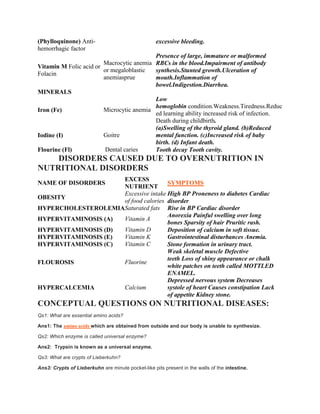
Vitamin E (Tocopherol) Anemia RBC devoid of hemoglobin
Vitamin K Bleeding disease Delayed and faulty blood clotting causing
(Phylloquinone) Anti-
hemorrhagic factor
excessive bleeding.
Vitamin M Folic acid or
Folacin
Macrocytic anemia
or megaloblastic
anemiasprue
Presence of large, immature or malformed
RBCs in the blood.Impairment of antibody
synthesis.Stunted growth.Ulceration of
mouth.Inflammation of
bowel.Indigestion.Diarrhea.
MINERALS
Iron (Fe) Microcytic anemia
Low
hemoglobin condition.Weakness.Tiredness.Reduc
ed learning ability increased risk of infection.
Death during childbirth.
Iodine (I) Goitre
(a)Swelling of the thyroid gland. (b)Reduced
mental function. (c)Increased risk of baby
birth. (d) Infant death.
Flourine (Fl) Dental caries Tooth decay Tooth cavity.
DISORDERS CAUSED DUE TO OVERNUTRITION IN
NUTRITIONAL DISORDERS
NAME OF DISORDERS
EXCESS
NUTRIENT
SYMPTOMS
OBESITY
Excessive intake
of food calories
High BP Proneness to diabetes Cardiac
disorder
HYPERCHOLESTEROLEMIASaturated fats Rise in BP Cardiac disorder
HYPERVITAMINOSIS (A) Vitamin A
Anorexia Painful swelling over long
bones Sparsity of hair Pruritic rash.
HYPERVITAMINOSIS (D) Vitamin D Deposition of calcium in soft tissue.
HYPERVITAMINOSIS (E) Vitamin K Gastrointestinal disturbances Anemia.
HYPERVITAMINOSIS (C) Vitamin C Stone formation in urinary tract.
FLOUROSIS Fluorine
Weak skeletal muscle Defective
teeth Loss of shiny appearance or chalk
white patches on teeth called MOTTLED
ENAMEL.
HYPERCALCEMIA Calcium
Depressed nervous system Decreases
systole of heart Causes constipation Lack
of appetite Kidney stone.
CONCEPTUAL QUESTIONS ON NUTRITIONAL DISEASES:
Qs1: What are essential amino acids?
Ans1: The amino acids which are obtained from outside and our body is unable to synthesize.
Qs2: Which enzyme is called universal enzyme?
Ans2: Trypsin is known as a universal enzyme.
Qs3: What are crypts of Lieberkuhn?
Ans3: Crypts of Lieberkuhn are minute pocket-like pits present in the walls of the intestine.
Qs4: What is deglutination ?
Ans4: Deglutination is the process of swallowing of food.
Qs5: Name the disorder caused by lack of Castle’s intrinsic gastric factor.
Ans5: Pernicious Anemia is occurred as nutritional disorders.
ANSWER THE FOLLOWING
Qs6: What is the function of bile salt?
Ans6: Sodium bicarbonate neutralizes the Hydrochloric acid of chyme while Sodium glycholate and
Sodium tetrachlorate emulsify the fats.
Qs7: Which lipid can cause heart ailment?
Ans7: Cholesterol can cause heart ailment followed by severe nutritional diseases.
Qs8: What is GIP?
Ans8: GIP stands for Gastric Inhibitory Peptide or Enterogastrone hormone secreted by duodenal
epithelium.
Qs9: What is chylomicrons ?
Ans9: From the micelles fatty acids, glycerides, sterols and fat soluble vitamins are absorbed into
the intestinal cells by diffusion where they are resynthesized in the E.R. and are converted into very
small fat molecules called Chylomicrons.
Qs10: What is heartburn in nutritional diseases?
Ans10: Sometimes acidic chyme is squeezed from stomach into the esophagus. This burns the
unprotected cells and causes heart burns or pyrosis. It gives burning sensation in the chest.
Qs11: What is oedema in nutritional diseases?
Ans11: Oedema means fluid accumulation which is a characteristic symptom of children suffering
from kwashiorkor.

NUTRITIONAL DISEASES.docx

  • 1.
    NUTRITIONAL DISEASES: HOWTO EXPLAIN THE PROBLEMS SCIENCE BLOG-NUTRITIONAL DISEASES INTRODUCTION: Intestine part of the alimentary canal is prone to many infections which we term as nutritional diseases which may lead to its inflammation. The various infectious agents causing nutritional disorders are bacteria, virus, tapeworms, roundworms, threadworms, hookworm, pin worm etc. Here are some common nutritional diseases or disorders of the digestive system : NAME OF THE DISEASE CAUSE SYMPTOM PREVENTION/TREATMENT KWASHIORKO R(protein energy malnutrition) Protein deficient diet Underweight Stunted growth Poor brain development Loss of appetite Anemia Protr uding belly with bulging eye. Infant between 1 o 3 ears are affected ; the must get protein- rich food to overcome this nutritional diseases. MARASMUS (protein energy malnutrition) Simultaneous deficiency of protein and carbohydrate. Ribs become prominent Thin limbs Dry skin. Child must get high quality of protein like milk. They must get supplementary food at early age. INDIGESTION or DYSPEPSIA IN NUTRITIONAL DISORDERS Overeating Eating in short time span Oily food Smoking Drink ing alcohol Stomach ulcer Pain or burning sensation in upper belly Nausea Bloating Uncontrolled burping Splashing up of stomach acid into oesophagus or mouth. Prevention by avoiding fatty and greasy food. Not to take too much chocolate, ice cream, citrus food Eating slowly, Avoiding smoking to prevent this nutritional diseases. CONSTIPATIO N Irregular bowel movement Retaining of bowel in rectum. Insufficient bowel. Adequate amount of water should be taken. Patient must take roughage as a daily diet to prevent nutritional disorders. VOMITING Inflammation of gastric wall. Gastroenteritis . Bowel obstruction. Appen dicitis. Food poisoning. Lactose intolerance. Allergic condition. Forceful expulsion of the content of stomach through the mouth. Following drugs can be given to the patients: Anticholinergics. Antihi stmines. Dopamine antagonists. Serotonin antagonists. JAUNDICE Inability of the liver to dispose of the Loss of appetite. Vomiting. Yel Patient must take complete rest. His diet contains very light
  • 2.
    bilirubin provided by thecirculatory system. lowness of skin, white part of eye due to excess secretion of bilirubin and deposition of bile pigment. food, sugarcane juice, pigeon pea leaf juice etc. DIARRHOEA Poor sanitation. Consum ption of contaminated water. Intense heat. E.coli bacteri al infection. Frequent evacuation of watery stool. Stools contain undigested food. Patient must have ORS frequently. Saline water should be provided if necessary. NUTRITIONAL DISEASES FOR THE DEFICIENCY OF DIETARY NUTRIENT NUTRIENT DEFICIENCY DISEASE DEFICIENCY SYMPTOMS VITAMINS FUNCTIONS Vitamin A (retinol) Anti- Xerophthalmic factor Night blindness (Nyctalopia) Xerophthalmia (Dry eye)Keratomalacia Less rhodopsin in rod cells of retina, so no vision in dim light.Thickened, keratinized, opaque and ulcerated cornea.Corneal epithelium becomes keratinized and opaque. Vitamin B1 (Thiamine) Antineurit ic factor Beri beri Loss of appetite.Inflammation of peripheral nerves.Numbness.Weakness of limb muscles.Paralysis.Cardiac odema . Vitamin B2 (Riboflavin) Cheilosis Cracking of the angles of mouth causing nutritional diseases. Vitamin B3 ( Niacin / Nicotinic acid) Pellagra Swollen lips.Thick pigmented skin of hands and legs.Irritability causing nutritional diseases. Vitamin B6 (Pyridoxine) Marasmus Convulsions.Dermatitis.Impairment of antibody synthesis. Vitamin B7 / Vitamin H (Biotin) Dermatitis Scaly skin.Muscle pain.Weakness. Vitamin B12 (Cyanocobalamin) Pernicious anemia Large, immature and nucleated RBC . RBCs are devoid of haemoglobin. Vitamin C (Ascorbic acid) Scurvy Bleeding gums.Loose teeth.Anemia.Painful and swollen joints.Delayed healing of wounds. Vitamin D (Calciferol) Rickets in childrenOsteomalaci a in adults Weak, soft, and thin bones due to poor deposition of Ca and P.Long bones become deformed or bent, painful swelling on the wrist, elbow and knee joint. Weak bones of the vertebral column. Pelvis gets bent and deformed by body weight. Vitamin E (Tocopherol) Anemia RBC devoid of hemoglobin Vitamin K Bleeding disease Delayed and faulty blood clotting causing
  • 3.
    (Phylloquinone) Anti- hemorrhagic factor excessivebleeding. Vitamin M Folic acid or Folacin Macrocytic anemia or megaloblastic anemiasprue Presence of large, immature or malformed RBCs in the blood.Impairment of antibody synthesis.Stunted growth.Ulceration of mouth.Inflammation of bowel.Indigestion.Diarrhea. MINERALS Iron (Fe) Microcytic anemia Low hemoglobin condition.Weakness.Tiredness.Reduc ed learning ability increased risk of infection. Death during childbirth. Iodine (I) Goitre (a)Swelling of the thyroid gland. (b)Reduced mental function. (c)Increased risk of baby birth. (d) Infant death. Flourine (Fl) Dental caries Tooth decay Tooth cavity. DISORDERS CAUSED DUE TO OVERNUTRITION IN NUTRITIONAL DISORDERS NAME OF DISORDERS EXCESS NUTRIENT SYMPTOMS OBESITY Excessive intake of food calories High BP Proneness to diabetes Cardiac disorder HYPERCHOLESTEROLEMIASaturated fats Rise in BP Cardiac disorder HYPERVITAMINOSIS (A) Vitamin A Anorexia Painful swelling over long bones Sparsity of hair Pruritic rash. HYPERVITAMINOSIS (D) Vitamin D Deposition of calcium in soft tissue. HYPERVITAMINOSIS (E) Vitamin K Gastrointestinal disturbances Anemia. HYPERVITAMINOSIS (C) Vitamin C Stone formation in urinary tract. FLOUROSIS Fluorine Weak skeletal muscle Defective teeth Loss of shiny appearance or chalk white patches on teeth called MOTTLED ENAMEL. HYPERCALCEMIA Calcium Depressed nervous system Decreases systole of heart Causes constipation Lack of appetite Kidney stone. CONCEPTUAL QUESTIONS ON NUTRITIONAL DISEASES: Qs1: What are essential amino acids? Ans1: The amino acids which are obtained from outside and our body is unable to synthesize. Qs2: Which enzyme is called universal enzyme? Ans2: Trypsin is known as a universal enzyme. Qs3: What are crypts of Lieberkuhn? Ans3: Crypts of Lieberkuhn are minute pocket-like pits present in the walls of the intestine.
  • 4.
    Qs4: What isdeglutination ? Ans4: Deglutination is the process of swallowing of food. Qs5: Name the disorder caused by lack of Castle’s intrinsic gastric factor. Ans5: Pernicious Anemia is occurred as nutritional disorders. ANSWER THE FOLLOWING Qs6: What is the function of bile salt? Ans6: Sodium bicarbonate neutralizes the Hydrochloric acid of chyme while Sodium glycholate and Sodium tetrachlorate emulsify the fats. Qs7: Which lipid can cause heart ailment? Ans7: Cholesterol can cause heart ailment followed by severe nutritional diseases. Qs8: What is GIP? Ans8: GIP stands for Gastric Inhibitory Peptide or Enterogastrone hormone secreted by duodenal epithelium. Qs9: What is chylomicrons ? Ans9: From the micelles fatty acids, glycerides, sterols and fat soluble vitamins are absorbed into the intestinal cells by diffusion where they are resynthesized in the E.R. and are converted into very small fat molecules called Chylomicrons. Qs10: What is heartburn in nutritional diseases? Ans10: Sometimes acidic chyme is squeezed from stomach into the esophagus. This burns the unprotected cells and causes heart burns or pyrosis. It gives burning sensation in the chest. Qs11: What is oedema in nutritional diseases? Ans11: Oedema means fluid accumulation which is a characteristic symptom of children suffering from kwashiorkor.