Today’s Lecture:
Bohr Atomic Model
You must be able to understand atomic structure.
1
2
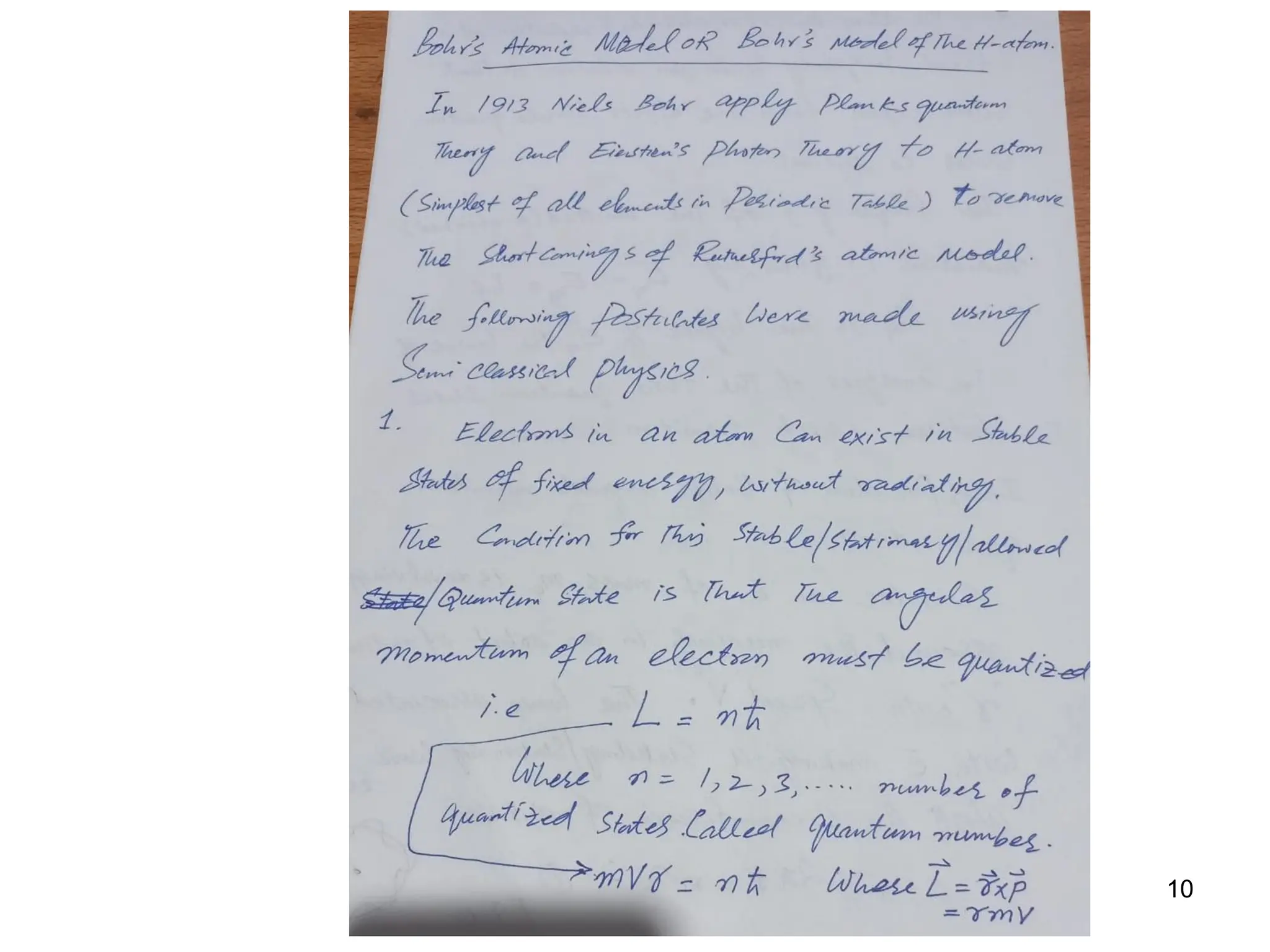
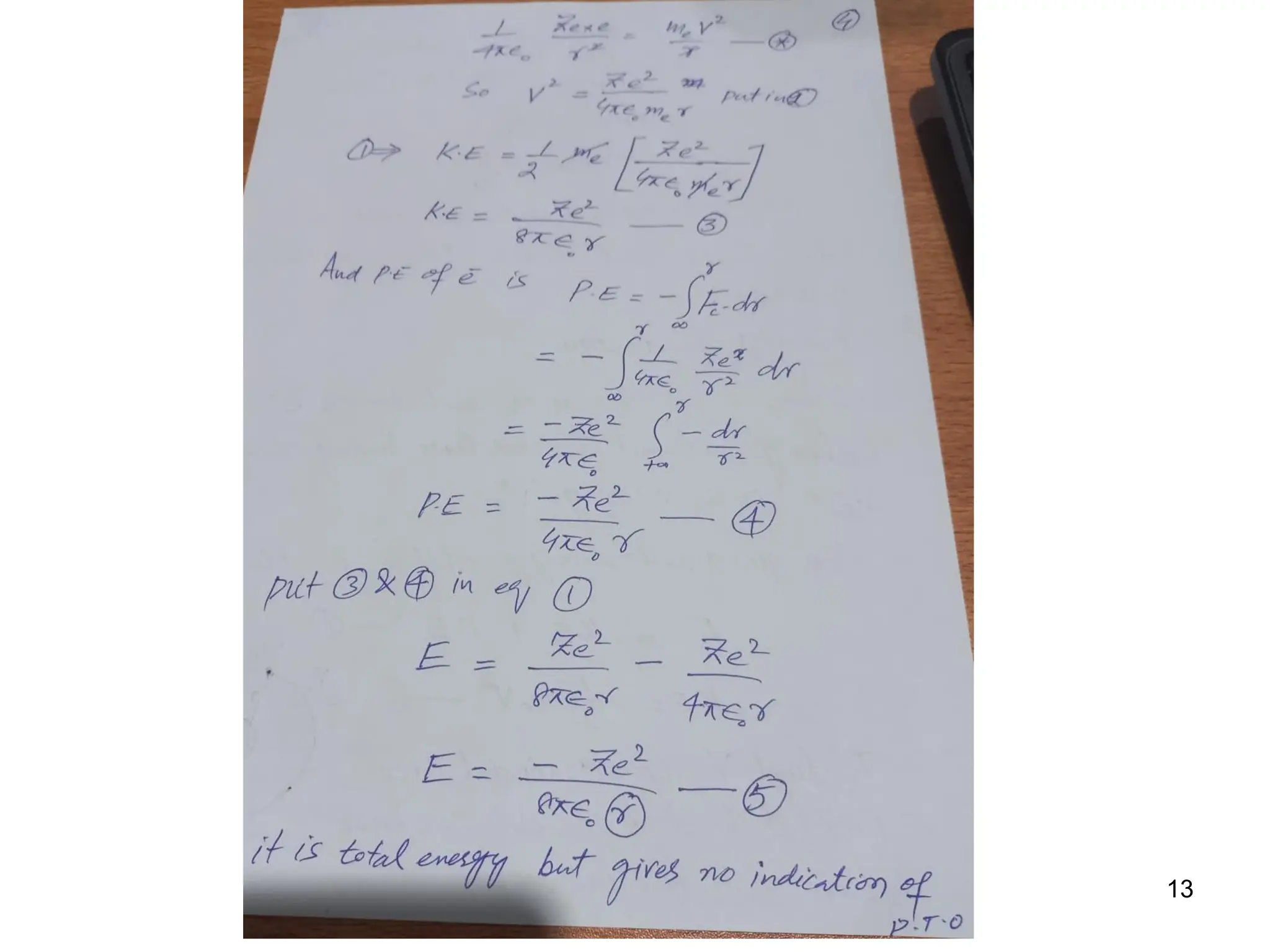
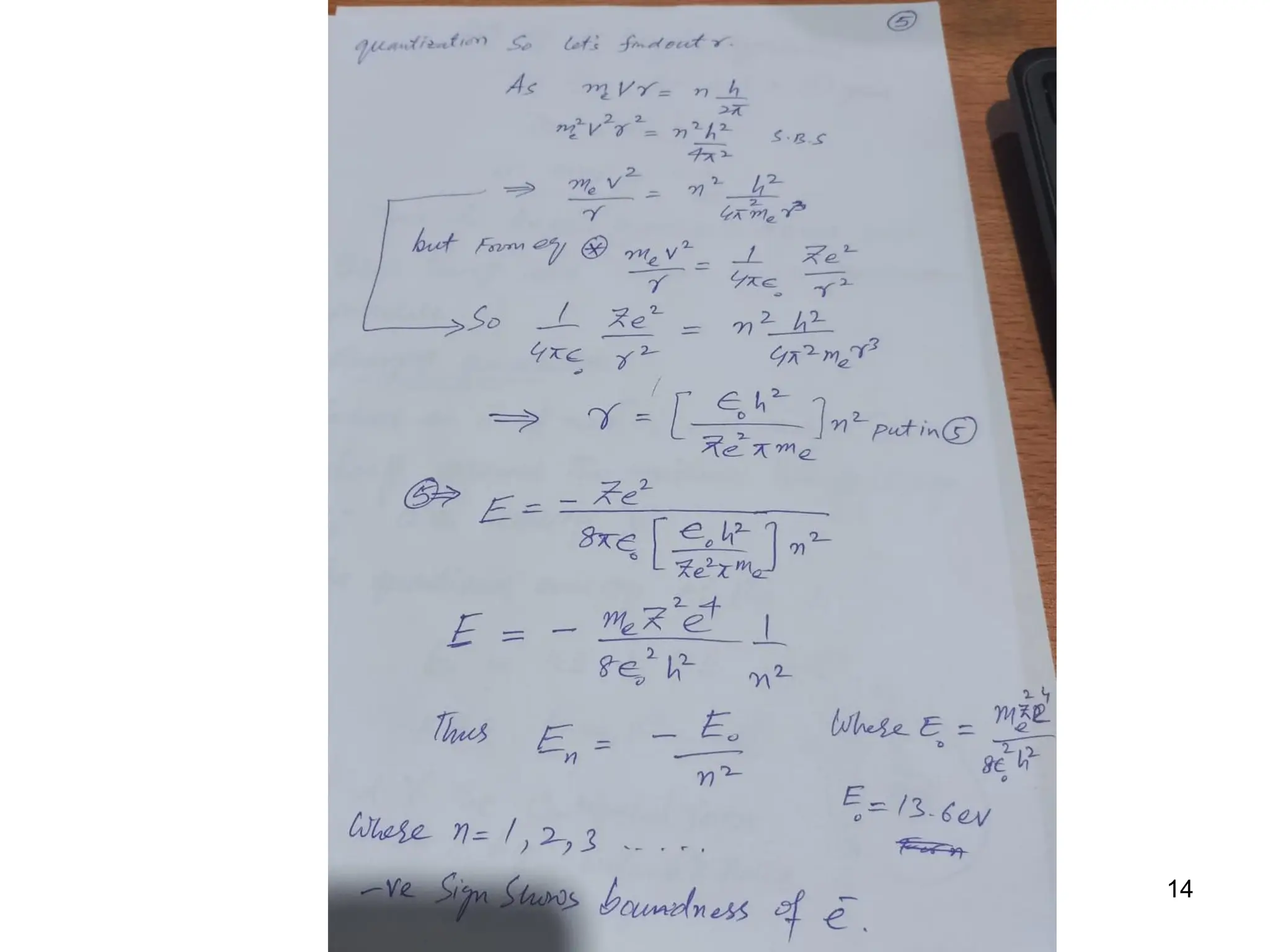
The electron in the hydrogen atom can occupy only
certain specific circular orbits of quantized angular
momentum and no others.
the angular momentum in an allowed orbit must be an
integer n (the quantum number) times h/2π, where h is
Planck's constant.
Since the electron of mass m moves with a speed v in a
circular path of radius r, its angular momentum is L = mvr.
this condition is
Ln = rnmvn = nh/2π
Bohr Atomic Model
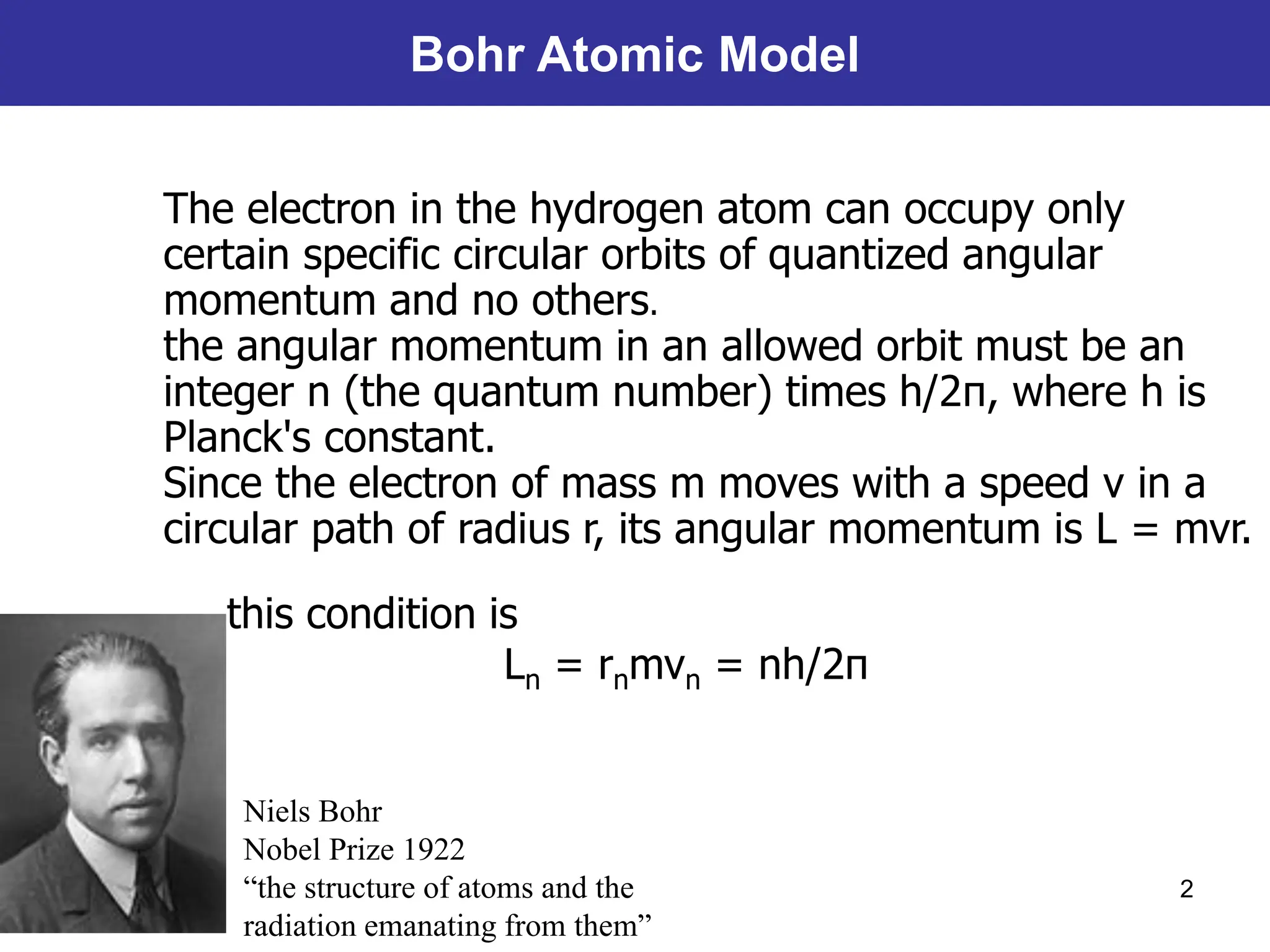
Niels Bohr
Nobel Prize 1922
“the structure of atoms and the
radiation emanating from them”
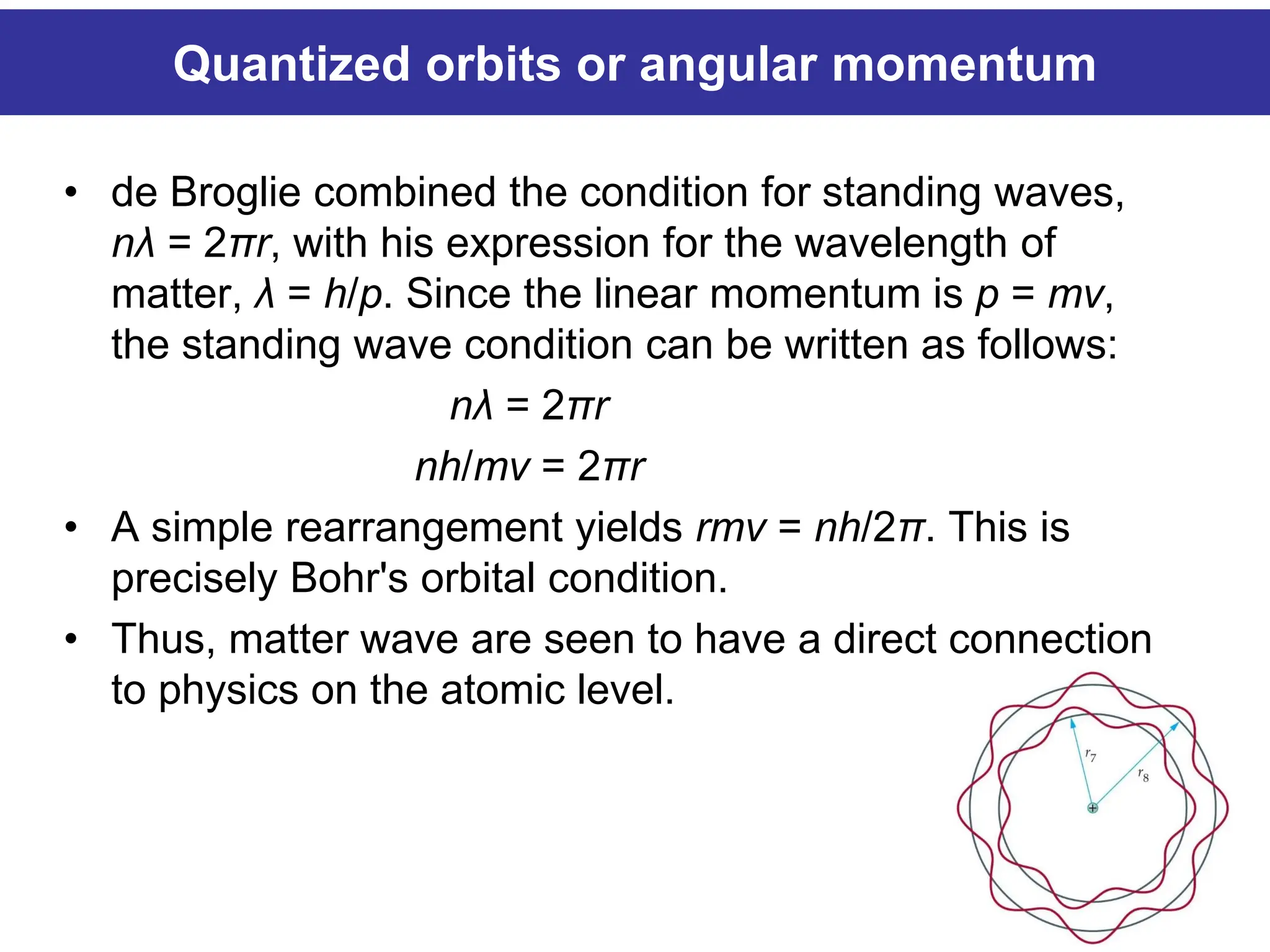
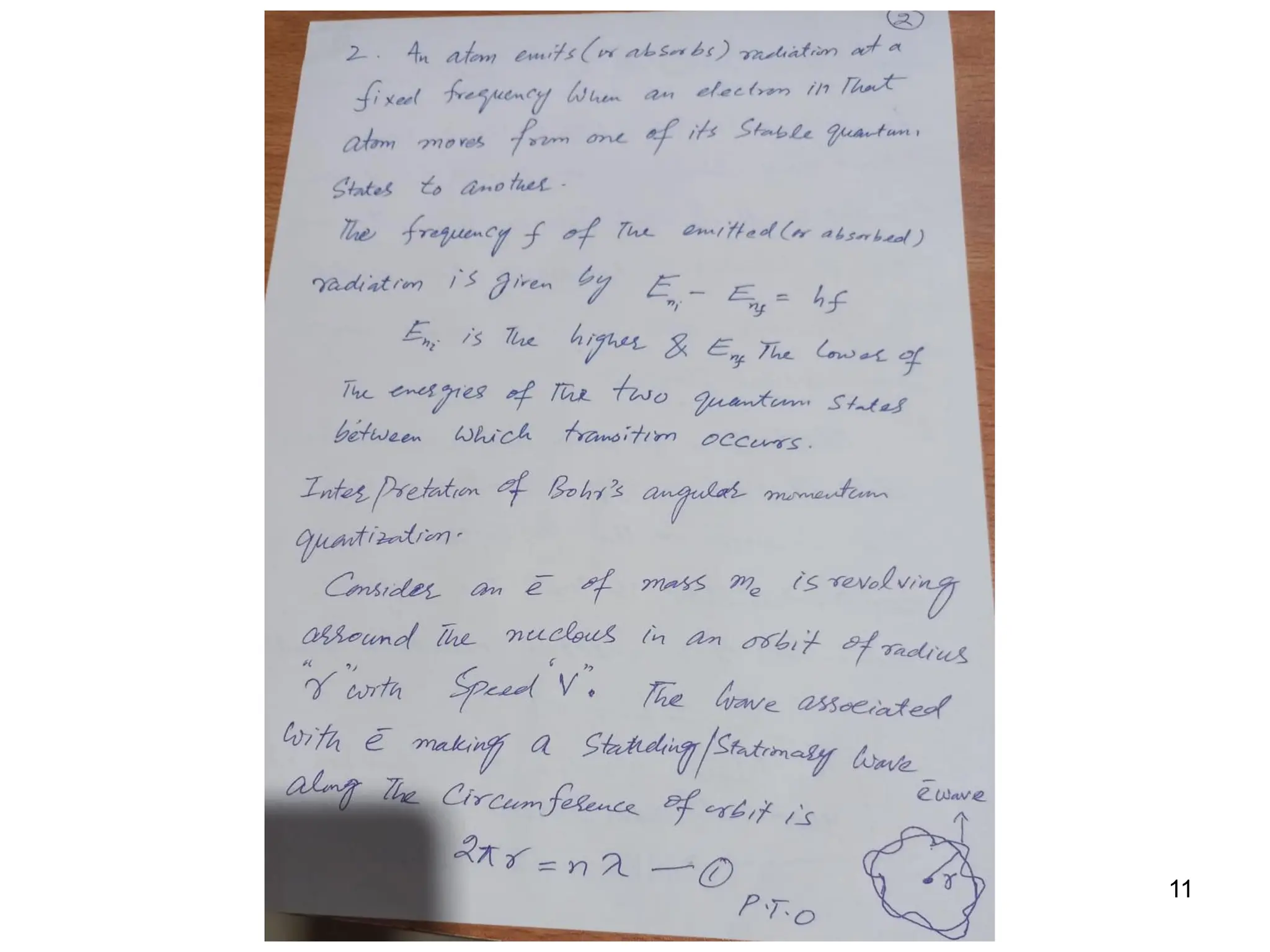
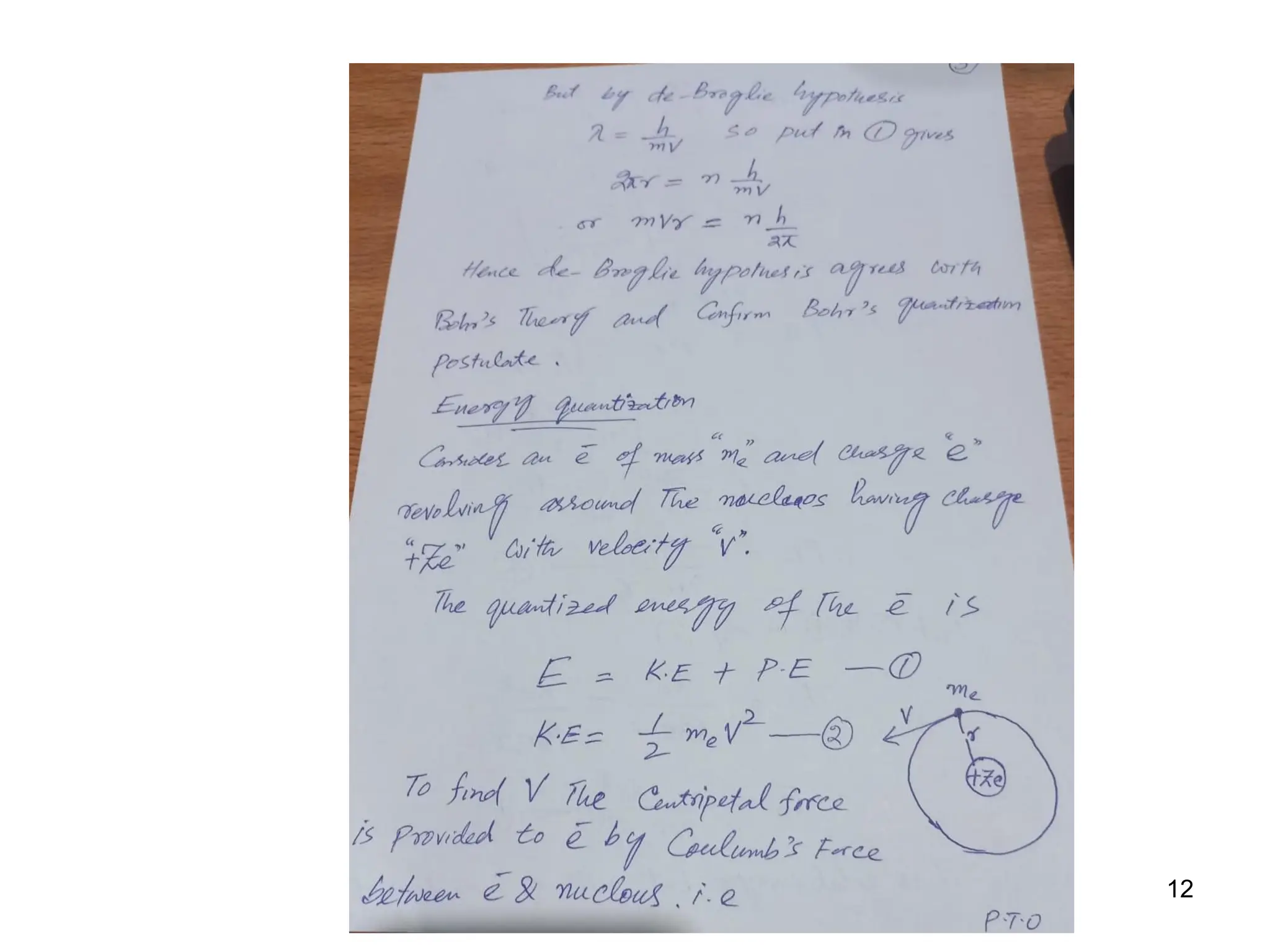
• de Broglie combined the condition for standing waves,
nλ = 2πr, with his expression for the wavelength of
matter, λ = h/p. Since the linear momentum is p = mv,
the standing wave condition can be written as follows:
nλ = 2πr
nh/mv = 2πr
• A simple rearrangement yields rmv = nh/2π. This is
precisely Bohr's orbital condition.
• Thus, matter wave are seen to have a direct connection
to physics on the atomic level.
Quantized orbits or angular momentum
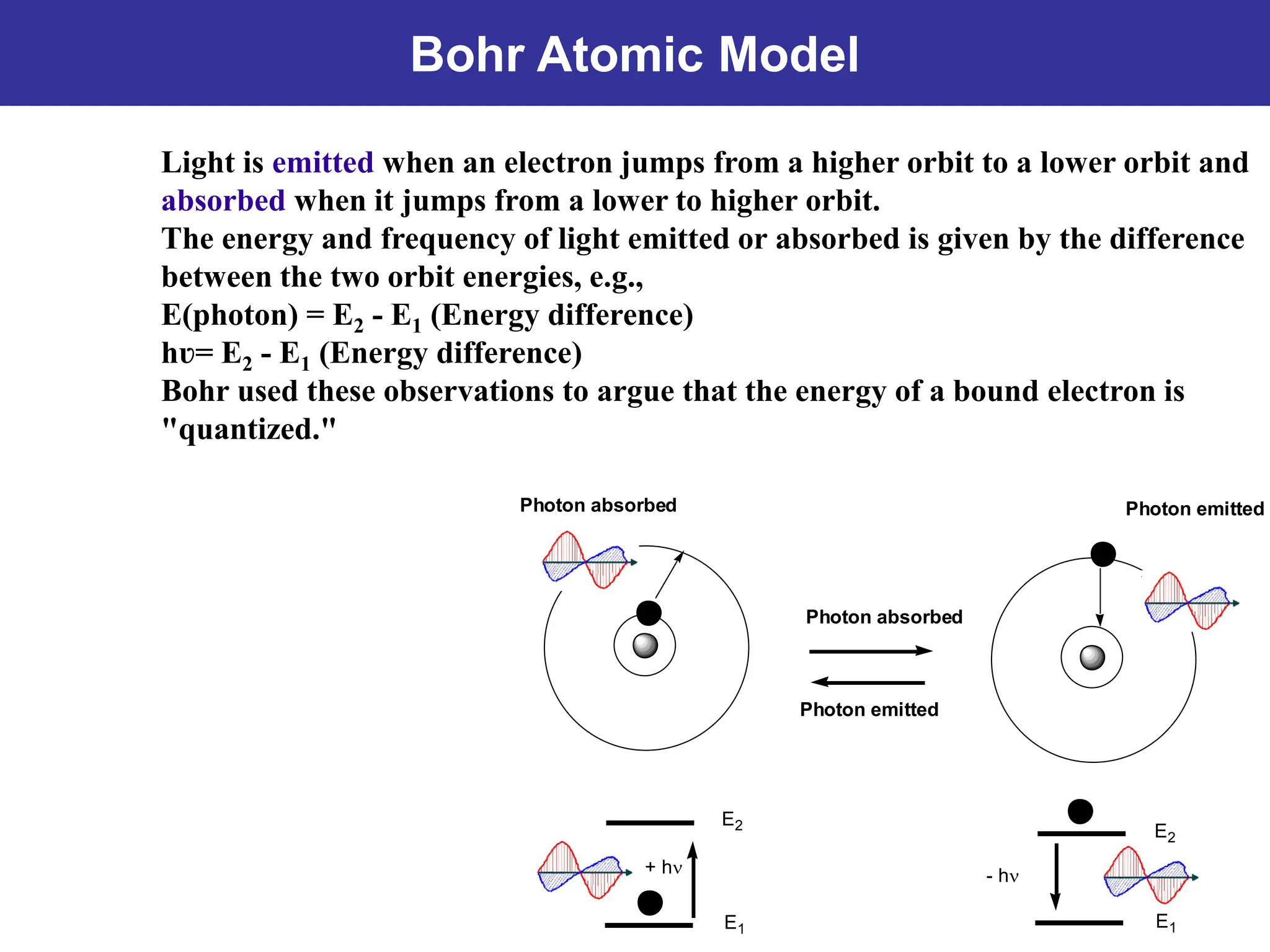
Light is emitted when an electron jumps from a higher orbit to a lower orbit and
absorbed when it jumps from a lower to higher orbit.
The energy and frequency of light emitted or absorbed is given by the difference
between the two orbit energies, e.g.,
E(photon) = E2 - E1 (Energy difference)
hʋ= E2 - E1 (Energy difference)
Bohr used these observations to argue that the energy of a bound electron is
"quantized."
E1
E2 E2
E1
Photon absorbed
Photon emitted
+ h - h
Photon absorbed
Photon emitted
Bohr Atomic Model
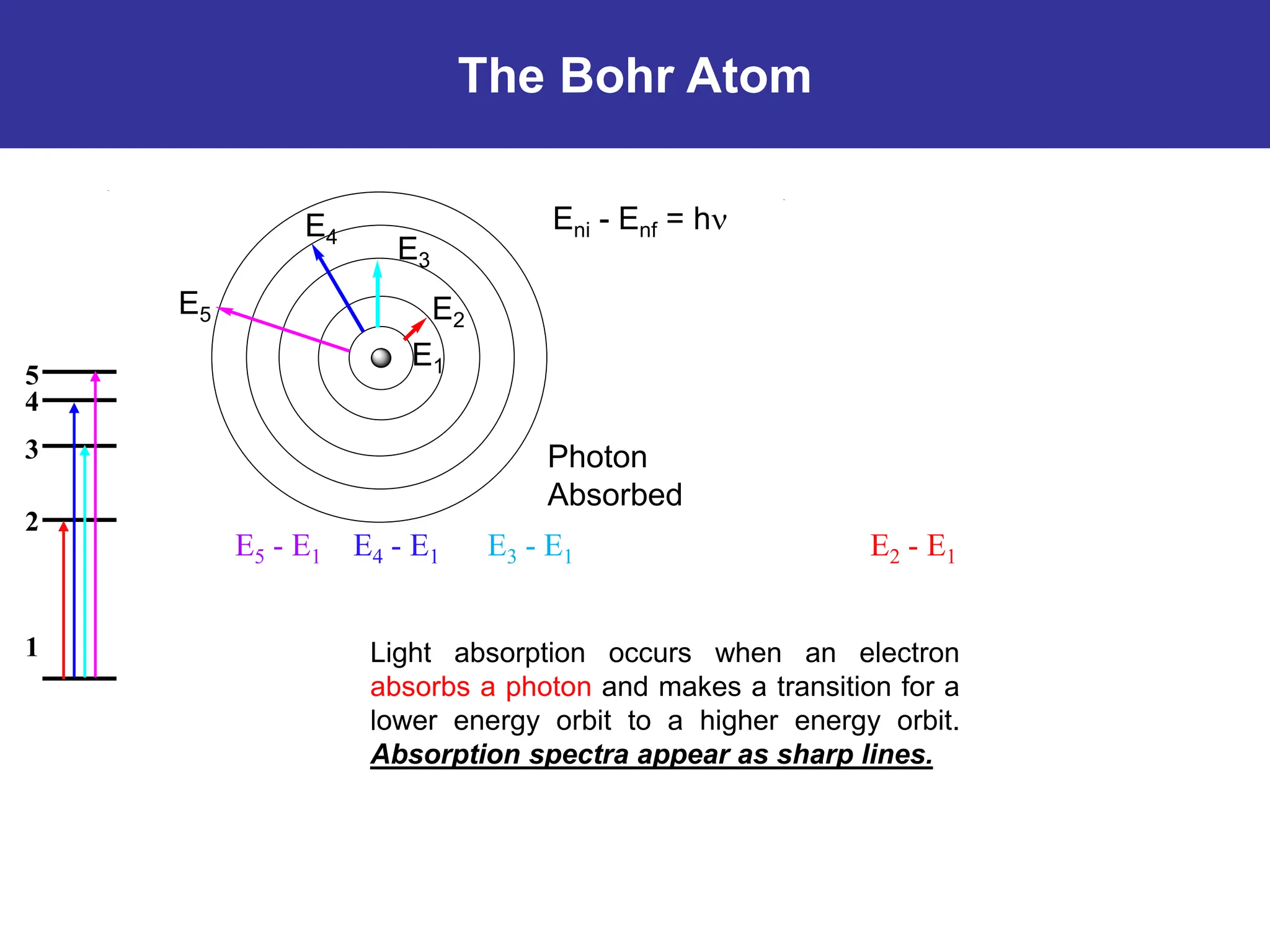
Light absorption occurs when an electron
absorbs a photon and makes a transition for a
lower energy orbit to a higher energy orbit.
Absorption spectra appear as sharp lines.
Eni - Enf = h
Photon
Absorbed
E5
E4
E3
E2
E1
The Bohr Atom
1
2
3
4
5
E5 - E1 E4 - E1 E3 - E1 E2 - E1
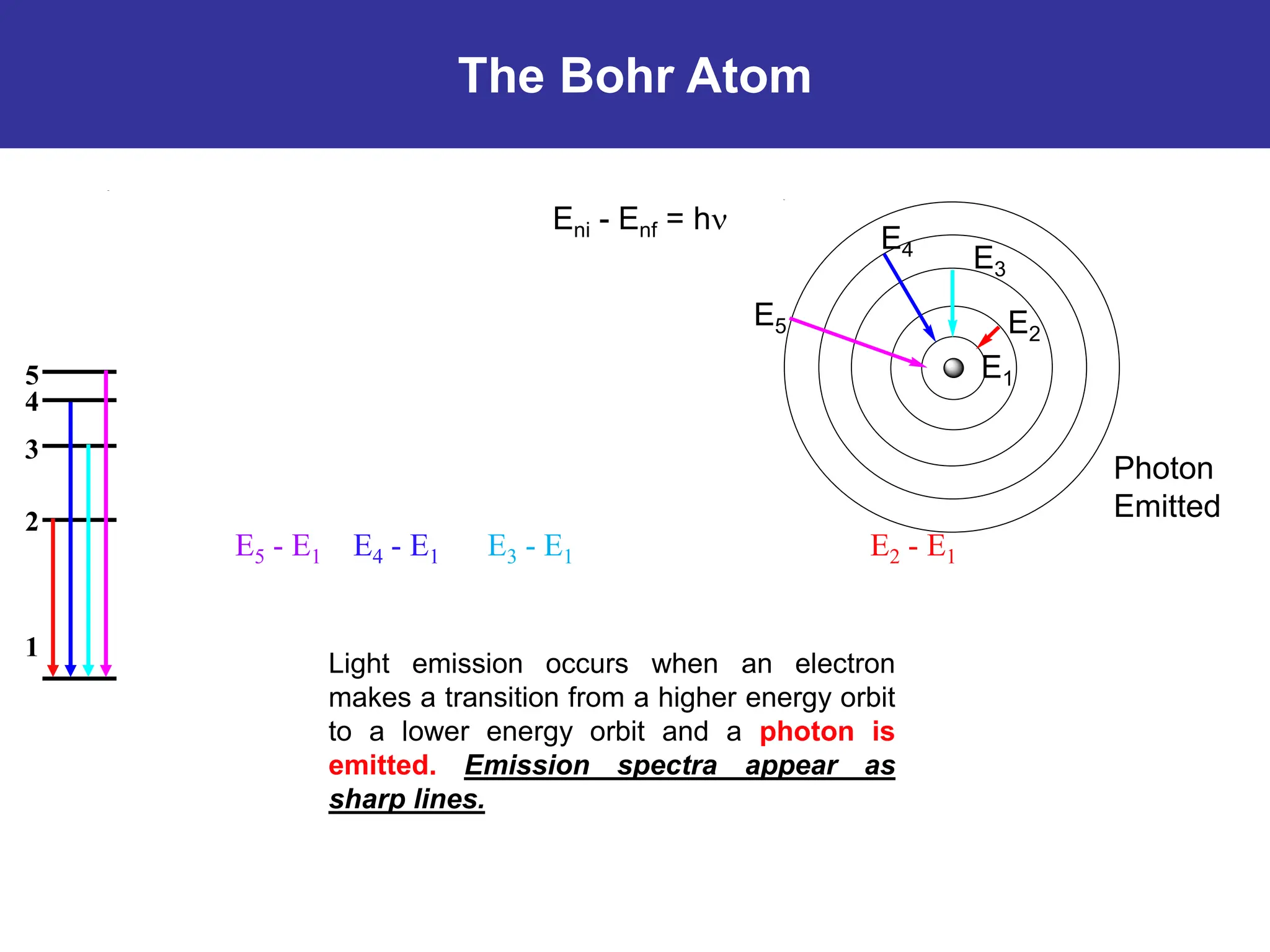
Light emission occurs when an electron
makes a transition from a higher energy orbit
to a lower energy orbit and a photon is
emitted. Emission spectra appear as
sharp lines.
Eni - Enf = h
Photon
Emitted
E3
E2
E1
E5
E4
The Bohr Atom
1
2
3
4
5
E5 - E1 E4 - E1 E3 - E1 E2 - E1
Sample Problem
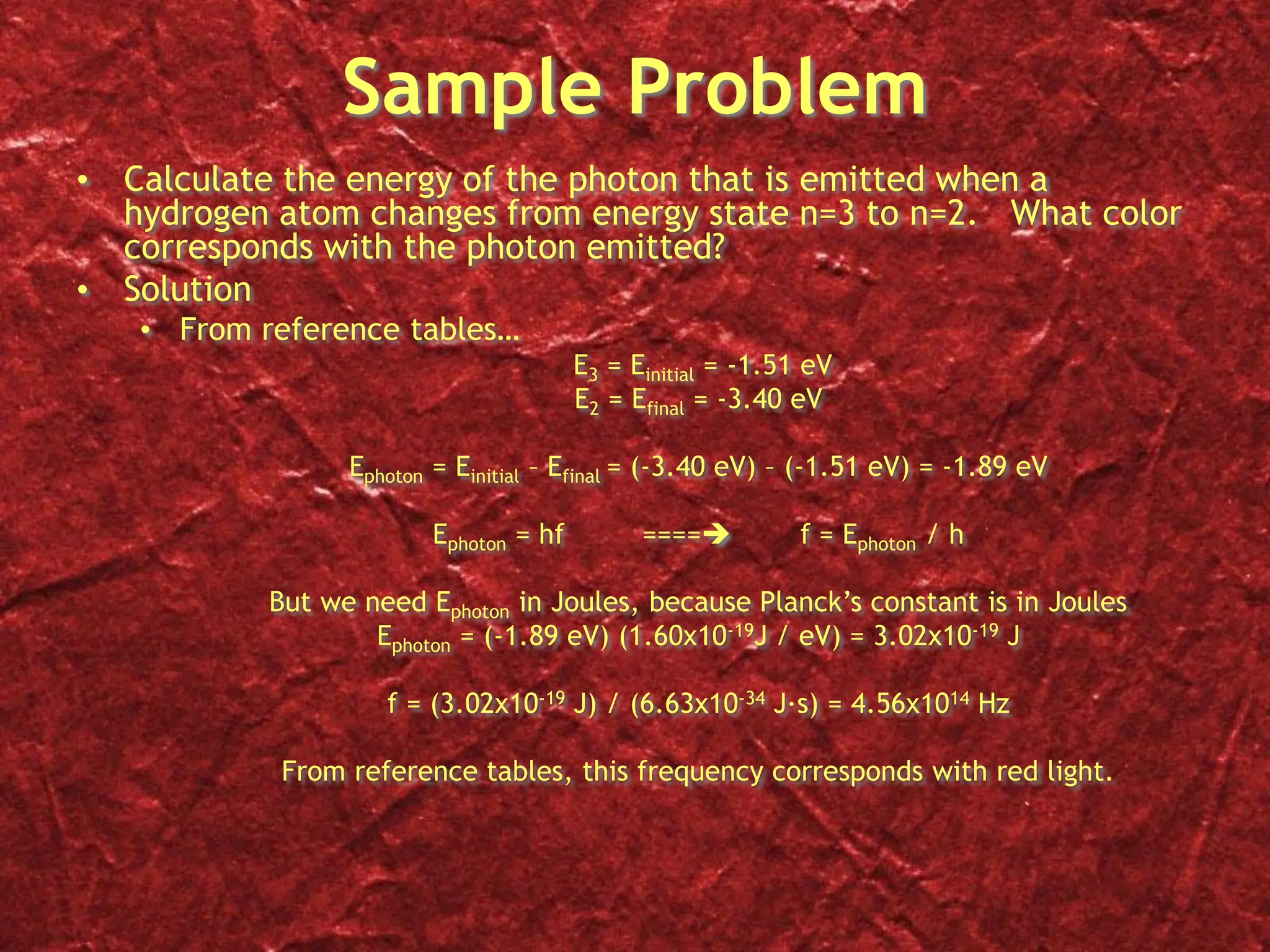
• Calculate the energy of the photon that is emitted when a
hydrogen atom changes from energy state n=3 to n=2. What color
corresponds with the photon emitted?
• Solution
• From reference tables…
E3 = Einitial = -1.51 eV
E2 = Efinal = -3.40 eV
Ephoton = Einitial – Efinal = (-3.40 eV) – (-1.51 eV) = -1.89 eV
Ephoton = hf ==== f = Ephoton / h
But we need Ephoton in Joules, because Planck’s constant is in Joules
Ephoton = (-1.89 eV) (1.60x10⁻¹⁹J / eV) = 3.02x10⁻¹⁹ J
f = (3.02x10⁻¹⁹ J) / (6.63x10⁻³⁴ J∙s) = 4.56x10¹⁴ Hz
From reference tables, this frequency corresponds with red light.
8
Summary of the Bohr Model
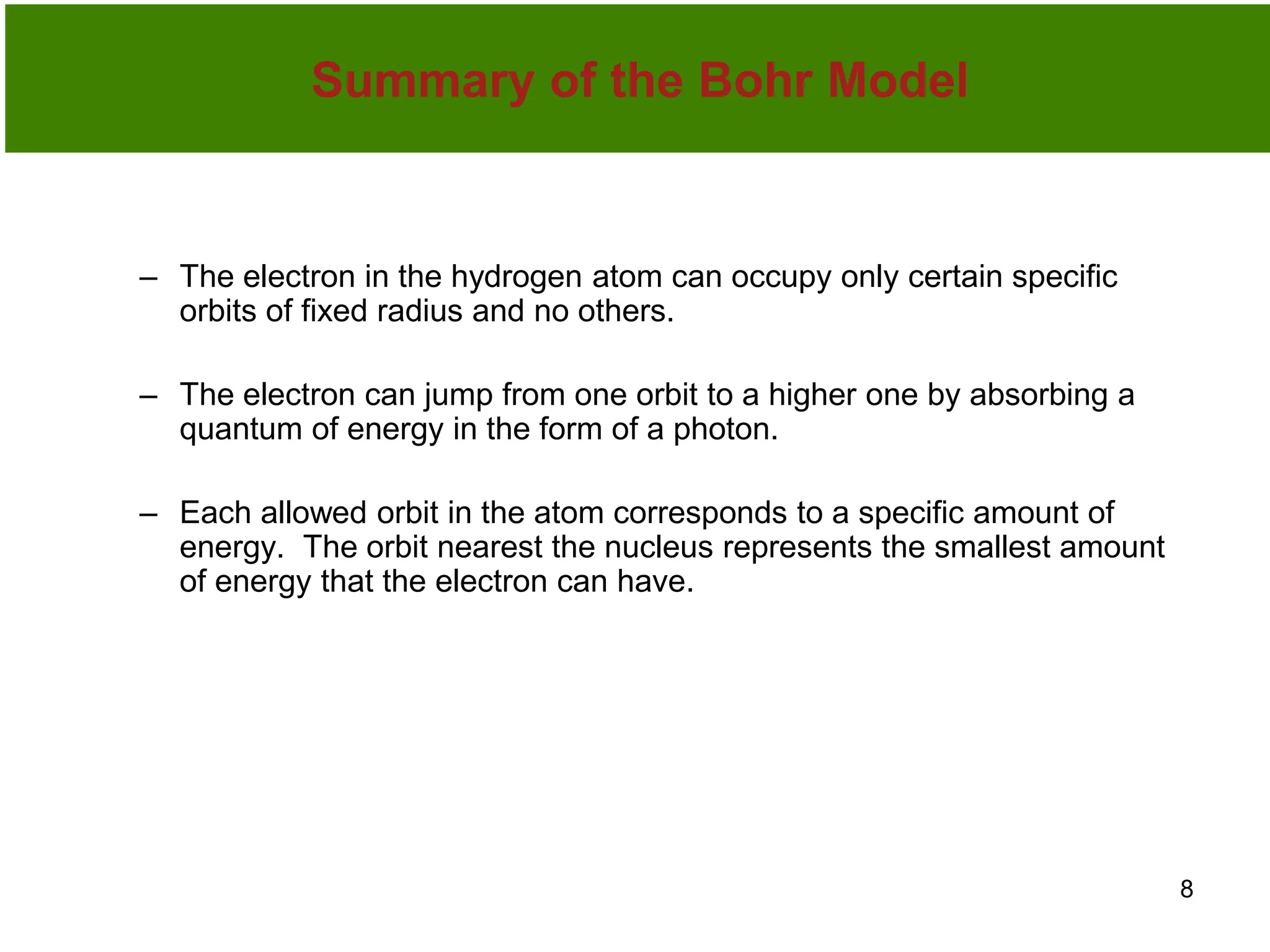
– The electron in the hydrogen atom can occupy only certain specific
orbits of fixed radius and no others.
– The electron can jump from one orbit to a higher one by absorbing a
quantum of energy in the form of a photon.
– Each allowed orbit in the atom corresponds to a specific amount of
energy. The orbit nearest the nucleus represents the smallest amount
of energy that the electron can have.
9
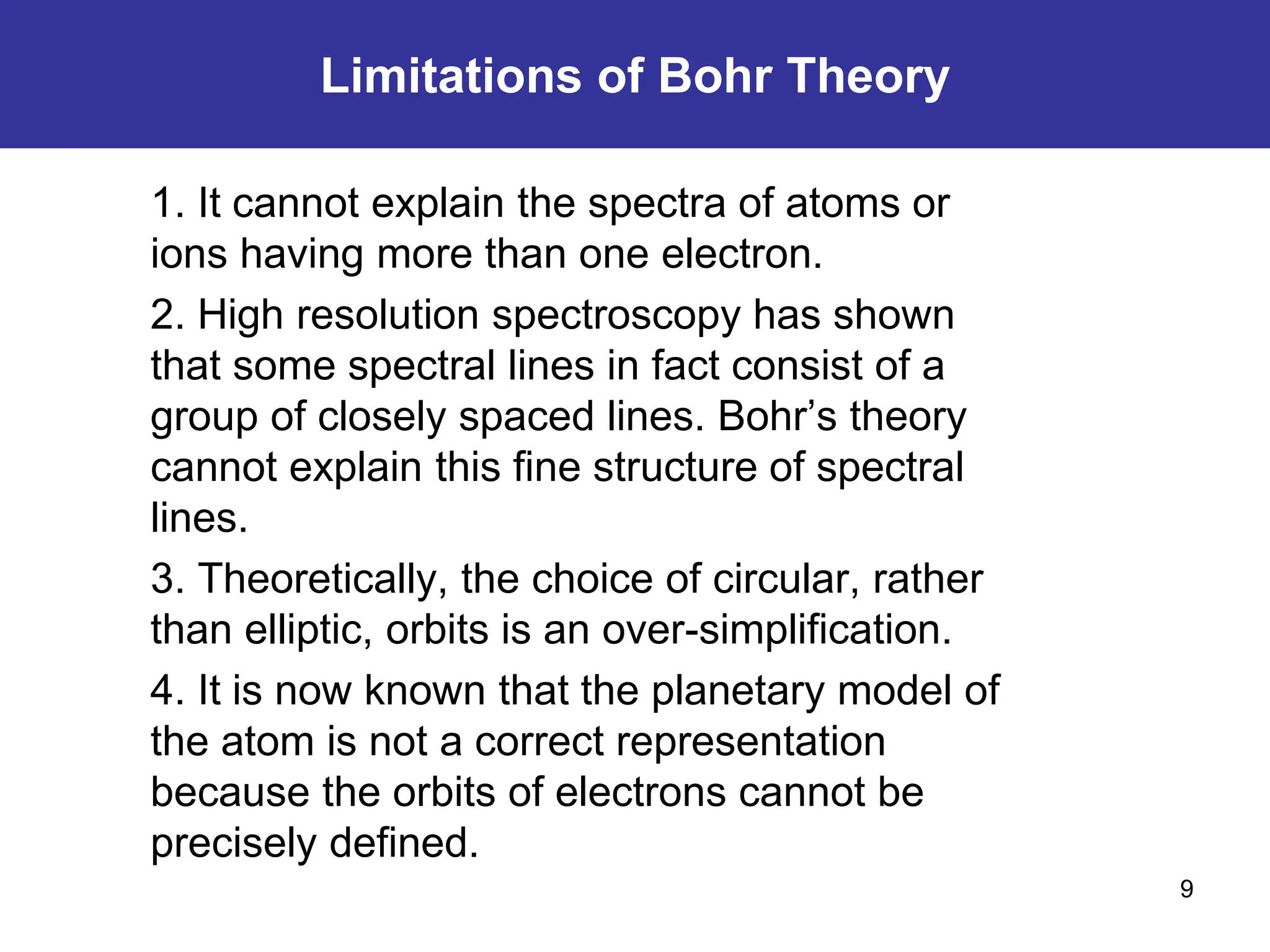
1. It cannot explain the spectra of atoms or
ions having more than one electron.
2. High resolution spectroscopy has shown
that some spectral lines in fact consist of a
group of closely spaced lines. Bohr’s theory
cannot explain this fine structure of spectral
lines.
3. Theoretically, the choice of circular, rather
than elliptic, orbits is an over-simplification.
4. It is now known that the planetary model of
the atom is not a correct representation
because the orbits of electrons cannot be
precisely defined.
Limitations of Bohr Theory
10
11
12
13
14

bohr model.pdf bohr model bsc level study

  • 1.
    Today’s Lecture: Bohr AtomicModel You must be able to understand atomic structure. 1
  • 2.
    2 The electron inthe hydrogen atom can occupy only certain specific circular orbits of quantized angular momentum and no others. the angular momentum in an allowed orbit must be an integer n (the quantum number) times h/2π, where h is Planck's constant. Since the electron of mass m moves with a speed v in a circular path of radius r, its angular momentum is L = mvr. this condition is Ln = rnmvn = nh/2π Bohr Atomic Model Niels Bohr Nobel Prize 1922 “the structure of atoms and the radiation emanating from them”
  • 3.
    • de Brogliecombined the condition for standing waves, nλ = 2πr, with his expression for the wavelength of matter, λ = h/p. Since the linear momentum is p = mv, the standing wave condition can be written as follows: nλ = 2πr nh/mv = 2πr • A simple rearrangement yields rmv = nh/2π. This is precisely Bohr's orbital condition. • Thus, matter wave are seen to have a direct connection to physics on the atomic level. Quantized orbits or angular momentum
  • 4.
    Light is emittedwhen an electron jumps from a higher orbit to a lower orbit and absorbed when it jumps from a lower to higher orbit. The energy and frequency of light emitted or absorbed is given by the difference between the two orbit energies, e.g., E(photon) = E2 - E1 (Energy difference) hʋ= E2 - E1 (Energy difference) Bohr used these observations to argue that the energy of a bound electron is "quantized." E1 E2 E2 E1 Photon absorbed Photon emitted + h - h Photon absorbed Photon emitted Bohr Atomic Model
  • 5.
    Light absorption occurswhen an electron absorbs a photon and makes a transition for a lower energy orbit to a higher energy orbit. Absorption spectra appear as sharp lines. Eni - Enf = h Photon Absorbed E5 E4 E3 E2 E1 The Bohr Atom 1 2 3 4 5 E5 - E1 E4 - E1 E3 - E1 E2 - E1
  • 6.
    Light emission occurswhen an electron makes a transition from a higher energy orbit to a lower energy orbit and a photon is emitted. Emission spectra appear as sharp lines. Eni - Enf = h Photon Emitted E3 E2 E1 E5 E4 The Bohr Atom 1 2 3 4 5 E5 - E1 E4 - E1 E3 - E1 E2 - E1
  • 7.
    Sample Problem • Calculatethe energy of the photon that is emitted when a hydrogen atom changes from energy state n=3 to n=2. What color corresponds with the photon emitted? • Solution • From reference tables… E3 = Einitial = -1.51 eV E2 = Efinal = -3.40 eV Ephoton = Einitial – Efinal = (-3.40 eV) – (-1.51 eV) = -1.89 eV Ephoton = hf ==== f = Ephoton / h But we need Ephoton in Joules, because Planck’s constant is in Joules Ephoton = (-1.89 eV) (1.60x10⁻¹⁹J / eV) = 3.02x10⁻¹⁹ J f = (3.02x10⁻¹⁹ J) / (6.63x10⁻³⁴ J∙s) = 4.56x10¹⁴ Hz From reference tables, this frequency corresponds with red light.
  • 8.
    8 Summary of theBohr Model – The electron in the hydrogen atom can occupy only certain specific orbits of fixed radius and no others. – The electron can jump from one orbit to a higher one by absorbing a quantum of energy in the form of a photon. – Each allowed orbit in the atom corresponds to a specific amount of energy. The orbit nearest the nucleus represents the smallest amount of energy that the electron can have.
  • 9.
    9 1. It cannotexplain the spectra of atoms or ions having more than one electron. 2. High resolution spectroscopy has shown that some spectral lines in fact consist of a group of closely spaced lines. Bohr’s theory cannot explain this fine structure of spectral lines. 3. Theoretically, the choice of circular, rather than elliptic, orbits is an over-simplification. 4. It is now known that the planetary model of the atom is not a correct representation because the orbits of electrons cannot be precisely defined. Limitations of Bohr Theory
  • 10.
  • 11.
  • 12.
  • 13.
  • 14.