by
Dr. S. H. Burungale
Department of Chemistry
Yashwantrao Chavan College of Science Karad
ATOMIC ABSORPTION
SPECTROSCOPY
State the use of Atomic Absorption (AA) spectroscopy.
• Atomic absorption spectroscopy is a quantitative method
of analysis that is applicable to many metals and a few
nonmetals.
• A few examples include:
Al in blood serum
Ca in blood serum, plants, soil, water
Cu in alloys
Cr in sea water
Fe in plants
• Only a drop of sample needed
• The metals need not be removed from other components
(AA is a highly selective technique)
• Sensitive in the ppm range (even ppb with the right
equipment)
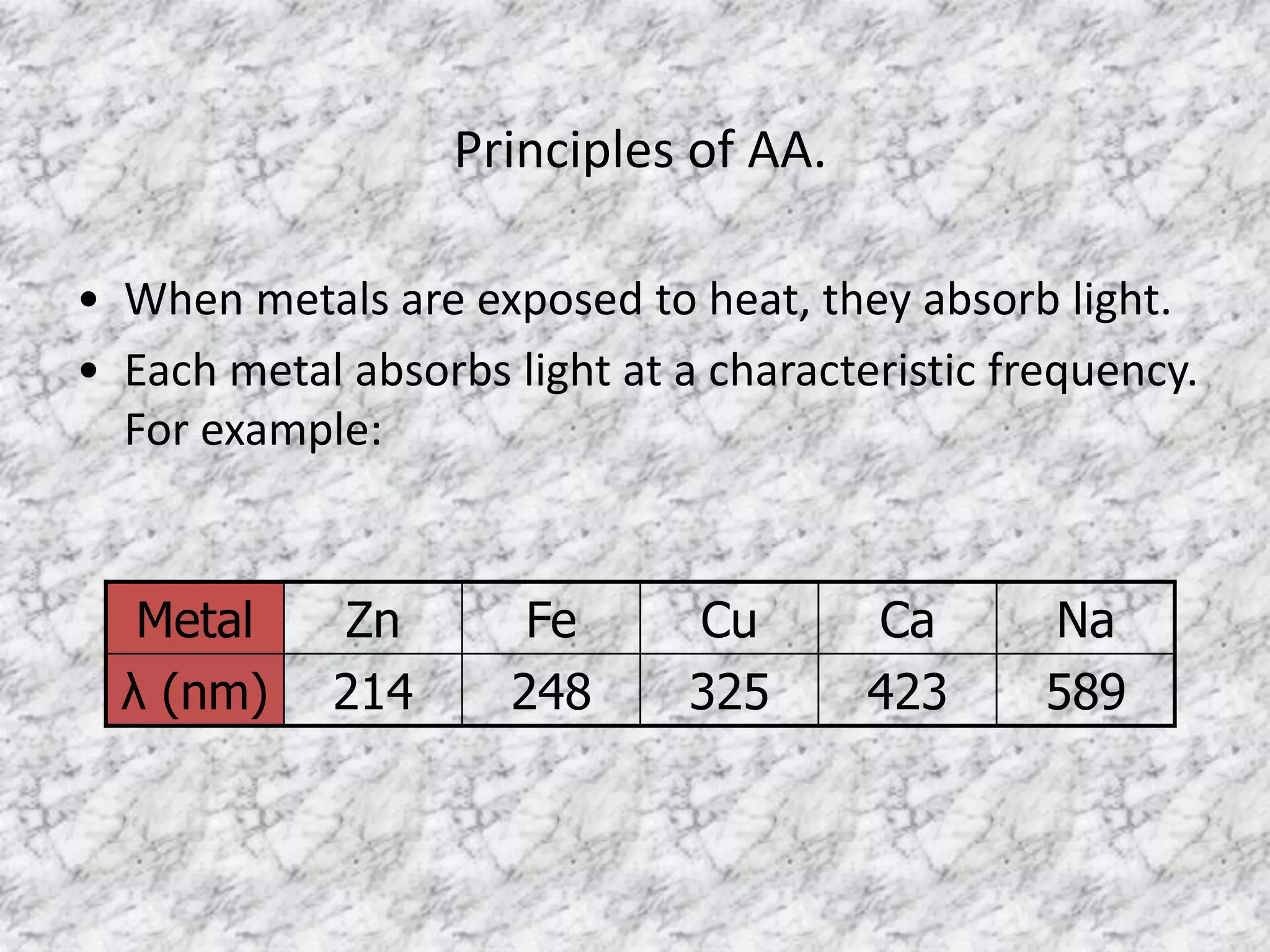
Principles of AA.
• When metals are exposed to heat, they absorb light.
• Each metal absorbs light at a characteristic frequency.
For example:
Metal Zn Fe Cu Ca Na
λ (nm) 214 248 325 423 589
Describe the principles of AA.
• The metal vapor absorbs energy from an external
light source, and electrons jump from the ground to
the excited states
• The ratio of the transmitted to incident light energy
is directly proportional to the concentration of
metal atoms present
• A calibration curve can thus be constructed
[Concentration (ppm) vs. Absorbance]
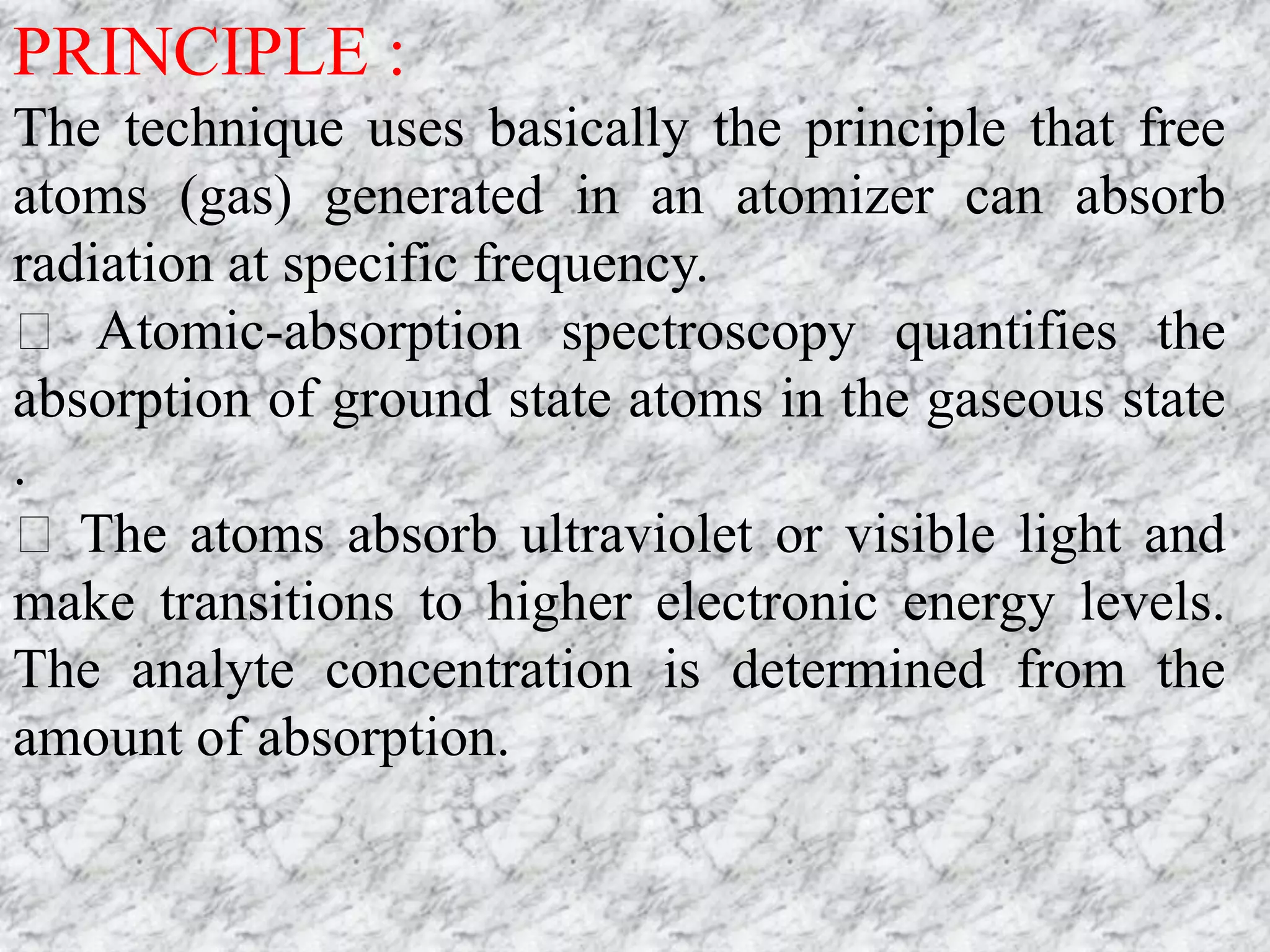
PRINCIPLE :
The technique uses basically the principle that free
atoms (gas) generated in an atomizer can absorb
radiation at specific frequency.
Atomic-absorption spectroscopy quantifies the
absorption of ground state atoms in the gaseous state
.
The atoms absorb ultraviolet or visible light and
make transitions to higher electronic energy levels.
The analyte concentration is determined from the
amount of absorption.
LIGHT SOURCE:
Hollow Cathode Lamp are the most common
radiation source in AAS. It contains a tungsten
anode and a hollow cylindrical cathode made of the
element to be determined. These are sealed in a
glass tube filled with an inert gas (neon or argon ) .
Each element has its own unique lamp which must
be used for that analysis .
Hollow Cathode Lamp: Quartz window Pyrex body
cathode Anode Cathode
NEBULIZER: suck up liquid samples at controlled
rate. create a fine aerosol spray for introduction into
flame. Mix the aerosol and fuel and oxidant
thoroughly for introduction into flame.
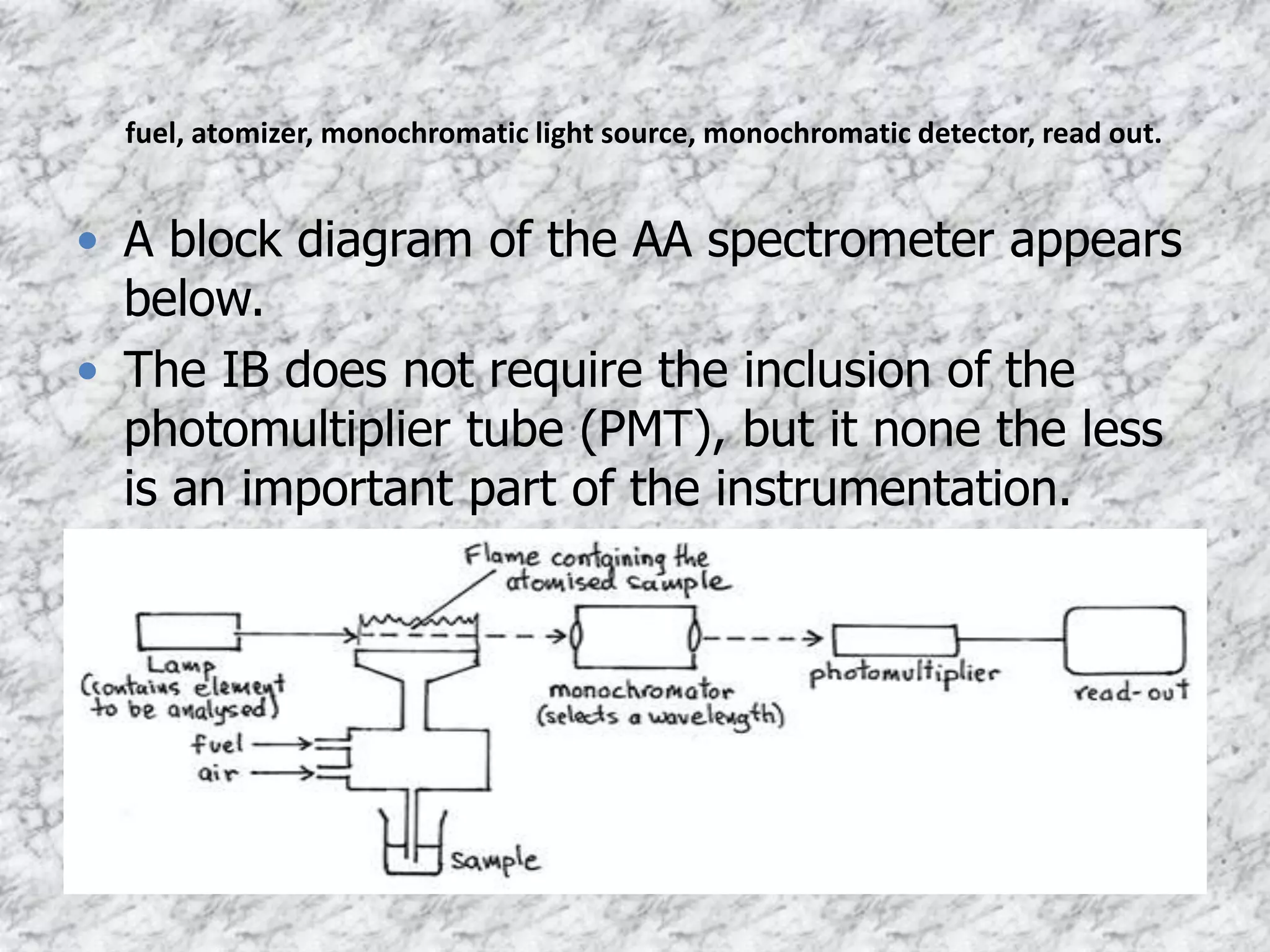
fuel, atomizer, monochromatic light source, monochromatic detector, read out.
• A block diagram of the AA spectrometer appears
below.
• The IB does not require the inclusion of the
photomultiplier tube (PMT), but it none the less
is an important part of the instrumentation.
Overview of AA
spectrometer.
Light Source Detector
Sample
Compartment
light source
• The source of light is a lamp whose cathode is
composed of the element being measured.
• Each analyzed element requires a different lamp.
• For example, a hollow cathode lamp for
• Aluminum (Al) is shown below
• The cathode lamps are stored in
a compartment inside the AA
spectrometer. The specific lamp
needed for a given metal
analysis is rotated into position
for a specific experiment.
fuel
• The sample is made up, typically in water
• A flame is created, usually using ethyne & oxygen
(fuel)
• The flame gases flowing into the burner create a
suction that pulls the liquid into the small tube from
the sample container. This liquid is transferred to the
flame where the sample is atomized [mixing the
sample with air to create fine droplets]. The metal
atoms then absorb light from the source (cathode
lamp).
Sample is
vaporized
in the flame.
Aspirator
tube sucks the
sample into the
flame in the
sample
compartment.
Light beam
monochromater
• The light passes through a monochromater (a device
used to select a particular wavelength of light for
observation)
• The intensity of the light is fairly low, so a
photomultiplier tube (PMT) is used to boost the signal
intensity
• A detector (a special type of transducer) is used to
generate voltage from the impingement of electrons
generated by the photomultiplier tube
Atomizer Elements to be analyzed needs to be in
atomic sate. Atomization is separation of particles
into individual molecules and breaking molecules
into atoms. This is done by exposing the analyte to
high temperatures in a flame or graphite furnace .
ATOMIZERS: ATOMIZER FLAME GRAPHITE
TUBEATOMIZERS ATOMIZERS
FLAME ATOMIZER: To create flame, we need to mix
an oxidant gas and a fuel gas. in most of the cases
air-acetylene flame or nitrous oxide- acetylene flame is
used. liquid or dissolved samples are typically used
with flame atomizer.
GRAPHITE TUBE ATOMIZER: uses a graphite coated
furnace to vaporize the sample. ln GFAAS sample,
samples are deposited in a small graphite coated tube
which can then be heated to vaporize and atomize the
analyte. The graphite tubes are heated using a high
current power supply.
detector
A typical photomultiplier tube
read out.
• The read out specified by
the user is displayed on the
computer screen for each
sample measured.
Read out.
The resulting
data can be
presented in
a variety of
ways, but
typically a
print out is
made.
Determine the concentration of a solution from a calibration
curve.
• AA can be used to identify the presence of an
element (qualitative analysis), or the concentration
of a metal (quantitative analysis)
• Quantitative analysis can be achieved by measuring
the absorbance of a series of solutions of known
concentration.
• A calibration curve and the equation for the line can
be used to determine an unknown concentration
based on its absorbance.
Determine the concentration of a solution from a calibration
curve.
Lead is extracted from a sample of blood and analyzed at 283 nm and gave an absorbance of
0.340 in an AA spectrometer. Using the data provided, graph a calibration curve and find the
concentration of lead ions in the blood sample.
[Pb+2] (ppm) Absorbance Calculated Pb (II) concentraions (ppm) Absorbance
0.000 0.000 0.357 0.340
0.100 0.116
0.200 0.216
0.300 0.310
0.400 0.425
0.500 0.520
Lead (II) Calibration Curve
y = 1.0505x
R2
= 0.9988
0.000
0.100
0.200
0.300
0.400
0.500
0.600
0.000 0.100 0.200 0.300 0.400 0.500 0.600
[Pb+2] (ppm)
Absorbance
• The data provided in
the problem appears
in the upper left hand
corner of this MS
EXCEL worksheet.
• The graph was used
to calculate the best
fit line.
• The equation was
then used to
calculate the
concentration of Pb
(II) ions with an
absorbance of 0.340.
• The result, 0.357
ppm, is displayed
above the graph.
APPLICATIONS
VANADIUM IN LUBRICATING OIL
THEORY:
High temperature corrosion and fouling can be
attributed to vanadium in the fuel. During combustion,
the element oxidize and form semi- liquid and low
melting salts (vanadium pentoxide), which adhere to
exhaust valves and turbochargers.
In practice, the extent of hot corrosion and fouling are
generally maintained at an acceptable level through
temperature control, an operational solution, and
material selection.
the oil is dissolved in white spirit and the absorption
of this solution is compared with the absorption of
standard.
STANDARD SOLUTION: the standard solutions
are made up from vanadium naphthenate in white
spirit which contain about 3% of vanadium. (weigh
out 0.6 g of vanadium naphthenate into a 100 ml
flask and made up to mark with white spirit. dilute
portions of this stock solution to obtain a series of
working standards containing 10-40 mg ml-1 of
vanadium).
PROCEDURE:
weigh out accurately about 5 g of the oil sample,
dissolve in small volume of white spirit and transfer to
50 ml flask. using same solvent, make up the sol. to
the mark. set up a vanadium hollow cathode lamp
selecting a resonance line of wavelength 318.5 nm.
adjust gas controls to give a fuel rich acetylene-nitrous
oxide flame. aspirate successfully into the flame the
solvent blank, standard solutions and finally the test
solution in each case recording the absorbance reading
.plot the calibration curve and ascertain the vanadium
content of the oil.
LEAD IN CONTAMINATED SOIL:
SAMPLING: samples of approx. 50g should be
taken from specified sampling points on the site.
The sampling point should include surface soil and
two further samples taken at depth, at 0.5 and 1.0m.
The exact location of these points should be noted,
for it may be necessary to take further samples.
PROCEDURE:
weight out about 1g of seived soil and transfer to a
100ml beaker. add 20 ml of 1:1 nitric acid .
boil gently on a hot plate until the volume of nitric
acid is reduced to 5ml
. add 20ml of deionised water and boil gently again
until the volume is 10ml. suitable for measurement
cool the suspension and filter through a whatman
filter paper, washing the beaker and filter paper
with deionised water until a volume of about 25ml
is obtained. transfer the filtrate to a 50ml flask
and make up to the mark with deionised water.
setup acetylene-air flame with resonance line
217.0 nm.
standard lead solutions containing 1-10 mg ml-1
are
THANK YOU

Atomic absorption spectroscopy

  • 1.
    by Dr. S. H.Burungale Department of Chemistry Yashwantrao Chavan College of Science Karad ATOMIC ABSORPTION SPECTROSCOPY
  • 2.
    State the useof Atomic Absorption (AA) spectroscopy. • Atomic absorption spectroscopy is a quantitative method of analysis that is applicable to many metals and a few nonmetals. • A few examples include: Al in blood serum Ca in blood serum, plants, soil, water Cu in alloys Cr in sea water Fe in plants • Only a drop of sample needed • The metals need not be removed from other components (AA is a highly selective technique) • Sensitive in the ppm range (even ppb with the right equipment)
  • 3.
    Principles of AA. •When metals are exposed to heat, they absorb light. • Each metal absorbs light at a characteristic frequency. For example: Metal Zn Fe Cu Ca Na λ (nm) 214 248 325 423 589
  • 4.
    Describe the principlesof AA. • The metal vapor absorbs energy from an external light source, and electrons jump from the ground to the excited states • The ratio of the transmitted to incident light energy is directly proportional to the concentration of metal atoms present • A calibration curve can thus be constructed [Concentration (ppm) vs. Absorbance]
  • 5.
    PRINCIPLE : The techniqueuses basically the principle that free atoms (gas) generated in an atomizer can absorb radiation at specific frequency. Atomic-absorption spectroscopy quantifies the absorption of ground state atoms in the gaseous state . The atoms absorb ultraviolet or visible light and make transitions to higher electronic energy levels. The analyte concentration is determined from the amount of absorption.
  • 7.
    LIGHT SOURCE: Hollow CathodeLamp are the most common radiation source in AAS. It contains a tungsten anode and a hollow cylindrical cathode made of the element to be determined. These are sealed in a glass tube filled with an inert gas (neon or argon ) . Each element has its own unique lamp which must be used for that analysis . Hollow Cathode Lamp: Quartz window Pyrex body cathode Anode Cathode NEBULIZER: suck up liquid samples at controlled rate. create a fine aerosol spray for introduction into flame. Mix the aerosol and fuel and oxidant thoroughly for introduction into flame.
  • 8.
    fuel, atomizer, monochromaticlight source, monochromatic detector, read out. • A block diagram of the AA spectrometer appears below. • The IB does not require the inclusion of the photomultiplier tube (PMT), but it none the less is an important part of the instrumentation.
  • 9.
    Overview of AA spectrometer. LightSource Detector Sample Compartment
  • 10.
    light source • Thesource of light is a lamp whose cathode is composed of the element being measured. • Each analyzed element requires a different lamp. • For example, a hollow cathode lamp for • Aluminum (Al) is shown below
  • 11.
    • The cathodelamps are stored in a compartment inside the AA spectrometer. The specific lamp needed for a given metal analysis is rotated into position for a specific experiment.
  • 12.
    fuel • The sampleis made up, typically in water • A flame is created, usually using ethyne & oxygen (fuel) • The flame gases flowing into the burner create a suction that pulls the liquid into the small tube from the sample container. This liquid is transferred to the flame where the sample is atomized [mixing the sample with air to create fine droplets]. The metal atoms then absorb light from the source (cathode lamp).
  • 13.
    Sample is vaporized in theflame. Aspirator tube sucks the sample into the flame in the sample compartment. Light beam
  • 14.
    monochromater • The lightpasses through a monochromater (a device used to select a particular wavelength of light for observation) • The intensity of the light is fairly low, so a photomultiplier tube (PMT) is used to boost the signal intensity • A detector (a special type of transducer) is used to generate voltage from the impingement of electrons generated by the photomultiplier tube
  • 15.
    Atomizer Elements tobe analyzed needs to be in atomic sate. Atomization is separation of particles into individual molecules and breaking molecules into atoms. This is done by exposing the analyte to high temperatures in a flame or graphite furnace .
  • 16.
    ATOMIZERS: ATOMIZER FLAMEGRAPHITE TUBEATOMIZERS ATOMIZERS FLAME ATOMIZER: To create flame, we need to mix an oxidant gas and a fuel gas. in most of the cases air-acetylene flame or nitrous oxide- acetylene flame is used. liquid or dissolved samples are typically used with flame atomizer. GRAPHITE TUBE ATOMIZER: uses a graphite coated furnace to vaporize the sample. ln GFAAS sample, samples are deposited in a small graphite coated tube which can then be heated to vaporize and atomize the analyte. The graphite tubes are heated using a high current power supply.
  • 17.
  • 18.
    read out. • Theread out specified by the user is displayed on the computer screen for each sample measured.
  • 19.
    Read out. The resulting datacan be presented in a variety of ways, but typically a print out is made.
  • 20.
    Determine the concentrationof a solution from a calibration curve. • AA can be used to identify the presence of an element (qualitative analysis), or the concentration of a metal (quantitative analysis) • Quantitative analysis can be achieved by measuring the absorbance of a series of solutions of known concentration. • A calibration curve and the equation for the line can be used to determine an unknown concentration based on its absorbance.
  • 21.
    Determine the concentrationof a solution from a calibration curve.
  • 22.
    Lead is extractedfrom a sample of blood and analyzed at 283 nm and gave an absorbance of 0.340 in an AA spectrometer. Using the data provided, graph a calibration curve and find the concentration of lead ions in the blood sample. [Pb+2] (ppm) Absorbance Calculated Pb (II) concentraions (ppm) Absorbance 0.000 0.000 0.357 0.340 0.100 0.116 0.200 0.216 0.300 0.310 0.400 0.425 0.500 0.520 Lead (II) Calibration Curve y = 1.0505x R2 = 0.9988 0.000 0.100 0.200 0.300 0.400 0.500 0.600 0.000 0.100 0.200 0.300 0.400 0.500 0.600 [Pb+2] (ppm) Absorbance • The data provided in the problem appears in the upper left hand corner of this MS EXCEL worksheet. • The graph was used to calculate the best fit line. • The equation was then used to calculate the concentration of Pb (II) ions with an absorbance of 0.340. • The result, 0.357 ppm, is displayed above the graph.
  • 23.
    APPLICATIONS VANADIUM IN LUBRICATINGOIL THEORY: High temperature corrosion and fouling can be attributed to vanadium in the fuel. During combustion, the element oxidize and form semi- liquid and low melting salts (vanadium pentoxide), which adhere to exhaust valves and turbochargers. In practice, the extent of hot corrosion and fouling are generally maintained at an acceptable level through temperature control, an operational solution, and material selection.
  • 24.
    the oil isdissolved in white spirit and the absorption of this solution is compared with the absorption of standard. STANDARD SOLUTION: the standard solutions are made up from vanadium naphthenate in white spirit which contain about 3% of vanadium. (weigh out 0.6 g of vanadium naphthenate into a 100 ml flask and made up to mark with white spirit. dilute portions of this stock solution to obtain a series of working standards containing 10-40 mg ml-1 of vanadium).
  • 25.
    PROCEDURE: weigh out accuratelyabout 5 g of the oil sample, dissolve in small volume of white spirit and transfer to 50 ml flask. using same solvent, make up the sol. to the mark. set up a vanadium hollow cathode lamp selecting a resonance line of wavelength 318.5 nm. adjust gas controls to give a fuel rich acetylene-nitrous oxide flame. aspirate successfully into the flame the solvent blank, standard solutions and finally the test solution in each case recording the absorbance reading .plot the calibration curve and ascertain the vanadium content of the oil.
  • 26.
    LEAD IN CONTAMINATEDSOIL: SAMPLING: samples of approx. 50g should be taken from specified sampling points on the site. The sampling point should include surface soil and two further samples taken at depth, at 0.5 and 1.0m. The exact location of these points should be noted, for it may be necessary to take further samples.
  • 27.
    PROCEDURE: weight out about1g of seived soil and transfer to a 100ml beaker. add 20 ml of 1:1 nitric acid . boil gently on a hot plate until the volume of nitric acid is reduced to 5ml . add 20ml of deionised water and boil gently again until the volume is 10ml. suitable for measurement
  • 28.
    cool the suspensionand filter through a whatman filter paper, washing the beaker and filter paper with deionised water until a volume of about 25ml is obtained. transfer the filtrate to a 50ml flask and make up to the mark with deionised water. setup acetylene-air flame with resonance line 217.0 nm. standard lead solutions containing 1-10 mg ml-1 are
  • 29.