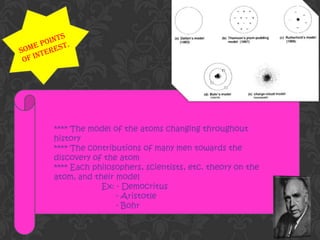
**** The model of the atoms changing throughout
history
**** The contributions of many men towards the
discovery of the atom
**** Each philosophers, scientists, etc. theory on the
atom, and their model
Ex: - Democritus
- Aristotle
- Bohr
He found that
matter is made of
atoms. He also
found that matter
will always exist.
He also found 4
elements, fire, wa
ter, earth, and air.
With all this, he
came up with the
theory of motion.
• This is the Greek philosopher
Democritus who began the search
for a description of matter more
than 2400 years ago.
• Proposed an Atomic Theory which
states that all atoms are
small, hard, indivisible and
indestructible particles made of a
single material formed into
different shapes and sizes.
• Found that atoms are not all the
same, they are eternal, and always
moving
• Aristotle did not support his
atomic theory
This was Democritus’ idea of an
atom which was forgotten for over
2,000 years
Named oxygen and hydrogen
He invented the first periodic
table, which had 33 elements.
Known as the “Father of
Modern Chemistry”
He also proposed the Law of
Conversation of Mass which
represents the beginning of
modern chemistry, which
states, in a chemical
reaction, matter is neither
created nor destroyed
 A brilliant youth that he
became an English school
teacher when barely 12 years
old
 Atomic theory of matter based
on his experimental
observations. :
*All matter is made of
atoms. Atoms are indivisible and
indestructible.
*All atoms of a given
element are identical in mass
and properties.
* Compounds are formed
by a combination of two or more
different kinds of atoms.
* A chemical reaction is a
rearrangement of atoms.
* Atoms can be neither
This is Dalton’s model of an atom,
created nor destroyed.
is once again compared to the
 This theory became one of
billiard ball, and similar to
the foundations of modern
Democritus’ model.
chemistry
• Proved that an atom can be divided
into smaller parts.
• In 1897, proposed the Plum Pudding
Model. Atoms were made from a
positively charged substance with
negatively charged electrons
scattered about, like raisins in a
pudding.
 Performed the Gold Foil
Experiment and
suggested the following
characteristics of the
atom:
**It consists of a small
core, or nucleus, that
contains most of the mass of
the atom
**This nucleus is made
up of particles called
protons, which have a
positive charge
**The protons are
surrounded by negatively
charged electrons, but most
of the atom is actually empty
space
 “Father of Nuclear
Physics”
 Was on the New Zealand

1. Some “bullets” went
straight through the gold foil
without changing its course
2. Some did bounce away
from the gold sheet as if
they had hit something
solid
3. Atoms were not a pudding
filled with a positively
charged material.
4. Rutherford concluded that
an atom had a
small, dense, positively
charged center that
repelled his positively
Proposed the Bohr Model, which suggests that electrons travel
around the nucleus of an atom in paths.
The electrons can jump from a path in one level to a path in
another level (depending on their energy level)
Protons: 36
Neutrons: 48

Let’s draw
a Bohr
Model!
He further explained the
nature of electrons in an
atom by stating that the
exact location of an
electron cannot be stated;
therefore, it is more
accurate to view the
electrons in regions called
electron clouds; electron
clouds are places where
the electrons are likely to
be found
Realized that the atomic mass of
most elements was double the
number of protons which resulted in
discovery of the neutron in 1932
Worked with Ernest Rutherford
- Electrons do not have a defined
path, they are in an electron cloud
- Small positively charged nucleus
surrounded by a large region
filled with electrons. (Wave
Mechanics)

Atom powerpoint

  • 2.
    **** The modelof the atoms changing throughout history **** The contributions of many men towards the discovery of the atom **** Each philosophers, scientists, etc. theory on the atom, and their model Ex: - Democritus - Aristotle - Bohr
  • 4.
    He found that matteris made of atoms. He also found that matter will always exist. He also found 4 elements, fire, wa ter, earth, and air. With all this, he came up with the theory of motion.
  • 5.
    • This isthe Greek philosopher Democritus who began the search for a description of matter more than 2400 years ago. • Proposed an Atomic Theory which states that all atoms are small, hard, indivisible and indestructible particles made of a single material formed into different shapes and sizes. • Found that atoms are not all the same, they are eternal, and always moving • Aristotle did not support his atomic theory This was Democritus’ idea of an atom which was forgotten for over 2,000 years
  • 6.
    Named oxygen andhydrogen He invented the first periodic table, which had 33 elements. Known as the “Father of Modern Chemistry” He also proposed the Law of Conversation of Mass which represents the beginning of modern chemistry, which states, in a chemical reaction, matter is neither created nor destroyed
  • 7.
     A brilliantyouth that he became an English school teacher when barely 12 years old  Atomic theory of matter based on his experimental observations. : *All matter is made of atoms. Atoms are indivisible and indestructible. *All atoms of a given element are identical in mass and properties. * Compounds are formed by a combination of two or more different kinds of atoms. * A chemical reaction is a rearrangement of atoms. * Atoms can be neither This is Dalton’s model of an atom, created nor destroyed. is once again compared to the  This theory became one of billiard ball, and similar to the foundations of modern Democritus’ model. chemistry
  • 8.
    • Proved thatan atom can be divided into smaller parts. • In 1897, proposed the Plum Pudding Model. Atoms were made from a positively charged substance with negatively charged electrons scattered about, like raisins in a pudding.
  • 9.
     Performed theGold Foil Experiment and suggested the following characteristics of the atom: **It consists of a small core, or nucleus, that contains most of the mass of the atom **This nucleus is made up of particles called protons, which have a positive charge **The protons are surrounded by negatively charged electrons, but most of the atom is actually empty space  “Father of Nuclear Physics”  Was on the New Zealand 1. Some “bullets” went straight through the gold foil without changing its course 2. Some did bounce away from the gold sheet as if they had hit something solid 3. Atoms were not a pudding filled with a positively charged material. 4. Rutherford concluded that an atom had a small, dense, positively charged center that repelled his positively
  • 10.
    Proposed the BohrModel, which suggests that electrons travel around the nucleus of an atom in paths. The electrons can jump from a path in one level to a path in another level (depending on their energy level)
  • 11.
  • 12.
    He further explainedthe nature of electrons in an atom by stating that the exact location of an electron cannot be stated; therefore, it is more accurate to view the electrons in regions called electron clouds; electron clouds are places where the electrons are likely to be found
  • 13.
    Realized that theatomic mass of most elements was double the number of protons which resulted in discovery of the neutron in 1932 Worked with Ernest Rutherford
  • 14.
    - Electrons donot have a defined path, they are in an electron cloud - Small positively charged nucleus surrounded by a large region filled with electrons. (Wave Mechanics)