By the endof this lesson, you will be
able to:
Lesson Objectives
Recall and explain the contributions of key
scientists in the development of the atomic
model.
Show interest and appreciation for how
scientific ideas change over time through
discussion and participation.
Create an atom model and correctly label its
parts.
3.
What is anAtom?
Recap
You may call a student to answer.
Do not forget to remove this before presenting
4.
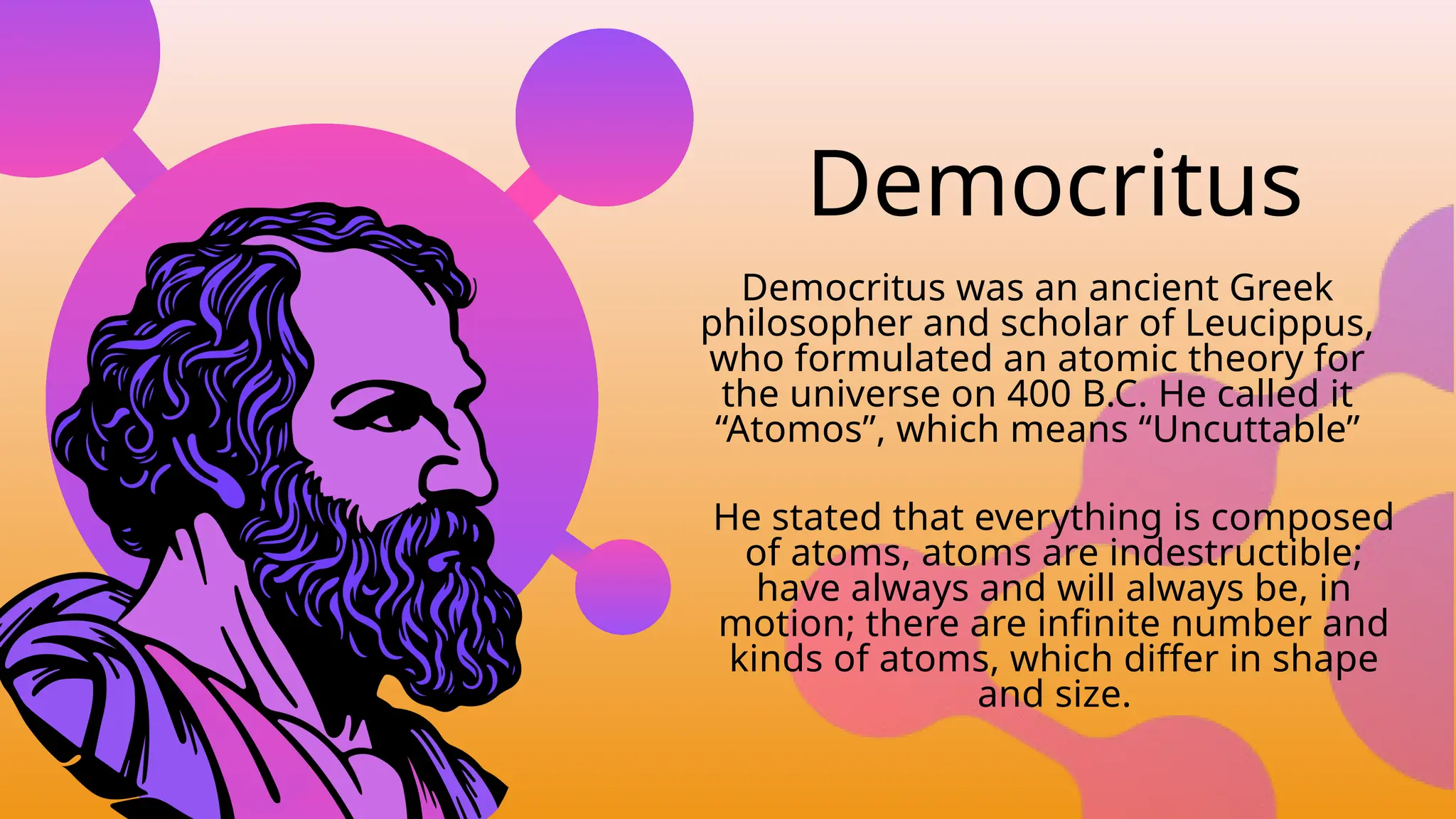
Democritus
Democritus was anancient Greek
philosopher and scholar of Leucippus,
who formulated an atomic theory for
the universe on 400 B.C. He called it
“Atomos”, which means “Uncuttable”
He stated that everything is composed
of atoms, atoms are indestructible;
have always and will always be, in
motion; there are infinite number and
kinds of atoms, which differ in shape
and size.
John Dalton
Dalton's atomictheory states that all
matter is made of atoms. Atoms are
invisible and indestructible. All atoms
of a given element are identical in
mass and properties.
John Dalton was an English chemist
with a Quaker background. A pioneer
meteorologist which led him to his
research into the nature of gases that
became the foundation he built his
atomic theory on.
7.
Dalton’s Atomic
model
1 oxygenatom at
16 mass units each
2 hydrogen atoms
at 1 mass units
each
1 water molecule
at 18 mass units
each
16 mass units 2 mass units 18 mass units
8.
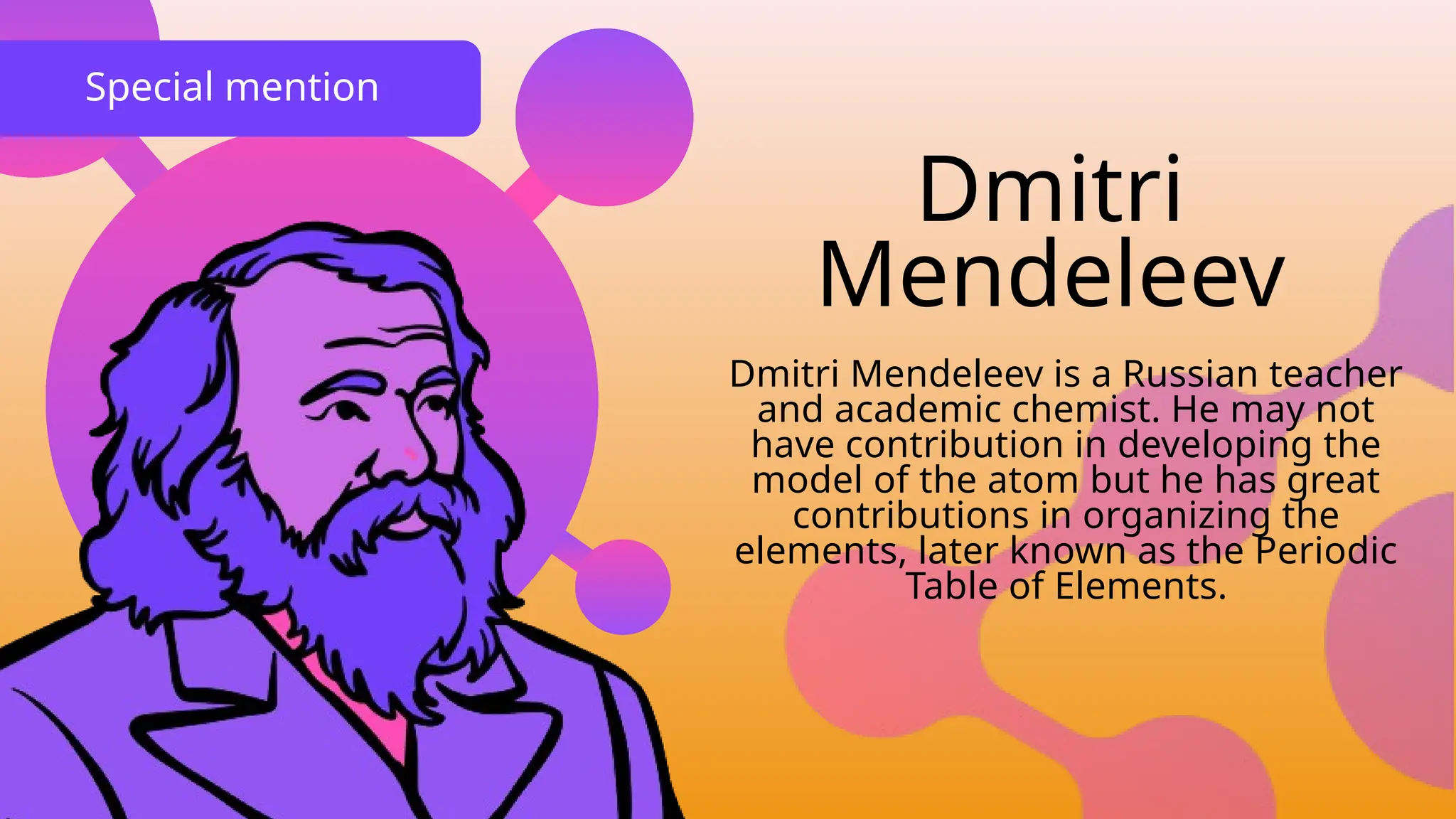
Dmitri
Mendeleev
Dmitri Mendeleev isa Russian teacher
and academic chemist. He may not
have contribution in developing the
model of the atom but he has great
contributions in organizing the
elements, later known as the Periodic
Table of Elements.
Special mention
9.
J.J. Thomson
J.J. Thomsonwas a Nobel Prize
winning physicist whose research in
cathode rays led to the discovery of
the electron.
To a large extent, it was Thomson who
made atomic physics a modern
science. The studies of nuclear
organization that continue even to
this day and the further identification
of elementary particles all followed his
most outstanding accomplishment,
his discovery of the electron in 1897.
Max Planck
In 1874he was a freshman at the
University of Munich. As he went
through college he realized that he
had a natural talent for theoretical
physics. After transferring schools he
was taught by 2 physics big-wigs,
Hermann von Helmholtz and Gustav
Kirchhoff.
He eventually came up with the
Quantum theory, which states only
certain amounts of energy can be
admitted. All his advances with the
Quantum Theory, won him a Noble
Prize in 1918.
Ernest
rutherford
Ernest Rutherford isa New Zealand-
born British physicist considered the
greatest experimentalist since Michael
Faraday (1791–1867).
He is also credited with the discovery
of the proton in 1919, and
hypothesized the existence of the
neutron. He was awarded the Nobel
Prize in Chemistry in 1908 “for his
investigations into the disintegration
of the elements, and the chemistry of
radioactive substances”.
James Chadwick
James Chadwickwas an English
physicist who received the Nobel Prize
for Physics in 1935 for the discovery of
the neutron.
That discovery provided a new tool for
inducing atomic disintegration, since
neutrons, being electrically
uncharged, could penetrate
undeflected into the atomic nucleus
and led to a new model of the atomic
nucleus being composed of protons
and neutrons.
Timeline
Dimocritus
John Dalton
J. J.Thomson
Max Planck
Ernest Rutherford
James Chadwick
First to propose
the presence of
atoms.
He called it
“Atomos”
Discovered the
Electrons
Discovered
Protons
Discovered
Neutrons
Introduced
Quantum
Theory
Dalton's atomic
theory states
that all matter is
made of atoms.
18.
group activity
Using recyclablematerials create a 3D model of an atom to show
where the protons, neutrons, and electrons are found.
Pick an Element
• Choose an element like
Hydrogen, Oxygen, or Carbon.
• Look up how many protons,
neutrons, and electrons it has.
Build the Nucleus
• Put protons and neutrons
together in the center.
Instructions:
Add Electrons
• Place electrons in circles
around the nucleus (these are
the energy levels or shells).
Label Everything
• Show which ones are:
⚬ Protons (+)
⚬ Neutrons (0)
⚬ Electrons (–)
Sutori. (n.d.). Sutori.https://www.sutori.com/en/story/history-of-the-atom-
the-scientists-who-made-it-possible--V7kFfHxjm52fqwwRnHovxx4p
eLEMENTS USED
rEFERENCE