Determining the Subatomic Particles of an Atom
To find the number of protons, electrons, and neutrons in a specific atom follow the following four steps.
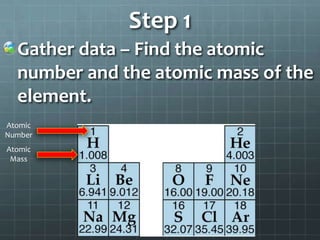
Step 1Gather data – Find the atomic number and the atomic mass of the element.Atomic NumberAtomic Mass
Step 2Identify the number of protonsThe atomic number represents the number of protons in an atom.If you add or subtract protons you end up with an entirely different element.
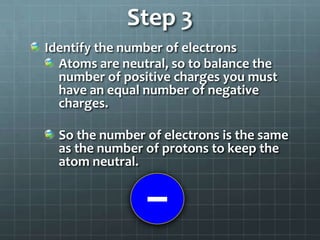
Step 3Identify the number of electronsAtoms are neutral, so to balance the number of positive charges you must have an equal number of negative charges.So the number of electrons is the same as the number of protons to keep the atom neutral.
Step 4Identify the number of neutronsRound the atomic mass to the nearest whole number.Example 14.65 = 15The atomic mass represents the number of protons and the number of neutrons in the nucleus. So subtract the atomic number from the atomic mass to find the number of neutrons in the atom.
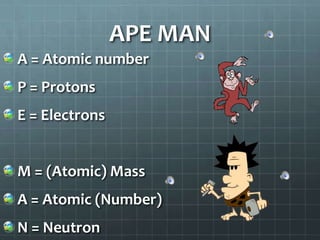
APE MANA = Atomic numberP = ProtonsE = ElectronsM = (Atomic) MassA = Atomic (Number)N = Neutron
MAN     Atomic Mass  - Atomic Number				= Neutron
Now you try it!Oxygen	Atomic number = 8Atomic mass = 15.999How many neutrons does this atom have?
Atom

Atom

  • 1.
    Determining the SubatomicParticles of an Atom
  • 2.
    To find thenumber of protons, electrons, and neutrons in a specific atom follow the following four steps.
  • 3.
    Step 1Gather data– Find the atomic number and the atomic mass of the element.Atomic NumberAtomic Mass
  • 4.
    Step 2Identify thenumber of protonsThe atomic number represents the number of protons in an atom.If you add or subtract protons you end up with an entirely different element.
  • 5.
    Step 3Identify thenumber of electronsAtoms are neutral, so to balance the number of positive charges you must have an equal number of negative charges.So the number of electrons is the same as the number of protons to keep the atom neutral.
  • 6.
    Step 4Identify thenumber of neutronsRound the atomic mass to the nearest whole number.Example 14.65 = 15The atomic mass represents the number of protons and the number of neutrons in the nucleus. So subtract the atomic number from the atomic mass to find the number of neutrons in the atom.
  • 7.
    APE MANA =Atomic numberP = ProtonsE = ElectronsM = (Atomic) MassA = Atomic (Number)N = Neutron
  • 8.
    MAN Atomic Mass - Atomic Number = Neutron
  • 9.
    Now you tryit!Oxygen Atomic number = 8Atomic mass = 15.999How many neutrons does this atom have?