ATOMIC STRUCTURE
Take these notes on page 31 in your notebook.
Use the Cornell Method of Note taking. Label
and Date the page.
SUBATOMIC PARTS
Electrons
Represented with lower case (e)
In electron shells or energy levels around
the nucleus
Negatively charged (-)
SUBATOMIC PARTS
Protons
-Represented with lower case (p)
-In nucleus
-Positively charged (+)
SUBATOMIC PARTS
Neutrons
-Represented with lower case (n)
-In nucleus
-No charge (neutral)
SUBATOMIC PARTS
Atoms have no charge
The # of protons = # of electrons
The proton (+) and electron(-) cancel
each other out. Neutrons have no
charge.
SUBATOMIC PARTS
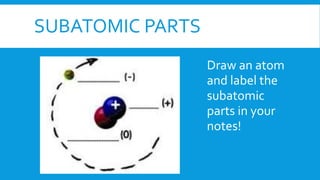
Draw an atom
and label the
subatomic
parts in your
notes!
ATOMIC NUMBER
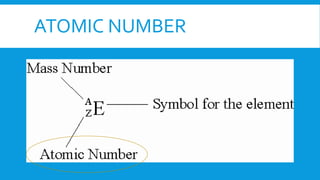
Represented by capital Z.
Z = the number of protons in an atom
ATOMIC NUMBER
ATOMIC NUMBER
 Use the periodicTable on page 288-289 in your
textbook to find the symbols and atomic number
of the following elements:
Selenium
Zinc
Caesium
Chromium
MASS NUMBER
“Electrons are to protons as fleas are to an elephant – the
proton being the elephant. When we calculate the mass
of an elephant, we don’t add on the mass of the
elephant‘s fleas, and when we calculate the mass of an
atom, we don’t add the mass of the electrons.” ~Joy of
Chemistry, Cobb & Fetterrolf
~it takes the mass of 1837 electrons to equal the mass of
1 neutron or proton
MASS NUMBER
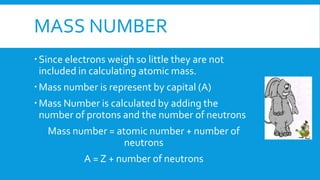
Since electrons weigh so little they are not
included in calculating atomic mass.
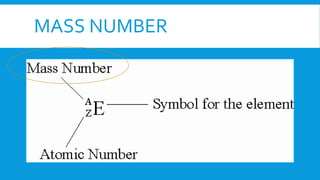
Mass number is represent by capital (A)
Mass Number is calculated by adding the
number of protons and the number of neutrons
Mass number = atomic number + number of
neutrons
A = Z + number of neutrons
MASS NUMBER
MASS NUMBER
Use the periodicTable on page 288-289 in your
textbook to find the symbols and mass number of
the following elements:
Molybdenum
Osmium
Titanium
Sulphur
MASS NUMBER
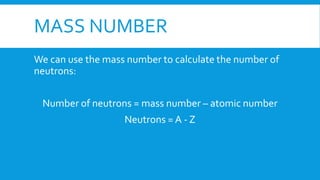
We can use the mass number to calculate the number of
neutrons:
Number of neutrons = mass number – atomic number
Neutrons = A - Z
NUMBER OF NEUTRONS
Using the atomic numbers and mass numbers you
found to calculate the number of neutrons in:
Molybdenum
Osmium
Titanium
Sulphur
Selenium
Zinc
Caesium
Chromium
IONS
Ions are electrically charged particles
If an atom loses one or more electrons it
becomes positively charged (K+)
If an atom gains one or more electrons it
becomes negatively charged (Cl-)
DIDYOU LABEL AND DATEYOUR PAGE?
Complete your Notes
with a Summary and
Main Ideas or Questions
in the Left column!

Atomic structure

  • 1.
    ATOMIC STRUCTURE Take thesenotes on page 31 in your notebook. Use the Cornell Method of Note taking. Label and Date the page.
  • 2.
    SUBATOMIC PARTS Electrons Represented withlower case (e) In electron shells or energy levels around the nucleus Negatively charged (-)
  • 3.
    SUBATOMIC PARTS Protons -Represented withlower case (p) -In nucleus -Positively charged (+)
  • 4.
    SUBATOMIC PARTS Neutrons -Represented withlower case (n) -In nucleus -No charge (neutral)
  • 5.
    SUBATOMIC PARTS Atoms haveno charge The # of protons = # of electrons The proton (+) and electron(-) cancel each other out. Neutrons have no charge.
  • 6.
    SUBATOMIC PARTS Draw anatom and label the subatomic parts in your notes!
  • 7.
    ATOMIC NUMBER Represented bycapital Z. Z = the number of protons in an atom
  • 8.
  • 9.
    ATOMIC NUMBER  Usethe periodicTable on page 288-289 in your textbook to find the symbols and atomic number of the following elements: Selenium Zinc Caesium Chromium
  • 10.
    MASS NUMBER “Electrons areto protons as fleas are to an elephant – the proton being the elephant. When we calculate the mass of an elephant, we don’t add on the mass of the elephant‘s fleas, and when we calculate the mass of an atom, we don’t add the mass of the electrons.” ~Joy of Chemistry, Cobb & Fetterrolf ~it takes the mass of 1837 electrons to equal the mass of 1 neutron or proton
  • 11.
    MASS NUMBER Since electronsweigh so little they are not included in calculating atomic mass. Mass number is represent by capital (A) Mass Number is calculated by adding the number of protons and the number of neutrons Mass number = atomic number + number of neutrons A = Z + number of neutrons
  • 12.
  • 13.
    MASS NUMBER Use theperiodicTable on page 288-289 in your textbook to find the symbols and mass number of the following elements: Molybdenum Osmium Titanium Sulphur
  • 14.
    MASS NUMBER We canuse the mass number to calculate the number of neutrons: Number of neutrons = mass number – atomic number Neutrons = A - Z
  • 15.
    NUMBER OF NEUTRONS Usingthe atomic numbers and mass numbers you found to calculate the number of neutrons in: Molybdenum Osmium Titanium Sulphur Selenium Zinc Caesium Chromium
  • 16.
    IONS Ions are electricallycharged particles If an atom loses one or more electrons it becomes positively charged (K+) If an atom gains one or more electrons it becomes negatively charged (Cl-)
  • 17.
    DIDYOU LABEL ANDDATEYOUR PAGE? Complete your Notes with a Summary and Main Ideas or Questions in the Left column!