Atomic Structure
Isotopes
Atomic Structure
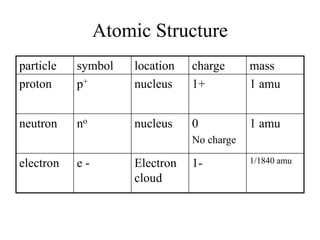
particle symbol location charge mass
proton p+ nucleus 1+ 1 amu
neutron no nucleus 0
No charge
1 amu
electron e - Electron
cloud
1- 1/1840 amu
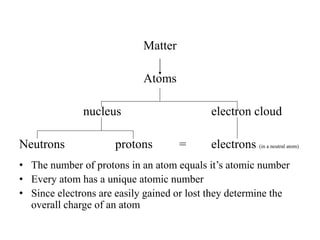
Matter
Atoms
nucleus electron cloud
Neutrons protons = electrons (in a neutral atom)
• The number of protons in an atom equals it’s atomic number
• Every atom has a unique atomic number
• Since electrons are easily gained or lost they determine the
overall charge of an atom
Isotopes
• Atoms with the same number of protons but
different numbers of neutrons
• Another way to say – atoms of the same
element with different numbers of neutrons
• An elements mass number is the number of
protons plus the number of neutrons
• REVIEW: to determine the number of
neutrons subtract the atomic number from the
mass number
• Mass # – atomic # = # of neutrons
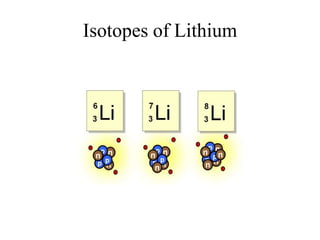
Isotopes of Lithium
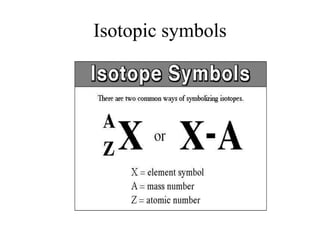
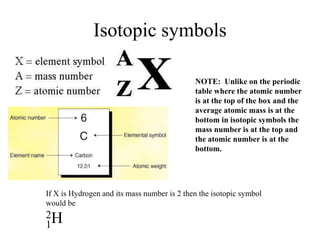
Isotopic symbols
Isotopic symbols
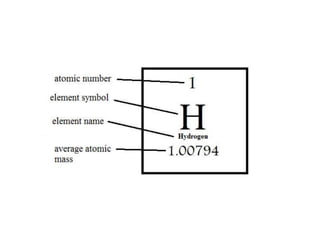
NOTE: Unlike on the periodic
table where the atomic number
is at the top of the box and the
average atomic mass is at the
bottom in isotopic symbols the
mass number is at the top and
the atomic number is at the
bottom.
If X is Hydrogen and its mass number is 2 then the isotopic symbol
would be
2H
1
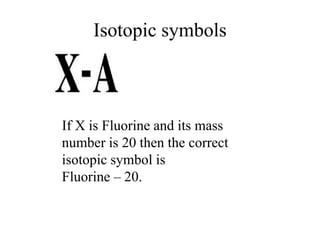
Isotopic symbols
If X is Fluorine and its mass
number is 20 then the correct
isotopic symbol is
Fluorine – 20.
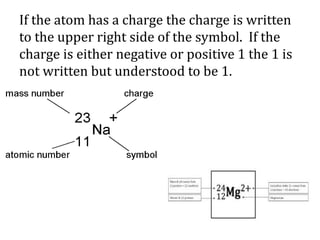
If the atom has a charge the charge is written
to the upper right side of the symbol. If the
charge is either negative or positive 1 the 1 is
not written but understood to be 1.
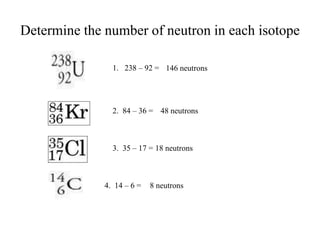
Determine the number of neutron in each isotope
1. 238 – 92 = 146 neutrons
2. 84 – 36 = 48 neutrons
3. 35 – 17 = 18 neutrons
4. 14 – 6 = 8 neutrons
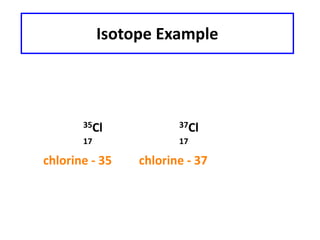
Isotope Example
35Cl 37Cl
17 17
chlorine - 35 chlorine - 37
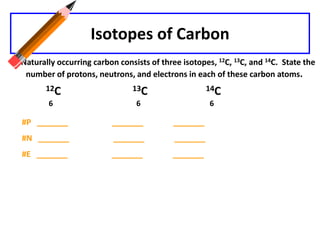
Isotopes of Carbon
Naturally occurring carbon consists of three isotopes, 12C, 13C, and 14C. State the
number of protons, neutrons, and electrons in each of these carbon atoms.
12C 13C 14C
6 6 6
#P _______ _______ _______
#N _______ _______ _______
#E _______ _______ _______
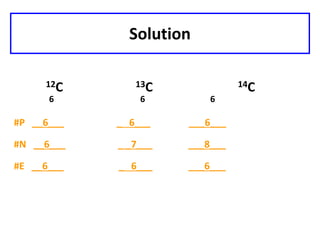
Solution
12C 13C 14C
6 6 6
#P __6___ _ 6___ ___6___
#N __6___ _ _7___ ___8___
#E __6___ _ 6___ ___6___
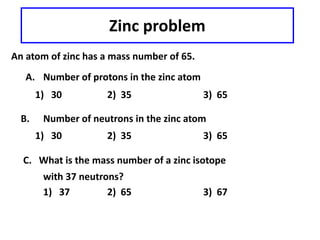
Zinc problem
An atom of zinc has a mass number of 65.
A. Number of protons in the zinc atom
1) 30 2) 35 3) 65
B. Number of neutrons in the zinc atom
1) 30 2) 35 3) 65
C. What is the mass number of a zinc isotope
with 37 neutrons?
1) 37 2) 65 3) 67
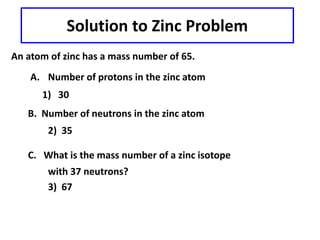
Solution to Zinc Problem
An atom of zinc has a mass number of 65.
A. Number of protons in the zinc atom
1) 30
B. Number of neutrons in the zinc atom
2) 35
C. What is the mass number of a zinc isotope
with 37 neutrons?
3) 67
Isotope or nuclide notation
• C-14 and C -12
When you see the symbol of the element and a
dash, the number after it is the mass number.
This is another way of modeling isotopes.
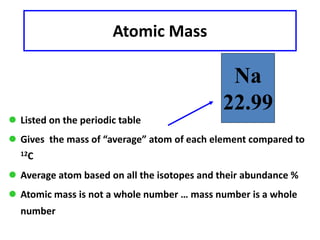
Atomic Mass
 Listed on the periodic table
 Gives the mass of “average” atom of each element compared to
12C
 Average atom based on all the isotopes and their abundance %
 Atomic mass is not a whole number … mass number is a whole
number
Na
22.99
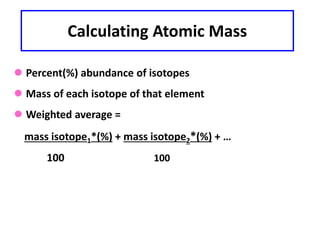
Calculating Atomic Mass
 Percent(%) abundance of isotopes
 Mass of each isotope of that element
 Weighted average =
mass isotope1*(%) + mass isotope2*(%) + …
100 100
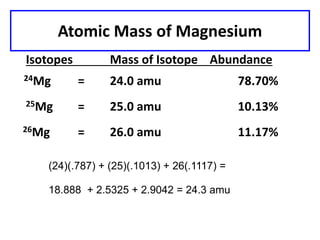
Atomic Mass of Magnesium
Isotopes Mass of Isotope Abundance
24Mg = 24.0 amu 78.70%
25Mg = 25.0 amu 10.13%
26Mg = 26.0 amu 11.17%
(24)(.787) + (25)(.1013) + 26(.1117) =
18.888 + 2.5325 + 2.9042 = 24.3 amu

Atomic_Structure_and_Isotopic_symbols.ppt

  • 1.
  • 2.
    Atomic Structure particle symbollocation charge mass proton p+ nucleus 1+ 1 amu neutron no nucleus 0 No charge 1 amu electron e - Electron cloud 1- 1/1840 amu
  • 3.
    Matter Atoms nucleus electron cloud Neutronsprotons = electrons (in a neutral atom) • The number of protons in an atom equals it’s atomic number • Every atom has a unique atomic number • Since electrons are easily gained or lost they determine the overall charge of an atom
  • 5.
    Isotopes • Atoms withthe same number of protons but different numbers of neutrons • Another way to say – atoms of the same element with different numbers of neutrons • An elements mass number is the number of protons plus the number of neutrons • REVIEW: to determine the number of neutrons subtract the atomic number from the mass number • Mass # – atomic # = # of neutrons
  • 6.
  • 7.
  • 8.
    Isotopic symbols NOTE: Unlikeon the periodic table where the atomic number is at the top of the box and the average atomic mass is at the bottom in isotopic symbols the mass number is at the top and the atomic number is at the bottom. If X is Hydrogen and its mass number is 2 then the isotopic symbol would be 2H 1
  • 9.
    Isotopic symbols If Xis Fluorine and its mass number is 20 then the correct isotopic symbol is Fluorine – 20.
  • 11.
    If the atomhas a charge the charge is written to the upper right side of the symbol. If the charge is either negative or positive 1 the 1 is not written but understood to be 1.
  • 12.
    Determine the numberof neutron in each isotope 1. 238 – 92 = 146 neutrons 2. 84 – 36 = 48 neutrons 3. 35 – 17 = 18 neutrons 4. 14 – 6 = 8 neutrons
  • 13.
    Isotope Example 35Cl 37Cl 1717 chlorine - 35 chlorine - 37
  • 14.
    Isotopes of Carbon Naturallyoccurring carbon consists of three isotopes, 12C, 13C, and 14C. State the number of protons, neutrons, and electrons in each of these carbon atoms. 12C 13C 14C 6 6 6 #P _______ _______ _______ #N _______ _______ _______ #E _______ _______ _______
  • 15.
    Solution 12C 13C 14C 66 6 #P __6___ _ 6___ ___6___ #N __6___ _ _7___ ___8___ #E __6___ _ 6___ ___6___
  • 16.
    Zinc problem An atomof zinc has a mass number of 65. A. Number of protons in the zinc atom 1) 30 2) 35 3) 65 B. Number of neutrons in the zinc atom 1) 30 2) 35 3) 65 C. What is the mass number of a zinc isotope with 37 neutrons? 1) 37 2) 65 3) 67
  • 17.
    Solution to ZincProblem An atom of zinc has a mass number of 65. A. Number of protons in the zinc atom 1) 30 B. Number of neutrons in the zinc atom 2) 35 C. What is the mass number of a zinc isotope with 37 neutrons? 3) 67
  • 18.
    Isotope or nuclidenotation • C-14 and C -12 When you see the symbol of the element and a dash, the number after it is the mass number. This is another way of modeling isotopes.
  • 19.
    Atomic Mass  Listedon the periodic table  Gives the mass of “average” atom of each element compared to 12C  Average atom based on all the isotopes and their abundance %  Atomic mass is not a whole number … mass number is a whole number Na 22.99
  • 20.
    Calculating Atomic Mass Percent(%) abundance of isotopes  Mass of each isotope of that element  Weighted average = mass isotope1*(%) + mass isotope2*(%) + … 100 100
  • 21.
    Atomic Mass ofMagnesium Isotopes Mass of Isotope Abundance 24Mg = 24.0 amu 78.70% 25Mg = 25.0 amu 10.13% 26Mg = 26.0 amu 11.17% (24)(.787) + (25)(.1013) + 26(.1117) = 18.888 + 2.5325 + 2.9042 = 24.3 amu