Seminar On
PRESENTATION by
CHETHAN N
(1RI14ME401)
Under the guidance of
Dr.L. ARULMANI
ASSOCIATE PROFESSOR
Department Of Mechanical Engineering
R R Institute Of Technology
R R INSTITUTE OF TECHNOLOGY
Raja Reddy Layout, Chikkabanavara, Banglore-560 090
• Discovery of cycle.
• Ideal thermodynamic cycle process.
• Working principle.
• Types of engines that use Atkinson cycle.
• Atkinson Cycle Engine pros and cons.
• Applications.
• Automobiles used Atkinson cycle engine.
• Future Scope Of The Atkinson Cycle Engine.
• References.
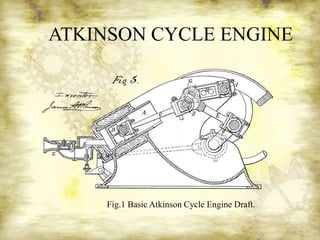
ATKINSON CYCLE ENGINE
Fig.1 Basic Atkinson Cycle Engine Draft.
Discovery of cycle
• The Atkinson-cycle engine is a
type of Internal Combustion Engine
invented by Dr. James Atkinson in
1882.
• The Atkinson cycle is designed to
provide efficiency at the expense of
power density, or total power
extracted per unit of displacement
per rotation.
• A modern variation of this approach
is used in some modern automobile
engines.
The True Atkinson Cycle and the
Modern Atkinson Cycle
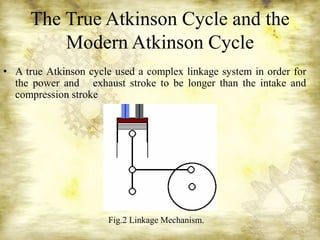
• A true Atkinson cycle used a complex linkage system in order for
the power and exhaust stroke to be longer than the intake and
compression stroke
Fig.2 Linkage Mechanism.
The True Atkinson cycle and the
modern Atkinson cycle
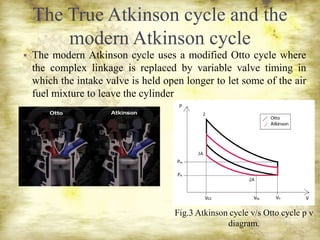
Fig.3 Atkinson cycle v/s Otto cycle p v
diagram.
• The modern Atkinson cycle uses a modified Otto cycle where
the complex linkage is replaced by variable valve timing in
which the intake valve is held open longer to let some of the air
fuel mixture to leave the cylinder
Ideal thermodynamic cycle process
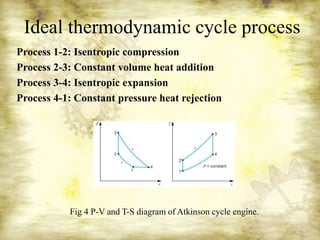
Process 1-2: Isentropic compression
Process 2-3: Constant volume heat addition
Process 3-4: Isentropic expansion
Process 4-1: Constant pressure heat rejection
Fig 4 P-V and T-S diagram of Atkinson cycle engine.
How It All Works
Fig.5 Working Principle.
 The intake stroke begins as usual, initially
drawing a full cylinder of fuel-air mixture.
 When the piston begins its upward travel,
the intake valve remains open.
 The intake valve closes after the piston has
moved some predetermined portion of this
stroke.
 The power and exhaust strokes remain as
in the four stroke, employing almost the
entire length of the piston travel.
Types of engines that use
Atkinson cycle
• Differential engine.
• Gas engine.
• Atkinson Utilite Engine.
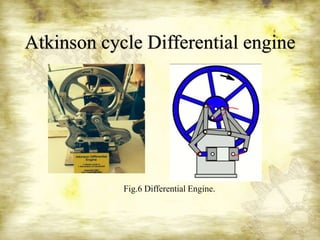
Atkinson cycle Differential engine
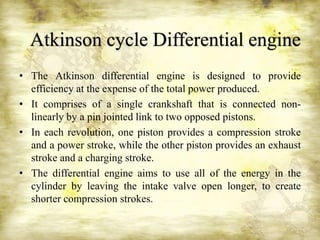
Fig.6 Differential Engine.
Atkinson cycle Differential engine
• The Atkinson differential engine is designed to provide
efficiency at the expense of the total power produced.
• It comprises of a single crankshaft that is connected non-
linearly by a pin jointed link to two opposed pistons.
• In each revolution, one piston provides a compression stroke
and a power stroke, while the other piston provides an exhaust
stroke and a charging stroke.
• The differential engine aims to use all of the energy in the
cylinder by leaving the intake valve open longer, to create
shorter compression strokes.
Atkinson cycle Gas Engine
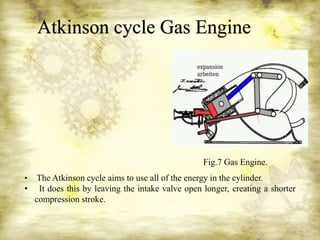
• The Atkinson cycle aims to use all of the energy in the cylinder.
• It does this by leaving the intake valve open longer, creating a shorter
compression stroke.
Fig.7 Gas Engine.
Atkinson Cycle Utilite Engine
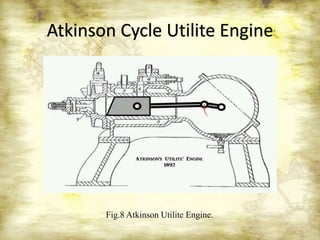
Fig.8 Atkinson Utilite Engine.
Atkinson Cycle Utilite Engine
• Atkinson's third design was named the "Utilite Engine".
• Atkinson realized an improvement was needed to make his
cycle more applicable to a high-speed engine.
• The final engine produced by the British Gas Engine company
was the Utilite Engine.
• With this design, Atkinson was able to make a more
conventional engine yet preserve the efficiency of having a
short compression stroke and a long expansion stroke in a
rather ingenious way.
Atkinson Engine
PROS
• Run relatively quietly.
• Smooth idling speeds.
• Relatively low amounts of
smoke.
• Higher overall efficiency.
CONS
• Complicated.
• Heavy in weight.
• Costly repairs.
• Less power.
Applications
Some of the area where Atkinson cycle engine
used are :
• Full Hybrids Automobiles.
• Plug in Hybrid Electrical Vehicles(PHEV’S).
• Prime Movers.
• Low cost/Power applications.
Automobiles Used This
Atkinson Cycle Engine
• Chevrolet volt.
• Hyundai Elantra.
• Lexus CT.
• Mercedes ML450.
• Toyota Camry Hybrid.
• Toyota prius.
Future Scope Of The Atkinson
Cycle Engine
Fig.11 Future scope of Atkinson cycle engine
References
 Unusual Internal-Combustion Engines, “The Atkinson Cycle Engine”, (Electronic
Database), http://www.dself.dsl.pipex.com/MUSEUM/POW ER/unusualICeng/atkinson/
atkinson.htm
 Wikipedia, “Atkinson Cycle”, (Electronic Database),
http://en.wikipedia.org/wiki/Atkinson_cycle
 Bhattacharjee, S.,”TEST: The Expert System for Thermodynamics," Electronic Resource,
Entropysoft, Del Mar, CA,
http://www.thermofluids.net.
 Yates, A. "The Atkinson Cycle Revisited for Improved Part-load Fuel Efficiency?"
Questions ?
Atkinson

Atkinson

  • 1.
    Seminar On PRESENTATION by CHETHANN (1RI14ME401) Under the guidance of Dr.L. ARULMANI ASSOCIATE PROFESSOR Department Of Mechanical Engineering R R Institute Of Technology R R INSTITUTE OF TECHNOLOGY Raja Reddy Layout, Chikkabanavara, Banglore-560 090
  • 2.
    • Discovery ofcycle. • Ideal thermodynamic cycle process. • Working principle. • Types of engines that use Atkinson cycle. • Atkinson Cycle Engine pros and cons. • Applications. • Automobiles used Atkinson cycle engine. • Future Scope Of The Atkinson Cycle Engine. • References.
  • 3.
    ATKINSON CYCLE ENGINE Fig.1Basic Atkinson Cycle Engine Draft.
  • 4.
    Discovery of cycle •The Atkinson-cycle engine is a type of Internal Combustion Engine invented by Dr. James Atkinson in 1882. • The Atkinson cycle is designed to provide efficiency at the expense of power density, or total power extracted per unit of displacement per rotation. • A modern variation of this approach is used in some modern automobile engines.
  • 5.
    The True AtkinsonCycle and the Modern Atkinson Cycle • A true Atkinson cycle used a complex linkage system in order for the power and exhaust stroke to be longer than the intake and compression stroke Fig.2 Linkage Mechanism.
  • 6.
    The True Atkinsoncycle and the modern Atkinson cycle Fig.3 Atkinson cycle v/s Otto cycle p v diagram. • The modern Atkinson cycle uses a modified Otto cycle where the complex linkage is replaced by variable valve timing in which the intake valve is held open longer to let some of the air fuel mixture to leave the cylinder
  • 7.
    Ideal thermodynamic cycleprocess Process 1-2: Isentropic compression Process 2-3: Constant volume heat addition Process 3-4: Isentropic expansion Process 4-1: Constant pressure heat rejection Fig 4 P-V and T-S diagram of Atkinson cycle engine.
  • 8.
    How It AllWorks Fig.5 Working Principle.  The intake stroke begins as usual, initially drawing a full cylinder of fuel-air mixture.  When the piston begins its upward travel, the intake valve remains open.  The intake valve closes after the piston has moved some predetermined portion of this stroke.  The power and exhaust strokes remain as in the four stroke, employing almost the entire length of the piston travel.
  • 9.
    Types of enginesthat use Atkinson cycle • Differential engine. • Gas engine. • Atkinson Utilite Engine.
  • 10.
    Atkinson cycle Differentialengine Fig.6 Differential Engine.
  • 11.
    Atkinson cycle Differentialengine • The Atkinson differential engine is designed to provide efficiency at the expense of the total power produced. • It comprises of a single crankshaft that is connected non- linearly by a pin jointed link to two opposed pistons. • In each revolution, one piston provides a compression stroke and a power stroke, while the other piston provides an exhaust stroke and a charging stroke. • The differential engine aims to use all of the energy in the cylinder by leaving the intake valve open longer, to create shorter compression strokes.
  • 12.
    Atkinson cycle GasEngine • The Atkinson cycle aims to use all of the energy in the cylinder. • It does this by leaving the intake valve open longer, creating a shorter compression stroke. Fig.7 Gas Engine.
  • 13.
    Atkinson Cycle UtiliteEngine Fig.8 Atkinson Utilite Engine.
  • 14.
    Atkinson Cycle UtiliteEngine • Atkinson's third design was named the "Utilite Engine". • Atkinson realized an improvement was needed to make his cycle more applicable to a high-speed engine. • The final engine produced by the British Gas Engine company was the Utilite Engine. • With this design, Atkinson was able to make a more conventional engine yet preserve the efficiency of having a short compression stroke and a long expansion stroke in a rather ingenious way.
  • 15.
    Atkinson Engine PROS • Runrelatively quietly. • Smooth idling speeds. • Relatively low amounts of smoke. • Higher overall efficiency. CONS • Complicated. • Heavy in weight. • Costly repairs. • Less power.
  • 16.
    Applications Some of thearea where Atkinson cycle engine used are : • Full Hybrids Automobiles. • Plug in Hybrid Electrical Vehicles(PHEV’S). • Prime Movers. • Low cost/Power applications.
  • 17.
    Automobiles Used This AtkinsonCycle Engine • Chevrolet volt. • Hyundai Elantra. • Lexus CT. • Mercedes ML450. • Toyota Camry Hybrid. • Toyota prius.
  • 18.
    Future Scope OfThe Atkinson Cycle Engine Fig.11 Future scope of Atkinson cycle engine
  • 19.
    References  Unusual Internal-CombustionEngines, “The Atkinson Cycle Engine”, (Electronic Database), http://www.dself.dsl.pipex.com/MUSEUM/POW ER/unusualICeng/atkinson/ atkinson.htm  Wikipedia, “Atkinson Cycle”, (Electronic Database), http://en.wikipedia.org/wiki/Atkinson_cycle  Bhattacharjee, S.,”TEST: The Expert System for Thermodynamics," Electronic Resource, Entropysoft, Del Mar, CA, http://www.thermofluids.net.  Yates, A. "The Atkinson Cycle Revisited for Improved Part-load Fuel Efficiency?"
  • 20.