Digestion and Sports Nutrition Digestion
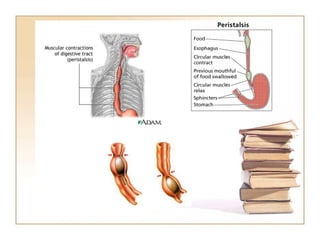
Your Digestive System The story we are about to tell is of stormy seas, acid rains, and dry, desert-like conditions.  It’s an arduous journey that traverses long distances and can take several days.  It’s one in which nothing comes through unchanged.  It’s the story of your digestive system whose purpose is to turn the food you eat into something useful – for your body. Down the Hatch It all starts with that first bite of pizza.  Your teeth tear off that big piece of crust.  Your  saliva glands  start spewing out spit like fountains.  Your  molars  grind your pizza crust, pepperoni, and cheese into a big wet ball.  Chemicals in your saliva start chemical reactions.  Seemingly like magic, starch in your pizza crust begins to turn to sugar!  A couple more chews, and then your tongue pushes the ball of chewed food to the back of your throat.  A trap door opens, and there it goes, down to your gullet! Next, your muscles squeeze the wet mass of food down, down, down a tube, or  oesophagus , the way you would squeeze a tube of toothpaste.  It’s not something you tell your muscles to do – they just do it – in a muscle action called  peristalsis .  Then the valve to the stomach opens up and pizza mush lands in your stomach.
Inside the Stomach Imagine being inside a big, pink muscular bag – sloshing back and forth in a sea of half digested mush and being mixed with digestive chemicals.  Acid rains down from the pink walls, which drip with mucus to deep them from being eroded. Sounds a little like an amusement park ride gone crazy?  Every time you think you’ve got your equilibrium back, the walls of muscles fold in on themselves again.  Over and over again, you get crushed under another wave of slop.  Every wave mixes and churns the food and chemicals together more – breaking food into even smaller and smaller bits.  Then another valve opens.  Is the end in sight you ask, as the slop gets pushed into the  small intestine ? Inside the small intestine, chemicals and liquids from places like the liver and pancreas break down and mix up leftovers.  The small intestine looks like a strange underwater world filled with things that resemble small finger like cactuses.  But they’re not cactuses, they’re  villi .  Like sponges, they’re able to absorb tremendous amounts of nutrients from the food you eat.  From the villi, the nutrients will flow into your bloodstream.
But hold on!!  The story is still not over yet – the leftovers that your body cannot use still have more travelling to do!  Next, they’re pushed into the  large intestines .  It’s much wider and much drier.  You find that the leftovers are getting smaller, harder and drier as they are pushed through the tube.  After all, this is the place where water is extracted and recycled back into your body.  In fact, the leftovers that leave your body are about 1/3 the size of what first arrived in your intestines. Where food turns into poop Finally, the end of the large intestine is in sight!  Now the drier leftovers are various handsome shades of brown.  They sit at the end of their journey, waiting for you to expel them – out your  anus .  Of course, you know the rest!  A glorious, if slightly stinky, journey, don’t you think??
Factoids How long are your intestines??  At least 8 metres in an adult.  Be glad you’re not a full-grown horse – their coiled up intestines are 29 metres long!! Chewing food takes from 5 – 30 seconds Swallowing takes about 10 seconds Food sloshing in the stomach can last 3 – 4 hours It takes 3 hours to food to move through the intestine Food drying up and hanging out in the large intestine can last 18 hours to 2 days. Americans eat about 333 million kgs of peanut butter  Americans eat over 1 billion kgs of chocolate a year In your lifetime, your digestive system may handle about 50 tons.
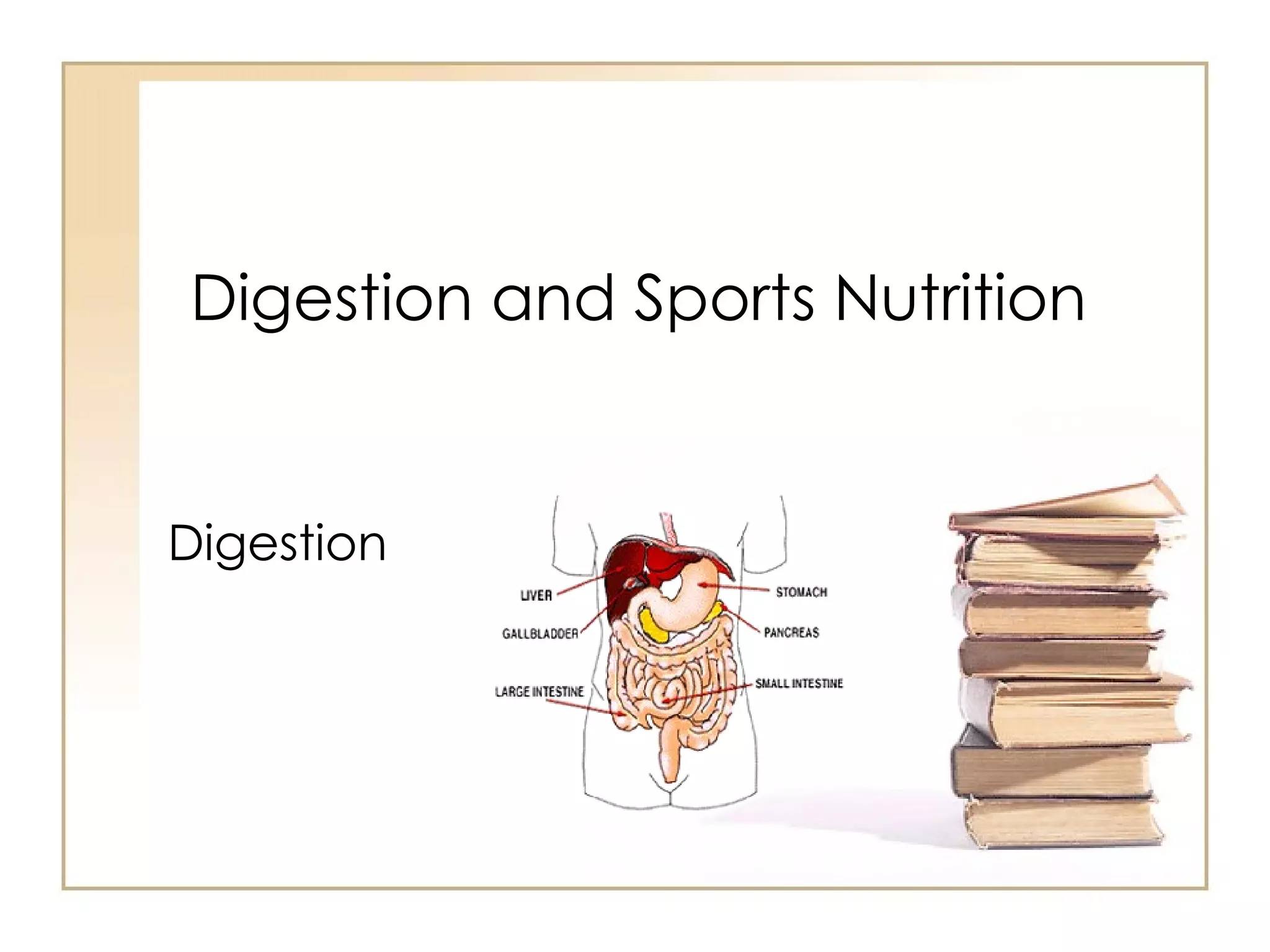
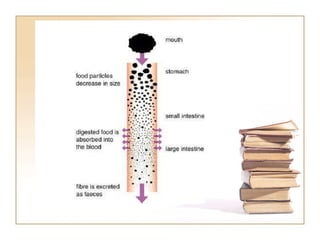
Digestive System The digestive system is often referred to as a food refinery – purifying the raw material foods to provide fuels and building materials for the cells.  It is the process that breaks down food into substances that can be absorbed by the body for energy, growth and repair.  The digestive system prepares food for use by hundreds of millions of body cells. Two processes occur;  ingestion , food is taken into the digestive system and swallowed, and  digestion , when food enters the alimentary canal (full length of the digestive pipe).  There are two types of digestion;  mechanical , the breakdown of food by the action of the teeth and alimentary canal (squeezing, turning and tossing food), and  chemical  (breaking bonds of large molecules), the breakdown of food by enzymes, acid and bile in the mouth, stomach and small intestine. The gut modifies food physically and chemically and disposes of unusable waste.
 
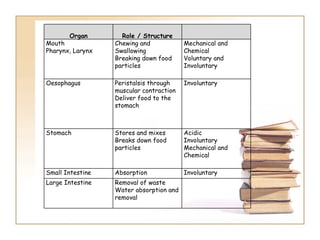
Organ Role / Structure Mouth Pharynx, Larynx Chewing and Swallowing Breaking down food particles Mechanical and Chemical Voluntary and Involuntary Oesophagus Peristalsis through muscular contraction Deliver food to the stomach Involuntary Stomach Stores and mixes Breaks down food particles Acidic Involuntary  Mechanical and Chemical Small Intestine Absorption Involuntary Large Intestine Removal of waste Water absorption and removal
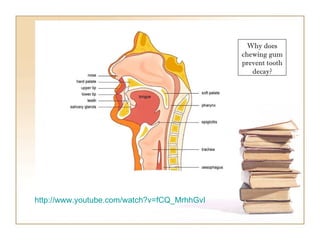
http://www.youtube.com/watch?v=fCQ_MrhhGvI   Why does chewing gum prevent tooth decay?
 
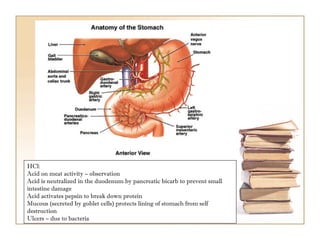
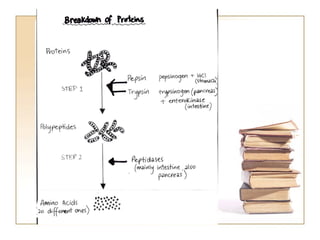
HCl: Acid on meat activity – observation  Acid is neutralized in the duodenum by pancreatic bicarb to prevent small intestine damage Acid activates pepsin to break down protein Mucous (secreted by goblet cells) protects lining of stomach from self destruction Ulcers – due to bacteria
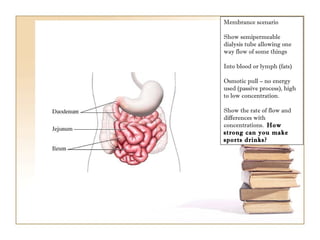
Membrance scenario Show semipermeable dialysis tube allowing one way flow of some things Into blood or lymph (fats) Osmotic pull – no energy used (passive process), high to low concentration.  Show the rate of flow and differences with concentrations.  How strong can you make sports drinks?
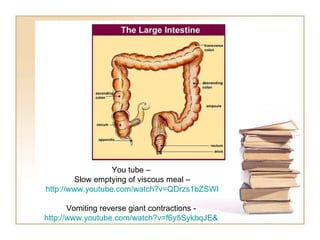
You tube –  Slow emptying of viscous meal – http://www.youtube.com/watch?v=QDrzs1bZSWI   Vomiting reverse giant contractions -  http://www.youtube.com/watch?v=f6y5SykbqJE&
 
Food intolerance (gluten, lactose) gut gets upset, causing inflammation, fatigue etc, can cause at the brain level (mood and depression) Coke angle can be helpful in stabilizing – potassium phosphate??? Barium swallowing from youtube.  Stretch sensitive brings on contraction Swallowing  http://www.youtube.com/watch?v=fCQ_MrhhGvI
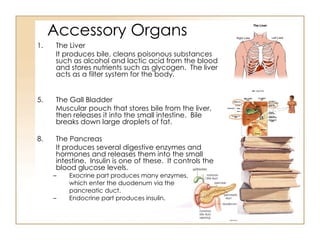
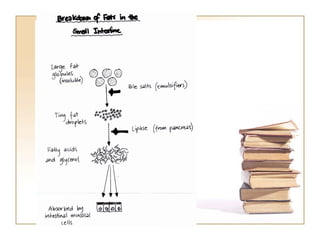
Accessory Organs The Liver It produces bile, cleans poisonous substances such as alcohol and lactic acid from the blood and stores nutrients such as glycogen.  The liver acts as a filter system for the body. The Gall Bladder Muscular pouch that stores bile from the liver, then releases it into the small intestine.  Bile breaks down large droplets of fat. The Pancreas It produces several digestive enzymes and hormones and releases them into the small intestine.  Insulin is one of these.  It controls the blood glucose levels. Exocrine part produces many enzymes,  which enter the duodenum via the  pancreatic duct. Endocrine part produces insulin.
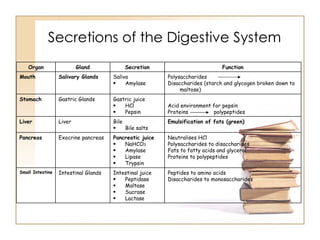
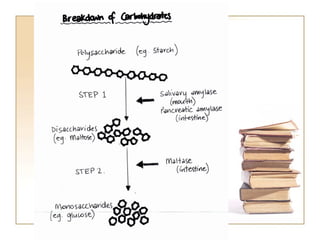
Secretions of the Digestive System Organ Gland Secretion Function Mouth Salivary Glands Saliva Amylase Polysaccharides Disaccharides (starch and glycogen broken down to maltose) Stomach Gastric Glands Gastric juice HCl Pepsin Acid environment for pepsin Proteins  polypeptides Liver Liver Bile Bile salts Emulsification of fats (green) Pancreas Exocrine pancreas Pancreatic juice NaHCO 3 Amylase Lipase Trypsin Neutralises HCl Polysaccharides to disaccharides Fats to fatty acids and glycerol Proteins to polypeptides Small Intestine Intestinal Glands Intestinal juice Peptidase Maltase Sucrase Lactase Peptides to amino acids Disaccharides to monosaccharides
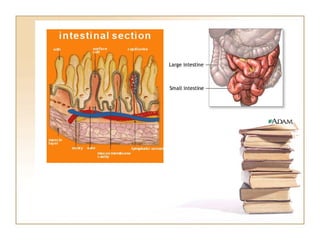
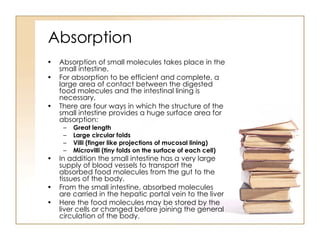
Absorption Absorption of small molecules takes place in the small intestine. For absorption to be efficient and complete, a large area of contact between the digested food molecules and the intestinal lining is necessary. There are four ways in which the structure of the small intestine provides a huge surface area for absorption: Great length Large circular folds Villi (finger like projections of mucosal lining) Microvilli (tiny folds on the surface of each cell) In addition the small intestine has a very large supply of blood vessels to transport the absorbed food molecules from the gut to the tissues of the body. From the small intestine, absorbed molecules are carried in the hepatic portal vein to the liver Here the food molecules may be stored by the liver cells or changed before joining the general circulation of the body.
Absorption and Surface Area  SA Surface Area model Huge increase in contact area but then must slow down the flow, compared to flat Therefore pre-digested protein in the first 2 hours when most needed (post exercise)


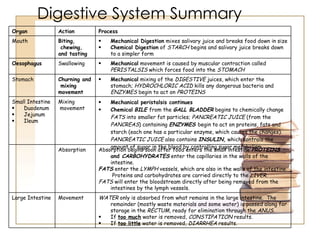
Digestive System Summary Organ Action Process Mouth Biting, chewing,  and tasting Mechanical Digestion  mixes salivary juice and breaks food down in size Chemical Digestion  of  STARCH  begins and salivary juice breaks down to a simpler form Oesophagus Swallowing Mechanical  movement is caused by muscular contraction called  PERISTALSIS  which forces food into the  STOMACH Stomach Churning and mixing  movement Mechanical  mixing of the  DIGESTIVE  juices, which enter the stomach;  HYDROCHLORIC ACID  kills any dangerous bacteria and  ENZYMES  begin to act on  PROTEINS Small Intestine Duodenum Jejunum Ileum Mixing movement Mechanical peristalsis continues Chemical   BILE   from the  GALL   BLADDER  begins to chemically change  FATS  into smaller fat particles;  PANCREATIC   JUICE  (from the  PANCREAS ) containing  ENZYMES   begin to act on proteins, fats and starch (each one has a particular enzyme, which causes the changes).  PANCREATIC JUICE  also contains  INSULIN ,  which controls the amount of sugar in the blood by controlling sugar metabolism. Absorption Absorption begins soon after food enters the small intestine  PROTEINS  and  CARBOHYDRATES  enter the capillaries in the walls of the intestine. FATS  enter the  LYMPH  vessels, which are also in the walls of the intestine.  Proteins and carbohydrates are carried directly to the  LIVER . FATS  will enter the bloodstream directly after being removed from the intestines by the lymph vessels. Large Intestine Movement WATER  only is absorbed from what remains in the large intestine.  The remainder (mostly waste materials and some water) is passed along for storage in the  RECTUM , ready for elimination through the  ANUS . If  too much  water is removed,  CONSTIPATION  results. If  too little  water is removed,  DIARRHEA  results.

Digestion 2011

  • 1.
    Digestion and SportsNutrition Digestion
  • 2.
    Your Digestive SystemThe story we are about to tell is of stormy seas, acid rains, and dry, desert-like conditions. It’s an arduous journey that traverses long distances and can take several days. It’s one in which nothing comes through unchanged. It’s the story of your digestive system whose purpose is to turn the food you eat into something useful – for your body. Down the Hatch It all starts with that first bite of pizza. Your teeth tear off that big piece of crust. Your saliva glands start spewing out spit like fountains. Your molars grind your pizza crust, pepperoni, and cheese into a big wet ball. Chemicals in your saliva start chemical reactions. Seemingly like magic, starch in your pizza crust begins to turn to sugar! A couple more chews, and then your tongue pushes the ball of chewed food to the back of your throat. A trap door opens, and there it goes, down to your gullet! Next, your muscles squeeze the wet mass of food down, down, down a tube, or oesophagus , the way you would squeeze a tube of toothpaste. It’s not something you tell your muscles to do – they just do it – in a muscle action called peristalsis . Then the valve to the stomach opens up and pizza mush lands in your stomach.
  • 3.
    Inside the StomachImagine being inside a big, pink muscular bag – sloshing back and forth in a sea of half digested mush and being mixed with digestive chemicals. Acid rains down from the pink walls, which drip with mucus to deep them from being eroded. Sounds a little like an amusement park ride gone crazy? Every time you think you’ve got your equilibrium back, the walls of muscles fold in on themselves again. Over and over again, you get crushed under another wave of slop. Every wave mixes and churns the food and chemicals together more – breaking food into even smaller and smaller bits. Then another valve opens. Is the end in sight you ask, as the slop gets pushed into the small intestine ? Inside the small intestine, chemicals and liquids from places like the liver and pancreas break down and mix up leftovers. The small intestine looks like a strange underwater world filled with things that resemble small finger like cactuses. But they’re not cactuses, they’re villi . Like sponges, they’re able to absorb tremendous amounts of nutrients from the food you eat. From the villi, the nutrients will flow into your bloodstream.
  • 4.
    But hold on!! The story is still not over yet – the leftovers that your body cannot use still have more travelling to do! Next, they’re pushed into the large intestines . It’s much wider and much drier. You find that the leftovers are getting smaller, harder and drier as they are pushed through the tube. After all, this is the place where water is extracted and recycled back into your body. In fact, the leftovers that leave your body are about 1/3 the size of what first arrived in your intestines. Where food turns into poop Finally, the end of the large intestine is in sight! Now the drier leftovers are various handsome shades of brown. They sit at the end of their journey, waiting for you to expel them – out your anus . Of course, you know the rest! A glorious, if slightly stinky, journey, don’t you think??
  • 5.
    Factoids How longare your intestines?? At least 8 metres in an adult. Be glad you’re not a full-grown horse – their coiled up intestines are 29 metres long!! Chewing food takes from 5 – 30 seconds Swallowing takes about 10 seconds Food sloshing in the stomach can last 3 – 4 hours It takes 3 hours to food to move through the intestine Food drying up and hanging out in the large intestine can last 18 hours to 2 days. Americans eat about 333 million kgs of peanut butter Americans eat over 1 billion kgs of chocolate a year In your lifetime, your digestive system may handle about 50 tons.
  • 6.
    Digestive System Thedigestive system is often referred to as a food refinery – purifying the raw material foods to provide fuels and building materials for the cells. It is the process that breaks down food into substances that can be absorbed by the body for energy, growth and repair. The digestive system prepares food for use by hundreds of millions of body cells. Two processes occur; ingestion , food is taken into the digestive system and swallowed, and digestion , when food enters the alimentary canal (full length of the digestive pipe). There are two types of digestion; mechanical , the breakdown of food by the action of the teeth and alimentary canal (squeezing, turning and tossing food), and chemical (breaking bonds of large molecules), the breakdown of food by enzymes, acid and bile in the mouth, stomach and small intestine. The gut modifies food physically and chemically and disposes of unusable waste.
  • 7.
  • 8.
    Organ Role /Structure Mouth Pharynx, Larynx Chewing and Swallowing Breaking down food particles Mechanical and Chemical Voluntary and Involuntary Oesophagus Peristalsis through muscular contraction Deliver food to the stomach Involuntary Stomach Stores and mixes Breaks down food particles Acidic Involuntary Mechanical and Chemical Small Intestine Absorption Involuntary Large Intestine Removal of waste Water absorption and removal
  • 9.
    http://www.youtube.com/watch?v=fCQ_MrhhGvI Why does chewing gum prevent tooth decay?
  • 10.
  • 11.
    HCl: Acid onmeat activity – observation Acid is neutralized in the duodenum by pancreatic bicarb to prevent small intestine damage Acid activates pepsin to break down protein Mucous (secreted by goblet cells) protects lining of stomach from self destruction Ulcers – due to bacteria
  • 12.
    Membrance scenario Showsemipermeable dialysis tube allowing one way flow of some things Into blood or lymph (fats) Osmotic pull – no energy used (passive process), high to low concentration. Show the rate of flow and differences with concentrations. How strong can you make sports drinks?
  • 13.
    You tube – Slow emptying of viscous meal – http://www.youtube.com/watch?v=QDrzs1bZSWI Vomiting reverse giant contractions - http://www.youtube.com/watch?v=f6y5SykbqJE&
  • 14.
  • 15.
    Food intolerance (gluten,lactose) gut gets upset, causing inflammation, fatigue etc, can cause at the brain level (mood and depression) Coke angle can be helpful in stabilizing – potassium phosphate??? Barium swallowing from youtube. Stretch sensitive brings on contraction Swallowing http://www.youtube.com/watch?v=fCQ_MrhhGvI
  • 16.
    Accessory Organs TheLiver It produces bile, cleans poisonous substances such as alcohol and lactic acid from the blood and stores nutrients such as glycogen. The liver acts as a filter system for the body. The Gall Bladder Muscular pouch that stores bile from the liver, then releases it into the small intestine. Bile breaks down large droplets of fat. The Pancreas It produces several digestive enzymes and hormones and releases them into the small intestine. Insulin is one of these. It controls the blood glucose levels. Exocrine part produces many enzymes, which enter the duodenum via the pancreatic duct. Endocrine part produces insulin.
  • 17.
    Secretions of theDigestive System Organ Gland Secretion Function Mouth Salivary Glands Saliva Amylase Polysaccharides Disaccharides (starch and glycogen broken down to maltose) Stomach Gastric Glands Gastric juice HCl Pepsin Acid environment for pepsin Proteins polypeptides Liver Liver Bile Bile salts Emulsification of fats (green) Pancreas Exocrine pancreas Pancreatic juice NaHCO 3 Amylase Lipase Trypsin Neutralises HCl Polysaccharides to disaccharides Fats to fatty acids and glycerol Proteins to polypeptides Small Intestine Intestinal Glands Intestinal juice Peptidase Maltase Sucrase Lactase Peptides to amino acids Disaccharides to monosaccharides
  • 18.
    Absorption Absorption ofsmall molecules takes place in the small intestine. For absorption to be efficient and complete, a large area of contact between the digested food molecules and the intestinal lining is necessary. There are four ways in which the structure of the small intestine provides a huge surface area for absorption: Great length Large circular folds Villi (finger like projections of mucosal lining) Microvilli (tiny folds on the surface of each cell) In addition the small intestine has a very large supply of blood vessels to transport the absorbed food molecules from the gut to the tissues of the body. From the small intestine, absorbed molecules are carried in the hepatic portal vein to the liver Here the food molecules may be stored by the liver cells or changed before joining the general circulation of the body.
  • 19.
    Absorption and SurfaceArea SA Surface Area model Huge increase in contact area but then must slow down the flow, compared to flat Therefore pre-digested protein in the first 2 hours when most needed (post exercise)
  • 20.
  • 21.
  • 22.
  • 23.
    Digestive System SummaryOrgan Action Process Mouth Biting, chewing, and tasting Mechanical Digestion mixes salivary juice and breaks food down in size Chemical Digestion of STARCH begins and salivary juice breaks down to a simpler form Oesophagus Swallowing Mechanical movement is caused by muscular contraction called PERISTALSIS which forces food into the STOMACH Stomach Churning and mixing movement Mechanical mixing of the DIGESTIVE juices, which enter the stomach; HYDROCHLORIC ACID kills any dangerous bacteria and ENZYMES begin to act on PROTEINS Small Intestine Duodenum Jejunum Ileum Mixing movement Mechanical peristalsis continues Chemical BILE from the GALL BLADDER begins to chemically change FATS into smaller fat particles; PANCREATIC JUICE (from the PANCREAS ) containing ENZYMES begin to act on proteins, fats and starch (each one has a particular enzyme, which causes the changes). PANCREATIC JUICE also contains INSULIN , which controls the amount of sugar in the blood by controlling sugar metabolism. Absorption Absorption begins soon after food enters the small intestine PROTEINS and CARBOHYDRATES enter the capillaries in the walls of the intestine. FATS enter the LYMPH vessels, which are also in the walls of the intestine. Proteins and carbohydrates are carried directly to the LIVER . FATS will enter the bloodstream directly after being removed from the intestines by the lymph vessels. Large Intestine Movement WATER only is absorbed from what remains in the large intestine. The remainder (mostly waste materials and some water) is passed along for storage in the RECTUM , ready for elimination through the ANUS . If too much water is removed, CONSTIPATION results. If too little water is removed, DIARRHEA results.