Astronomy Intro to
Solar System Models   Geocentric   – ancient people believed that the Earth was the center of the universe, and all planets and stars moved in orbits around Earth (remember, the sun appears to rise and set each day when it is really the Earth spinning that causes this) Heliocentric  – this is the accepted model.  It states that the sun is the center of the solar system, and all the planets move around the sun
GEO = EARTH HELIO = SUN CENTRIC = CENTER
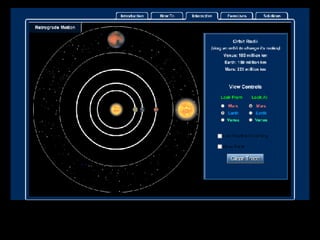
All of the planets travel around the sun in the  same direction , but  not  at the same speed  Because of this, there may be times when Earth passes a planet in its orbit  The planet will then appear to be moving in the opposite direction ( backward )  This is called  retrograde motion   The planet is not really moving backward (think about two cars traveling side by side…when one car speeds up, the other car may appear to move backward)
 
Copernicus  proposed a  heliocentric  model, with the Sun as the center of the Solar System. His model was purely geometric and it was  not  based on astronomical observations. Brahe , a believer in the Ptolemaic system, made very accurate observations of the planetary motion, using only  instruments with open sights (a telescope was not used for astronomy until about 1609).  Kepler  was at first an assistant of Brahe, but a firm believer in the Copernican model. Brahe mistrusted Kepler and kept some of his finest observations secret. After Brahe died, Kepler apparently stole the data documents. Based on Brahe’s data (especially on the trajectory of Mars), Kepler was able to empirically formulate the  laws of planetary motion .
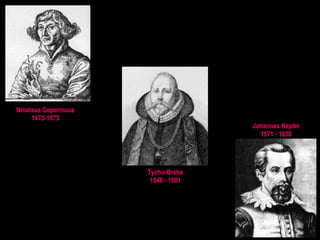
Nicolaus Copernicus 1473-1573 Tycho Brahe 1546 - 1601 Johannes Kepler 1571 - 1630
Kepler’s Laws of Planetary Motion
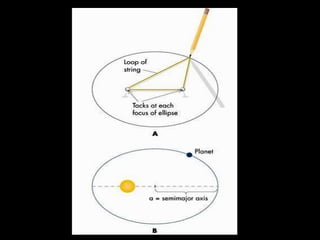
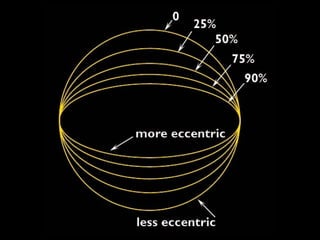
First Law – Elliptical Orbits All planets travel around the sun in an  elliptical orbit  (LAB) with the  sun as one of the foci   Because the orbits are not circular, the distance between the sun and the planet changes Eccentricity is how stretched out  the planet’s orbit is (Ref. Tables, LAB)
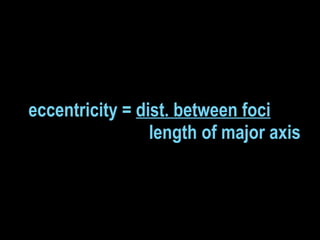
eccentricity =  dist. between foci      length of major axis


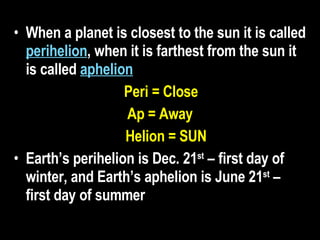
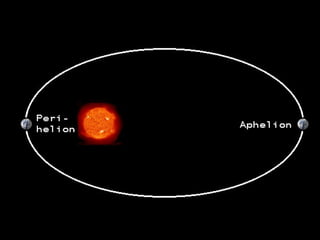
When a planet is closest to the sun it is called  perihelion , when it is farthest from the sun it is called  aphelion   Peri = Close Ap = Away Helion = SUN Earth’s perihelion is Dec. 21 st  – first day of winter, and Earth’s aphelion is June 21 st  – first day of summer
 
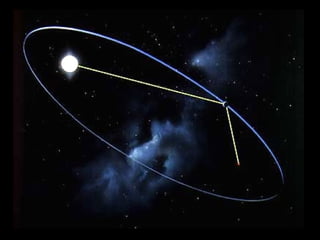
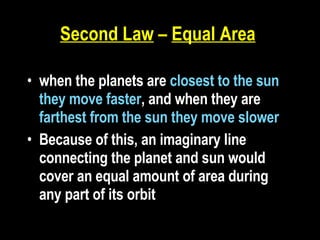
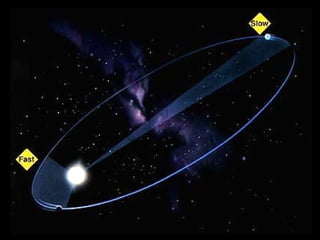
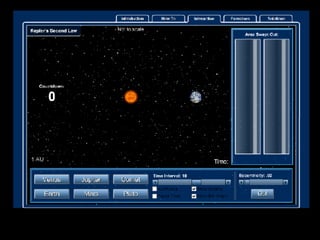
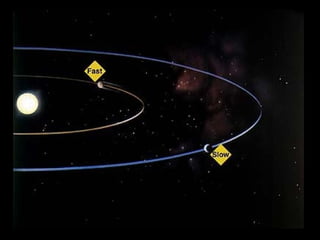
Second Law  –  Equal Area   when the planets are  closest to the sun they move faster , and when they are  farthest from the sun they move slower Because of this, an imaginary line connecting the planet and sun would cover an equal amount of area during any part of its orbit
 
 
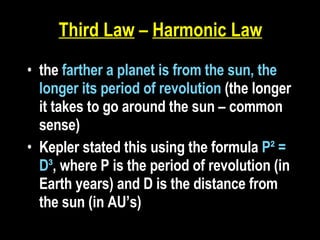
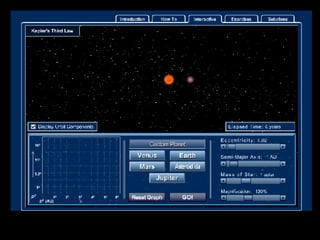
Third Law  –  Harmonic Law   the  farther a planet is from the sun, the longer its period of revolution  (the longer it takes to go around the sun – common sense) Kepler stated this using the formula  P² = D³ , where P is the period of revolution (in Earth years) and D is the distance from the sun (in AU’s)
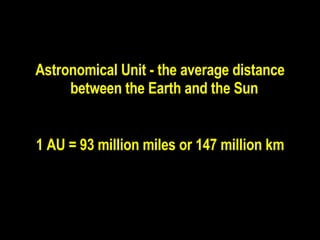
Astronomical Unit - the average distance between the Earth and the Sun  1 AU = 93 million miles or 147 million km
 
 
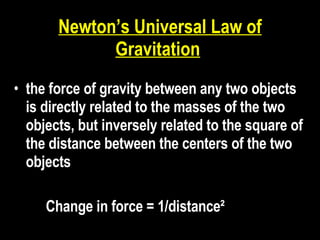
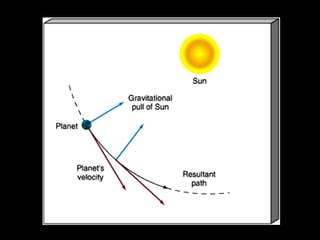
Newton’s Universal Law of Gravitation   the force of gravity between any two objects is directly related to the masses of the two objects, but inversely related to the square of the distance between the centers of the two objects   Change in force = 1/distance²
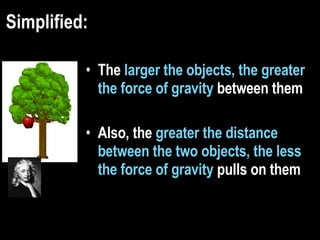
Simplified: The  larger the objects, the greater the force of gravity  between them Also, the  greater the distance between the two objects, the less the force of gravity  pulls on them
 

Astronomyintro

  • 1.
  • 2.
    Solar System Models Geocentric – ancient people believed that the Earth was the center of the universe, and all planets and stars moved in orbits around Earth (remember, the sun appears to rise and set each day when it is really the Earth spinning that causes this) Heliocentric – this is the accepted model. It states that the sun is the center of the solar system, and all the planets move around the sun
  • 3.
    GEO = EARTHHELIO = SUN CENTRIC = CENTER
  • 4.
    All of theplanets travel around the sun in the same direction , but not at the same speed Because of this, there may be times when Earth passes a planet in its orbit The planet will then appear to be moving in the opposite direction ( backward ) This is called retrograde motion The planet is not really moving backward (think about two cars traveling side by side…when one car speeds up, the other car may appear to move backward)
  • 5.
  • 6.
    Copernicus proposeda heliocentric model, with the Sun as the center of the Solar System. His model was purely geometric and it was not based on astronomical observations. Brahe , a believer in the Ptolemaic system, made very accurate observations of the planetary motion, using only instruments with open sights (a telescope was not used for astronomy until about 1609). Kepler was at first an assistant of Brahe, but a firm believer in the Copernican model. Brahe mistrusted Kepler and kept some of his finest observations secret. After Brahe died, Kepler apparently stole the data documents. Based on Brahe’s data (especially on the trajectory of Mars), Kepler was able to empirically formulate the laws of planetary motion .
  • 7.
    Nicolaus Copernicus 1473-1573Tycho Brahe 1546 - 1601 Johannes Kepler 1571 - 1630
  • 8.
    Kepler’s Laws ofPlanetary Motion
  • 9.
    First Law –Elliptical Orbits All planets travel around the sun in an elliptical orbit (LAB) with the sun as one of the foci Because the orbits are not circular, the distance between the sun and the planet changes Eccentricity is how stretched out the planet’s orbit is (Ref. Tables, LAB)
  • 10.
    eccentricity = dist. between foci length of major axis
  • 11.
  • 12.
  • 13.
  • 14.
    When a planetis closest to the sun it is called perihelion , when it is farthest from the sun it is called aphelion Peri = Close Ap = Away Helion = SUN Earth’s perihelion is Dec. 21 st – first day of winter, and Earth’s aphelion is June 21 st – first day of summer
  • 15.
  • 16.
    Second Law – Equal Area when the planets are closest to the sun they move faster , and when they are farthest from the sun they move slower Because of this, an imaginary line connecting the planet and sun would cover an equal amount of area during any part of its orbit
  • 17.
  • 18.
  • 19.
    Third Law – Harmonic Law the farther a planet is from the sun, the longer its period of revolution (the longer it takes to go around the sun – common sense) Kepler stated this using the formula P² = D³ , where P is the period of revolution (in Earth years) and D is the distance from the sun (in AU’s)
  • 20.
    Astronomical Unit -the average distance between the Earth and the Sun 1 AU = 93 million miles or 147 million km
  • 21.
  • 22.
  • 23.
    Newton’s Universal Lawof Gravitation the force of gravity between any two objects is directly related to the masses of the two objects, but inversely related to the square of the distance between the centers of the two objects Change in force = 1/distance²
  • 24.
    Simplified: The larger the objects, the greater the force of gravity between them Also, the greater the distance between the two objects, the less the force of gravity pulls on them
  • 25.